We look at how to choose a catering format to match the program, guests and venue, write a brief and compare estimates without hidden assumptions.
The catering format at an event affects the program rhythm, guest flow and budget. A coffee break helps to recharge between business blocks. A reception encourages free networking. A banquet requires seating and precise synchronization of courses. Food stations turn choosing dishes into part of the route. A business lunch puts calm conversation at the center.
At Aventura, we start with the event objective, guest composition and venue layout. We discuss the menu after understanding the journey of a person from registration to departure. This order helps to compare suitable formats and get an estimate where all conditions are visible.
Leave a request - let's discuss the task
We will clarify the event format and suggest the next step.
Where to start when choosing a catering format?
The format is chosen based on what guests are doing at a particular moment in the program. A person may grab a quick coffee, continue a conversation standing, sit down at a shared table, or visit several themed stations. Each scenario requires its own space, service, equipment, and time.
First, we ask the client four questions:
- What should happen during the meal: relaxation, networking, negotiations, awards, or an entertainment program?
- Where were the guests before this segment and where will they go after it?
- Does everyone need to receive food at the same time, or can the flow be staggered?
- What constraints are imposed by the venue, program, and audience composition?
The answers quickly eliminate clearly inconvenient options. For example, banquet seating hinders the free exchange of conversation partners. A single coffee line creates a bottleneck if the entire hall heads there at once. Food stations require clear navigation and space for several queues.
We view catering as part of the entire event. In corporate programs, we connect it with team goals, the scenario, and logistics in corporate event organization. At business events, we check whether service is taking time away from negotiations and presentations.
There is no universal format for a specific number of guests. The decision depends on the audience composition, event duration, available space, infrastructure, and what people need to do while eating.
Coffee break, reception, banquet, stations and business lunch
Five formats solve different tasks. It is useful to compare them by guest behavior, space requirements and service management. The name alone does not say anything about the quality of the solution.
The table summarizes the key points of the section: Format, When suitable, What to check. Use it as a quick reference when preparing an event.
| Format | When suitable | What to check | Main risk |
|---|---|---|---|
| Coffee break | pause between sessions, short communication, restoring attention | number of serving points, approaches to them, replenishment, place for used dishes | the whole hall exits at the same time and forms a queue |
| Reception | free communication, client evening, reception after the business part | the height and number of tables is determined by the venue layout, guests need free hands and staff routes | beautiful lines occupy the aisle, and guests have nowhere to put a glass and plate |
| Banquet | ceremony, awards, evening program, fixed seating | table plan, serving order, kitchen coordination with the script, handling special requests | program delay disrupts dish readiness and kitchen work |
| Food stations | festival or multi-zone scenario, choice of cuisine, distributed flow | each station's capacity, power supply, ventilation, signage, queues and replenishment | a popular station is overloaded, neighboring ones are idle |
| Business lunch | negotiations, partner meeting, small group with a common agenda | quietness, seating, serving pace, ability to talk without constant interruptions | service breaks up the conversation or guests can't hear each other |
A coffee break can be an independent short pause or a permanent coffee zone. In the second case, the logic of replenishment and cleanliness control changes. A reception can support networking if tables and drink stations are distributed around the hall, and quiet conversations are moved away from the through traffic.
A banquet is convenient when guests need to see the stage and stay in their seats. It depends more on a single master version of the script. The kitchen and service team must know when serving starts and which block cannot be interrupted by waiters' movement.
Food stations, or food stations, give guests a choice and help distribute people across the space. They require separate planning for each point. For stations with live cooking, additionally check power, ventilation, fire restrictions and service routes.
A business lunch is similar to a small banquet only in seating. Its purpose is different: to preserve the conversation. We reduce the number of distracting elements, check acoustics and coordinate serving with the meeting agenda.
How to integrate catering into the timing?
In the timing, you need to see the guest's entire journey: the end of the session, leaving the hall, the walk to the dining area, receiving the dish, finding a seat, the meal itself, and returning. A line that just says 'lunch' without these transitions hides half the process.
We layer catering onto the program in three layers:
- Guest layer. When people vacate the hall, where the first flow forms and what they carry with them.
- Service layer. When staff enter the area, restock lines, clear dishes, and remove waste.
- Production layer. When dishes are prepared, delivered, brought to readiness, and handed over for serving.
These layers must coincide in a single version of the timing. If a business session runs late, the person in charge decides: shift the serving, open part of the area, or shorten the next transition. The contractor states in advance which actions are permissible for the specific menu and equipment.
We do not set a universal duration for a coffee break or banquet. It is calculated based on the actual route, number of stations, serving method, and program. A plan check and a test walk-through provide more benefit than an average figure from someone else's checklist.
Flow map and service zones
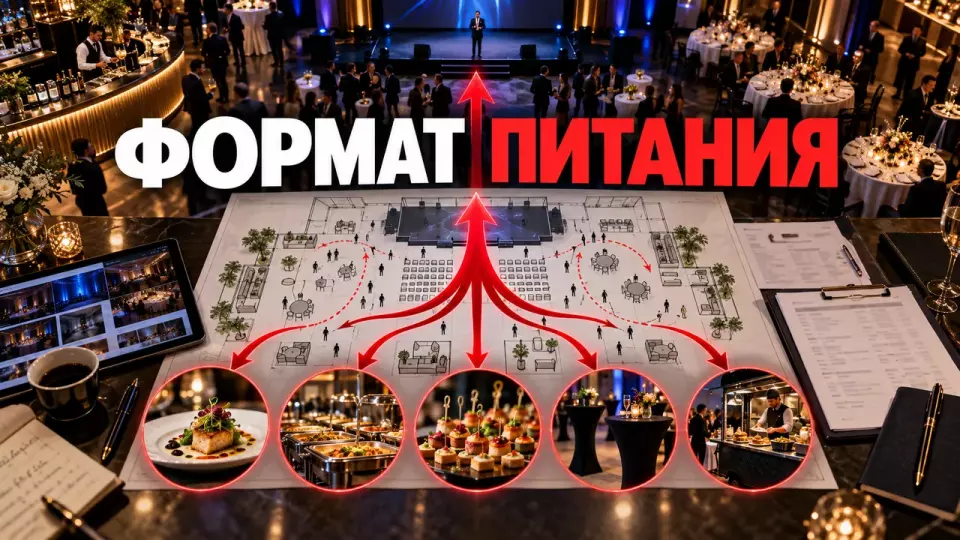
Such a scheme shows where guests, staff, delivery and cleaning will meet. We mark on the plan entrances, serving lines, seating, drink stations, dish return, waste and service routes. After that we check the path of a person with a plate in their hands.
The plan should show:
- approach to each food station and exit from it;
- a waiting area that does not block neighboring activity;
- tables or surfaces where dishes can be placed;
- the path of a waiter with clean dishes and the cleaning route;
- a zone for storage, preparation and temporary placement of equipment;
- access to water and power where they are needed;
- free exits and agreed evacuation routes.
At a buffet reception, a guest should be able to go from food to drinks without oncoming flow. At stations we check whether one point is creating a queue near the stage, registration or sanitary zone. We evaluate the banquet layout by the width of working aisles and the ability to serve tables without crossing the program.
The venue may restrict open flame, equipment capacity, unloading time, use of its kitchen or a third-party contractor. Therefore, the event venue should be evaluated together with the catering scheme. A beautiful hall without a service entrance and preparation area often creates extra costs that only become visible in a late estimate.
Accessibility is also part of the route. Part of the line should be convenient for a guest who finds it difficult to use a high counter or stand in line for a long time. Staff assistance and an alternative way of obtaining a dish are agreed in advance. Specific dimensions of aisles and furniture are confirmed by the venue documentation and current requirements.
What data should be collected about guests?
Before ordering the menu, we need the current number of participants, the composition of groups, and dietary restrictions. We collect only the information that will help safely provide an appropriate dish. Medical details are usually not needed for this task.
In the registration form, you can ask:
- whether the guest needs a special dietary option;
- which ingredients cause allergies or are excluded;
- whether there are religious or ethical restrictions;
- whether assistance is needed when receiving food;
- who can be asked a clarifying question about the answer.
Next, the team compiles the answers into a working spreadsheet without unnecessarily distributing personal data. The contractor receives the number and content of requests to the extent needed for the menu and service. On-site coordinators know the method of serving but do not discuss a guest's restrictions aloud in front of the queue.
For packaged food products, TR CU 022/2011 sets labeling requirements, including composition and storage conditions. These rules cannot be automatically applied to every buffet menu card. In practice, we still ask for a "dish - ingredients - allergens" matrix and clear labels on the line. This approach helps guests make choices and reduces the risk of staff error.
A separate dish alone does not solve the allergy issue. Storage, tools, containers, display, and possible cross-contact need to be discussed. The British Food Standards Agency recommends that businesses manage allergen information and handling practices. For a Russian event, contractual requirements are checked against Russian norms, technical regulations, and the contractor's procedures.
Venue: kitchen, water, power and delivery
The infrastructure is checked before the menu is approved. Otherwise, dishes that look suitable on paper will require unplanned refrigerators, thermal containers, cables, water, or an extra staff shift. We conduct an inspection together with representatives of the venue and catering.
The working list of questions includes:
- Where are the dishes prepared and what operations are performed at the venue?
- Is there a separate area for receiving, storage, preparation, and washing?
- What water supply, drainage, power, ventilation, and refrigeration equipment are available?
- How is delivery, unloading, and access for transport and staff handled?
- Where are clean and used dishes, packaging, and waste stored?
- What restrictions apply to open flame, heating, noise, and setup time?
- Who receives the products and records the condition of the delivery?
TR CU 021/2011 links food safety with working control procedures, storage, transportation, cleanliness, and traceability. Therefore, a mere statement "we have a Hazard Analysis and Critical Control Points (HACCP) system" is not enough for an operational plan. We ask to describe who controls and how the specific delivery, equipment, and dish production at this event.
GOST R 55051-2012 confirms that there is a separate standard of general requirements for catering. The contractor checks the applicability of the standard and mandatory norms for their service. On the organizer's side, it is more useful to record observable actions: acceptance, responsible persons, logs, batch labeling, and the procedure for reacting to deviations.
The catering format can change the choice of venue. For a complex off-site scheme, it is worth discussing catering for the event in advance along with access, zone plan, and technical conditions. Then the proposal includes the actual volume of equipment and work.
What should be in the estimate?
The estimate should show the composition of the service, the unit of calculation, the initial assumptions, and the conditions for changing the amount. A single line 'guest catering' makes it difficult to compare proposals and understand the consequences of editing the program.
We ask to break down the calculation into the following blocks:
The table summarizes the key points of the section: Block, What we record, What changes the amount. Use it as a quick reference when preparing the event.
| Block | What we record | What changes the amount |
|---|---|---|
| Menu | items, yield, quantity, special options | confirmed number of guests, menu composition, serving method |
| Beverages | assortment, volume, dispensing method, water for the team | duration of zone operations, number of points, venue rules |
| Staff | roles, shifts, access time, setup and teardown | service format, schedule, number of zones, late finish |
| Delivery | addresses, time windows, passes, unloading, lifting | route, site restrictions, repeat trip |
| Equipment | refrigeration and heating equipment, furniture, textiles, electrics | venue infrastructure and chosen menu |
| Crockery | type, quantity, washing, return, consumables | format, crockery turnover, washing possibility |
| Service charges | cleaning, removal, technical water, venue fees | contract with the venue and actual scope of work |
| Changes | confirmation and recalculation procedure | late edits to guest count, time, menu, or layout |
In each line, an answer to the question 'what is included' is needed. Delivery may include only one trip. Equipment may arrive without installation. Staff work may be counted up to a certain point in the program. These boundaries are better seen before the contract.
A universal reserve percentage does not replace risk management. We separately name the risk, the solution, and the owner. Fluctuations in guest numbers are covered by the fixation date and recalculation rule. A program delay requires an allowable working window and an extension price. For an outdoor format, a backup plan is needed that the venue and contractor can execute.
For comparison, contractors are sent the same brief. Otherwise, a low price may mean a different menu composition, less equipment, or excluded cleaning. First, we bring proposals to a common structure, then discuss quality, flexibility, and cost.
Team and Responsibility Matrix
Catering should have one coordination loop. The client confirms the guest count and changes. The organizer connects the program, venue, and contractor. The caterer is responsible for production and service in their area. The venue confirms access, infrastructure, and local rules.
The matrix might look like this:
The table summarizes key points of the section: Decision, Prepares, Confirms. Use it as a quick reference when planning the event.
| Decision | Prepares | Confirms | Who receives the change |
|---|---|---|---|
| format and menu | organizer and contractor | client | venue, service, financial owner |
| guest count | client | appointed representative | contractor and organizer |
| area layout | organizer | venue and security services | contractor, technical team |
| serving schedule | organizer and contractor | program manager | kitchen, service, stage |
| special requests | registration coordinator | catering manager | kitchen and distribution coordinator |
| additional expense | solution provider | budget owner | organizer and accounting |
The phrase "the venue will handle everything" does not replace the list of responsible parties. Even with an on-site restaurant, the program, guest count, special requests, contractor access, and expense approval remain. Each decision should have an owner, deadline, and working version of the document.
A change is considered accepted after the shared version of the budget, menu, layout, or schedule is updated. A chat message serves as a signal, but the team must see which document has changed. After an edit, we check related blocks: a new table affects the plan, service, and sometimes electrical or walkway arrangements.
How to check readiness before opening?
Readiness is checked through route and observed actions. The phrase "everything is ready" is too broad. We walk through the guest path and separately the staff path, then record any issues, the owner, and a re-check.
Before opening the zone, the team checks:
- Delivery went through the agreed entrance, and the products were received by the designated employee.
- The requested furniture, dishes, equipment, and consumables are in place.
- Electricity and water are available without cables or hoses in the guest walkway.
- Dish names and selection information are legible from the approach to the line.
- Special options are separated and served according to the agreed procedure.
- Staff knows the opening time, restocking, cleaning, and closing procedures.
- The queue does not block the stage, registration, neighboring activities, or exits.
- Those responsible know whom to inform about delays, shortages, or program changes.
For banquets, we add synchronization between the kitchen and the directing team. For coffee breaks, we check the first wave of guests leaving the hall. At food stations, we test navigation and the readiness of each point. During a business lunch, we listen to the room and see if service can work without constant intrusion into conversations.
After correcting an issue, a re-test is needed. A rearranged line may free up the walkway and at the same time block access to a power outlet. The check is considered complete when the result can be seen on site.
Short Catering Brief
A good brief puts the goal, facts, constraints, and decision-making process into one document. It can be sent to the venue and the contractor to get comparable proposals. Fields without a ready answer are marked as open questions with an owner and a deadline.
Copy this template and fill it in during the first working call:
```text Event and goal: Date, city, address or venue requirements: Program format and key blocks: Expected number of guests and confirmation date: Audience composition and groups with different routes:
Catering task in each block: Preferred format or options for comparison: Opening and closing time of each zone: What happens in the program before, during, and after the meal: Is fixed seating needed: Are food and water needed for the team, speakers, and contractors:
Dietary restrictions and how to collect them: Requirements for ingredients and guest communication: Procedure for serving special dishes: Accessibility and guest assistance requirements: Alcohol, who provides and serves it:
Kitchen and prep area at the venue: Water, sewage, power, ventilation, refrigeration: Restrictions on fire, heating, installation, and unloading: Service entrance, passes, parking, and elevator: Guest, service, cleaning, and waste routes:
What to include in the budget as separate line items: Menu and portion sizes: Beverages: Staff and working hours: Delivery, unloading, and elevator: Equipment, furniture, and linens: Dishes, washing, and consumables: Cleaning, waste, and venue fees: Recalculation terms and cost of changes:
Who approves the menu: Who confirms the guest count: Who manages changes on the event day: Response deadline and proposal format: ```
The brief does not dictate portion sizes, the number of waiters, or the break duration. The contractor calculates these parameters based on the menu, service style, layout, and timing. The client receives the basis for the calculation and can compare options under the same conditions.
Reducing food waste is also better addressed through the facts of a specific event. WRAP links a significant portion of plate waste outside the home to portion size, and UNEP recommends measuring food waste as a basis for reduction. We ask the contractor to propose the display size, replenishment procedure, and method for tracking leftovers. We do not apply a universal norm from research to an individual event.
Frequently Asked Questions
The format is chosen based on what guests are doing at a particular moment in the program. A person might grab a quick coffee, continue a conversation standing up, sit at a shared table, or visit several themed stations. Each scenario requires its own space, service, equipment, and time.
The five formats serve different purposes. It's useful to compare them based on guest behavior, space requirements, and service management. The name alone says nothing about the quality of the solution.
The schedule must show the guest's entire journey: finishing the session, leaving the room, getting to the food area, receiving the dish, finding a seat, eating, and returning. A 'lunch' line without these transitions hides half the process.
This diagram shows where guests, staff, delivery, and cleaning will intersect. We mark entrances, serving lines, seating, drink stations, dish return, waste, and service routes on the floor plan. Then we check the path of a person holding a plate.
Before ordering the menu, you need the current number of attendees, group composition, and dietary restrictions. We collect only the information needed to safely serve a suitable dish. Medical details are usually unnecessary for this task.
Infrastructure must be checked before finalizing the menu. Otherwise, dishes that look good on paper will require unplanned refrigerators, insulated containers, cables, water, or an extra staff shift. We conduct a site inspection together with venue and catering representatives.
Sources
- SanPiN 2.3/2.4.4282-26, ConsultantPlus
- GOST R 55051-2012. General requirements for catering, Rosstandart
- TR CU 021/2011 "On Food Safety", official PDF of the EEC
- Why it is important to indicate the composition of dishes on the menu, Rospotrebnadzor
- TR CU 022/2011 "Food products in terms of their labeling", official PDF of the EEC
- Allergen guidance for food businesses, Food Standards Agency
- Portion size is the main reason for plate waste when we eat out, WRAP
- Food Waste Index Report 2024, UNEP
- How Do You Handle Special-Meal Requests, PCMA
Contents
Was this article helpful?