A practical plan for the organiser: how to agree on volume, measure sound, remove hazardous zones, give guests a breather and act when complaints come in.
Loud sound is often mistaken for convincing sound. On site this quickly produces a different picture: guests move away from the stage, conversations turn into shouting, and after the programme someone complains of ringing or muffled hearing. It is too late to fix this during a performance if the team has not agreed in advance on limits, measurement points and what to do when they are exceeded.
At Aventura we treat sound as part of safety and the guest experience. The goal is not to make the programme quiet. You need even coverage across the room, keeping speech intelligible and musical dynamics intact, without creating areas of unnecessary sound exposure.
Send us a request and we'll discuss your brief
We'll clarify the event format and suggest the next step.
What does safe sound at an event mean?
Safe sound combines three conditions: controlled sound exposure, even coverage of the audience, and the ability to reduce personal exposure. A single reading on the mixing console does not describe the entire hall. The team must know the average level over a period, peak values, the loudest spots, and the duration of the program.
The World Health Organization (WHO) proposes a voluntary benchmark for entertainment venues: an average A-weighted level below 100 dB over 15 minutes. In the document, it is written as 100 dB LAeq,15min. This is a recommendation for safe listening, not a universal norm of Russian law and not permission to constantly operate at the upper limit.
Risk depends on the level and duration of exposure. The WHO explains the equal energy principle: a 3 dB increase doubles the sound energy. Therefore, a short loud segment and a long program require different management. For a corporate event, a reasonable target is usually below the WHO limit, especially when guests spend a long time in the hall, converse, and do not expect concert-level loudness.
Sound policy before equipment selection
A short written policy eliminates the argument "can it be louder?" during the show. It is agreed upon by the client, organizer, venue, technical contractor, and artist's representative. The document records the goal, measurement method, sound engineer's authority, and the procedure for responding to exceedances.
We include in the policy:
- The event format and expected duration of sound exposure.
- A working benchmark for average loudness and a separate limit for peaks.
- The control point and adjustments for other areas of the hall.
- Who monitors the readings and keeps the log.
- Who has the right to immediately reduce the level.
- How the team responds to a complaint from a guest or employee.
- Where the quiet zone and available hearing protection are located.
- What rules apply for setup, soundcheck, and dismantling.
Values cannot be copied from someone else's rider without verification. The venue may have contractual restrictions, the employer has obligations to staff, and the specific program changes in duration, audience composition, and acoustics. If the issue involves mandatory norms, they are separately verified with the venue, an occupational safety specialist, and a relevant expert.
It is convenient to attach the policy to the technical specification and technical audit of the venue. Then sound requirements appear before the budget and installation, not after the system is set up.
Where and how should loudness be measured?
Measurements should reflect the impact on the audience, not just a nice number next to the mixing console. The WHO recommends continuous monitoring with a calibrated system and a designated staff member. The monitoring position should be linked to a reference point in the loudest part of the guest area through a pre-defined correction.
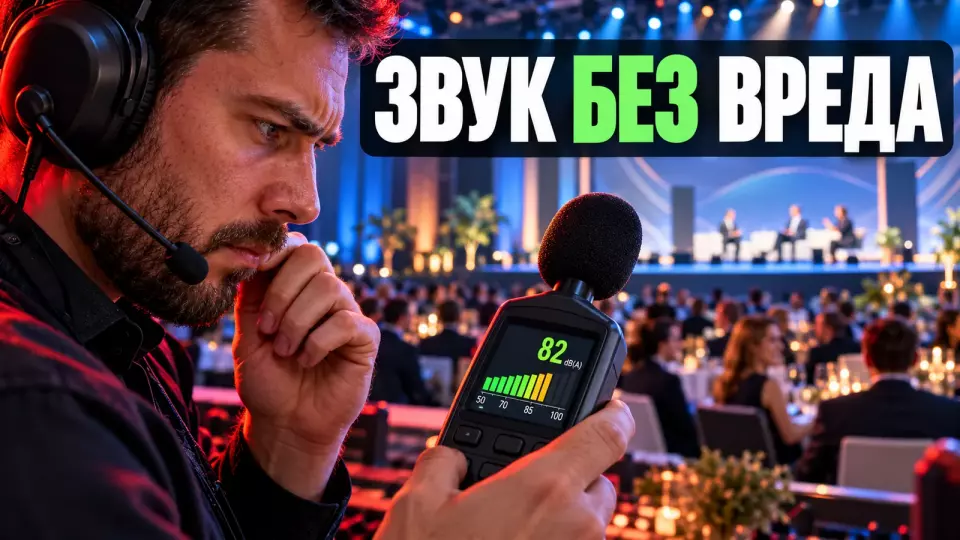
The minimum kit consists of a measurement microphone or sound level meter of a suitable class, an acoustic calibrator, display software and a log. A phone is useful as a personal indicator, but it does not replace an agreed measurement system when signing off and monitoring an event.
The table summarises the key points of this section: Metric, What it shows, How to use it. Use it as a quick reference when preparing an event.
| Metric | What it shows | How to use it |
|---|---|---|
| LAeq over a period | the averaged A-weighted sound exposure | compare it with the working reference and the duration of the programme |
| LCpeak | short-term peak values with C-weighting | catch sharp impacts, claps and transients |
| level at the monitoring point | the current situation at the measurement microphone | control the system in real time |
| correction to the loudest area | the difference between the console and the area of maximum exposure | do not underestimate the level at the stage or loudspeakers |
| time-stamped log | the history of levels and team actions | review exceedances and complaints after the event |
Before the doors open, we ask the technician to walk the hall using a grid of points. They check the front row, the edges, the areas under the balcony, the aisles near additional speakers, the staff areas and the tables that end up close to the sound system. The result is compared with the permanent monitoring position.
Even coverage matters more than power
A good system delivers comparable intelligibility across different parts of the room. If the back rows can't hear the speech, trying to raise the overall level first overloads the guests near the stage. This problem is solved by coverage design, delays and tuning, not by a single volume knob.
The WHO treats room acoustics and system design as a separate part of safe listening. In a real project we look at the geometry of the hall, reflective surfaces, reverberation time, the placement of main and additional loudspeakers, stage monitors and the areas in front of the speakers.
The table summarises the key points of this section: Mistake, What happens, Working solution. Use it as a quick reference when preparing an event.
| Mistake | What happens | Working solution |
|---|---|---|
| two powerful speakers cover the whole room | the front row gets too much, the back row loses intelligibility | distribute coverage and set up delayed lines |
| the loudspeaker is aimed at a wall or glass | reflections blur the speech | change the direction, height and room treatment |
| tables are placed right next to the system | some guests get maximum level all evening | change the seating plan or create an exclusion zone |
| stage monitors compete with the room | the overall level rises on stage and in the front rows | reduce stage noise, use personal monitoring |
| bass is boosted at certain points | perceived loudness varies across the room | measure low frequencies and adjust the layout |
The technical contractor should show a coverage map and explain where the maximum level is expected. For conferences and forums, sound is tied to organising a business event, the run of show, seating, screens and guest routes. For the evening programme, the concert mode is checked separately.
If you need a single contractor for both the programme and the technical side, see how we organise conferences and forums. We coordinate the sound system with the venue, the artists and the objectives of the event, and then test it before the guests arrive.
We publish practical notes on the technical preparation of events in Aventura's Telegram channel.
How do you sign off on sound before guests arrive?
The sign-off is done on the same configuration that will run during the programme. An empty hall and a hall filled with people sound different, so the team leaves headroom for final correction once the audience comes in. The soundcheck must not turn into a contest for maximum volume.
The working sequence looks like this:
- Check the power supply scheme, signal lines and backup channels.
- Calibrate the measurement system.
- Set up each loudspeaker and delay line separately.
- Check speech on all microphones and at all speaker positions.
- Walk the hall with music material close to the programme.
- Record the difference between the reference point and the loudest spots.
- Set up warnings and limiters as a safety layer.
- Check the stage monitors, artist exits and crew communications.
- Record the baseline settings and the responsible persons.
- Repeat a short check once the hall is full.
Backup power and switching to the spare path must not cause a sharp jump. We cover the related scenarios in the material on event backup power. Radio systems and microphones are checked against a separate conference radio frequency plan.
Quiet zone, seating and hearing protection
Guests should have a simple way to reduce their exposure: move to a quieter place, choose a different position or pick up earplugs. The WHO includes quiet zones and accessible hearing protection among the six basic elements of a safe event. These measures complement system control but do not justify excessive volume.
The quiet zone is placed so that it can be reached without leaving the venue and losing your bearings. It should not be next to subwoofers, the service generator or a noisy bar. On the plan and signage, it is best to use a clear name: "Quiet Zone" or "Place to take a break from loud sound".
Seating is checked against the actual coverage map. Seats directly in front of loudspeakers are removed or left free. Guests who report increased sound sensitivity are offered a calmer zone without publicly explaining the reasons.
Earplugs are placed at the entrance, the cloakroom, the information desk and next to the quiet zone. The US National Institute on Deafness and Other Communication Disorders notes that protective earplugs and earmuffs reduce levels, but the choice and correct fit affect the result. For a music programme, models with more even frequency attenuation are convenient so that the sound does not turn into a muffled background.
What to do about staff and performers?
Employees face a greater cumulative load than most guests: setup, soundcheck, the entire programme and teardown all happen in a single working day. The WHO guest guideline does not replace a professional exposure assessment or occupational health and safety requirements. The team needs a separate plan that takes into account time, location and the possibility of rotation.
The plan should specify:
- who is constantly at the stage, in the technical area and near the loudspeakers;
- where hearing protection is mandatory based on the assessment results;
- how staff rotation is organised;
- where a break can be taken in a quiet place;
- who checks the fit and condition of protective equipment;
- how complaints of ringing, pain or muffled hearing are recorded.
The UK Health and Safety Executive emphasises a sequence: first assess and reduce exposure through technical and organisational measures, then use hearing protection for the residual risk. For an event, this means that earplugs do not replace a sound system, seating plan and time control done properly.
With performers and their representatives, the sound policy is discussed before the final rider is signed. The venue's sound engineer must have the authority to reduce the level if it exceeds the agreed guideline. This condition is best written down explicitly so that the decision does not depend on a dispute during the performance.
Information for guests without an alarming tone
A warning should help a person act. The phrase "the sound may be loud" changes almost nothing. It is more useful to show where it is quieter, where to get earplugs, who to contact and what to do if you feel discomfort.
Information is placed in the registration, programme, signage and on screens before the music block. The wording could be:
Important: during the concert part, the sound level will increase. Earplugs are available at the information desk; the quiet zone is in the foyer to the right of the hall. If the sound causes pain or severe discomfort, move away from the loudspeakers and contact a coordinator.
It is not worth promising a complete absence of consequences. The WHO explicitly notes that its standard reduces the risk to an acceptable level but does not eliminate it for every person. Frequent attendees of loud events and people with increased sensitivity need additional measures.
What to do in case of an exceedance or a complaint?
The team responds immediately and records the facts. A guest's complaint cannot be put off until the end of the evening, even if the overall reading looks normal. The cause may be a local zone near a loudspeaker, a sharp peak, acoustic feedback or individual sensitivity.
Procedure:
- The coordinator helps the guest move to a quiet zone or safely leave the loud area.
- The sound engineer checks the current average level, the peaks and the guest's position.
- If the limit is exceeded, the authorised specialist lowers the level without waiting for lengthy approval.
- The technician inspects the local zone and, if necessary, changes the direction, delay or operation of a specific loudspeaker.
- The control centre records the time, the programme, the readings, the location, the complaint and the action taken.
- In case of pronounced pain, sudden hearing loss, dizziness or persistent ringing, the team offers medical assistance according to the procedure adopted for the event.
- After the programme, the technical director reviews the episode and adjusts the policy for the next event.
NIDCD notes that after a loud sound a person may notice muffled hearing, distortion or ringing. Even temporary improvement is no reason to treat the episode as trivial. The organiser does not make a diagnosis, but provides a calm route to assistance and does not argue with the guest's sensations.
Sound log and post-event report
The log links the readings to the programme and the team's actions. It is not needed for a formal archive. It shows at which act the peaks occurred, where guests complained and which changes actually helped.
The table summarises the key points of this section: Field, What to record. Use it as a quick reference when preparing an event.
| Field | What to record |
|---|---|
| time | start and end of the interval, the moment of the complaint or exceedance |
| programme | speaker, video, musical number, pause |
| LAeq | average level over the agreed period |
| LCpeak | maximum peak over the interval |
| measurement point | microphone position and the correction applied |
| event | exceedance, feedback, complaint, configuration change |
| action | level reduction, system correction, moving the guest, issuing protection |
| person responsible | role of the employee who made the decision |
| result | repeat measurement and the state of the situation |
The final report includes a level graph, a list of episodes, a map of problem areas and recommendations for the next setup. If the system regularly hits the upper limit, the issue is resolved not by raising the limit but by changing the coverage, acoustics, stage noise or scenario.
Organiser's checklist
Safe sound is built in before the budget is set, checked during setup and monitored until the end of load-out. A responsible organiser can use this short list:
- The sound policy is agreed with the venue, the contractor and the artists.
- Operating levels and the response procedure are documented without ambiguity.
- The measurement system is calibrated.
- The monitoring point is linked to the loudest area of the hall.
- Coverage has been checked across the grid and problem spots have been resolved.
- Seating does not fall within the excluded zones in front of the PA.
- A quiet zone is marked and accessible.
- Earplugs are available at several clearly signposted points.
- Staff know the rotation and hearing protection rules.
- Coordinators know how to handle a complaint without arguing.
- A sound log is kept throughout the programme.
- After the event, a debrief with corrective actions is prepared.
Frequently asked questions
Safe sound combines three conditions: controlled sound exposure, even coverage of the audience and the ability to reduce personal exposure. A single reading at the mixing desk does not describe the whole hall. The team must know the average level over the period, the peak values, the loudest spots and the duration of the programme.
A short written policy removes the argument "can it go any louder?" during the show. It is agreed by the client, the organiser, the venue, the technical contractor and the artist's representative. The document sets out the goal, the measurement method, the sound engineer's authority and the procedure for responding to an exceedance.
Measurements must show the exposure in the audience, not a flattering number next to the mixing desk. The WHO recommends continuous monitoring with a calibrated system and a designated member of staff. The monitoring position must be linked to a reference point in the loudest part of the guest area through a pre-defined correction.
A good system delivers comparable intelligibility in different parts of the hall. If the back rows cannot hear speech, trying to raise the overall level first overloads the guests near the stage. This problem is solved by coverage design, delays and tuning, not by a single volume knob.
Sign-off takes place on the same configuration that will run during the programme. An empty hall and a hall filled with people sound different, so the team leaves headroom for final correction once the audience comes in. The soundcheck must not turn into a competition for maximum loudness.
Guests must have a simple way to reduce their exposure: move to a quieter place, choose a different position or take earplugs. The WHO includes quiet zones and accessible hearing protection among the six basic elements of a safe event. These measures complement system control but do not justify excessive loudness.
Sources
- WHO: Global standard for safe listening venues and events
- WHO: full text of the safe listening standard
- NIDCD: How Loud is Too Loud?
- NIDCD: Hearing Protectors
- HSE: Noise at work
- EU-OSHA: Directive 2003/10/EC on noise
Contents
Was this article helpful?