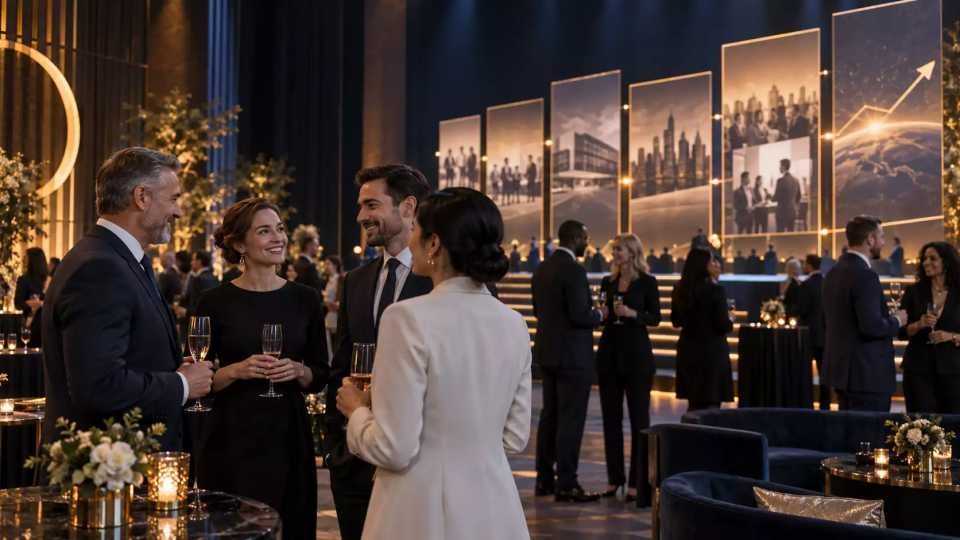
A company anniversary becomes a powerful event when its program tells the business story and gives employees a clear role. We analyze the script, venue, team, and preparation without unnecessary pomp.
A company anniversary should start with a goal, not with choosing a banquet hall. We will show how to connect the business history, employee roles, script, and venue into a single program.
What should a company anniversary accomplish?
In short: a company anniversary should accomplish one main task: to show what unites people now and where the company is moving next. A banquet and a concert can support this idea, but they do not replace it.
First, we define the goal in one sentence. For example: to mark an important milestone, thank employees, strengthen ties with partners, or show the overall result of branches. If there are many goals, we choose one main and two supporting ones.
The table summarizes the key points of the section: Goal, What the guest will see, How we check the program. Use it as a quick guide when preparing the event.
| Goal | What the guest will see | How we check the program |
|---|---|---|
| Recognition of the team | contribution of people and departments | employees have clear stories and roles |
| Company history | the path from first decisions to the present day | facts are integrated into the event flow, not presented in a long report |
| Partner relationships | respect for the joint journey | partners are given time for networking |
| The future of the company | the next stage and shared tasks | the finale gives a clear image of moving forward |
We link this goal to the brief for a corporate event. This way the program meets the business objective, not just a list of entertainment.
Company history as the foundation of the program
Important: it is better to collect the company's history as a sequence of turning points and people's voices. Guests should understand what changed, who made it happen, and what next step the company is preparing.
We ask the team to choose several key episodes: the start, the first notable result, a difficult period, an important decision, and the current stage. Each episode needs a hero, an object or visual material, and a brief takeaway.
Don't turn the anniversary into a director's report for the whole evening. Alternate facts with live scenes: a short interview, an archive photo, a product demonstration, gratitude to the team, or a conversation between two generations of employees.
It is important to verify the facts. Names, positions, dates, and photos must be coordinated with the responsible people before the rehearsal. This way the script does not put a guest in an awkward position.
How to assemble the guest list and roles?
In brief: the guest list determines the tone of the event. Employees need involvement, partners need respectful attention, executives need the opportunity to say what matters most, and families need a clear and comfortable route.
We divide the audience into groups and assign each a role in the program. Some guests perform, others take part in interactive activities, and still others come as observers and conversation partners.
- We draw up a map of groups: employees, former employees, partners, clients, families, and honored guests.
- Then we determine what each group should feel and learn.
- We check whether there are blocks where one group talks all the time while the others just wait.
- We appoint an owner of the guest list and a separate meeting coordinator.
If the event will include children, elderly guests, or people with limited mobility, the route and duration of the blocks need to be checked in advance. The general principles of digital accessibility are collected in the W3C guidelines from the list of sources. For the venue, we translate this principle into practical solutions: clear signage, accessible entrance, and a place for quiet rest.
Anniversary Program Flow: From History to the Future
In brief: a good script guides the guest from recognizing a shared history to a shared experience and a clear finale. We alternate intense and calm segments so that the evening doesn't turn into a marathon of congratulations.
A working framework might look like this:
- Entrance and mood setting. Registration, music, visual materials, and first introductions.
- Opening. A short welcome and an explanation of why the company has gathered.
- Pivotal moments. History through photographs, objects, interviews, or stage episodes.
- Team recognition. Acknowledgements, nominations, or department stories without a drawn-out list.
- Joint activity. A format where guests do something together and don’t remain spectators.
- The future. One clear image of the next stage and the leader’s substantive remarks.
- Free networking. Time for conversations, music, and informal continuation.
Between the meaningful blocks, we build in transitions. The host must know why the next episode begins, and the technical team must know what material to display and when to remove it from the stage.
Venue and technical route
In brief: the venue should support the script, not force the program to adapt to a random layout. We check in advance the entrance, stage, sound, light, networking areas, catering, and staff flow.
Assemble the route through the guest’s eyes: from invitation and registration to exit. Separately, walk the path of the speaker, host, artist, photographer, and technical specialist.
The table summarizes the key points of the section: Zone, What we check, Backup. Use it as a quick guide when preparing the event.
| Zone | What we check | Backup |
|---|---|---|
| Entrance | signage, registration, cloakroom | backup table and printed lists |
| Stage | visibility, sound, light, screen | backup microphone and a copy of materials |
| Networking | tables, acoustics, aisles | quiet zone for conversations |
| Archive and photo | light, background, access to materials | agreed publication procedure |
Business industry venues often separate the general program and meeting areas. This principle is also useful for an anniversary: a loud stage should not drown out guests’ conversations.
Team and Rehearsal
In short: every critical area must have one person responsible. We don't leave decisions to "the team as a whole," because at a moment of failure that means no one makes the decision.
Minimum set of roles: project manager, director or program lead, host, venue coordinator, technical lead, guest liaison, photographer, and the person who approves publication of materials.
One day before the event, we hold a technical run-through. We check the host's entrance, video order, lighting transitions, music cues, awardee entrances, and the backup scenario in case of delay.
The rehearsal should not copy the entire evening minute by minute. Its purpose is to find places where people, equipment or script may clash.
Want to put together a whole event? Turnkey organization of corporate, business and client events connects concept, script, venue, team and execution control.
We publish additional ideas for corporate and business events in the Aventura Telegram channel.
How to work with photos, videos and questionnaires?
In short: decide in advance what materials are collected, who has access to them, and where they will be published. This applies to guest questionnaires, archival photos, video filming and reviews.
For the questionnaire, we leave only questions that help organize participation. We explain the purpose of collection and restrict access to the guest list. We check the legal framework for personal data processing against 152-FZ from the list of sources; the specific basis depends on the type of processing.
Before the event, agree on:
- who is responsible for checking the legal basis and collecting consents, if needed;
- which photos and videos can be shown within the company;
- which materials can be posted on the website and social media;
- where the source files are stored and who deletes them upon completion of the task.
The host and photographer receive a short memo. It helps avoid filming people in awkward situations and publishing archival materials without checking.
Step-by-step preparation plan
In short: it's convenient to conduct preparation from meaning to details. First the goal and guests, then the program and venue, after that the team, materials, rehearsal and final check.
- Establish the goal of the anniversary and criteria for a completed program.
- Gather a map of guests, speakers, and participants in the company's history.
- Choose a narrative arc and distribute blocks according to the rhythm of the evening.
- Check the venue, routes, accessibility, and technical limitations.
- Assign decision owners and assemble a unified timing.
- Prepare texts, photos, videos, music, navigation, and backups.
- Conduct a team run-through and separately check guest entry.
- On the day of the event, maintain a single channel for urgent changes and record decisions.
For a large project, this order turns into a calendar with checkpoints. We link it with the budget and agreements so that a change in one part is not lost in the others.
What to do after the anniversary?
In short: the event ends for guests, but not for the team. Within the next few days, we collect materials, thank participants, hand over agreements, and record what should be repeated or changed.
Divide post-event work into three streams: internal communication for employees, materials for partners, and public content. For each stream, assign an owner and an approval date.
Don't send the same message to everyone. Show employees the team's contribution, to partners – continuation of contact, to management – a short report on the goal and decisions. Record questions for the next event immediately while the details are still fresh.
Frequently asked questions
In short: a company anniversary should accomplish one main task: to show what unites people now and where the company is heading next. A banquet and concert can support this idea, but they do not replace it.
Important: it is better to assemble the company's history as a sequence of turning points and people's voices. Guests should understand what changed, who did it, and what next step the company is preparing.
In short: the guest list determines the tone of the event. Employees need involvement, partners – respectful attention, executives – the opportunity to say the main thing, and families – a clear and comfortable route.
In short: a good script leads the guest from recognizing a shared history to a collective experience and a clear finale. We alternate dense and calm blocks so that the evening does not turn into a marathon of congratulations.
In short: the venue should support the script, not force the program to adapt to a random layout. We check in advance the entrance, stage, sound, light, networking areas, catering, and staff route.
In short: each critical area should have one responsible person. We do not leave a decision "to the team as a whole," because at a moment of failure this means that no one makes the decision.
View Aventura's portfolio of business and corporate events and request a quote if you need to design a company anniversary around a specific story, audience, and city.
Sources
- W3C: Introduction to Web Accessibility
- 152-FZ “On Personal Data”
- RUEF: about the events industry
- Expocentre: organizing a company's exhibition activities
- Expocentre: business meetings - holding and preparation
Contents
Was this article helpful?