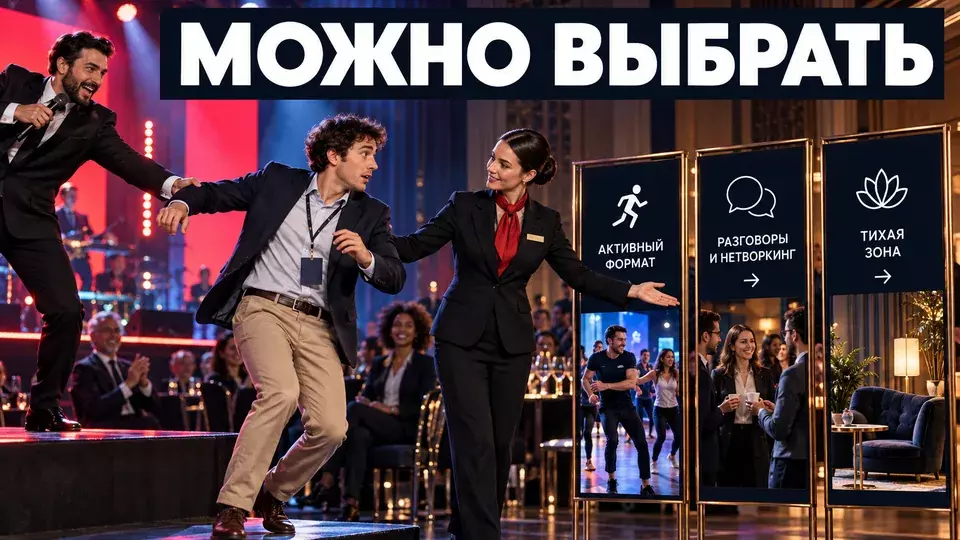
How to run a corporate event without pressure: separate the work part from the voluntary part, give employees a choice of route, and keep the programme manageable.
A corporate event without compulsory attendance remains a company-wide occasion, but it doesn't turn into a loyalty test. First, separate work tasks from the social programme. Then give employees a clear choice: come for the whole day, choose part of the programme, or opt out of the voluntary block without public explanations. If you need to build this kind of mechanism for your team, request a quote and a programme review.
Why isn't the phrase "participation is optional" enough?
Voluntariness shapes the employee's entire experience, not just a single line in the invitation. What matters is the timing of the event, the manager's tone, how visible the opt-out button is, the department lists, and whether attendance is linked to performance reviews. People need to understand in advance which parts count as work, where free choice applies, and how to decline without a public explanation.
If a manager asks for every employee to show up while HR publishes a list of those who declined, a formal disclaimer no longer works. Pressure can arise even without a direct order: a quota per department, a mandatory team photo, a report to the boss, or the host making jokes about those who left early.
We start with the content of the programme. A business meeting, training, briefing and the social part can each have a different status. For teams on shift schedules this boundary is especially noticeable; we covered a separate production model in our piece on events for shift workers.
If the business part is tied to job duties, the company determines its status, schedule and paperwork together with HR and legal. Calling it a "corporate party" does not answer these questions on its own. For the host, HR specialist, organiser or manager, certain tasks at the event may count as work.
The boundary between the business and social programme
In short: If the programme includes a mandatory business module, put it in a separate block with a clear time, task and outcome. Mark the dinner, games, concert and free networking separately. Don't hide a business meeting inside a party, and don't turn a voluntary evening into an extension of a meeting.
The business part answers a business question. For example, management announces a decision, the team completes training, or departments agree on a plan. The block has a start, an end, a host, materials and a way to record the outcome.
The social part is for networking, recognition, relaxation or getting to know colleagues. It should not become an informal exam. If it matters to the company that most people attend the business module, it is more honest to schedule it during working hours and formalise it under internal rules.
If the employer assigns participation as a work task outside the established schedule, the company separately checks the rules on overtime, weekends and public holidays. We ask the client to resolve scheduling, paperwork and compensation before invitations go out. That way employees know in advance where the work module ends and the voluntary programme begins.
It helps to build an explicit fork into the programme:
- A work module according to the approved schedule.
- A transition break after which a person can leave without comment.
- A voluntary social programme with separate confirmation of participation.
- A short pack of materials for those who did not attend the work block for an agreed reason.
This scheme removes ambiguity and helps shape each part around a specific task.
What exactly should employees be free to choose?
The choice should cover the entire participation journey. People decide in advance how much time they will spend at the event, which format suits them, what role they are ready to take on, and how they will ask a question. Separate options are needed for food, pace, physical exertion and how to contact the coordinator.
Before the event, employees choose their participation, which parts of the programme to join and a suitable pace. The form also lets them report time, dietary or accessibility constraints and allow the coordinator to get in touch to clarify the arrangements.
On site, the choice continues. People can move from an active zone to a conversation area, watch the programme from the sidelines, skip a game, take a soft drink or leave early. No public reason is required for this.
We prepare a participant decision map:
The table summarises the key points of this section: Stage, Employee decision, What the organiser prepares. Use it as a quick reference when planning your event.
| Stage | Employee decision | What the organiser prepares | What we don't do |
|---|---|---|---|
| Invitation | attend, decline, decide later | equal response buttons and exact timing | we don't hide the decline option behind a tiny link |
| Registration | choose parts of the programme | statuses for each module | we don't collect unnecessary personal data |
| Before the event | report the conditions they need | a private coordinator channel | we don't ask for a diagnosis or an explanation for declining |
| At the entrance | confirm or change their route | a single master list | no re-registration needed |
| During the programme | participate, observe, switch | signage and free capacity in the zones | choices are never commented on from the stage |
| After the event | give feedback | an honest description of anonymity | no report that reveals who said what |
The map helps estimate guest flow and service. It also shows where pressure is hidden. If the "not taking part" option exists only in theory, the process needs reworking.
If you need a programme where participant choice is built in before the venue is even selected, we will put together a scenario and budget tailored to your team composition, schedule and constraints.
Equal participation routes
In our working practice, three routes give participants more options than a single shared activity with space for spectators. The active, conversational and calm scenarios are part of the overall programme and receive an equal level of service. Guests move freely between them, and the host explains the rules without judging the pace chosen.
The active route suits those who want to move, play, perform or solve a team task. Participants see the level of exertion, the duration and the option to stop in advance.
The conversational route is built around small groups, workshops, tabletop formats and chatting with colleagues. There is no need to go on stage or compete.
The calm route includes observation, an exhibition, a quiet zone, short individual activities and places to rest. It should not look like a punishment for those who opted out of the group contest.
The routes are linked by a shared narrative: an opening, several meeting points and a finale. Transitions are free. The host does not ask the room to explain why someone stayed a spectator.
This principle also applies to the menu. In the article on a corporate party without alcohol we looked separately at drinks and the evening's scenario. Here the rule is broader: alcohol, sports activities or public speaking do not become a pass into the team.
For organising a corporate party for employees, we first calculate the capacity of each route, the intersection points and the reserve. Only then do we choose the activities and decor.
How to invite without hidden pressure
The invitation should make the programme and the right to choose equally clear. State the status of each block, the exact end time, the available routes and the coordinator's contact details. The decline button is visible next to the confirmation, and managers receive separate instructions: explain the work task, help with the schedule and do not collect excuses in a group chat.
The wording "attendance is mandatory, participation is voluntary" creates confusion. It is better to name each block separately. If a work session is mandatory for specific roles, list those roles and the internal company reasons. Everyone else should not have to guess their status.
Check the invitation step by step:
- Name the purpose of each programme block.
- State the start and end times, including transport.
- Separate confirmation for the work and social parts.
- Offer the options "I'll come", "I can't", "I'll decide later".
- Describe the physical exertion, noise, contact activities and catering format.
- Add a private channel for requesting participation conditions.
- Remove departmental quotas and public lists of those who declined.
- Ask managers not to collect explanations in work chats.
- State what materials those who did not attend will receive.
Department managers need separate instructions. Their task is to explain the purpose of the work module and help with the schedule. A voluntary dinner should not affect the assessment of work discipline.
The invitation could be worded like this: "The business session runs from 15:00 to 17:00 during participants' working hours. The evening programme from 17:30 is optional. You can choose the whole evening or individual zones. Declining the social part requires no explanation."
Confirmation of attendance and statuses without a loyalty rating
In short: The registration list helps calculate service, security and zone capacity. Keep the operational module separate from the social part, store one current status and show declines next to confirmations. Personal requests are visible only to employees who need this information to prepare specific arrangements. Do not use responses as a rating of departments or individuals.
The basic statuses are enough: "invited", "will attend", "cannot attend", "will decide later", "route selected", "attended". Store the change history separately. The main record should contain one current response.
The decline button should be as prominent as the confirmation. It is better not to make the reason field mandatory. If the client needs to understand barriers, add an optional list: time, transport, format, family circumstances, other. Responses are analysed in aggregate without a personal rating.
We have put together the detailed architecture of fields and statuses in the article on event participant registration. For repeat confirmations, you can use the logic from the material on how to reduce the share of guests who confirmed attendance but did not show up, but do not turn the reminder into pressure.
Restrict access to requests about participation conditions by role. The coordinator sees the full request. Pass only the information needed to prepare the service to the venue and contractors, and only where there is an agreed basis and processing procedure. The company checks the data composition, retention period and transfer conditions with the person responsible for personal data.
What do those who don't attend get?
Missing the voluntary part should not cut an employee off from work information. Prepare a short package with the business block's decisions, materials, a channel for questions and the next step. Send it to everyone who needs it for work, regardless of participation in the evening programme. That way a social choice does not affect access to tasks and documents.
A multi-hour recording of the evening rarely solves the task. A person needs a clear outcome. What was announced? What decisions were made? Where are the documents? Who should they contact? By what date is a response needed?
Publish photos and videos only in line with company rules, with an appropriate legal basis and the necessary consents. Have the publication procedure checked in advance with a lawyer and the person responsible for personal data. Captions about "the real team" or "those who are always with us" should not be used: they once again turn a voluntary evening into a loyalty test.
If an employee could not come because of a shift, family responsibilities or the conditions of participation, the next format should take that signal into account. We do not ask a person to prove that their reason is valid in order to get into a future programme.
Shifts, accessibility and safe alternatives
Important: Choice works only when the options are physically available. Check the shift schedule, the route around the venue, noise, light, rest areas, food and the ability to speak to a coordinator without a public conversation. Communicate the limitations of each format in advance and prepare an equivalent alternative for people with a different pace, schedule or way of taking part.
For a shift-based team, a single date may not be enough. A repeat wave, short modules or local inclusions are fairer than requiring people to come after a night shift. The employer agrees the work schedule and compensation.
In the form, ask only about specific conditions of participation: step-free entry, a seat, subtitles, food, a quiet zone or the time of leaving. Do not request a diagnosis, religion or an explanation for declining if this information is not needed for the stated purpose of processing. The request can be phrased neutrally: "What conditions would help you take part?"
We covered the practice of a full route in the article on inclusive corporate events. For this topic, one conclusion matters: an alternative route is planned in advance, not put together in the guest's presence.
The non-alcoholic option must be visible and full-fledged. A person is not obliged to explain whether it is related to health, medication, religion, driving or a personal decision. The same applies to dietary restrictions: the caterer receives the necessary information, and the host and colleagues do not discuss it publicly.
How do you manage choice at the venue?
The team must be able to see how busy each zone is and help guests change their route without registering again. This requires clear signage, spare capacity, coordinators and written rules for the host. Before the venue opens, assign an owner for each decision and agree on actions for queues, late arrivals or an overcrowded quiet zone. That way, an individual's choice does not disrupt the overall schedule.
At the rehearsal, test four scenarios: fewer people than expected arrive at the active zone; the quiet route is overcrowded; some guests arrive late; a group wants to move together. For each scenario, assign a decision and an owner.
If one zone has a queue, do not herd people into an available activity just to make the statistics look good. It is better to open a reserve slot, shorten the cycle or redirect the flow while explaining the practical benefit.
The host receives a written brief:
- going on stage is agreed with the participant in advance;
- declining, leaving early and choosing non-alcoholic options are not joked about;
- all routes are presented as equally valid;
- the rules for moving between zones are clear;
- the coordinator is easy to find;
- department attendance is not announced from the stage.
A venue with several independent zones makes such a programme easier, but the layout matters more than the number of halls. Check the acoustic separation, the walkways, accessibility and the real capacity for the chosen seating arrangement.
Selection metrics and a pre-launch checklist
In short: Don't judge voluntariness by a single attendance figure. Look at how clear the options are, where people change their minds, which areas get overcrowded and which barriers keep recurring. This data helps you fix the next format, but it doesn't measure an employee's loyalty. Compare plan versus actual for service tasks, not departments by headcount.
Useful metrics are organisational: the share of responses to the invitation, how routes are distributed, the number of switches, early declines, requests for conditions, actual participation and area load. Comparing departments by voluntary attendance is risky: teams have different schedules, compositions and access to transport.
We described the full system of goals and reporting in the article on corporate event KPIs. For a corporate party with choice, add qualitative questions: was it clear which parts were mandatory; could someone decline without giving a reason; did the person find a suitable route; could they change it on site.
Before launch, go through the final checklist:
- The work and social parts are named separately.
- HR and legal have checked the mandatory blocks and the schedule.
- The invitation states the exact end time.
- Declining is possible without a mandatory comment.
- There are no department quotas or public lists.
- Routes are equivalent in content and service.
- The venue can handle movement between areas and peak load.
- The host knows the prohibitions on public pressure.
- A coordinator handles requests about participation conditions.
- For those who didn't come, a work-related outcome is prepared.
- Feedback honestly describes anonymity and who can access the responses.
- The team knows in advance what will change if registration plans and actual attendance diverge.
Frequently Asked Questions
Voluntariness shapes the employee's entire journey, not just one line in the invitation. What matters is the timing of the event, the manager's tone, how visible the opt-out button is, the department lists, and whether attendance is linked to performance reviews. People need to understand in advance which parts are work-related, where free choice applies, and how to decline without a public explanation.
The business part answers a business question. For example, management announces a decision, the team goes through training, or departments agree on a plan. The block has a start, an end, a facilitator, materials and a way to capture the outcome.
The choice should cover the entire participation journey. People decide in advance how much time they will spend at the event, which format suits them, what role they are ready to take on, and how they will ask a question. Separate options are needed for food, pace, physical activity and how to reach the coordinator.
In our experience, three tracks give participants more options than a single shared activity with space for spectators. The active, conversational and relaxed scenarios are part of the overall programme and receive the same level of service. Guests can move freely between them, and the facilitator explains the rules without judging the pace chosen.
The invitation should make the programme and the right to choose equally clear. State the status of each block, the exact end time, the available tracks and the coordinator's contact details. The opt-out button is visible next to the confirmation, and managers receive separate instructions: explain the business task, help with scheduling and don't collect excuses in a group chat.
A basic set of statuses is enough: "invited", "attending", "can't make it", "will decide later", "track selected", "attended". Keep the change history separately. The main record should contain one current response.
If you want to organise a turnkey corporate event with a business module, several tracks and clear service, request a quote. At Aventura, we'll start with your team composition, schedule and each participant's decision map.
Sources
- ILO: business questions about working time
- ILO: working time and work organisation
- W3C: accessible presentations and events
Contents
Was this article helpful?