A practical event plan for shift-based staff: equal waves, coverage of critical posts, routes, catering, Q&A and a command centre.
An event for shift-based staff cannot be put together as one big corporate party after work. A production facility, warehouse, store or dispatch centre has no single free window. While one group takes part in the programme, another must keep the critical posts manned. That is why we design several equal waves with shared content, separate routes and a controlled return of people to work.
The main risk appears when the event calendar is approved before the shift map. Day staff get the managers, the full programme and fresh service. The night shift is left with a recording, a shortened block or an inconvenient time right after work. Formally there is coverage, but the employee experience differs. This quickly becomes noticeable in questions, feedback and attitudes towards the company's initiative.
At Aventura we start with operational constraints. Together with the client we determine how many employees can be released from each shift, which posts cannot be left without cover, how long it takes to get to the event area and when the group must return. After that we put together the programme, registration, catering, command centre communications and a single register of questions.
If you are preparing a programme for several shifts, request a flow calculation and quote. We will link the scenario to the work schedule, venue and services before invitations are sent out.
Why doesn't a single shared slot work?
A single shared slot requires pulling people out of work areas at the same time, even though some posts must remain staffed. Even if the venue can hold the entire team, operations may not be able to sustain that level of output. The second problem is timing: an additional program after a shift doesn't suit everyone. An invitation on a day off also raises questions about whether attendance is mandatory and how time is recorded.
We start by separating three concepts: the work process, the mandatory part of the program, and the voluntary social part. They must not be lumped together under a single phrase like "a corporate event for everyone." A work meeting, a safety briefing, a session with management, an awards ceremony and an entertainment program can all have different statuses. Decisions about working time and compensation are made by the employer together with HR and an employment lawyer.
The fresh agenda of the 2026 All-Russian Occupational Safety and Health Week brings together industrial safety, human capital and employee health. For us this is a practical signal: a program for shift teams must take into account the content, people's work schedules, fatigue, access to information and route safety.
The usual scenario also breaks down at the communication stage. Frontline staff may not have constant access to corporate email or a work computer. Invitations, the program and any changes must reach them through the channels people actually use: shift supervisors, information screens, printed materials, a corporate app or short messages via an approved scheme.
Shift and Critical Post Map
First, we calculate how many people can be released per wave without losing process control. Shift names and total headcount alone are not enough for this. We identify critical posts, minimum staffing, handover time, travel time, replacement reserve and the point at which an employee must return to the work area.
We start the work with a table.
The table summarises the key points of this section: Field, What we record, Who confirms. Use it as a quick reference when preparing the event.
| Field | What we record | Who confirms |
|---|---|---|
| Shift | start, end, breaks, shift handover | HR and department head |
| Critical posts | functions that cannot be left without a person | production or operations service |
| Minimum staffing | how many employees remain in the area | shift supervisor |
| Permissible release | how many people can be sent in one wave | production and the organiser |
| Travel time | exit, security check, cloakroom, registration, return | route coordinator |
| Reserve | who replaces a participant in case of an urgent work task | shift supervisor |
| Restrictions | protective equipment, access clearance, noise, sanitary requirements | occupational health and safety and facility services |
Permissible release is calculated based on the narrowest point. If ten people can be replaced in the workshop, but the checkpoint only lets a group through in twenty minutes, we factor the checkpoint into the timing. If catering is served more slowly than registration, the service window becomes the constraint. The scenario must be based on the real throughput of the entire chain.
The map is also needed for managers. Without it, the shift supervisor receives a general list of invitees and decides at the last moment who to release. Then the group composition changes after badges have been printed, catering ordered and activities allocated. We set the replacement rule and a separate status for an employee called back to their work post in advance.
For a large internal event, it is useful to link the shift map with the overall service of organising corporate parties. Then the concept, service and technical part immediately receive production constraints, rather than being adapted to them after the programme is approved.
How do you split the programme into equivalent waves?
Equivalent waves give each shift the same substantive core, access to managers, service and a way to ask a question. They may differ in timing, the line-up of facilitators or the length of transitions, but they must not turn into an "main" and a "leftover" version. For each wave we set the same mandatory outcomes and check them after the route is completed.
We build the scheme step by step.
- We determine the maximum size of one wave using the critical post map.
- We choose the module duration together with the travel there and back.
- We fix a single substantive core that cannot be shortened for later groups.
- We assign slots to day, evening and night shifts without automatically extending their working day.
- We add a reserve wave for those who could not be released due to a work situation.
- We repeat the same rules for registration, catering, questions and recording results.
- We check whether the team has enough time to prepare the venue between groups.
A wave does not have to repeat every line of the facilitator. Stability is ensured by the module passport: the goal, mandatory talking points, duration, materials, working question, method of participation and outcome. If one facilitator runs the morning block and another the night one, both work from the same passport and receive a fresh list of clarifications from the coordination team.
A late wave cannot automatically be scheduled right after a night shift. HSE treats fatigue as a work risk that depends on the time and length of the shift, workload, breaks and overtime. The specific decision is made by the employer. We raise this issue before the schedule is approved.
A single content core
The content core keeps the meaning of the programme consistent across waves. It includes management's address, key facts, participation rules, discussion questions, award criteria and next steps. Everything that influences an employee's decision or their understanding of the task must be identical for the first and the last group.
We divide materials into three levels.
The table summarises the key points of this section: Level, Example, Can be changed between waves. Use it as a quick reference when preparing the event.
| Level | Example | Can be changed between waves |
|---|---|---|
| Mandatory core | company decision, rules, key metrics, recognition criteria | only after centralised approval |
| Adaptation | example for a specific department, group order, local navigation | yes, if the meaning does not change |
| Operational service | entrance number, registration desk, meal times, return route | yes, at the discretion of the command centre |
This division protects the programme from unnoticed divergence. After the first group, a manager may want to add an explanation. We record it, check it and either release it for all subsequent waves or include it in the general Q&A pack. Accidental improvisation must not create different versions of the same decision.
If the programme includes stations or practical zones, each one needs a brief. It covers throughput, duration, facilitator, materials, safety requirements, an alternative role and a way to close out the result. Between waves the team changes consumables and fixes operational issues, but does not rewrite the content without a collective decision.
For the business part, you can use approaches from organising conferences, forums and seminars: a single editorial plan, speaker preparation, a director's script and centralised handling of questions. The only difference is that instead of one hall we plan several repetitions for different work streams.
We publish our practical experience with the programme, the venue and the team in the Aventura Telegram channel. For a shift-based project, the channel does not replace local instructions, but it helps the client prepare a brief and questions for the organiser.
What should be agreed with HR and occupational safety?
Before sending invitations, you need to determine the participation status, permissible time windows, time-tracking rules and restrictions for specific groups of employees. The organiser does not resolve employment matters on behalf of the employer. We compile a list of contentious points, and HR, occupational safety, the legal department and department heads confirm the working scheme.
We submit the following for approval:
- whether each part of the programme is mandatory or voluntary;
- whether it takes place within a shift, between shifts, after work or on a day off;
- how participation time and travel within the venue are accounted for;
- who can change the schedule and how employees are notified;
- which posts cannot be left without a replacement;
- whether medical, age or other restrictions are required for the activity;
- where a participant can take a break or choose an alternative role;
- who makes the decision in case of fatigue, feeling unwell or an urgent call to work.
Working two shifts in a row and the procedure for changing the schedule cannot be circumvented for the sake of convenient event timing. Before approving the scheme, the employer checks it against its own local regulations and the current version of labour legislation. We include only the confirmed schedule in the plan.
We also check the wording of the invitation separately. The phrase “attendance is mandatory” must match the actual status of the event. If the programme is voluntary, declining should not turn into a hidden negative signal. If part of it is mandatory, employees should understand where it ends and the social programme begins.
Route inside an operating facility
We plan the event route alongside production, preserving its normal operation. On a single plan we combine work flows, participant movement, equipment, catering, sanitary zones, evacuation routes and return points. Where routes intersect, we change the location or timing of the block. The ongoing process must not be reconfigured on the day of installation.
On the map we mark:
- the point where employees leave the work zone;
- the handover point for shift changes or replacement confirmation;
- the route to the cloakroom, sanitary zone and registration;
- the issue of personal protective equipment, if required;
- entry to and exit from the event zone;
- catering, medical assistance and a quiet zone;
- the return route to the workplace;
- separate routes for equipment, catering and contractors.
The Ministry of Emergency Situations recommends not cluttering evacuation routes and, before a mass event, inspecting the premises with designated responsible persons. For an operating enterprise this is not enough: the facility's service also checks technological restrictions, permits, noise, dust, vehicle movement and proximity to hazardous zones. Safety decisions remain with the authorised specialists of the client and the facility.
We plan installation in a separate window. The freight lift, gates and service corridor may be needed simultaneously by production, catering and the technical team. In the work plan, each delivery has a slot, route, receiving contact and a backup in case of delay.
Registration, catering and wave-based service
We tailor the service to the rhythm of the waves so that small groups do not end up in one long queue. A single chain includes release from the shift, the route, participant check-in, catering and the return. The team prepares materials for each window in advance. The late shift receives a full set and a separate, pre-prepared serving line.
In the registration list we add operational fields: shift, wave, route, release time, replacement status and any required participation condition. The staff at the desk do not need full personal details. The main flow moves quickly, while changes are handled by the senior coordinator at a separate station. A detailed diagram of statuses and the backup entry point is described in the article on event participant registration.
We plan catering as an operation with several short peaks. The timing includes the route from the work area, serving, the place at a table or counter, the time to eat and the return. Rospotrebnadzor specifically highlights the dedicated portioning area, labelling, storage conditions and shelf life, as well as the allocation of responsibility for off-site catering.
For repeat waves we check four conditions:
- the menu and volume are comparable for all shifts;
- special diets are labelled and served without publicly disclosing medical details;
- the late group receives a fresh, pre-prepared line rather than leftovers from the first serving;
- the queue does not block the exit, registration or the route back to work.
If the project needs a catering contractor, we bring in event catering after calculating the waves. The supplier receives the serving schedule, the number of portions per window, the equipment list and the venue requirements. The total headcount without a time distribution is useless for this task.
How do you hand over questions between shifts?
All waves must work from a single register of questions. An employee on the night shift should not have to repeat a question that the day group has already asked, and should not receive a second-hand version of the answer through their manager. We collect questions in advance and on site, merge duplicates without losing meaning, and assign an owner to every answer.
Each entry has a clear status:
The table summarises the key points of this section: Status, What happens next. Use it as a quick reference when preparing your event.
| Status | What happens next |
|---|---|
| Answered | the wording is available to the following waves and will go into the final pack |
| Needs review | an owner and an update deadline are assigned |
| Cannot be disclosed | the employee is told where the boundary lies and which channel is available |
| Needs a separate process | the question is passed to HR, occupational safety, management or another function |
| Repeated | the topic's priority increases, but no new card is created |
The facilitator of each wave receives a fresh version of the register. They can see what has already been explained, which topics need clarification and where improvisation is not allowed. If the company's position has changed, the coordination team issues a new wording centrally and notes which groups need to receive the update.
At the end of the programme, employees receive a consolidated pack of answers in a channel they can access. For some of the team this is the corporate app, for others a printed sheet held by the shift supervisor or a screen in the break room. The client chooses the channel, and the organiser makes sure the outcome does not remain only in the inboxes of office employees.
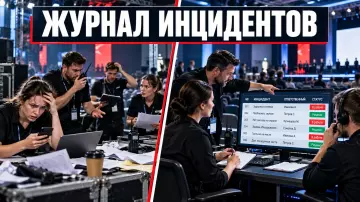
The command centre manages group release and return
On the day of the event, a single command centre links production, the programme and services. The team can see the readiness of each wave, the release of people from their posts, route delays, how full the zones are, and the return of employees. The shift manager only needs one confirmation through an agreed channel. They don't have to call several contractors in a row before sending a group.
The minimum size of the command centre depends on the scale, but the functions are usually as follows:
- the project manager makes overall decisions;
- the dispatcher keeps the log and wave statuses;
- the production representative confirms that release is permitted;
- the route coordinator tracks the movement of groups;
- the programme representative reports the readiness of the venue;
- the technical manager is responsible for equipment;
- the service coordinator oversees registration and catering;
- occupational health and safety and the venue's services make decisions within their remit.
The working cycle is repeated before each wave.
- Production confirms the people and replacements at critical posts.
- The event zone reports that the programme and services are ready.
- The command centre authorises the release of the group or moves it to a backup window.
- The coordinator receives the wave en route.
- During the programme, the command centre records delays and changes.
- Before the end, production confirms it is ready to take employees back.
- The coordinator marks the return and hands open issues over to the next command centre shift.
Messages by radio or phone must contain the fact and the required action. The phrase "the third group is delayed" doesn't help. A working message names the wave, the location, the reason within permitted limits, and the decision required from the recipient.
The full map of roles and communications is in the article about the event command centre and radio communication. For a shift-based project, we add group release and return statuses to the usual log.
Accessible package for absentees
A recording does not replace participation, but it helps employees who could not be released in any wave. Such a package must be self-contained: a short video, a text summary, subtitles, a description of meaningful visual information, speakers' materials and the same question channel. A raw three-hour recording shifts responsibility to the viewer and rarely solves the problem.
W3C recommends planning accessibility for meetings and media in advance. In practice, we check the full journey: invitation, entry, programme, catering, question, break and receiving the outcomes. An employee may need a seat, a written way to respond, extra time or an alternative role in an activity. It is better to collect the necessary participation condition in advance without unnecessary medical details.
We produce the package for absentees using the same logic as the waves:
- the same mandatory core;
- a clear viewing deadline;
- the opportunity to ask a question;
- an answer owner;
- confirmation of review, if the employer needs it;
- the next step after the material.
If part of the team works without constant digital access, we prepare an offline version: a printed summary, a screen in the break room, a short briefing by the manager using the approved text, or a designated viewing point. The channel must not change the meaning of the message.
What to check at the rehearsal?
The rehearsal must follow the real schedule of at least one wave. The team starts by confirming critical posts, releases a test group, goes through registration, the programme and catering, then returns people along the working route. A tabletop discussion does not show the queue at the checkpoint, the time for changing clothes and the conflict over the service lift.
We carry out the check sequentially.
- The shift manager confirms the test composition and the reserve.
- The control centre checks communication and declares the zone ready.
- The group goes from the work post to registration.
- The coordinator measures bottlenecks without speeding up the procedure for the sake of the test.
- The programme starts according to the module passport.
- A participant asks a question that requires checking after the wave.
- Catering is provided in the planned window.
- One employee receives an urgent call back to the workplace.
- The group returns, and the control centre records the status.
- The next control centre team takes over open tasks according to the log.
After the rehearsal, we do not limit ourselves to the phrase "everything went well". Each remark has a location, an observed fact, an impact, an owner and a deadline for re-checking. If the journey takes longer than planned, we reduce the programme or the size of the wave. Time cannot be deducted from shift handover and employee rest.
We test the late group separately. The venue, team, food and materials must remain at the same level of quality. If contractors have calculated their resources only for the first half of the day, this will be discovered before the event.
Client's checklist before launch
A project is ready to launch when production, HR, the organizer and the venue's services have confirmed the same plan. It contains no unknown number of participants, no verbal promise to "let people go somehow", and no separate simplified program for the night shift. All waves are tied to stations, routes, service and the overall content.
Production
- critical stations and minimum staffing confirmed;
- permissible output calculated for each shift;
- replacements and the emergency return rule are assigned;
- the program does not interfere with shift handover and work operations.
HR and legal
- the status of each part of the program is defined;
- time tracking and compensation are agreed;
- the invitation reflects the actual level of obligation;
- schedule changes follow the employer's current procedure.
Venue and safety
- routes do not cross hazardous zones and do not block evacuation;
- installation, equipment, catering and cleaning have separate time slots;
- the venue's services have carried out an inspection;
- participants have clear restrictions and alternatives.
Program and service
- the substantive core is the same for all waves;
- managers and hosts are allocated according to the schedule;
- registration, catering and materials are prepared by group;
- a shared issue log is in place;
- the package for those absent has an accessible format.
Management
- the command center knows the output and return statuses;
- communication has been tested;
- a backup wave is included in the schedule;
- a rehearsal has been held along the actual route;
- issues are closed before the first group opens.
The shift-based format requires more repetitions, but gives the client a manageable plan. We preserve the work process, and employees receive comparable participation regardless of the time of their shift.
Frequently asked questions
A single shared slot requires pulling people out of work areas all at once, even though some stations must remain staffed. Even if the venue can hold the entire team, production may not be able to sustain such an output. The second problem is timing: an additional program after a shift doesn't suit everyone. An invitation on a day off also raises questions about whether participation is mandatory and how time is recorded.
First, we calculate how many people can be released for each wave without losing process control. Shift names and total headcount alone are not enough for this. We mark critical stations, minimum staffing, handover times, travel time, backup for replacements and the moment when an employee must return to the work area.
Equivalent waves give each shift the same substantive core, access to managers, service and a way to ask a question. They may differ in timing, the line-up of hosts or the length of transitions, but they must not turn into an "main" and a "leftover" version. For each wave we set the same mandatory outcomes and check them after the route is completed.
The substantive core holds the meaning of the program together across waves. It includes the management address, key facts, participation rules, discussion questions, award criteria and next steps. Everything that affects an employee's decision or their understanding of the task must be the same for the first and the last group.
Before invitations go out, you need to determine the status of participation, permissible windows, time-recording rules and restrictions for specific groups of employees. The organizer does not resolve employment matters on the employer's behalf. We compile a list of contentious points, and HR, occupational safety, the legal department and department heads confirm the working scheme.
We lay the event route alongside production while keeping its normal operations running. On a single plan we combine work flows, participant movement, equipment, catering, sanitary areas, evacuation routes and return points. Where routes cross, we change the location or time of the block. The existing process must not be restructured on the installation day.
If you need to build a program around an existing schedule, submit a request via the form. At Aventura, we will calculate the waves, routes, service and command-center operations together with the production team.
Sources
- Russian Ministry of Labour: business programme of the 2026 Russian Occupational Safety Week (VNOT)
- Outcomes of VNOT-2026 on the Ministry of Labour website
- HSE: managing the risk of fatigue
- HSE: shift handover communication
- European Agency for Safety and Health at Work: the impact of shift work on health
- ILO: working time, health and safety
- W3C: accessible meetings and conferences
- Russian Ministry of Emergency Situations: safety at events with large crowds
- Rospotrebnadzor: catering arrangements for off-site service
- GOV.UK: compensatory rest for shift work
- Acas: rules on night work
Contents
Was this article helpful?