Practical plan for HR and internal communications: how to organize a family Open Day at an enterprise around a clear route and safe program.
Why hold an Open Day for employees' families?
In short: An Open Day for employees' families helps show loved ones where and on what the team works, in a clear and manageable format. For an enterprise, this is not a replacement for the tour mode and not a reason to open all areas. It is a pre-agreed route, several human stories about professions, and a family part outside the production zone.
Such an event is especially appropriate when it is important for the company to explain a complex product in simple words, support respect for professions, or bring together employees from different shifts around a common occasion. In published cases, industrial companies combine a tour of selected points with interactive activities, a museum, a master class, or a family zone. The general logic here is clear: production remains the main content, and the family gets time to ask questions and see the work of a loved one in context.
It is better to formulate the goal before choosing entertainment. For example: introduce families to the enterprise's professions, show the path of a product from blank to finished product, or give employees an opportunity to talk about their role. Such a framework helps avoid turning the program into a random set of activities. The approach to the goal and audience will also be useful when organizing a corporate event.
What approvals are needed before inviting guests?
In short: first the possibility of a visit is approved, and only then the announcement is written. The route, age restrictions, group composition, PPE, photo policy, access control procedures, and access boundaries must be approved by production, occupational safety, industrial and facility security, the access control service, and HR. The decision for a specific site is made by the enterprise itself according to its own local rules.
You shouldn't transfer rules from someone else's case to your own site. At one plant, an observation gallery is safe; at another, only a museum or training area is accessible. If safe observation of the process cannot be ensured along the route, the section is replaced with a model, video, demonstration in a training classroom, or an employee's story. The family format does not justify bypassing established restrictions.
It is useful to immediately assign an owner for each decision. HR is responsible for communication and registration, the production representative for the content of the route, the security service for access conditions, and the event producer coordinates timing, navigation, and the work of all zones.
The table summarizes the key points of the section: Question, What to approve, Who confirms. Use it as a quick guide when preparing the event.
| Question | What to approve | Who confirms |
|---|---|---|
| Guest access | Age, group composition, time slots, access control procedure | Facility access control and security |
| Route | Stop points, access boundaries, backup version | Production and occupational safety |
| Equipment | Required PPE and issuance procedure | Occupational safety and site supervisor |
| Filming | Permitted zones, photo publication, photographer work | Access control service and communications |
| Family zone | Location, food, activities, and accessibility | HR and event producer |
Submit a request - let's discuss your task
We'll clarify the event format and suggest the next step.
In the Telegram channel "Aventura" we discuss business and corporate events - from the first idea to the day of the event.
How to Build a Route Through an Enterprise?
In short: a good route consists of several short stops, each with one clear question. The guest should understand what is happening here, what role the employee plays, and how this part relates to the product. The route should not take visitors to places that cannot be safely controlled.
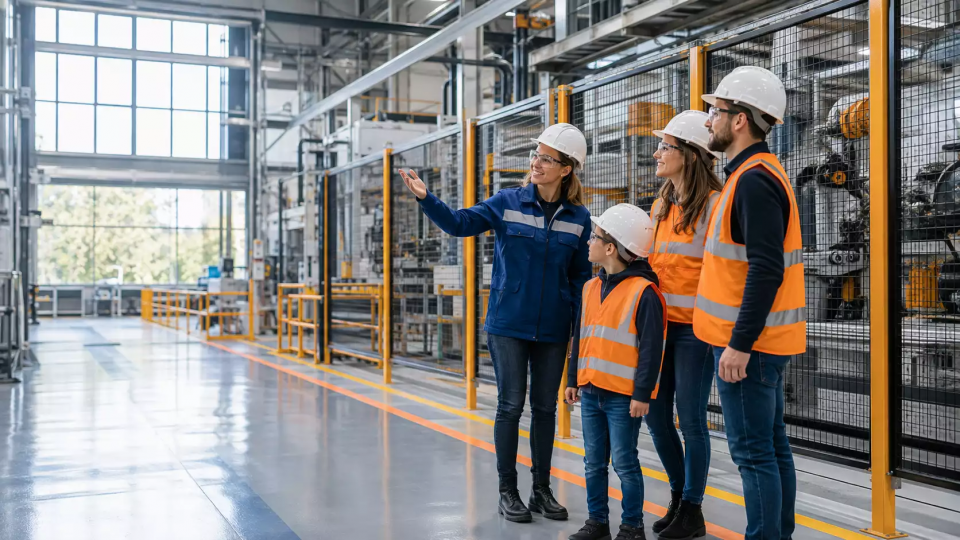
Start with a safe starting zone: registration, greeting the group, issuing approved equipment, and a short briefing in language that both children and adults understand. Then choose three or four points. A convenient narrative structure is built from the general to the specific: what the enterprise does, how the product is created, what work people perform, and what happens next to the finished product.
In the cases of the «Transformer» and UZPA plants, the tour logic is based on the product's journey and getting acquainted with work roles. This is a good reference point for the script, but the composition of the route always depends on the current restrictions of a specific site. Do not promise guests they will «see the whole plant» if only certain zones are open.
- Prepare a card for each stop: topic, duration, speaker, approved point for the group, and a way to show the process.
- Walk the route together with the area supervisors before registration opens.
- Check the transitions: where the group waits, who opens the passage, what happens in case of a delay, and where guests go if the program changes.
- Create a backup route for bad weather, equipment stoppage, or production needs.
- Give the escort the right to skip a stop if conditions on site have changed.
For a large flow, it is better to use slots and small groups rather than gathering everyone at one line. Manageability is more important than scale: visitors should hear the speaker, see the route boundaries, and stay close to the escort.
How to explain manufacturing to children and adults?
In short: tell the story through the product, the profession and a specific task, rather than through a stream of terms. It is easier for a family to remember a simple answer: what the enterprise produces, how the item comes to be, and what the person does at that stage. Technical depth is reserved for the places where it genuinely helps to understand the process.
It is useful to collect short stories from employees in advance. One shows how quality is checked, another explains the role of an engineer, and a third links the work of a section to the finished product. Such material must not reveal technological secrets, documents or information that the enterprise is not ready to show. The boundaries of the content are fixed before the rehearsal.
Instead of a long lecture, use an object, a safe sample, a screen in the training area or a pre-recorded video. At a production site, this is often clearer than trying to stop the group near operating equipment. If the program includes an employee's workplace, agree on exactly what can be shown and told.
The program becomes stronger when a family guest sees the connection between the profession and the result. For the company, it is also a chance to support a conversation about working professions without advertising promises. The practices gathered in the article on professional skills competitions will help highlight the professional side of such a story.
What program works outside the workshop?
In short: after the production tour, the family needs a calm block outside the workshop. Here you can gather a Q&A session, a workshop, a museum part, an interactive about professions, or a photo zone in an approved area. Such a zone gives guests time together, and allows organizers to avoid prolonging visitors' stay in production.
At First Bakery, the tour for employees' children was supplemented with a creative workshop and treats. At «Power Machines», the family day had separate zones with activities. These examples are useful as ideas, not as a ready-made scenario: the specific set of activities is chosen based on the age of guests, venue, budget, and corporate culture.
Build the program around one theme related to the enterprise. If the company produces a complex technical product, you can hold a laboratory on materials or engineering. If the history of the enterprise is important, a museum station with tasks for families will work. The game part does not have to be noisy: sometimes a short quest with questions along the route and a conversation with employees works better.
Important: children's activities, food, and the photo zone must be located in an approved area. Do not transfer game mechanics into the production route if it interferes with group discipline or distracts from safety rules.
What roles are needed on the day of the event?
In short: each part of the program should have one person responsible, and each group should have an escort. The production speaker is responsible for the content, but is not obliged to simultaneously keep track of latecomers, issue badges, and solve technical issues. Dividing roles helps maintain the rhythm and not distract the employees of the area.
The minimum team includes a client representative from HR or internal communications, an event producer, a registration coordinator, a production representative, a person responsible for labor protection or route safety, group escorts, and a family zone coordinator. For the photographer and videographer, approved work points are set in advance. If filming is restricted, this rule is announced to guests before the start of the route.
The scenario needs not only speaker appearances but also transitions. Who meets the next group? Who checks the list before entry and after exit? Where do guests go if the tour is delayed? How to keep children occupied while adults receive equipment? These details reduce the load on the production team on the day of the event.
The logic of role distribution can also be used when organizing a business event: first the owner of the result, then the scenario, venue, and operational control.
How to prepare communications and registration?
In short: the invitation should honestly explain the format and restrictions. Guests are informed in advance of the time slot, meeting point, duration, dress code, age conditions, photo rules, and the possibility of route changes due to production needs. Registration is needed not only to count guests but also for controlled access.
Create separate messages for employees and for guests. It is important for an employee to understand how to register their family and whom to ask an organizational question. A guest needs a simple route: where to come, what to bring, when the visit will end, and why some areas may be inaccessible. Promise only what has been confirmed by all departments.
Before the event, hold a short rehearsal with the escorts. Go over the movement rules, phrases for explaining restrictions, gathering points, and actions in case of timing changes. The wording “today we will show the agreed areas” is more honest and reassuring than a broad promise of full access.
After the event, send participants the permitted materials, a thank-you note, and a short feedback form. Ask what was clear, which professions they wanted to learn more about, and where it was difficult to navigate. The answers will help improve the next route rather than become a formal evaluation of the company's employees.
What mistakes most often break the family format?
In short: problems arise when the entertainment part is prioritized over the agreed route, groups are too large, or access rules are left to the last day. The most important decisions are made before the announcement: who can come, where guests can be taken, how the group moves, and who is responsible for each transition.
A common mistake is making the program the same for toddlers, teenagers, and adults. It is better to separate flows by time slots or give each age group a separate task in the family area. Another mistake is asking an employee to improvise at the equipment without preparation. The speaker needs a short script, clear boundaries, and the right to pass a question to a specialist.
Do not put a photographer in front of the production team as a fait accompli. Photo and video mode is agreed in advance, permitted locations and publication procedure are determined. If guests cannot take photos on the route, create a good photo zone outside the production area. Then you won't have to argue with the rules on the day of the event.
The finale should also be manageable: return of equipment, organized exit, group check, and a short wrap-up in the family area. If a company needs help with the concept, route, navigation, and operation of all zones, the Aventura team will prepare an estimate for the task and the limitations of your site.
Frequently Asked Questions
Such an event is especially appropriate when a company needs to explain a complex product in simple terms, foster respect for professions, or bring together employees from different shifts around a common occasion. In published case studies, industrial companies combine a tour of selected locations with interactive activities, a museum, a workshop, or a family zone. The overall logic is clear: production remains the main content, while the family gets time to ask questions and see their loved one's work in context.
Don't transfer rules from someone else's case study to your own site. At one plant, an observation gallery is safe; at another, only a museum or training area is accessible. If safe observation of the process cannot be ensured along the route, the area is replaced with a model, video, demonstration in a training classroom, or an employee's story. A family format does not justify bypassing established restrictions.
Start with a safe starting zone: registration, group welcome, distribution of permitted equipment, and a short briefing in language that both children and adults understand. Then choose three or four stops. A convenient narrative structure is built from general to specific: what the enterprise does, how the product is created, what work people do, and what happens next to the finished product.
It is useful to prepare short employee stories in advance. One shows how quality is checked, another explains the role of an engineer, a third connects the work of a section with the finished product. Such material must not disclose technological secrets, documents, or information that the enterprise is not ready to show. Content boundaries are set before the rehearsal.
At Pervy Khlebozavod, the tour for employees' children was supplemented with a creative workshop and refreshments. At Power Machines, the family day included separate zones with activities. These examples are useful as ideas, not as a ready-made scenario: the specific set of activities is chosen according to the guests' age, venue, budget, and corporate culture.
The minimum team includes a client-side representative from HR or internal communications, an event producer, a registration coordinator, a production representative, a person responsible for occupational health and safety or route safety, group escorts, and a family zone coordinator. For the photographer and videographer, permitted shooting locations are set in advance. If filming is restricted, this rule is announced to guests before the route starts.
Sources
- ODK-Klimov: Family Day for employees' relatives
- VOLMA: factory tour for employees' children
- Transformator Plant: tour for employees' children
- UZPA: tour for employees' children and new team members
- First Bakery: tour for employees' children
- Gostol TST: Open Day for employees' family members
- Open Industry: organization and safety of industrial tourism
- ConsultantPlus: labor safety rules for work at height
Contents
Was this article helpful?