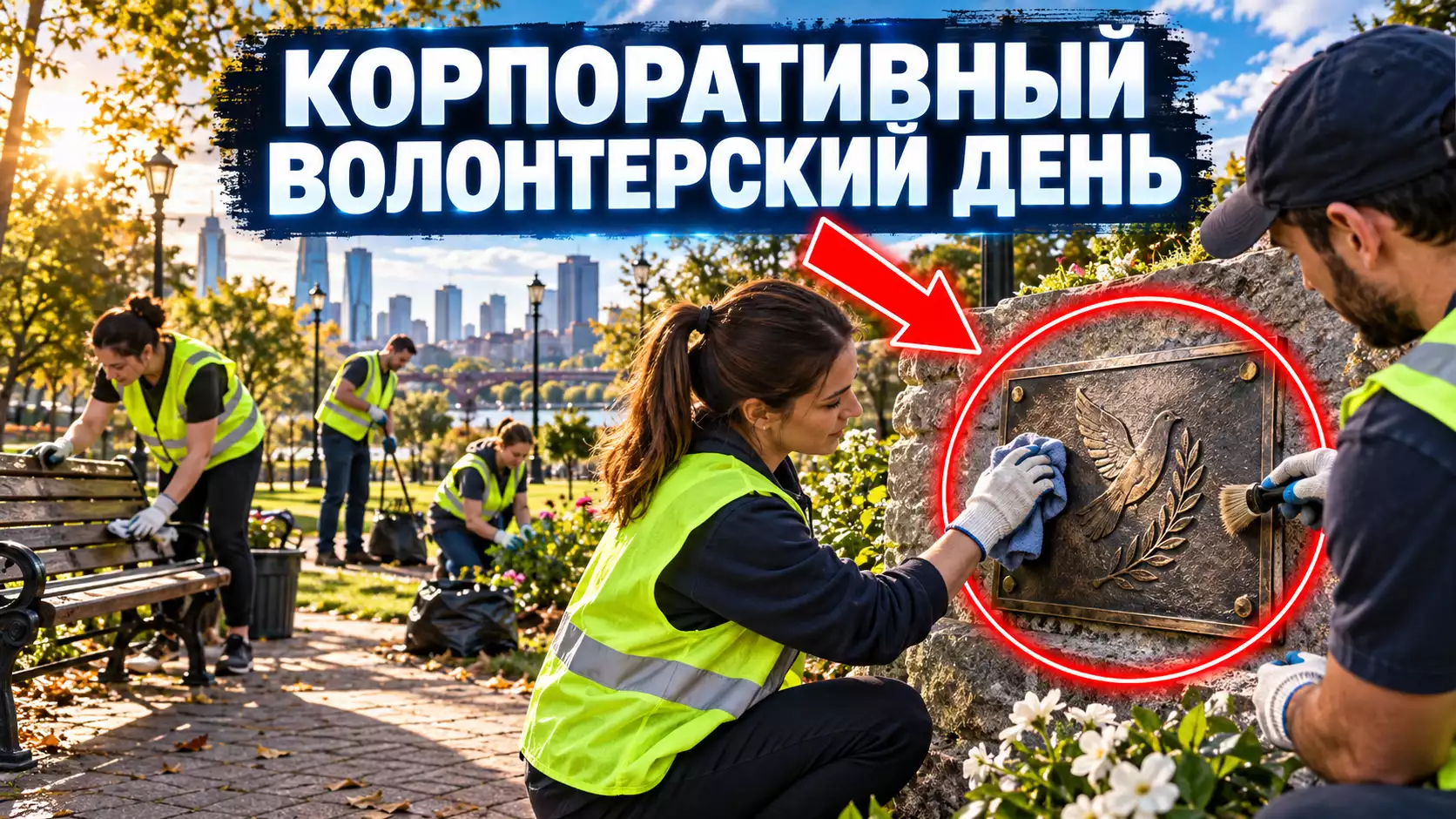
A corporate volunteering day starts with a useful task and employees' voluntary choice. We break down the program, roles, safety and metrics.
A corporate volunteering day is easy to ruin with good intentions. A company comes up with a beautiful campaign, gathers people, buys materials — and only then asks the partner organization whether such help is needed. At Aventura, we start with the useful outcome and the recipient's constraints. The event program comes later.
What is a corporate volunteering day?
In short: A corporate volunteering day is organized employee participation in a socially useful task with the employer's support. Participation remains voluntary, and the content is determined by the real need of the partner nonprofit organization or community. The event team is responsible for a clear program, logistics and safe conditions, but does not replace the specialist partner.
The Federal Law on Charitable Activities and Volunteering ties volunteer activity to voluntary and unpaid performance of work or provision of services. For a corporate program, this is a practical boundary. A manager's order, a mandatory list of departments and a loyalty assessment for refusing destroy the meaning of the format.
One day is suitable for specific work with a clear handover of the result. This could be assembling kits according to the partner's specification, improving a prepared area, sorting materials, helping at a community event or providing professional consultation. A single campaign does not solve a systemic social problem.
First, agree on a useful task
In short: First, the partner describes the need, the recipient, the constraints and how the work will be accepted. The company checks the task against its resources and employee interest. The organizer translates the agreements into a route, roles, a technical plan and a budget. This sequence protects the project from unwanted outcomes and last-minute emergency purchases.
At the first meeting, we ask the partner simple questions: what needs to be achieved by the end of the day, in what form, who will check the quality, where the result will be stored and what will happen to it next. If the answer is still general, it's too early to turn the mechanics into a program.
A useful task is checked against four criteria:
- the partner confirms the need and is ready to accept the result;
- the work can be safely divided between groups;
- quality can be checked on site;
- there is a clear next step after the event.
A beautiful shot is not a criterion of usefulness. For example, planting plants requires an agreed plot, suitable species, watering and ongoing care. Without an owner of the result, the day ends before the benefit begins.
How to keep participation voluntary?
In short: Give the employee a clear description of the task, time, physical exertion, site conditions and role options. Registration should confirm a free choice. A manager can explain why the company supports the project, but does not link participation to performance evaluation, a bonus or attitude toward the employee. Refusal does not require a public explanation.
The invitation answers five questions: whom we help, what exactly we do, how long the shift lasts, what restrictions there are and how to decline. The wording 'five people from each department' looks convenient for a spreadsheet, but creates pressure within departments.
Offer several roles. One participant works with their hands, another keeps records, a third assembles materials while seated, a fourth helps with navigation. Such a choice expands participation and gives the employee a fair opportunity to assess the load.
If you need to combine the partner's task, registration, roles and the site in one plan, request a quote from us. In your first message, specify the city, approximate number of participants and the desired type of help.
We publish practical case studies of corporate events in Aventura's Telegram channel. There we analyze programs, venues and work with participants.
Partnership with NGOs and boundaries of responsibility
In short: The partner NGO is responsible for the social mission, the requirements for the outcome, and respectful interaction with beneficiaries. The company defines resources, internal rules, and communication with employees. The organizer brings together the venue, flow, equipment, and coordination. Responsibilities are fixed before the announcement so that a disputed issue is not resolved in a working slot.
We draw up a short role matrix. It includes the owner of each task, the deadline for a decision, and the communication channel on the day of the event. Separately, we set out who approves materials, who delivers the introductory briefing, who accepts the finished work, and who can stop the process.
The table summarises the key points of this section: Question, Partner NGO, Company. Use it as a quick guide when preparing the event.
| Question | Partner NGO | Company | Organizer |
|---|---|---|---|
| What kind of help is needed | formulates the need | checks it against the program goals | translates it into the event format |
| Who takes part | describes the limitations | invites employees on a voluntary basis | builds registration and flows |
| How the work is checked | sets the acceptance criteria | appoints the owner of the outcome | sets up a checkpoint |
| What to do in case of a failure | confirms a safe replacement | makes the decision on resources | launches the backup scenario |
The NGO should not suddenly become a supplier of staging, catering, and transport. The event team does not make substantive decisions on behalf of the specialized partner. This boundary saves time and preserves trust.
How do you put together a one-day program?
In short: A working program consists of a short introductory brief, several slots, transitions, a quality check and the handover of the result. The duration is set by the slowest operation, and the group size by the capacity of the tightest zone. Add time for questions and a buffer. Keep the manager's general speech short so that people have time to do useful work.
Below is a sample grid for one wave. The times serve as a starting point and change after the operation is tested together with the partner.
The table brings together the key points of the section: Block, Time, What happens. Use it as a quick guide when preparing the event.
| Block | Time | What happens | Checkpoint |
|---|---|---|---|
| Introductory brief | 10 minutes | task, boundaries, safety, roles | the group understands the result and the stop signal |
| Work slot 1 | 35 minutes | performing the operation according to the instructions | the coordinator checks the first units |
| Transition | 10 minutes | changing roles, replenishing materials | aisles are clear, records updated |
| Work slot 2 | 35 minutes | continuing work or a new operation | defects separated, results counted |
| Handover | 15 minutes | the partner accepts the work | actual volume and next step signed off |
| Debrief | 10 minutes | questions, feedback, further contact | participants know what will happen after the day |
Before a large launch, run a test with a small group. It shows the real speed, awkward movements, material consumption and the place where a queue starts to build up.
Roles, route, and site safety
In brief: An event needs one leader, coordinators for work zones, a partner representative, a safety officer, and a person who tracks materials and the actual scope. The route is checked from unloading to removal of the result. For each operation, set a group limit, protective equipment, a stop criterion, and a safe reserve.
The HSE advises scaling the plan to the event's size and risk level, appointing responsible people, and preparing incident response actions in advance. In practice, we include safety in each zone's card rather than putting it in a general document that no one opens during work.
Check the site as part of the workflow:
- separate pedestrian traffic from unloading and vehicles;
- secure structures and protect cable runs;
- label materials and defect areas;
- keep exits and access to first aid clear;
- designate a stop signal and the person who makes the decision;
- prepare a replacement operation for weather, breakdown, or material shortage.
The overall outline can be checked against our article on event safety. We covered the decision matrix for failures separately in the event crisis plan.
What should be provided for accessibility and filming?
In brief: Collect participants' needs before the event and offer equivalent roles with different levels of physical exertion. Check the accessible entrance, route, restroom, rest area, audibility, and clarity of instructions. Agree photo and video rules with the partner in advance. Beneficiaries and their stories do not automatically become background for a corporate report.
W3C recommendations for accessible events suggest communicating requirements to speakers and organizers in advance, using clear materials, and accommodating different ways of participating. For a volunteer day, this means a large diagram of the operation, a demonstration of the action, written instructions, and the option to do the work while seated.
The filming map is divided into three zones: free filming of employees with the necessary consents, filming only with permission, and a no-camera zone. The Federal Law on Personal Data sets the general framework for data processing. The specific legal basis and consent form are determined by the responsible parties at the company and the partner NGO.
Do not ask participants to post photos as proof of loyalty. It is better to provide a ready set of facts about the work completed and approved footage after the result has been accepted.
Metrics without pretty empty numbers
In short: Count the path from registration to an accepted result. The number of applications shows interest, attendance shows organisation, the completed volume shows the day's work, the partner's acceptance shows quality. Separately record safety, accessibility and the intention to take part again. A single campaign does not prove growth in engagement, an improved reputation or the solution of a social problem.
The table brings together the key points of the section: Level, Metric, What it shows. Use it as a quick reference when preparing an event.
| Level | Metric | What it shows | What it does not prove |
|---|---|---|---|
| Interest | registrations and role selection | clarity of the invitation | actual participation |
| Participation | attendance and completed slots | how the programme worked | usefulness of the result |
| Result | volume accepted by the partner | the task of the day completed | long-term social impact |
| Quality | returns, defects, stoppages | stability of the process | absence of all risks |
| Continuation | requests for the next step | readiness of part of the team | loyalty of all employees |
Before the announcement, agree on the units in which the partner will accept the result. “A lot of useful work” is not suitable for a report. Specific units of the task itself will work: accepted kits, processed applications, prepared materials or consultation hours. The partner sets the number and the method of accounting, and the final result is published after verification.
For a general event report, use our framework for assessing the effectiveness of a corporate event. Do not mix event metrics with the long-term evaluation of a corporate social responsibility programme.
Result and next step
In short: A volunteer day ends with acceptance of the work, thanks to the participants, and a clear follow-up. The partner reports what has been accepted and what will happen next. The company collects feedback without pressure. The organizer records actual throughput, material consumption, failures, and solutions. This data makes the next project more precise.
After the event, close out five actions:
- hand over the result to the partner and record acceptance;
- report the actual outcome back to participants without exaggeration;
- pay and close obligations to the venue and contractors;
- review stoppages, defects, and inquiries;
- assign an owner for the next contact with the partner.
At Aventura, we can build a volunteer day as a full-fledged corporate event: from a briefing with the partner and registration to routes, a technical plan, and venue coordination. The substantive task and rules for working with beneficiaries are confirmed by a specialized NGO.
Frequently asked questions
The Federal Law on Charitable Activities and Volunteering ties volunteer activity to voluntary and unpaid performance of work or provision of services. For a corporate program, this is a practical boundary. A manager's order, a mandatory list of departments, and loyalty assessment for refusal destroy the meaning of the format.
At the first meeting, we ask the partner simple questions: what needs to be achieved by the end of the day, in what form, who will check the quality, where the result will be stored, and what will happen to it next. If the answer is still general, it is too early to turn the mechanics into a program.
The invitation answers five questions: whom we are helping, what exactly we are doing, how long the shift takes, what restrictions there are, and how to decline. The wording “five people from each department” looks convenient for a spreadsheet, but it creates pressure within departments.
We create a short role matrix. It includes the owner of each task, the deadline for resolution, and the communication channel on the day of the event. We separately record who approves materials, who conducts the introductory briefing, who accepts the completed work, and who can stop the process.
Below is an example schedule for one wave. The time serves as a starting point and changes after testing the operation together with the partner.
HSE advises matching the plan to the scale of the event and the degree of risk, appointing responsible people, and preparing incident actions in advance. In practice, we include safety in the card for each zone rather than putting it in a general document that no one opens during the work.
A volunteer day also works as a team format: a shared cause brings departments together no less than classic team building.
To discuss a program for your team, request a quote from us. Just specify the city, number of participants, the desired area of assistance, and a possible partner.
Sources
- Federal Law No. 135-FZ on Charitable Activities and Volunteering.
- Federal Law No. 152-FZ on Personal Data.
- Dobro.University: Corporate and Social Volunteering.
- W3C WAI: Accessibility of Meetings, Training, and Presentations.
- HSE: Getting Started with Event Safety Planning.
- CyberLeninka: Corporate Volunteering as a Tool for Internal and External Communications of an Organization.
Contents
Was this article helpful?