An event's crisis plan assigns decisions before the doors open. We break down thresholds, roles, backup communications and the team's order of actions when something fails.
A failure rarely gives you a convenient heads-up email. A speaker is late, the internet drops, the queue grows, and the team has only a few minutes to decide. At Aventura, we prepare Plan B together with the scenario: we identify in advance the signs of a failure, the authority, the backup actions and the wording for guests. That way the team acts on site without arguing over the basics.
At Aventura, we regularly write about preparing business and corporate events.
Why does an event need a separate Plan B?
In short: Plan B is needed for disruptions that change the program, route or service but do not always become an emergency. It connects an observed fact to a decision and team action. It also sets out the text for guests and the condition under which the event returns to the main program.
Emergency procedures at the venue and the event's operational reserve serve different purposes. In the event of a fire, a medical incident or another threat, the team follows the instructions of the responsible specialists and emergency services. If a speaker is delayed, a screen fails or registration is overloaded, the organizer adjusts the program within pre-agreed authority.
We do not combine everything into one scary list. Plan B is useful when a regular coordinator understands the boundary: this disruption can be handled on our own, here we call the venue manager, and here we stop the program and follow the safety procedure.
Decision thresholds before the doors open
The basis of the plan is an observable sign of a disruption instead of a general 'if something goes wrong'. For each risk, write down how long we wait for confirmation, who makes the decision and what we do if the time runs out. The exact threshold depends on the program, the venue, the contract and the importance of that part of the program. The wording must be clear to the entire working team.
For practical purposes, it is convenient to divide situations into three levels.
The table brings together the key points of the section: Level, Impact on the event, Who decides. Use it as a quick reference when preparing an event.
| Level | Impact on the event | Who decides | Typical action |
|---|---|---|---|
| Green | the guest does not notice the change | coordinator of their area | replace a cable, open a second desk, hand over a spare presentation remote |
| Yellow | the schedule or route changes | project manager | activate the agreed reserve and inform affected participants |
| Red | there is a threat to people, control over the venue has been lost or an instruction from the services has been received | person responsible for the venue procedure | stop the regular program and switch to the safety procedure |
Do not copy someone else's minutes and limits. At a closed meeting, a five-minute delay may go unnoticed. In a live broadcast, the same interval will require prepared content and a message to viewers. The threshold must be clear to the person observing the situation.
Who makes the decision when something goes wrong?
The working scheme is simple: one person gathers the facts, one makes the final decision, designated executors change the program, and a separate coordinator informs the guests. Every key role needs a deputy. If authority is divided between the client, the venue, and the contractor, the boundaries are fixed before setup. The scheme is confirmed at a general team meeting.
The project manager doesn't have to switch equipment himself or meet a late speaker. His job is to see the big picture and choose an agreed-upon option. The technical director is responsible for the system's functionality. Coordinators manage their own zones.
The client's representative confirms decisions that affect content, reputation, or additional costs.
For safety matters, the final say is determined by current requirements, the venue's documents, and the responsible specialists. The organizing team does not replace the venue's security service or emergency services.
If you're preparing a large forum, this scheme should be fixed already in the technical specification for a corporate forum. Then roles and backup are included in the agreements before contractors are selected.
Role matrix and a single communication channel
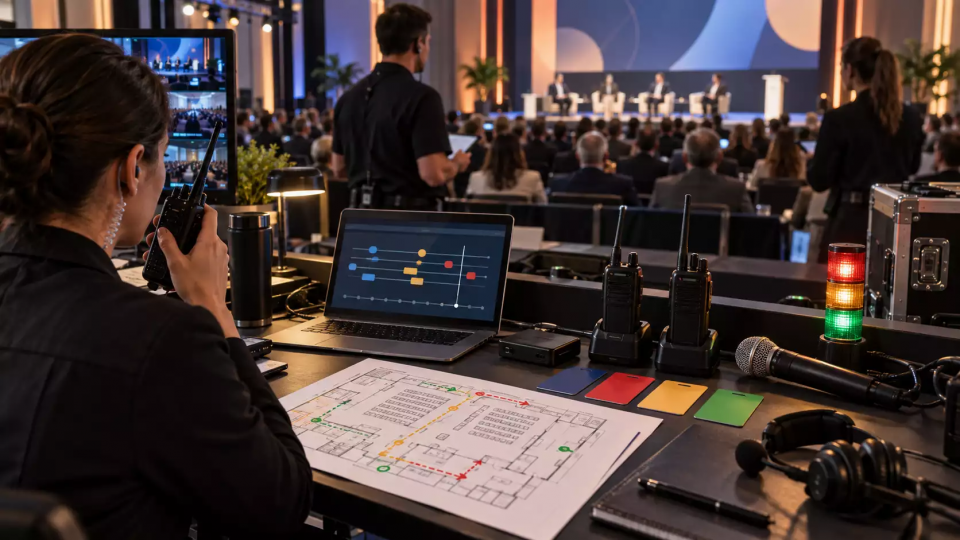
The working map shows who is notified of a failure. It also indicates who makes the decision and passes it on to the team. There must be one channel for decisions on site and a separate method of communication in case the main service is unavailable. This map is fixed before setup begins and checked with the venue.
The minimal map includes five functions:
- Observes. The zone coordinator reports only verified facts: location, time, scope, and current impact.
- Decides. The project manager chooses the main or backup scenario within their authority.
- Executes. The technical, venue, or program team carries out a specific command.
- Informs. The communications lead conveys the same information to guests via the host, screen, mailing, or staff.
- Records. The headquarters secretary keeps a short log of decisions and times.
In the work chat, pin the list of roles, zone names, and backup contacts. Personal numbers are not published in the guest program. If the messenger fails, the team switches to a pre-selected backup channel. New chats at the moment of failure will only split the information.
Subscribe to Aventura's Telegram channel, if you want to receive new practical materials about the program, venue, and technical preparation.
Which scenarios should be prepared in advance?
You don't need to describe every possible disaster. Choose the failures that are likely for this particular event or that strongly affect people, the program and the outcome. For each scenario, fill in five lines: the sign of failure, the solution, the action, the message and the condition for returning to the main program. Save the result in a separate risk card.
The table summarizes the key points of the section: Situation, Working backup, Who confirms the switch. Use it as a quick reference when preparing the event.
| Situation | Working backup | Who confirms the switch |
|---|---|---|
| speaker is delayed | the order of blocks changes, the host receives a new transition | program manager |
| the main screen fails | the material is displayed from a backup computer or the block runs without slides | technical director |
| the queue at the entrance grows | an additional check point opens, the flow is split across zones | registration manager |
| part of the venue is unavailable | guests receive a new route and clear navigation | venue manager and project manager |
| online platform failure | a backup link or a pre-recorded block is activated | technical host |
| contractor is not ready on time | the zone opens later, is replaced or excluded after assessing the impact on adjacent work | project manager |
The list changes depending on the format. For the opening of a production facility, access, the route and the restrictions of the site are important. It is better to check them against a separate analysis of the scenario and safety of a factory opening. For an evening program, the risk of delays to artists, transport and setup is higher.
Technical backup without unnecessary complexity
A backup only works after a real test. A spare laptop without the right file, mobile internet without coverage, and a second microphone without a charge create the appearance of readiness. The team must know where the backup is, who turns it on, and how many steps it takes to switch over. The switchover itself is tested under the conditions of the chosen venue.
For a presentation, we check the source file, fonts and video on the main and backup computers. Then we test the cables and the switchover to the backup itself. Streaming requires checking the network, sound, platform, backup link, recording settings, and the communication channel with remote speakers. Before recording, explain to participants what is being recorded and how the material will be used. Check the legal basis and required consents with the project's lawyer.
The U.S. National Institute of Standards and Technology (NIST) recommends using a one-time code, a waiting room, and participant control for sensitive online meetings. Access to screen sharing should also be restricted. In Plan B, specify who blocks an unauthorized participant, stops an incorrect screen share, or redirects viewers to the backup link.
For a distributed audience, use a separate checklist for a hybrid conference for branches. The online stream is assigned its own moderator. A person busy working in the hall will not be able to reliably manage both directions.
How to inform guests about changes?
A good message during a disruption has three parts: a confirmed fact, an action for the participant, and the time of the next update. There is no need to explain an internal dispute or look for someone to blame on the air. It is more important for the guest to understand where to go, what is happening with the program, and when new information will appear.
Prepare short templates for the host, screens, email communications, and staff. The wording must be consistent. If registration is delayed, one channel cannot promise a quick opening while another sends people to the neighboring entrance.
The UK Health and Safety Executive (HSE) states that a unified command center helps gather the overall picture and coordinate the actions of staff and external services. At a business event, this function can be performed by the project manager's desk with an up-to-date plan, log, and communications. The key condition is a single version of the decision.
Do not state an unverified cause. If there is no accurate data, say that the team is checking the situation and give the participant a safe action now.
Safety, accessibility, and the boundaries of the template
Plan B does not replace risk assessment, the evacuation plan, venue instructions, and legal requirements. A fire, security threat, or medical incident moves the team from the usual scenario to procedures of responsible specialists. These boundaries must be discussed with all coordinators before the venue opens. Special attention is required when changing the guest route.
HSE considers event management from the start of physical work at the site to the completion of dismantling. After significant incidents, the agency recommends conducting a debrief. We verify the fire safety section against the requirements of the specific venue, the venue's documents, and the responsible specialist. A universal template does not determine capacity, evacuation route, or composition of services.
Accessibility is also included in the backup. The World Wide Web Consortium (W3C) advises checking in-person, remote, and hybrid participation: the route to the venue, a microphone for questions, accessibility of materials, and perception of information. If the hall or entrance changes, the new scheme must take into account people with limited mobility, hearing or vision impairments.
Staff learn the assistance procedure in advance. Critical messages must be understandable to people with different ways of perceiving information.
The communication backup must also be accessible. A single voice announcement is not enough if some guests cannot hear it. Duplicate the critical message visually and through trained coordinators if this is consistent with the venue's plan.
How to run a Plan B rehearsal?
A rehearsal doesn't have to be long. Bring together the project manager, the venue, the technical team, the program and the client, pick a few of the most important scenarios and walk through the solution from the first signal to the message to guests. After each run-through, mark the unclear spot in the plan. Looking for someone to blame won't improve anything here.
The working order is as follows:
- The person leading the check names the observed fact without a ready-made solution.
- The zone coordinator passes the fact along the primary channel.
- The manager clarifies the missing data and announces the decision.
- The executors repeat their task to rule out differences in understanding.
- The person responsible for communication formulates the message to guests.
- The team switches the actual equipment or physically walks the new route.
- The secretary records the time, the gaps and the required changes to the plan.
Check the backups. Even the most carefully designed plan falls apart if the only person with the password, key or approval authority is unavailable.
Post-event debrief and updating the plan
At the wrap-up meeting, the team reviews the failure and updates the plan for the next project. Record the facts, the timing of decisions, the impact on the guest and how the backup performed. Separate the cause from the symptom: lost sound can be an equipment failure, a connection error, a power loss or an incorrect action. Changes are tested at the next rehearsal.
We hold a short debrief with the client and key contractors. First we reconstruct the timeline, then we note the successful actions and the gaps. After that, we assign a person responsible for each fix. They will update the brief, add a check, replace the communication channel or clarify the arrangement with the venue.
Don't judge the team only by whether the guests noticed the problem. Sometimes an unnoticed failure reveals a dangerous dependence on a single person or device. That dependence must be eliminated before the next event.
Plan B as part of the budget and scenario
A crisis plan for an event becomes workable when the backup is tied to the scenario and the technical brief. The necessary expenses are visible in the budget, and responsibilities are in the team map. The client understands which situations have been prepared in advance and where limitations remain. Unnecessary backups can be removed. The most important decisions are tested before installation.
Frequently asked questions
The venue's emergency procedures and the event's operational backup solve different tasks. In the event of a fire, a medical incident, or another threat, the team follows the instructions of the responsible specialists and emergency services. If a speaker is delayed, a screen fails, or registration is overloaded, the organizer reshapes the program within previously agreed authority.
The basis of the plan is an observable sign of failure instead of a general “if something goes wrong.” For each risk, write down how long we wait for confirmation, who makes the decision, and what we do if time runs out. The exact threshold depends on the program, the venue, the contract, and the importance of that part of the program. The wording must be clear to the entire working team.
The project manager is not required to switch equipment himself or meet a delayed speaker. His task is to see the big picture and choose an agreed option. The technical director is responsible for the system's operability. Coordinators manage their own areas.
The working map shows who is notified of a failure. It also indicates who makes the decision and passes it to the team. At the venue, there should be one channel for decisions and a separate method of communication in case the primary service is unavailable. This map is fixed before installation begins and checked with the venue.
There is no need to describe every disaster in the world. Choose failures that are likely for this specific event or that strongly affect people, the program, and the outcome. For each scenario, fill in five lines: the sign of failure, the decision, the action, the message, and the condition for returning to the main program. Save the result in a separate risk card.
A backup only works after a real test. A spare laptop without the necessary file, mobile internet without coverage, and a second microphone without a charge create an illusion of readiness. The team must know where the backup is located, who turns it on, and how many actions are needed to switch over. The switchover itself is tested under the conditions of the chosen venue.
At Aventura, we start with a brief and a risk map. Then we assemble the program, venue, equipment, and team. If you need to prepare a business, corporate, or client event, discuss the task and request a quote. In the request, it's enough to specify the format and the main concerns for the project.
Sources
- HSE: incident planning, managing an event and crowd flow control inside the venue
- NIST: protecting privacy in virtual meetings
- W3C: Making Events Accessible
- Bassetlaw District Council: structure of an event safety management plan
- ConsultantPlus: Fire Safety Regulations in the Russian Federation
Contents
Was this article helpful?