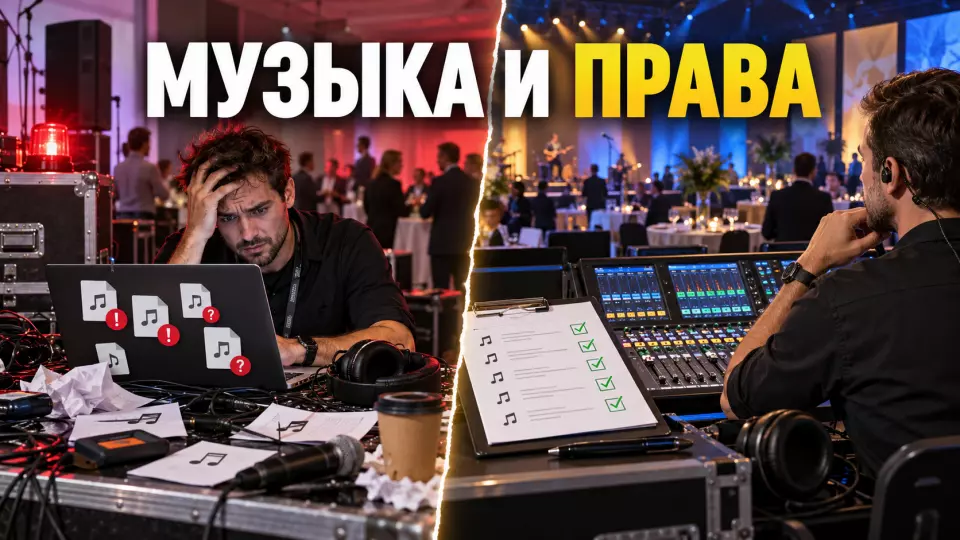
Music at a corporate event requires separate verification for the venue, the DJ, live performances, streaming and the final video. We break down the roles and the documents.
A music licence for a corporate event rarely comes down to a single contract. Background music plays in the lobby. Then the DJ starts the programme, the band uses backing tracks, and the video team adds a track to the final video. The phrase "rights included" explains nothing until the mode of use, the responsible party and the supporting document are named.
At Aventura we start with a map of music episodes. It shows where music plays, who turns it on, whether the sound ends up in the stream and the recording, who prepares the documents and who submits the actual report after the event. The legal conclusion on a specific repertoire and contract is confirmed by the client's specialised lawyer.
Leave a request - let's discuss your task
We'll clarify the format of the event and suggest the next step.
When does a corporate event require a music rights check?
A music license for a corporate event requires verification when protected music is played in front of guests, transmitted to a remote audience, recorded, or included in a published video. A closed guest list and free admission do not automatically provide an exemption. For each scenario, the applicable right, the parties' actions, and the supporting document are determined. This scheme is put together before the program is approved.
The Civil Code classifies both live performance and the playback of music by technical means as public performance. The criterion is not solely related to open ticket sales. What matters is the presence of a significant number of people outside the ordinary family circle. A corporate event for employees, clients, and partners usually requires a separate legal review.
Music is used in several parts of the event:
- background playlist during registration and dinner;
- DJ set and musical stings;
- live cover band performance;
- performance by a invited artist;
- backing tracks, intros, and tracks within presentations;
- live broadcast;
- recording of the performance and the final video.
A single document rarely covers all these actions. Permission for music in the venue should not be considered permission for streaming, editing, or further publication. We apply the same principle in the article about rights to brand materials and recording the program.
Two layers of rights: work, performance and phonogram
A popular recording usually has a copyright layer and a related rights layer. The first relates to the music and lyrics of the work. The second relates to the specific performance and the phonogram. A payment or permission for one layer does not cover the other. The client needs a clear scheme for each music segment.
For public performance of works, organisers usually check copyright. The Russian Authors' Society, hereinafter RAO, publishes separate materials and forms for event organisers. When commercially published phonograms are used, remuneration to performers and phonogram producers is checked separately. It is administered by the All-Russian Organisation of Intellectual Property, hereinafter VOIS, within the scope of its accreditation.
This does not mean that the client is always obliged to conclude two contracts personally. The documents may be handled by the venue or another party that takes the initiative and responsibility for the use. But the allocation must match the actual work, not just the name of the party in the contract.
The table summarises the key points of the section: Music object, What we check, Typical client question. Use it as a quick guide when preparing an event.
| Music object | What we check | Typical client question |
|---|---|---|
| Song as a work | the right to public performance and other stated methods of use | who has cleared the copyright for the repertoire |
| Live performance | the contract with the performer, recording, stream and further use | is only the performance in the hall allowed, or also filming |
| Commercial phonogram | remuneration to the performer and the producer of the recording | who reports on the tracks actually included |
| Final video | the work, phonogram, performance, editing and publication | where, for how long and for what purpose the video will be available |
The artist's fee pays for their participation on the agreed terms. It does not automatically prove that the organiser has obtained all rights to the songs, backing tracks, broadcast and video recording. These points are best checked separately.
Who pays: the client, the venue or the organiser?
Who must handle the paperwork and make the payments is determined by how the music is used, the actual actions of the parties, the contracts and the applicable regulations. The name of a party in the contract does not in itself determine this. The Supreme Court links liability to the initiative and control over the musical use. If the allocation is not proven, the role of the venue owner may also matter. So the answer starts with the contracts and the actual actions of the parties.
We ask four questions:
- Who decides which music will be played?
- Who invites the artist or DJ and sets the task for the technical team?
- Who provides the hall, the equipment and the source of background music?
- Who runs the stream, keeps the recording and publishes the video?
The answers may differ within a single project. The venue is responsible for its own permanent background music in the lobby, the organiser for the programme in the main hall, the artist for the accuracy of the set list, and the video production for the music added during editing. But every responsibility must have an owner and documentary evidence.
The table summarises the key points of this section: Scenario, Possible responsible party, What to check. Use it as a quick guide when preparing an event.
| Scenario | Possible responsible party | What to check |
|---|---|---|
| Venue background music | the venue | address, zones, term and category of use in its contracts |
| DJ and programme stings | the organiser or another party managing the programme | contracts, preliminary and actual track list |
| Live artist | the person who secured the performer's participation | repertoire, backing tracks, recording and streaming terms |
| Stream | the channel owner or the party organising the broadcast | separate terms for online transmission |
| Final video | the client and the video team within their areas of control | music list, publication channels, term and territory |
The phrase "the venue provides the licences" only becomes workable after the scope has been checked. A restaurant's permanent background music contract may not cover a separate stage, an invited band, an online stream or the use of music in video.
Leave a request - let's discuss your task
We'll clarify the format of your event and suggest the next step.
Music scenario map before contracts are signed
The music scenario map links location, time, signal source, method of use and the person responsible. It is compiled before the final budget and contracts. That way, the rights issue does not come up the day before the event, when the programme, artists and video production have already been approved and a safe track replacement breaks the director's script.
Start with the programme and the guest journey. Music may play in the foyer, cloakroom, main hall, awards area, at the evening part and in a parallel broadcast. Check the client's videos and speakers' presentations separately: an embedded track is easy to miss in the overall playlist.
For each episode, it is useful to record:
- the exact area and time window;
- live performance or recording;
- the source of the file or signal;
- the preliminary repertoire;
- whether there is a broadcast and recording;
- plans for further publication;
- the responsible party;
- the document and the deadline for obtaining it;
- the fallback option.
The table summarises the key points of the section: Episode, Source, Use. Use it as a quick reference when preparing the event.
| Episode | Source | Use | Fallback |
|---|---|---|---|
| Guest welcome | venue system | background in the foyer | approved business playlist |
| Executive entrance | director's file | hall and broadcast | short licensed sting |
| Awards ceremony | music excerpts | repeated playback in the hall | a set of pre-checked tracks |
| Cover band | live performance and backing tracks | hall, possible recording | a programme without disputed backing tracks |
| Afterparty | DJ set | hall, sometimes stream | preliminary list of replacements |
| Final video | editing music | publication after the event | a version without an external track |
The map must match the director's script and the technical plan. To achieve this, we link it to the event approval calendar and the file lock deadline.
What to check in a venue's documents before booking?
We request documents from the venue with a verifiable scope. A letter with the general wording "music is permitted" is not enough for this check. What matters is the legal entity, the address, the specific rooms, the term, the category of use and the reporting procedure. If the corporate party is held by a tenant, the venue must confirm whether its agreements extend to third-party events.
A working list of questions:
- Which valid agreements cover copyright and related rights?
- Which legal entity are they issued to?
- Which address, hall, foyer, terrace and other areas are within the scope?
- Do the documents cover corporate and special events held by tenants?
- Is a live programme included, or only a permanent background playlist?
- Who submits the playlist and the actual report?
- What changes in the case of broadcasting or recording?
- Are there restrictions on the repertoire and excluded rights holders?
We transfer the answers into an annex to the contract. If the venue confirms only background music, the obligations for the DJ, artists and recording remain open. They are allocated between the client, the organiser and the relevant contractors.
The venue's documents do not replace a technical check. A speech system may prove weak for a music programme. A separate stage is sometimes outside the confirmed area. We check these interfaces during a technical audit of the venue.
DJ, cover band and artist: different confirmation packages
DJs, cover bands and guest artists use music in different ways. That is why a performer's general obligation to respect rights is weaker than a specific set of documents. The client should see the repertoire, backing tracks, permitted methods of use and the procedure for replacing a track. After the event, they receive the actual list. Such a package links the contract to what was actually played.
For a DJ, we ask for a preliminary playlist, exact track versions, the source of the files, a list of their own edits and the obligation to provide the actual list of music. A personal subscription to a music service does not by itself confirm the right to commercial public use. It is necessary to look at the terms of the specific plan and the entire rights clearance scheme.
For a cover band, we check the titles of works and authors, the performance format, backing tracks, intros and the procedure for replacements. Even a fully live cover touches the copyright layer. If the band uses a backing track, verification of the specific recording is added.
The guest artist's package includes separate verification:
- the representative's authority;
- the programme and possible replacements;
- backing tracks and instrumental tracks;
- permission for live streaming;
- consent to record the performance;
- permissibility of fragments in the final video;
- the term and channels of publication;
- a ban on using the recording in advertising if the right has not been transferred.
It is better to start choosing a performer after determining the role of the music block. In the artist catalogue you can gather candidates, but an available date, terms, rider and rights are confirmed separately for the selected programme.
Broadcasting and recording require separate clearance
Music in the venue, a live stream and a published recording are different uses. Permission for a programme in the venue cannot automatically be carried over to online. For a broadcast, the channel owner, platforms, territory, access, retention of the replay and the repertoire are all checked. The final video requires separate clearance for editing and publication. These decisions are made before going on air.
Before the broadcast we establish which musical segments will go out on air. Every disputed block needs a fallback: muting the track, replacing the track, a pause without music or a separate offline version of the programme. The technical contractor confirms the signal source and the actual audio path, but must not issue a legal opinion in place of the rights holder.
The performer's consent to record a live performance is checked separately. In the final video the video team compiles a music sheet with versions and timecodes. The client approves the publication channels in advance: website, social media, internal portal, advertising or an archive with restricted access.
The table summarises the key points of this section: Action, What needs to be determined. Use it as a quick reference when preparing your event.
| Action | What needs to be determined |
|---|---|
| Live stream | who runs the broadcast, where it is available and whether the replay is retained |
| Technical recording | purpose, access to the source files, retention period and publication rules |
| Video editing | tracks, versions, timecodes and permitted changes |
| Publication | channels, territory, term, advertising or internal use |
| Removal | who disables the replay and deletes unconfirmed versions |
If the project includes filming, it is convenient to link the music terms of the contract to the photo and video production service. That way music does not appear in the edit after the budget has been closed and the event signed off.
How to prepare a music sheet and an annex to the contract?
A music sheet is a single register of planned and actual music. It supports contract review, directing, technical rehearsal and reporting. In the annex to the contract, the responsible persons, documents and deadlines are recorded alongside. The sheet is needed by the team to reconcile the programme with what actually happened; the client's list of preferences serves a different purpose.
Minimum fields of a music sheet:
The table brings together the key points of this section: Field, Why it is needed. Use it as a quick reference when preparing an event.
| Field | Why it is needed |
|---|---|
| Title of the work | to identify the composition |
| Exact version | to distinguish the original, remix, edit, instrumental and live versions |
| Authors of the music and lyrics | to prepare authors' reporting |
| Performer | to determine the specific performance |
| Producer of the phonogram | to check related rights |
| Live performance or recording | to choose the required verification scenario |
| Signal source | to understand where the music is played from |
| Zone and episode | to link the track to the programme |
| Number of performances | to compile the actual report |
| Broadcast and recording | to see additional ways of use |
| Publication channel | to determine further access |
| Responsible person | to appoint the owner of the document |
| Basis | to link the item to the contract or licence |
| Status | to confirm, replace or send for review |
| Backup track | to keep the programme running if a track fails |
The annex to the contract can be built from five blocks: event parameters, a map of ways of use, responsible persons, the music sheet and a package of closing documents. The contractor's general obligation to respect rights is best supplemented with verifiable actions within their area of control.
Documents for acceptance and payment
Payment and acceptance are tied to documents that confirm the actual use of music. A preliminary package is needed before the event, and an actual one after it. This condition reduces the risk of a late replacement, an unidentified track, and a video that cannot be published on the planned channel. The owner of each document and the deadline for submission are fixed in advance.
Before the main payment or arrival at the venue, we check:
- the map of music episodes;
- the responsibility matrix;
- the venue's documents with the exact scope;
- preliminary playlists and set lists;
- the terms of recording and broadcasting;
- the list of music within videos and presentations;
- backup tracks;
- the forms of future reports;
- contact details of a specialised lawyer for disputed cases.
After the event, we collect:
- the actual list of DJs;
- the artists' actual set lists;
- the list of backing tracks, intros and stings;
- a report on the zones with sound;
- confirmation of the reporting stipulated by the contract;
- the music list for the broadcast and the final video;
- the list of replacements between the plan and the actual outcome;
- confirmation of the deletion of unconfirmed versions;
- the acceptance certificate for commissioned music and source files, if an anthem or jingle was created.
An invoice, an acceptance certificate or an all-inclusive letter do not show the scope of the rights transferred. What is needed is the subject matter, the methods of use, the term, the territory, the event and the responsible party. At the technical rehearsal, we additionally verify the actual files and sound sources. The approach is described in the article about the technical rehearsal of an event.
When do you need a dedicated intellectual property lawyer?
A separate legal review is needed if the parties dispute who the actual organiser is, the repertoire has been withdrawn from collective management, the artist promises a direct licence, a remix, translation, musical collage, advertising or long-term online access is planned. Without a lawyer, you should also not classify a small family-corporate event or estimate potential liability.
We check with particular care:
- a small private dinner with a mixed family and business guest list;
- singer-songwriters who claim they control the entire repertoire;
- direct licences and exceptions from registries;
- reworking lyrics or arrangements;
- a commissioned anthem, jingle and third-party samples;
- streaming via a contractor's or platform's account;
- publishing a full recording of the performance;
- using the video in advertising;
- public domain music in a modern recording.
At Aventura, we do not promise abstract legal purity of the music. Our job is to build a verifiable operational chain: the scenario, the responsible party, the music list, the supporting document and actual confirmation. If the chain does not add up, the track, the streaming format or the publication option is changed before the material goes out.
Frequently Asked Questions
A music licence for a corporate event requires a check when protected music is played in front of guests, transmitted to a remote audience, recorded, or included in a published video. A closed guest list and free admission do not provide an automatic exemption. For each scenario, the applicable right, the parties' actions and the supporting document are determined. This framework is put together before the programme is approved.
A popular recording usually has a copyright layer and a related rights layer. The first covers the music and lyrics of the work. The second covers the specific performance and the recording. A payment or permission for one layer does not cover the other. The client needs a clear framework for every music segment.
Who must prepare the documents and make the payments is determined by how the music is used, the parties' actual actions, the contracts and the applicable rules. The name of the party in the contract does not determine this on its own. The Supreme Court links liability to the initiative for and control over the music use. If the allocation is not proven, the role of the venue owner may also matter. So the answer starts with the contracts and the parties' actual actions.
A music scenario map links the place, time, signal source, method of use and the person responsible. It is put together before the final budget and contracts. That way the rights issue does not come up the day before the event, when the programme, artists and video production have already been approved and a safe track replacement breaks the director's script.
We ask the venue for documents with verifiable scope. A letter with the general wording "music is permitted" is not enough for this check. What matters is the legal entity, the address, the specific premises, the term, the category of use and the reporting procedure. If the corporate event is held by a tenant, the venue must confirm whether its contracts extend to third-party events.
A DJ, a cover band and a guest artist use music in different ways. That is why a performer's general obligation to respect rights is weaker than a specific set of documents. The client should see the repertoire, the recordings, the permitted methods of use and the procedure for replacing a track. After the event, they receive the actual list. Such a set links the contract to what was actually played.
Leave a request — let's discuss your task
We'll clarify the format of your event and suggest the next step.
Sources
- Civil Code of the Russian Federation, Article 1270: exclusive right to a work and ways of using it
- Licence agreement: Article 1235 of the Civil Code of the Russian Federation
- Rights to a performance: Article 1317 of the Civil Code of the Russian Federation
- Commercially published phonograms: Article 1326 of the Civil Code of the Russian Federation
- Resolution of the Plenum of the Supreme Court of the Russian Federation No. 10 of 23 April 2019
- RAO: information for organisers of concert events
- Online broadcasts of events: RAO information
- Registers and exclusions from management on the RAO website
- WIPO: user questions about related rights
- WIPO documents and accreditation certificates
- WIPO rates and forms for different ways of use
Contents
Was this article helpful?