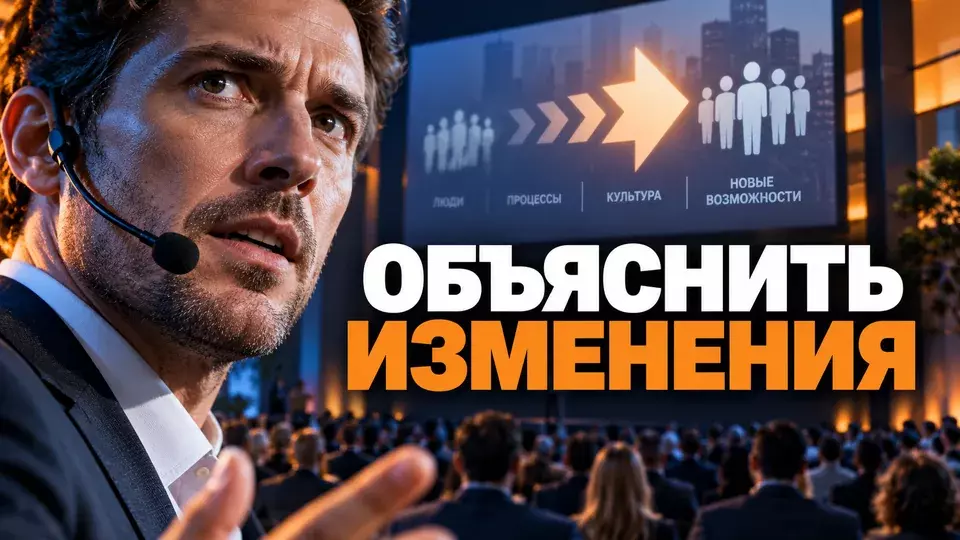
A practical event scenario for a period of change: what to tell employees, how to prepare managers, collect tough questions and bring back the answers.
An event during a period of change helps employees separate confirmed decisions from assumptions and understand the immediate next steps. It does not replace a fair process or the work of managers. But a general meeting can eliminate the information vacuum, collect tough questions and set a clear rhythm for the next updates.
If the transformation has already begun and teams are hearing different versions of what is happening, request a meeting scenario and a preliminary estimate. For the first conversation, it is enough to describe the reason for the changes, the audiences, the geography, the known constraints and the desired timing of the event.
What problem does an event solve during changes?
In short: an event creates a shared base of facts, translates the change into the language of different roles and opens a safe channel for questions. Its outcome is clarity: what has already been decided, what is still under discussion, what the employee does next and when the company will come back with a new update. After the meeting, this clarity must translate into team materials and next steps.
The festive staging is secondary here. An employee needs to understand how processes, their manager, tools, schedule, interaction with other teams or the requirements for their role will change. If the content does not answer these questions, an expensive stage can widen the gap between the official presentation and day-to-day reality.
At Aventura, we start with the boundaries of the task. Strategic decisions are made by management before the event. If a direction is still under discussion, a working session is needed, not a ceremonial announcement. Once a decision is made, the event helps explain the rationale, the consequences and the next step.
For company-wide communication, you can use a business event, an all-hands meeting between management and employees, a series of meetings by branch or a hybrid broadcast. The format is chosen after the content, not the other way around. A detailed scenario for an all-hands meeting is covered in the article about a town hall for a company.
Message boundaries: decided, under discussion, unknown
Before preparing slides, divide each sensitive topic into three statuses. Employees should see what has been approved, what they can still influence, and where there is no answer yet. This framework reduces the risk of unprepared improvisation and false certainty. For every unknown, immediately assign an owner and a condition for the next update.
The British Health and Safety Executive (HSE) advises that during changes, you should promptly explain the reasons, timelines, impact on work, available support, and the opportunity for consultation. The Advisory, Conciliation and Arbitration Service (Acas) separately distinguishes information-sharing from genuine consultation: if people's opinions can no longer influence the decision, you should not pretend there is an open choice.
We build the content table before the script:
The table brings together the key points of the section: Status, What we communicate, What we do not do. Use it as a quick reference when preparing the event.
| Status | What we communicate | What we do not do |
|---|---|---|
| Decided | the fact, the rationale, the owner, the timeline, and the impact on work | we do not present the decision as a topic for a vote |
| Under discussion | the options, the criteria, the boundaries of employee influence | we do not promise to accept every suggestion |
| Unknown | what exactly is not yet known, who is finding out, the condition for the next answer | we do not fill the pause with a convenient guess |
| Unchanged | the processes, guarantees, or rules that remain the same | we do not make people look for confirmation in rumours |
An honest "there is no answer yet" only works together with an owner and a next contact point. A phrase without a follow-up sounds like an evasion. The phrase "no decision has been made, the HR director is looking into the matter, an update will follow after the board meeting" gives the employee a clear point to wait for.
One transformation, different consequences
The core message must be consistent, but examples and instructions differ by audience. Office staff, production, branches, remote employees and line managers receive different practical context. There should be no contradictory versions. For each group, define in advance the nearest change in work, the available channel and the person who will continue the conversation.
An audience map shows who is directly affected by the change, who will work in a new way and who will become a channel for explanation. Basic job titles are not enough. Shift, region, access to corporate email, language, work format, proximity to consequences and a trusted source of information matter.
For each group we record:
- What changes in their work now and later.
- What remains the same.
- What question will arise first.
- Who should provide the answer.
- Which channel is available to this group.
- What support or training is needed after the event.
- When the next contact will take place.
The stakeholder map from the British analytical service helps choose the frequency and depth of communication based on the audience's influence and interest. For corporate transformation, we add the degree of impact and timing. A team that changes a system in a month needs instructions and training. Employees in an adjacent function only need to understand the new handover points.
If the changes are related to a merger of companies, a separate analysis of the integration day after the merger is useful. Here we cover more than mergers: the same principles work during reorganization, implementation of an information system, a change of strategy and operating model.
The all-hands stage and the conversation within the team
Senior leadership explains the direction and takes responsibility, while the line manager translates the change into the work of a specific team. There should be no gap of several weeks between these conversations. Managers are prepared before the all-hands event, not after the first tough questions. That way their answers stay aligned with the overall message and remain useful for specific roles.
The UK's Chartered Institute of Personnel and Development (CIPD) describes line and middle managers as the link between strategy and day-to-day work. At the same time, they cannot be expected to defend a decision they do not understand or to answer personal HR questions without the authority to do so.
A manager's pack includes a one-pager with decision statuses, implications for typical roles, answers to frequently asked questions, a list of promises not to make, an escalation channel and a short script for the conversation with the team. Sending this by email is not enough. Before the event, managers go through a rehearsal and ask their own questions.
The working sequence looks like this:
- Leadership and process owners agree on the factual core.
- Line managers receive a briefing and rehearse the Q&A block.
- The company holds an all-hands meeting or broadcast.
- In the next work cycle, managers discuss the implications with their teams.
- Unconfirmed questions go into a single register.
- Answers are fed back into the shared FAQ list and managers' materials.
For the local conversation, an article on a manager's meeting with employees will be useful. The all-hands stage sets the direction. The small meeting helps work through the real operational implications without discussing personal situations in public.
How to run an honest Q&A session?
In short: questions should take up a significant part of the agenda, not just the final minutes. Participants choose an oral, written, or anonymous channel. Each question receives one of the following statuses: answered, restricted, owner of the follow-up, and date of the next update. Unanswered topics after the event move to a central register rather than disappearing with the stage.
Difficult questions cannot be selected solely for convenience. The moderator merges duplicates, separates personal cases, and ensures the speaker addresses the core issue. If the answer is restricted by law, personal data, or commercial confidentiality, the specific boundary must be named, rather than saying "we cannot comment on this" without explanation.
A safe answer formula:
- Acknowledge the question and its implications for people.
- Give a direct status in the first sentence.
- State the confirmed fact.
- Separate what is unknown and explain why.
- Name the owner of the next action.
- Set the condition or date for an update.
The question "will there be layoffs?" cannot be closed with a general statement about stability if no decision has been made. It is more appropriate to outline the scope of the decision made, the boundaries of the current analysis, and the procedure for individual communication. The event must not create a promise the company cannot keep.
The UK's National Protective Security Authority (NPSA) warns that information vacuums are filled by rumours and disinformation. The World Health Organization recommends frequently updating available facts in a rapidly changing situation, listening to the audience, and aligning messages. These principles also apply to corporate transformation: regular incomplete updates are more useful than long silence until the "perfect picture" is ready.
How to collect feedback without false anonymity?
The format of questions can be anonymous, confidential or pseudonymised - these are different modes. Before collecting data, explain the purpose, access to raw responses, metadata, retention period and method of aggregation. Do not promise anonymity that the system does not provide. The fewer unnecessary fields a form collects, the lower the risk of accidentally revealing the author.
Corporate authorisation, the device's network address, a unique link, a small department and recognisable free text can reveal the author. The UK data protection regulator ICO emphasises that pseudonymised data remains personal data if the individual can be re-identified with additional information.
We advise collecting the minimum data needed for the purpose. If a department does not affect the analysis, that field is removed. Managers receive topics and aggregated slices, not a list of critical employees. The organisational feedback channel is kept separate from reports of misconduct, individual HR matters and urgent psychological support.
Before the form, a short text is needed: why responses are being collected, who will see them, how they will be combined, how long they are stored and where to turn for a personal response. For a hybrid event, you can use streaming and remote participation, but the rules for handling questions must be equally clear in the room and online.
We publish practical breakdowns of corporate and business formats in the AVENTURA EVENTS Telegram channel.
Materials and commitments after the meeting
After the event, employees need a text version or recording, a list of frequently asked questions, materials for managers, and a commitments register. If the company records the meeting, participants are notified in advance about the purpose, access, and retention period of the recording, and consent is obtained where required. If a question disappears along with the stage, trust in the next feedback session may decline.
A commitments log turns promises made from the stage into a manageable queue. It retains the original wording, the owner, the deadline or condition for a response, the current status, and a link to the result. Postponing does not delete the old entry: an explanation and a new update date appear alongside it.
The table summarizes the key points of this section: Field, What we record. Use it as a quick reference when preparing an event.
| Field | What we record |
|---|---|
| Question or promise | the exact scope of what was said, without broad interpretation |
| Owner | a specific role, not "management" |
| Deadline or condition | a date or a decision on which the response depends |
| Status | new, in progress, completed, postponed, cancelled |
| Result | a link to a document, process, training, or response |
| Next update | when the team will return to the topic |
After the general meeting, managers hold conversations with their teams. The list of frequently asked questions is updated from a single source. It is better to flag and correct an error than to quietly rewrite an old version. Such a trail shows that communication continues and does not depend on the memory of individual speakers.
How do you check understanding rather than applause?
Registrations, recording views and likes show engagement with the event. If the meeting is recorded, the audience is told in advance who will get access and how long the file will be stored. For transformation, something else matters more: whether employees understand the reason, can distinguish between decided and discussed statuses, know the impact on their role, the channel for questions and the next action.
The UK government communications standard GovS 011 recommends linking metrics to organisational goals. In practice, it is convenient to compare the same short questions before the meeting, immediately after it and at the next stage of the changes.
A useful set of questions:
- I understand why the change is happening.
- I can separate a decision that has been made from one under discussion.
- I understand what the change means for my role.
- I know what I need to do now.
- Leaders clearly stated what they do not yet know.
- I know where to get confirmed information.
- I was able to ask a question in a safe way.
- I can see what happened with employee feedback.
It is best to compare the same questions before and after the event, and then between waves of change. Answers should not be turned into a personal "resistance" rating. High attendance can go hand in hand with low clarity, and a critical question sometimes shows good understanding of the consequences.
How do you choose the format and ensure accessibility?
The format depends on scale, geography, the sensitivity of the topic and how ready the decisions are: one company may be suited by a general leadership meeting with employees, while another needs a series of conversations by function and shift. Accessibility, good sound, subtitles and a text version also affect understanding. First check how each group will connect, hear questions and receive materials.
A distributed company often needs a single broadcast and several local conversations. In a production setting, the programme is repeated for shifts or access to the recording is provided without a corporate computer. Sensitive personal questions are moved into separate consultations. A general hall is not suitable for discussing individual data.
The World Wide Web Consortium (W3C) recommends asking about participation needs in advance, checking the venue and platform, using microphones, providing accessible materials, subtitles and a text transcript, and voicing important visual information. If part of the audience cannot hear a question or open the materials, the assessment of overall understanding will be unreliable.
When preparing, we choose the venue after mapping the audiences: we check capacity, acoustics, step-free access, meeting rooms for private questions, connectivity and the possibility of hybrid participation. An impressive stage does not compensate for poor sound and the absence of a channel for branches.
Mistakes That Erode Trust
Distrust grows when words do not match the process. The dangerous moves are putting a positive spin on unpleasant consequences, staging a fake consultation, sending unprepared managers, cherry-picking the questions, and letting promises quietly disappear after the event. Each of these mistakes leaves employees unsure about the status of a decision and unable to choose the right action. That is why the script needs to be checked not only against the slides but also against the actual sequence of changes.
Common mistakes:
- saying "it's all decided" and then asking for opinions;
- promising that nothing will change;
- leaving the Q&A block to the last minutes;
- handing managers slides without a rehearsal;
- dismissing a critical question as a rumor without checking;
- using a form with authentication while promising full anonymity;
- communicating different decision statuses to different levels;
- measuring success by attendance and applause;
- failing to follow up on questions after the meeting;
- deleting an overdue promise instead of explaining it.
An event helps reduce information uncertainty and surface well-founded objections. It does not guarantee automatic acceptance of change. If the procedure is perceived as unfair, stage communication will not fix that.
Frequently asked questions
The celebratory staging is secondary here. Employees need to understand how processes, their manager, tools, schedules, interaction with other teams or the requirements for their role will change. If the content does not answer these questions, an expensive stage show can widen the gap between the official presentation and day-to-day reality.
Before preparing slides, divide every sensitive topic into three statuses. Employees should see what has been approved, what can still be influenced and where there is no answer yet. This framework reduces the risk of unprepared improvisation and false certainty. For every unknown, immediately assign an owner and the condition for the next update.
The factual core of the message should be the same, but examples and instructions differ by audience. Office staff, production, branches, remote employees and line managers each receive a different practical context. There must be no contradictory versions. For each group, define in advance the nearest change to their work, the available channel and the person who will continue the conversation.
Senior management explains the direction and takes responsibility, while the direct manager translates the change into the work of a specific team. There should be no gap of several weeks between these conversations. Managers are prepared before the general event, not after the first difficult questions. That way their answers continue the overall line and remain useful for specific roles.
Difficult questions must not be selected purely for convenience. The moderator merges duplicates, separates personal cases and makes sure the speaker addresses the substance. If an answer is limited by law, personal data or commercial confidentiality, the specific boundary must be named rather than saying "we cannot comment on this" without explanation.
A feedback form can be anonymous, confidential or pseudonymised - these are different modes. Before collecting data, explain the purpose, who has access to raw responses, the metadata, the retention period and how the data will be aggregated. Do not promise anonymity that the system does not provide. The fewer unnecessary fields the form collects, the lower the risk of accidentally revealing the author.
If you need to explain a transformation to employees without unnecessary promises and without a gap between the stage and real work, discuss the task with us. We will start with the audiences, decision statuses and difficult questions, then put together the format, script, roles and budget.
Sources
- Acas: Consulting employees and representatives
- HSE: Management Standards - Change
- UK Government Analysis Function: Stakeholder mapping
- NPSA: Communicating Organisational Change
- CIPD: People managers - an evidence review
- ICO: Data protection and monitoring workers
- ICO: Anonymisation guidance
- W3C WAI: Making events accessible
- WHO: Communicate in emergencies
- GOV.UK: Government Functional Standard GovS 011 - Communication
Contents
Was this article helpful?