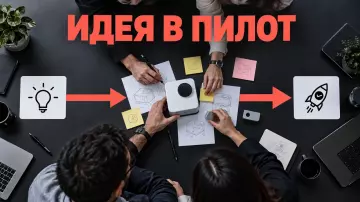
A small meeting between leadership and employees works as a dialogue if it has a clear topic, a moderator, and a register of answers. We provide a scenario for preparation and conduct.
A small group meeting between leadership and employees is needed when a general presentation is no longer sufficient. It is important for people to clarify how a decision will affect their work, and for the leader to hear the context of a specific team. At Aventura, we build this format around conversation, and we leave the presentation only for the facts without which the discussion cannot begin.
In this article, we focus on a group of 7-25 participants and a meeting lasting 45-60 minutes. This is our working model for the scenario. The composition and duration depend on the topic, the leader's authority, and the opportunity to give participants a chance to speak.
How does a small meeting differ from a town hall?
In short: A general town hall synchronizes a large audience, while a small meeting examines the implications of a decision for a specific group. If employees only listen to a shortened presentation, a small group does not turn the event into a dialogue. Participants need time for questions, clear boundaries for answers, and a next step after the conversation.
Both formats are useful but serve different purposes. A company-wide meeting (town hall) is needed for a unified message, common business context, and questions from a broad audience. A small meeting suits a department, shift, management level, or project team that is affected by one topic.
The table summarizes the key points of the section: Criterion, General town hall, Small meeting. Use it as a quick reference when preparing the event.
| Criterion | General town hall | Small meeting |
|---|---|---|
| main task | synchronize a large audience | examine local context and barriers |
| role of the leader | give a general message and answer key questions | briefly set the frame, listen, and make decisions |
| employee participation | common question channel | direct remarks, form, and written questions |
| outcome | recording, summary, mass responses | decisions, open topics, owners, and update dates |
| technology | stage, broadcast, flow management | audibility, shared document, and if necessary remote connection |
Acas describes quality consultation as a two-way discussion: employees can voice suggestions and concerns, and the employer considers them before taking next steps. Group size alone does not ensure this. Conversation rules and management's readiness to act on what is heard are needed.
Purpose and composition of the group
The purpose answers three questions: what participants should understand, what context management wants to hear, and what decision may emerge after the meeting. The phrasing "talk to the team" is too broad. It's better to choose one topic: a process change, the work of a new department, the consequences of a reorganization, or barriers in a specific project.
The group is assembled around a shared work context. This could be one function, one shift, one level of responsibility, or employees affected by a specific decision. A random selection of convenient and loyal participants will lead to a calm conversation, but won't show the whole picture.
We check the composition against four criteria:
- Participants encounter the discussed task in their work.
- Different roles and ways of participation are represented in the group.
- The manager is entitled to answer on the topic or name the decision owner.
- Everyone will have a real opportunity to ask a question within the allotted time.
If the topic concerns several branches or shifts, it's better to hold a series of meetings using one framework. The questions will differ, but a single registry will allow seeing recurring barriers without mixing local context.
Preparing the manager for the conversation
The manager prepares a map of questions and boundaries of answers instead of a speech. Before the meeting, they separate confirmed facts from decisions in progress. Then they mark confidential topics and agree on who will check a question outside their authority. Such preparation helps answer directly and not promise what the team cannot deliver.
First, we collect questions from past communications, a preliminary form, and conversations with line managers. Then we group them by meaning. An awkward phrasing does not make the topic less important, so the moderator edits personal data and repetitions but preserves the content.
The working answer map consists of four steps:
- Acknowledge the question without judging the author.
- State what is already known and confirmed.
- Explain the boundary: what is still unknown, outside the authority, or cannot be discussed with this group.
- Record the action, owner, and date of the next update.
Google re:Work links team effectiveness with psychological safety, clarity, and the ability to discuss problems. A small meeting by itself does not create a safe environment. It is created by behavior: the manager does not argue with an employee's experience, does not demand to name the author of an anonymous question, and calmly admits when there is no answer yet.
If you need to connect group composition, program, moderation, and venue work, request an estimate from us. In the request, specify the city, the topic of the conversation, the number of groups, and the need for online connection.
We publish breakdowns of business and corporate events in Aventura's Telegram channel. There you will find practical solutions for programs, venues, and team work.
55-minute meeting scenario
Fifty-five minutes is a working model that can be shortened or extended. The important thing is the proportion: the opening section provides only the necessary context, while questions and decisions take up most of the meeting. The moderator protects this time in advance in the scenario and moves reference materials from the spoken presentation to an email or appendix.
The table brings together the key points of the section: Time, Block, What the leader does. Use it as a quick reference when preparing the event.
| Time | Block | What the leader does | What the team records |
|---|---|---|---|
| 0–5 minutes | frame | explains the goal, decision scope, and constraints | participation rules and question channels |
| 5–12 minutes | context | provides verified facts without a long presentation | terms and clarification questions |
| 12–32 minutes | questions | answers briefly, separates fact from hypothesis | answers and topics to verify |
| 32–42 minutes | diagnostics | asks about barriers and consequences | priority problems |
| 42–50 minutes | decisions | names actions, boundaries, and owners | commitments and update dates |
| 50–55 minutes | closing | repeats the conclusions | summary channel and next contact |
At the beginning, the moderator explains what the meeting can and cannot resolve. If a decision has already been made, do not present the discussion as a vote. Participants are honestly told where they can influence implementation and which constraints are set in advance.
For a series of meetings, keep one scenario framework and change examples and questions for each group. After each conversation, the team updates the topic map. Common facts stay consistent so that employees do not receive contradictory versions of the decision.
How to collect complex questions?
Questions are collected before and during the meeting through several parallel channels. A preliminary form helps to see recurring themes, the live microphone provides clarifications, and written or anonymous modes lower the barrier to participation. The organizer explains in advance the boundaries of anonymity and does not publish the raw data dump.
CIPD notes two reasons for employee silence: fear of consequences and the feeling that speaking up is useless. Therefore, an empty form does not prove that there are no questions. The team should show what happened to previous submissions and give participants a clear choice of how to participate.
We use three channels:
- Pre-meeting form - for topics that require a prepared answer.
- Oral questions - for live dialogue and clarifications.
- Written channel during the meeting - for remote participants and those who are uncomfortable taking the microphone.
Absolute anonymity cannot be promised if the author can be identified by the content of the question or the small group size. In the invitation, it is better to state who sees the original questions, what data will go into the final document, and when an individual topic will be moved to a separate protected channel.
The moderator combines duplicates, removes names and unnecessary details, but does not change the meaning. Questions about personal situations, disciplinary decisions, or medical data are not discussed in front of the group. They are forwarded to the appropriate HR or legal process.
Moderator, protocol, and boundaries of response
The manager should not answer, manage the queue, and take minutes at the same time. The moderator keeps the frame and pace, while the secretary records decisions. At a small meeting, one person can combine two functions, but the responsibility is still stated before the start. Participants should understand who will give the floor, who will record an open question, and who will send the final document.
The moderator does seven things:
- repeats the purpose and rules of participation;
- monitors the voice, chat, and preliminary questions;
- gives the floor to those who have not spoken yet, without coercion;
- stops a monologue regardless of the participant's status;
- separates observable fact from opinion;
- marks a question as answered, open, or forwarded to another channel;
- reads the commitments aloud before closing.
The minutes do not have to be a verbatim transcript. For a working summary, a topic, brief answer, action, owner, update date, and publication channel are sufficient. Such a document is easier to verify and safer to distribute.
For an open question, we use the status "requires verification" rather than the vague "we'll look into it". If information cannot be disclosed, the manager states the reason as specifically as the situation allows and explains what next step is possible.
Checking the venue and hybrid connection
A small meeting requires audibility, an accessible route, and equal participation. The team walks through the entrance and seating, then checks the display of materials. It separately asks a question from the room and a question online. The fix is confirmed by repeating the same action, so that the technical agreement becomes a verified result.
The World Wide Web Consortium (W3C) recommends asking about accessibility requirements in advance. The venue and platform must support the stated way of participation. Materials are provided before the meeting, and audio is tested at the actual location. We ask what type of participation a person needs, without requesting medical details.
Before the meeting, we check:
- An accessible route to the conversation area and suitable seating.
- Audibility from each seat and microphone quality.
- Materials in an accessible format, not only on the shared screen.
- Subtitles or another requested service.
- One digital channel for questions from the room and online.
- The functioning of chat, hand raising, and the shared document.
- A backup way to continue without a screen or network.
Microsoft recommends in a hybrid meeting to give in-person and remote participants an equal chance to be heard. We appoint a moderator for the online queue and give remote participants an early opportunity to speak in the Q&A block. Questions from the room are repeated into the microphone: this technique is part of the W3C recommendations for accessible events.
A short run-through can be linked with the technical rehearsal of the event. If a remote question is not heard in the room, the team changes the setting and checks the same question again. Only repetition confirms that the audio is fixed.
Privacy without unnecessary recording
Recording is not needed by default. For a trusting conversation, an anonymized log of topics, decisions, and actions is often more useful. If video or transcripts are needed, the client determines in advance the purpose and legal basis. They also appoint those responsible for access, storage, and deletion of the material.
The principle of data minimization means that the team collects only the information necessary for the stated purpose. The UK data protection regulator (ICO) explains this principle in its guidance. The company checks Russian rules together with a lawyer and the personal data officer.
In practice, this means:
- not keeping the original export of questions in shared access;
- not including names and sensitive details in the group record;
- protecting individual inquiries separately;
- informing about recording and usage rules in advance; if consent is the basis, obtain and record it before recording;
- appointing an owner for data review and deletion;
- not promising full confidentiality where it cannot be ensured.
Before the meeting, the company checks how to process data, record the conversation, and inform participants. The decision depends on applicable law and internal rules.
How to end the meeting and close promises?
In short: At the end, the moderator repeats aloud the decisions, open questions, owners, and update dates. After the meeting, participants receive a brief summary without personal remarks. Before the next conversation, the team starts with past commitments: what is closed, what is still in progress, and why the deadline changed.
The response card contains seven fields: topic, briefly formulated question, status, answer, action, responsible person, and update date. This is enough to verify the promise. A full transcript often adds noise and personal data but does not help manage actions.
We recommend three steps after the meeting:
- Send participants decisions, open questions, and a channel for clarifications.
- By the promised date, give an answer or an honest status with a new date.
- Before the next meeting, show the fate of past commitments.
The usefulness of the format is assessed by whether questions received an answer or a transparent status, whether actions have owners, and whether promises are closed by the stated date. There are no universal percentages for a good meeting. The company compares groups and cycles with its own starting point.
The work after the conversation determines trust in the next meeting. If answers disappear after the door closes, employees quickly stop asking difficult questions. Therefore, the register of commitments is included in the scenario from the very beginning, just like the event approval calendar.
Frequently Asked Questions
Both formats are useful, but they solve different tasks. The company-wide meeting (town hall) is needed for a unified message, shared business context, and questions from a broad audience. A small meeting works well for a department, shift, management level, or project team that is affected by one topic.
The goal answers three questions: what participants should understand, what context management wants to hear, and what decision might emerge after the meeting. The phrasing 'talk to the team' is too broad. It is better to choose one topic: a process change, the work of a new unit, the consequences of a reorganization, or barriers in a specific project.
The manager prepares a map of questions and answer boundaries instead of a speech. Before the meeting, he separates confirmed facts from decisions in progress. Then he marks confidential topics and agrees who will verify a question outside his authority. This preparation helps answer directly and not promise what the team cannot deliver.
Fifty-five minutes is a working model that can be shortened or extended. The proportion is important: the introduction provides only the necessary context, and questions and decisions take up most of the meeting. The moderator protects this time in advance in the scenario and moves reference materials from the oral presentation to an email or appendix.
Questions are collected before and during the meeting through several equal channels. A preliminary form helps to see recurring themes, a live microphone allows clarifications, and a written or anonymous mode lowers the barrier to participation. The organizer explains the limits of anonymity in advance and does not publish raw exports.
The manager should not simultaneously answer, manage the queue, and take minutes. The moderator holds the framework and pace, and the secretary records decisions. In a small meeting, one person can combine two functions, but the responsibility is still named before the start. Participants should understand who will give the floor, who will record an open question, and who will send the final document.
To prepare a series of small meetings between management and employees, request a quote from us. We will clarify the topic, group composition, cities, and connection format, then put together the scenario, moderation, and venue work.
Sources
- Acas: how to conduct a consultation with employees.
- CIPD: employee voice in hybrid work.
- Google re:Work: team effectiveness and psychological safety.
- W3C WAI: how to make an in-person or hybrid meeting accessible.
- Microsoft Learn: principles of a hybrid meeting.
- ICO: principle of personal data minimisation.
Contents
Was this article helpful?