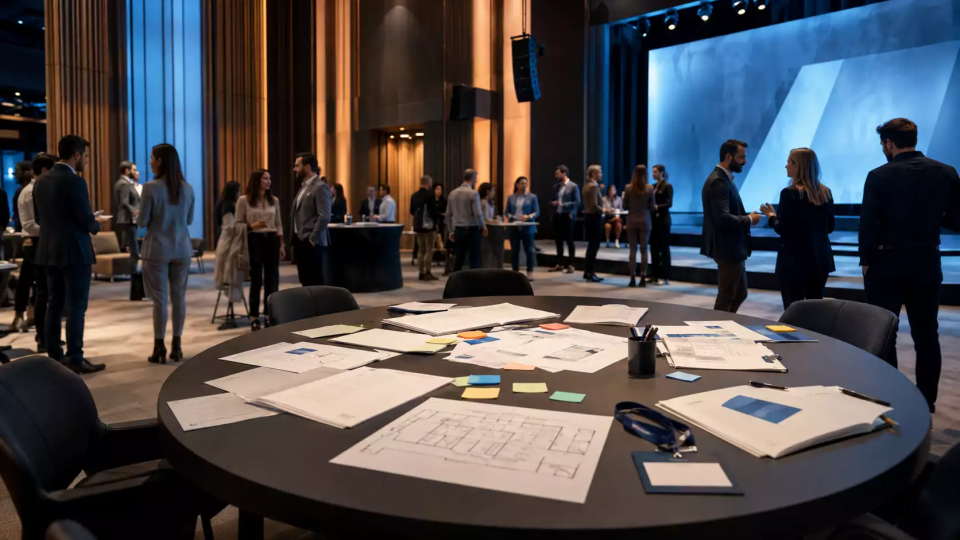
The corporate forum project passport helps the client and contractors work on the same task. We explain what to lock down in the brief before choosing a venue and launching registration.
A brief for a corporate forum helps bring together in one document the business task, participant journey, program, roles, estimate and method for evaluating the result. Such a passport is needed before choosing a venue: then the client, agency and contractors discuss the overall scope of work, composition of services and decisions to be made.
Leave a request - we'll discuss the task
We'll clarify the event format and suggest the next step.
In Aventura's Telegram channel, the team publishes practical observations on preparing business events and new formats.
Why does a forum need a single project brief?
In short: the brief for a corporate forum links decisions that usually live in different files. It records the forum's goal, audience, format, scope of work, decision owners and change rules. The document is needed by the client, the agency, the venue and technical contractors to compare the same scope of work before preparation begins.
A good venue and strong speakers by themselves do not answer the question of what should change after the forum. Start with one working formulation: for whom the event is held, what action or understanding the participant should gain, who is responsible for the next step and by what signs the team will see progress. This could be informing employees about changes, a series of meetings with partners or launching a new direction for clients.
It is worth immediately including in the brief the date, city, expected format, audience range, venue access, program requirements, list of client decisions and approval points. For a corporate forum, it is also useful to add venue constraints: transport, accessibility, guest flows, waste requirements and contractor rules. These issues are easier to resolve in the brief than to add at the end of the project.
What goals and KPIs should be set before the program?
In short: forum KPIs are chosen based on the goal, not on the desire to collect as many metrics as possible. For reach, confirmed registrations and attendance will work; for learning, participation in relevant sessions and answers to questions; for a commercial task, scheduled conversations or requests for follow-up. Sales should not automatically be attributed to the result of a single event.
For each goal, write down one metric, data source and owner. If the forum is needed for dialogue with partners, it is more useful to count confirmed meetings and topics for follow-up than to sum up all touchpoints into one metric. If the task is related to internal communications, the team can check reach, understanding of key decisions and questions remaining after the presentations.
The table collects the key points of the section: Forum goal, What to monitor, Where to get data. Use it as a quick guide when preparing the event.
| Forum goal | What to monitor | Where to get data |
|---|---|---|
| Communicate changes to the team | Registrations, attendance, questions and a short survey | Registration form, check-in, post-event survey |
| Collect business contacts | Scheduled conversations and agreed next steps | Meeting slots and manager notes |
| Share practical experience | Participation in the session and questions on application | Session check-ins and feedback form |
Cvent describes data collection before, during and after the event: registration and digital activity, actual attendance, real-time feedback, then surveys and follow-up contacts. For a Russian forum, the set of fields and the method of data processing are agreed with the person responsible for personal data.
How to describe the audience and the participant journey?
In short: the participant journey begins with the invitation, not at the registration desk. The passport records who receives the invitation, why they should come, how they get to the right hall, where they ask a question and how they get the next action. This walkthrough helps spot queues, unclear navigation and unnecessary programme blocks before the day of the event.
Divide the audience by role in the task, not just by job title. A branch employee, a department head and an invited partner may have different contexts, even though they sit in the same hall. For each group, define the reason to come, the key programme block and a clear way to continue the conversation.
It is useful to walk the journey minute by minute: invitation, registration, cloakroom, first navigation point, hall, break, question, meeting, exit. At each stage, appoint a person who makes decisions on the spot. For an internal management team that needs to develop a decision together rather than receive information, a strategic session for the company is better suited.
How to build a programme as a path, not a dense grid?
In short: a forum programme works when each block continues one participant question. The main stage provides context, themed sessions add detail, a discussion or demonstration turns the topic into action, and the finale captures the next step. The participant does not have to figure out the meaning of each room and each talk from scratch.
The programme should work as a consistent participant journey, not just a schedule. For a business forum, it is worth checking how a person moves from the main question to application: what they will hear first, where they can clarify details, with whom they will discuss the topic and what information they will receive after the event.
In the brief, include for each block the task, the responsible speaker, the required technical minimum, the transition to the next element and a backup format. Leave time for orientation at the venue, questions and personal conversations. If the format includes an awards ceremony or a production topic, it is appropriate to link it to the material on the professional skills competition, where the programme and preparation of the finale are discussed separately.
- Formulate one question that each key block answers.
- Appoint an owner for the transition between the stage, the session and personal interaction.
- Check the timing through the eyes of a participant who is at the venue for the first time.
- Collect unanswered questions into a list for a message after the forum.
What to consider for safety and accessibility?
In short: forum safety should not be left only in the venue's folder. The passport should include risks, prevention, trigger, decision owner, communication channel, and backup scenario. Accessibility is planned in the same way: during registration, necessary participation conditions are collected, and the route, sound, navigation, and remote connection are checked in advance.
HSE recommends aligning the plan with the scale and risk of the event, assessing the audience, venue, duration, and time. For the organizer, this is a practical guideline, not a replacement for Russian requirements: local responsibilities and measures are coordinated with the venue, specialized professionals, and the facility's rules.
The table summarizes the key points of the section: Scenario, What to check in advance, Who decides. Use it as a quick guide when preparing the event.
| Scenario | What to check in advance | Who decides | How it is communicated |
|---|---|---|---|
| Queue at the entrance | Flow scheme, additional desk, and navigation | Guest coordinator | Through volunteers and signs |
| Speaker delay | Backup block and contact of the host | Program producer | From the stage and in the event chat |
| Restricted access to the hall | Alternative area and broadcast | Venue manager | Through coordinators and mailing |
| Technical failure | Backup channel, switching procedure, and timing | Technical director | To the host and team in the service channel |
The Government Digital Service's guide to event accessibility suggests asking in advance about participation conditions and checking physical accessibility, sound, captions, or remote connection. W3C also notes that accessible design helps avoid creating barriers for people with different abilities. These materials are used as international practices, while specific decisions are made for the venue and customer requirements.
After two or three meaningful sections, it usually becomes clear how much coordination is needed at the venue. Aventura organizes business and corporate events: from concept and scenario to control of all details at the venue. Request a quote.
How to prepare an estimate and a request to contractors?
In short: estimates can be compared when all contractors calculate the same scope of work. The technical specification should specify mandatory and optional line items, assumptions, site access, rehearsals, technical requirements, staff, catering, build-out, recording, and conditions for project changes. The final figure without these conditions does not help in making a decision.
MPI warns that a vague request forces suppliers to make different assumptions. Because of this, proposals are difficult to compare, and new costs may appear after the contractor has been selected. In the forum's master document, it is useful to keep a register: what is included, what is excluded, who approves a change, and how it affects the timeline or budget.
Do not set a universal contingency percentage in the article or brief. It depends on the contract, scenario, market, and risks of the specific event. Instead, agree as a separate clause on contractor replacement, overtime work, postponement, the procedure for approving an additional estimate, and the decision owner.
What data should be collected during registration?
In short: the registration form collects only data for which there is a clear purpose and process of use. Contact is needed for communication, role and company for program segmentation, special requirements for organizing participation. For each field, the master document records the purpose, contractor access, retention period, and action after the forum.
The public example of the ICO shows how registration, access, and feedback data can be linked to communication, the program, and event improvement. NIST considers privacy risk management as part of overall organizational management. In a Russian project, before launching the form, the purpose of processing, the set of fields, the legal basis, contractor access, retention periods, withdrawal procedure, and the rules of photo and video recording are checked separately. Federal Law No. 152-FZ contains provisions on the principles, conditions, and security of personal data processing.
This material does not replace legal advice. Consent texts, contracts with contractors, and the setup of the registration platform are reviewed by a lawyer and the customer's personal data officer. For regular guest visits to a production site, it is also useful to study the material on open day for employees' families: separate rules for the route and access are important there.
What roles should be assigned on the day of the forum?
In short: every touchpoint must have an owner who can make a decision on the spot. The forum passport describes roles through outcomes: who is responsible for guest flow, the stage, technical switching, venue liaison, capturing issues and follow-up contact. Such a list helps reduce pauses when the program requires changes.
The minimum team depends on the scale, but the brief usually includes a project manager, program producer, guest coordinator, technical director, venue representative and post-event communications owner. For each one, specify the work communication channel, availability times, decision boundaries and a backup person.
The table brings together the key points of the section: Event point, Owner, Check. Use it as a quick reference when preparing the event.
| Event point | Owner | Check |
|---|---|---|
| Registration | Guest coordinator | Lists, badges, flow and special requests |
| Stage | Program producer | Timing, speaker readiness and transitions |
| Technical | Technical director | Sound, presentations, broadcast and backup |
| Follow-up contacts | Communications owner | Questions, materials and next contact |
A short team briefing before the opening should not turn into a lecture. Go through the critical points, Plan B triggers, venue service contact numbers and the rule: who informs participants about changes.
How to close a forum with a report and a 7-day plan?
In short: the forum report links the original goal, actual data, the conclusion and the owner of the next action. Photos and the number of guests remain part of the document, but do not replace an agreed assessment. On the next business day, the team checks questions, materials, contacts and deadlines while the context of conversations is not lost.
Collect the data in the structure that was fixed before the event. For each metric, specify the source, the limitation of interpretation and the decision. For example, an increase in the number of scheduled meetings indicates a continuation of the dialogue, but by itself does not prove future revenue. Such accuracy protects the report from unnecessary promises.
Within a week, send participants the promised materials, answers to questions and a clear next step. Then hold a short debrief with the client, the venue and key contractors. HSE considers a post-event review a good practice, especially when all involved parties take part in it.
What to check before approving the brief?
In short: before starting preparations, the team must check the connection between the goal, the program, the routes, the budget, registration and the report. If any block cannot be explained through the forum's task, it should be clarified or removed. This way the brief remains a working document, not a beautiful attachment to an email.
- One main objective of the corporate forum and several observable KPIs are formulated.
- For each audience, the invitation, the route and the next step are clear.
- The program has a logic of transitions, time for questions and a fallback option.
- The budget marks assumptions, exclusions and the procedure for changes.
- Risks and technical failures have an owner, a communication channel and a plan B.
- The registration describes the purposes of the fields and the procedure for legal review.
- The report predefines the data, the conclusion and the owner of further contacts.
In Aventura's portfolio examples of implemented formats are collected. If you need a corporate forum for employees, clients or partners, you can discuss the brief with the team.
Frequently asked questions
A good venue and strong speakers by themselves do not answer the question of what should change after the forum. Start with one working statement: who the event is for, what action or understanding the participant should gain, who is responsible for the next step, and by what indicators the team will see progress. This could be informing employees about changes, a series of meetings with partners, or launching a new line of business for clients.
For each goal, write down one metric, a data source, and an owner. If the forum is needed for dialogue with partners, it is more useful to count confirmed meetings and topics for follow-up than to sum up all touchpoints into one metric. If the task relates to internal communications, the team can check reach, understanding of key decisions, and questions remaining after the presentations.
Divide the audience by role in the task, not only by job title. An employee from a branch, a department head, and an invited partner may have different contexts, even though they sit in the same room. For each group, define the reason to attend, the key program block, and a clear way to continue the conversation.
The program should work as a sequential participant journey, not just a schedule. For a business forum, it is worth checking how a person moves from the main question to application: what they will hear first, where they can clarify details, with whom they will discuss the topic, and what information they will receive after the event.
HSE recommends aligning the plan with the scale and risk of the event, assessing the audience, venue, duration, and timing. For the organizer, this is a practical guideline, not a replacement for Russian requirements: local responsibilities and measures are agreed with the venue, relevant specialists, and the facility's rules.
MPI warns that a vague request makes suppliers make different assumptions. Because of this, proposals are hard to compare, and new costs may appear after the contractor has already been selected. In the forum charter, it is useful to keep a register: what is included, what is excluded, who approves a change, and how it affects the timeline or budget.
Sources
- HSE: getting started with event safety
- HSE: managing an event and debriefing afterwards
- ICO: conference privacy notice
- MPI: how to reduce the risk of hidden costs in event RFPs
- Cvent: guide to event ROI
- Government Digital Service: accessible events and presentations
- W3C WAI: accessibility fundamentals
- NIST Privacy Framework
- FEMA: special events planning course
- Federal Law No. 152-FZ
Contents
Was this article helpful?