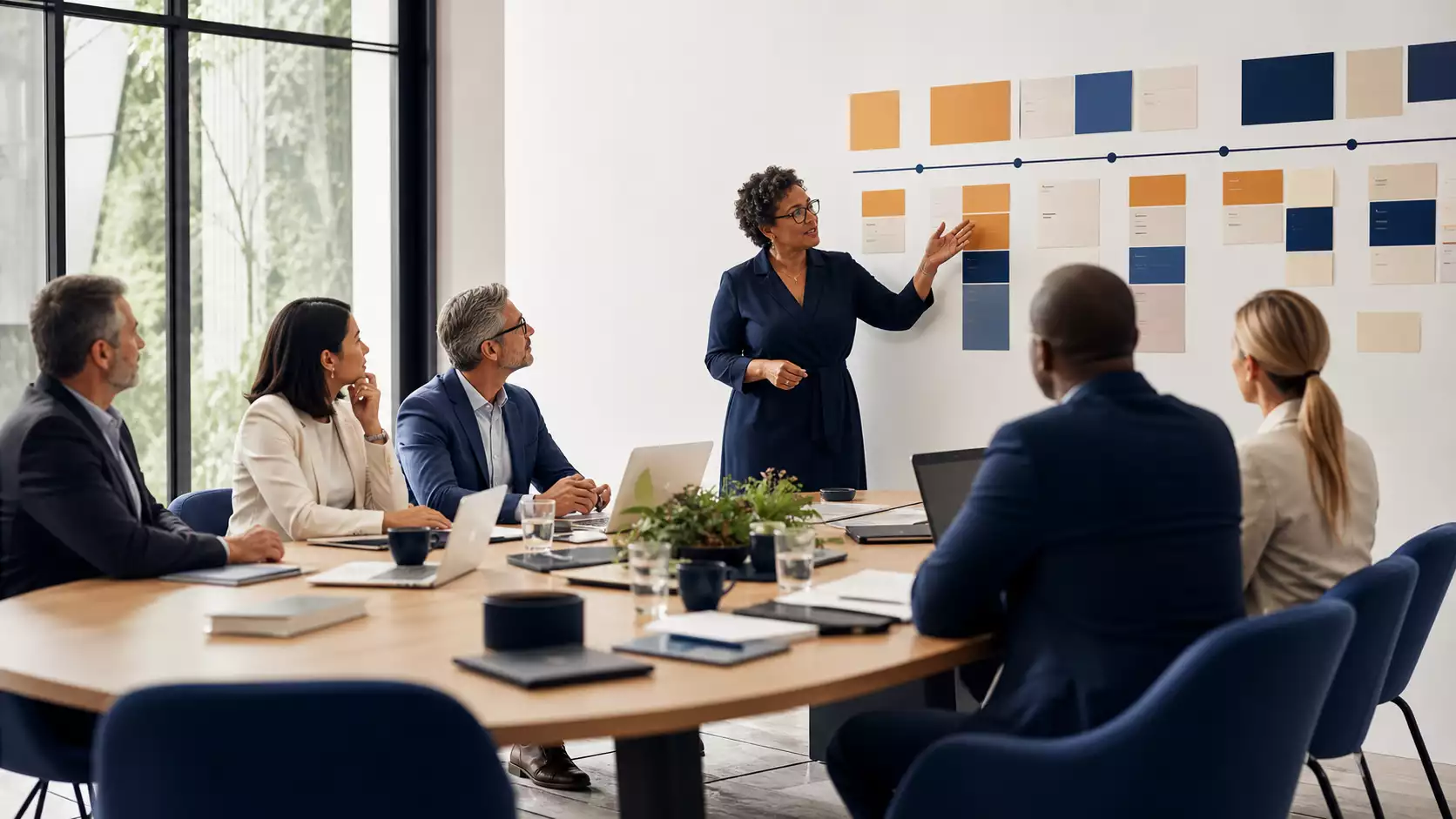
A strategic session brings value when the team comes not for a general conversation, but for a few decisions with owners and deadlines. We break down the preparation, the agenda, and how to work with the outcome.
When does a company need a strategic session?
Answer: a strategic session is needed when managers need to agree on direction, priorities, and next steps, and a regular meeting can no longer accommodate the task. It makes sense to plan the meeting around a specific decision: what to launch, what to abandon, how to coordinate the work of functions, or how to prepare for a change.
A session does not replace day-to-day management. Its result should be a short set of decisions that is clear to those who will implement them. If the issue can be resolved in a status meeting, a separate format is not needed.
Similar logic helps when preparing a corporate forum: first, the task is formulated, then the method of working with the audience is chosen.
How to formulate the result before inviting participants?
Answer: before booking a venue, it is worth writing down one main question, the expected decisions, and the form of the final document. The wording "discuss the strategy" is too broad: participants will bring different expectations, and it will be difficult for the facilitator to bring the conversation into a common route.
A useful brief for the initiator includes the context, constraints, a list of decisions, and a readiness criterion. For example: by the end of the day, three priorities for the planning period are agreed upon, each with an owner and a first step.
The table summarizes the key points of the section: Question for the initiator, What to record, Why it is needed. Use it as a quick guide when preparing the event.
| Question for the initiator | What to record | Why it is needed |
|---|---|---|
| What decision is required? | Choice of direction, priorities, or plan | Avoid turning the meeting into an exchange of opinions |
| What is already known? | Data, constraints, decisions made | Avoid wasting time repeating old disputes |
| What should remain afterward? | Roadmap, list of initiatives, minutes | Check that the result can be applied |
Who to Invite to a Strategy Session?
Answer: the group is assembled based on their relation to the decision, not by position or formal status. You need people who have information, make decisions, or are responsible for executing them; the rest can provide input before the meeting.
Too wide a circle slows the pace: the group has to explain context instead of making choices. Too narrow a circle risks missing a constraint that will only emerge after the plan is approved. Therefore, it is useful to pre-divide participants into decision-makers, experts, and those who need the outcome.
How to Structure the Agenda So the Conversation Doesn't Fall Apart?
Answer: the agenda is built backward from the decision - from final sign-off to data, discussion of options, and selection. Each block must answer a question, otherwise it turns into a report that could have been sent in advance.
A working sequence looks like this:
- Share context and materials with participants before the meeting.
- At the start, align on the goal, discussion rules, and decision boundaries.
- Sort through facts and hypotheses, separating them from each other.
- Gather options and compare them against agreed criteria.
- Make decisions and immediately assign owners of the first actions.
Long blocks should have a pause and a change of mechanics: general discussion, work in small groups, prioritization, return to the shared board. This helps retain attention and makes disagreements visible.
In Aventura's Telegram channel we discuss working formats for business and corporate events: without generic advice and without pressure.
What to prepare before the meeting?
Answer: preparation starts not with seating and coffee breaks, but with input materials and decision-making rules. The team needs shared context, a clear agenda, and a way to capture agreements right during the work.
Put together a short folder: source data, a list of unresolved issues, previous decisions, and constraints. Don't hide controversial data until the day of the session. When participants see contradictions in advance, the meeting moves to making choices rather than getting acquainted with the problem.
For the in-person format, separately check the participants' route, lighting, sound, seating, and surface for collaborative work. In a business event, these details support the content just as in a tender for an event agency requirements for the contractor help compare proposals by the same logic.
How to choose a venue and format of work?
Answer: the venue should help participants see the overall work, quickly move between plenary and group discussion, and not be distracted by logistical failures. The choice depends on the team composition, confidentiality of the discussion, duration, and the need to work with materials on walls or screens.
Offline is easier for complex discussions with a lot of visual materials. A hybrid format requires a separate scenario for remote participants: camera, sound, and a digital board should be part of the program, not an addition at the last moment.
The table summarizes the key points of the section: Format, Suitable when, What to check in advance. Use it as a quick guide when preparing the event.
| Format | Suitable when | What to check in advance |
|---|---|---|
| Offline | Need to discuss quickly and gather decisions as a group | Several work zones, sound, screen, logistics |
| Hybrid | Some key participants are in another city | Roles of online participants, connection, digital board |
| Online | The issue is narrow and materials are already prepared | Short blocks, moderation, shared document |
Who leads the discussion and records the agreements?
Answer: the facilitator keeps the discussion on track, and the team documents decisions in a clear format as the work progresses. The facilitator's role is especially important when participants have different interests: they bring the group back to the question and prevent one voice from taking up all the time.
It is not always convenient for the initiator to moderate alone. They have to simultaneously defend their position, listen to objections, and keep track of what will remain after the meeting. An external facilitator or a separate moderator takes some of this burden off them.
Agree in advance on what the record looks like: decision, rationale, owner, first step, review deadline. This format is easier to pass on to those who did not attend the session.
What to do immediately after a strategy session?
Answer: after the meeting, the most important thing is to turn the agreements into a working document and communicate it to those who were not at the table. If the minutes appear several weeks later, participants begin to remember the conversation differently, and decisions lose their author and context.
In the first days, gather the summary without literary editing: decisions, open questions, owners, and upcoming checkpoints. Then have a short communication with the teams affected by the changes. The format of this communication can be built into a client B2B event or an internal program if the task requires engaging a wider audience.
What mistakes most often nullify the result?
Answer: The session result is nullified by a vague goal, unprepared data, the absence of people with decision-making authority, and the lack of actions after the meeting. These mistakes seem minor in the moment, but each one postpones the dispute to the next meeting.
Do not try to fit all the company's issues into one day. It is better to choose one node and finish it with a decision. Do not leave the recording to memory: participants almost always hear the same wording differently.
Frequently asked questions
How long does a strategic session last?
Duration is determined by the number of decisions and the readiness of materials. For a narrow issue, one working day may be enough; a complex task with several functions requires separate preparation and continuation after the in-person meeting.
Can a session be held without an external facilitator?
It is possible if the initiator has time to lead the process and does not advocate one of the disputed positions. In case of a conflict of interest, a separate moderator helps maintain the pace and neutrality of the conversation.
How does a strategic session differ from a meeting?
A meeting usually helps to check status and distribute current tasks. A strategic session is organized around choosing a direction, priorities, or changes that affect the work of several functions.
How do you know the session was worthwhile?
After it, the team has decisions, owners of next actions, check deadlines, and a clear way to communicate changes to those affected.
If you need help with preparing the business part, the scenario, the venue, and the team's work on the day of the event, Aventura organizes corporate and business events from concept to on-site control.
Sources
- How to run a strategic session: a step-by-step guide from a facilitator
- Running a strategic session: a step-by-step guide
- How to conduct a strategic session: a step-by-step guide
- Strategic session: a step-by-step guide to running it
- HR strategies for 2026: what plans and goals do Russian companies have?
Contents
Was this article helpful?