A practical backup power plan for an event: critical functions, generator, UPS, team roles, testing and what to do during an outage.
A generator may be standing at the venue, and Plan B still won't work. For example, the team doesn't know which lines are connected to backup, who gives the command to switch over, and whether the uninterruptible power supply (UPS) will last until the generator starts. The budget includes equipment, but there is no tested scenario.
At Aventura, we start event backup power with a list of functions the event cannot lose. Then we link them to loads, sources, roles and testing. The electrical part is calculated and checked by a qualified specialist. They select cables and protection and determine the requirements for grounding, installation, connection and switching.
If you need to align the programme, the venue and the technical plan, send a request via the form. We will compile the event's critical functions and prepare questions for the venue and the technical team.
Why is one generator not enough?
In short: one generator is not enough because backup power works as a chain. The team defines the critical loads, the acceptable interruption and the switching sequence in advance. The UPS supports the selected devices until power is restored or another source starts. The generator supplies the agreed groups once it starts. The performance of the whole scheme is confirmed jointly: from the line and cable route to the responsible staff and the end equipment.
The phrase "there is a generator on site" only tells you that a unit is available. It does not answer which distribution boards and sockets are connected to it. The changeover time, the load composition and the procedure for restoring equipment also remain unknown.
We ask a different question: what must keep running if the main power is lost? The answer depends on the format. For a conference, the critical items may be the show control, the command centre communications, the core network equipment, registration, the display and part of the sound system. In another format, the priorities will change.
We check the site's baseline conditions before the final scheme. In the article on the technical audit of the venue, we cover connection points, boundaries of responsibility and confirmations from the venue. This data cannot be replaced by a verbal promise from a manager.
Plan B also includes simplifying the programme. Sometimes the team keeps control and the key sound while switching off decorative lighting, some screens or non-priority household loads. The acceptable mode is approved in advance by the client, the technical director and the venue.
Critical Functions and Backup Levels Matrix
First, the team categorises functions by the consequences of an interruption: what must run continuously, what can be restored after switching over, and what may be switched off. An engineer then links these priorities to specific equipment and designs the scheme. This matrix helps discuss backup in terms of programme tasks rather than a list of rented equipment, and it immediately shows which decisions the venue must confirm.
The building's safety systems are considered separately from the event's production loads. The venue confirms which of its standard systems are covered by its emergency power and who is responsible for them. The event team does not connect its own power supply to these systems on its own initiative.
The working matrix for discussion looks like this:
The table summarises the key points of this section: Level, What the team determines, Examples of functions. Use it as a quick reference when preparing your event.
| Level | What the team determines | Examples of functions | What needs to be confirmed |
|---|---|---|---|
| Venue safety systems | what the venue provides and maintains | emergency lighting, public address and other systems per the venue's documentation | the list of systems, the source, the owner, and the prohibition on intervention by the event team |
| Without a noticeable interruption | what cannot tolerate a power loss in the agreed scenario | show control, network core, critical communications, recording | the actual load, UPS autonomy and test results |
| After switching over | what can be restored after the backup source starts and stabilises | some screens, lighting, sound and broadcast equipment | the start-up sequence, priority and observable result |
| Loads that can be switched off | what can be removed from backup mode | decor, charging areas and other non-priority consumers | who switches the function off and how the programme changes |
This table does not define regulatory categories. It helps the client articulate consequences and priorities. Specialist engineers determine the final composition of the groups based on the venue's documentation and the event programme.
For organising a business event, the matrix links the programme to production. Each critical block gets an owner, a backup mode and a clear recovery criterion.
How does a generator differ from a UPS?
The main difference: a UPS supports the selected loads immediately after the main power supply is lost and provides time for changeover or a proper shutdown. A generator can supply the agreed groups for longer after start-up, stabilisation and switching. These devices serve different purposes and can complement each other. The configuration of the circuit, equipment compatibility and the actual result are confirmed by calculation and a joint test.
The table summarises the key points of this section: Criterion, UPS, Generator. Use it as a quick reference when preparing an event.
| Criterion | UPS | Generator |
|---|---|---|
| Purpose | supports the selected sensitive loads when the main power supply is lost | supplies the agreed groups after start-up and switching |
| When it operates | takes on the load immediately, according to the logic of the specific circuit | connects after start-up, stabilisation and approved switching |
| Role in the circuit | keeps devices running during the transition or provides time to shut down | supports longer operation of the selected groups |
| What is confirmed by calculation | the load, the required battery runtime and the operating conditions | the load composition, the connection diagram and the operating conditions |
| What is checked in the test | preservation of functions and equipment behaviour | start-up, switching and restoration of the agreed functions |
A UPS is needed where even a short power loss leads to a restart, loss of communication, interruption of recording or a control failure. Its battery runtime depends on the specific model, the condition of the batteries and the actual load. No universal runtime for an event can be stated.
A generator covers a different interval. Starting the engine does not yet mean that the required line is powered. Between the unit and the end device there remain a changeover switch, distribution, cables, protection and the order in which the groups are switched on.
Compatibility cannot be assumed. The specific models, permissible source parameters and switching mode are checked by the designer or integrator. The basis is the design, the equipment documentation and the result of testing the entire assembled circuit.
In the conference technical rider we record the already agreed circuit, connection points, owners and verification status. The rider helps manage versions, but it does not replace the engineering calculation itself.
Load schedule before calculation
In practice, the client compiles a single register of consumers and shows the dependencies between them. For each function, the equipment, operating mode, priority and backup path are specified. A qualified specialist then cross-checks the register against the nameplate data and survey results. On this basis, they calculate the power, cables, protection and switching, and the team receives a clear list of input data and open questions.
A list of equipment is not enough: the dependencies between devices need to be shown. A screen depends on the controller and the signal transmission line. Registration depends on laptops, the network, the printer and access to data. A UPS on one device does not preserve the function if the adjacent node remains without power. That is why the engineer checks the entire chain against the nameplate data, the diagram and the working scenario of the event.
We start with this template:
The table brings together the key points of the section: Field, What to record, Why it is needed. Use it as a quick guide when preparing an event.
| Field | What to record | Why it is needed |
|---|---|---|
| Event function | registration, display, communication, recording or another process | to see the consequence of a shutdown for the programme |
| Consumers and dependencies | all devices and shared nodes on which the function depends | not to lose a hidden element of the chain |
| Owner | who confirms the need and takes part in the test | to get a decision quickly when something changes |
| Operating mode | continuous, periodic, only in a separate block | to give the engineer the real load scenario |
| Nameplate data | data from the equipment and documentation | to provide the basis for a professional calculation |
| Priority | uninterrupted, after switching, disconnectable | to determine the function's place in the plan B |
| Primary path | connection point, line and responsible person | to check the original diagram |
| Backup path | UPS, generator, another line or a simplified programme | to describe the actual backup of the function |
| Permissible interruption | the agreed limit for the process | to choose the appropriate type of solution |
| Test status | not tested, tested separately, tested during switching | to distinguish the plan from a confirmed result |
| Evidence | report, log, certificate or photo of the labelling | to pass the result on to the whole team |
The schedule is maintained by a single owner. Contractors report changes for their blocks, and the technical lead updates the master version. After a screen, refrigeration equipment, heating or another consumer is added, the affected part of the diagram is recalculated and rechecked.
If the event includes a live broadcast, power must be considered together with the router, switch, computer, encoder and monitoring. We plan the full configuration of an online event and broadcast as a single production chain.
If you need a consolidated register of functions, loads and responsible persons, request a review via the form. We will help you compile the input data for the venue and a suitably qualified electrician.
Who is responsible for backup power at an event?
Responsibilities are allocated before setup begins. The client sets the programme priorities, the venue confirms access to the utility networks and the site's constraints, and the relevant specialist is responsible for the electrical part within their role. A person to lead the test and authorised operators to perform switching are appointed separately. If power is lost during the event, the team must know immediately who makes the decision and who is informed of the outcome.
The client defines the business priorities. They decide which functions must be kept running, which simplified scenario is acceptable, and at what point the event is paused. The technical lead translates these decisions into production requirements.
The venue confirms the available connection points, its built-in systems, the constraints and the procedure for works. It also names the people who have access to the site's utility networks. At some venues, connection is permitted only by the designated technical service.
A qualified electrician or engineer calculates and verifies the electrical part. They are responsible for the design decisions within their role. The generator supplier confirms the condition of the unit, the documentation, fuel handling and operating conditions.
The table summarises the key points of this section: Decision or action, Who confirms. Use it as a quick reference when preparing your event.
| Decision or action | Who confirms |
|---|---|
| Critical programme functions | the client and the event's technical lead |
| Built-in systems and site constraints | the chief engineer or the venue's technical service |
| Calculations, cables, protection and earthing | a qualified specialist in the relevant field |
| Right to connect to the utility networks | the venue or a contractor appointed by it |
| Generator location and fuel handling | the venue, its designated responsible department and the unit supplier |
| Compatibility of generator, UPS and switching | the designer or integrator, based on the equipment documentation |
| Test instruction and acceptance criteria | the technical lead, the venue and the client |
| Manual switching and emergency shutdown | pre-appointed authorised persons |
| Report and closure of findings | the document owner on the project side |
For each role we record a contact, availability on the day of the event and a backup person. The escalation channel is fixed in advance in the event control centre and radio communication plan. Electrical operations remain with authorised specialists.
How do you test Plan B before guests arrive?
The test covers the agreed fallback scenario from input to final functions. During the test, the team observes UPS operation, backup source start-up, switching, distribution and the behaviour of the event equipment. Simply starting a generator without a working load does not confirm that this chain is ready. The success criteria, participants' authority and the safe testing method are agreed in advance with the venue and the relevant specialists.
The test scenario is agreed in advance with the venue and the relevant specialists. Only an authorised team performs the input disconnection, work with switchboards, measurements and manual operations. The client observes the result and checks it against the criteria.
The protocol can be structured as follows:
- Record the current version of the diagram, the load schedule and the list of equipment running in normal operating mode.
- Name the test lead, the observers and the person with the authority to stop the test.
- Confirm the safe scenario for simulating loss of mains power in line with the venue's rules.
- Check which functions continued without interruption and which devices restarted.
- Confirm generator start-up and stabilisation based on the technical team's data.
- Check the recovery of the agreed groups after switching.
- Go through registration, communications, network, display, sound, recording, the service area and other critical functions.
- Maintain operating mode for as long as the engineer has specified for the specific diagram and test.
- Return to the main source following the venue's procedure.
- Record deviations, the owners of fixes and the conditions for re-testing.
We formulate the criterion in terms of an observable result. For example, the director's computer kept running, the network node maintained connectivity, registration returned to the agreed mode, and the selected group of screens recovered after a command from the technical service.
We include the backup test in the overall technical rehearsal of the event. The team then sees how switching affects the programme, speakers' outputs, communications and the host's actions.
We publish practical breakdowns of technical preparation in Aventura's Telegram channel. The channel is useful for those who put together briefs, budgets and rehearsal plans.
Placement of a portable generator and safety boundaries
In short: the emergency services rules in this section apply to a portable electric generator. Such a unit must not be placed in a garage, shed, room or other confined space: during operation it emits carbon monoxide, which is colourless and odourless. The location is agreed with the venue and specialist professionals. The unit is protected from moisture, and operating conditions are checked against the equipment documentation and the venue's regulations.
The Russian Ministry of Emergency Situations states that a portable generator emits carbon monoxide, which has no colour or smell. The agency prohibits placing such a unit in a garage, shed, room or other confined space and requires that it be protected from moisture.
During approval we check:
- where the exhaust goes given the actual wind direction;
- whether there are windows, doors, ventilation intakes, marquees and guest areas nearby;
- whether fire lanes, exits and access to utility systems are kept clear;
- whether the unit is protected from guests, vehicles, water and accidental impact;
- how the supplier organises fuel delivery and storage;
- who controls spills, hot surfaces and fire extinguishing equipment;
- whether the generator can be heard in the hall, behind the stage and in adjacent rooms;
- whether the service team can reach the unit without crossing the guest flow;
- whether the weather protection matches the documentation for the specific unit.
Fuel handling, servicing and any work on the unit are carried out by trained personnel following an approved procedure. The Russian Ministry of Emergency Situations requires fuel to be stored away from the portable generator and heat sources. Before draining fuel, the generator must be switched off and allowed to cool. Specific distances, fuel volumes, noise limits and fire safety measures are determined by the applicable requirements, the equipment documentation and the venue's regulations.
The cable route is designed together with the generator location. Connections are not placed where water may be present. Cables are protected from wheels, doors, sharp edges and people moving around. The choice of cable cross-section, protective devices and installation method remains with an authorised specialist.
What to do in the event of a power outage on the day of the event
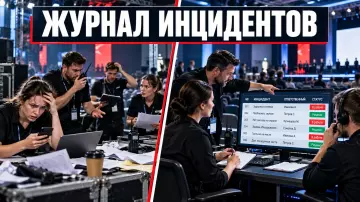
In the event of a power outage, the team follows a pre-approved incident card. The observer reports which functions have been lost, and the command centre confirms the scale of the failure with the venue and the technical lead. Electrical operations are performed only by authorised specialists. All other participants switch the programme to the agreed mode, check critical functions, inform guests if necessary, and return to the normal scenario once technical confirmation is received.
We deliberately do not describe the procedure for electrical operations in this article. It depends on the facility's electrical scheme and must be held by those authorised to work with the installation. The team's general actions can be documented in advance.
- The observer reports the fact: which functions have been lost, where and when it happened.
- The command centre confirms the scale of the failure through the venue and the technical lead.
- The authorised manager gives the instruction to switch the programme to the agreed mode.
- The electrician or venue engineer performs the operations according to their own procedure.
- Function owners check registration, communications, display, sound, network and recording.
- The host or coordinator delivers a pre-prepared message to guests if one is needed.
- The command centre records which functions are available and which restrictions apply.
- Returning to the normal programme is authorised after confirmation from the technical service and the owners of critical functions.
The card helps eliminate guesswork:
The table summarises the key points of this section: Field, What to record in advance. Use it as a quick reference when preparing your event.
| Field | What to record in advance |
|---|---|
| Failure symptom | the observed fact, without assuming the cause |
| Who checks | the role that confirms the system status |
| Who decides | the owner of the switch to backup mode |
| Who switches | the authorised technical specialist |
| What we preserve | the critical functions of the current programme block |
| What we simplify | the agreed screens, lighting, broadcast or other elements |
| Message | a short text for the team and guests |
| Return condition | the set of confirmations required for normal mode |
We covered the overall approach to incident levels, messages and authority in the event crisis management plan. For a power failure, this model gains technical dependencies and tolerances.
If the network and registration also depend on the failed line, the team must have a standalone mode. The article on running an event without mobile internet shows how to test the entire function chain, including the power supply to local nodes.
Post-test documentation and the retest rule
After the test, the team receives a report with observed facts, findings, owners and retest conditions. The document records the version of the schematic, the load composition, participants, criteria and the result for each critical function. A verbal "everything works" does not show what exactly was checked or what limitations remain. The report lets the confirmed status be handed over to the next shift, the client and the venue.
The confirmation package includes the current load schedule and the functional schematic to the agreed scope. We attach separately the marking map of backup lines, equipment data and the documents required by the venue. We supplement the test scenario with the list of participants, criteria, observations and logs taken by the specialists.
For each deviation we record:
- what we expected to see;
- what actually happened;
- which function the deviation affected;
- who is fixing it;
- which decision we need to revisit;
- what exactly is being retested;
- who gives the final readiness status.
The US National Institute of Standards and Technology (NIST) recommends setting test objectives and criteria in advance and, after the check, recording the conclusions and corrective actions. We carry this principle over into a short production report for the event.
A retest is needed after changes that affected the load or the power path. These include equipment replacement, relocating the connection point, a new version of the distribution, changes to the UPS, generator or switching. The decision on the scope of the retest is made by the technical lead together with the relevant specialists.
For conference organisation, the report links the technical side to the programme. The producer sees the limitations, the director knows the available functions, and the client gets a basis for the readiness decision.
Client checklist before approving the backup power plan
The plan can be approved once the team knows the set of backup functions, acceptable interruptions, roles and venue constraints. For each critical function, the primary and backup paths must be clear, and a qualified specialist must be assigned to the electrical solutions. An end-to-end test shows the actual switching result. Without an owner, documentation or a test, having a generator and a UPS does not by itself eliminate the risk.
Before final sign-off, ask the team these questions:
- Which event functions must run without interruption?
- Which functions come back after switching?
- Which loads are switched off in backup mode?
- Which built-in safety systems does the venue confirm?
- Who performed the engineering calculation and checked the documentation?
- Which specific devices are connected to the UPS?
- Has the compatibility of the UPS, generator and switching been confirmed?
- Who is authorised to connect, switch and emergency-shut down the system?
- Where is the portable generator installed, and who has approved the exhaust, fuel storage, fire measures and access?
- Has the transition been tested with a load close to the working load, up to the final functions?
- Is there a list of issues and confirmation of a repeat test?
- What will guests see and what will the host say during a failure?
- Under what conditions does the programme continue, pause or end?
Technical and sound equipment is selected once the programme, venue and system constraints are clear. The electrical part is calculated and approved by a specialist in the field.
If a critical question has no owner, documentation or test, its status remains open. This is stated explicitly in the budget and schedule. The phrase "we'll sort it out during setup" moves the risk to the most expensive and stressful moment of the project.
Frequently asked questions
In short: one generator is not enough because backup works as a chain. The team identifies critical loads, the acceptable interruption and the switching sequence in advance. A UPS supports the selected devices until power is restored or another source starts. The generator supplies the agreed groups once it has started. The performance of the whole scheme is confirmed jointly: from the line and cable route to the responsible parties and the end equipment.
First, the team divides functions by the consequences of an interruption: what must run continuously, what can be restored after switching, and what may be switched off. The engineer then links the priorities to specific equipment and calculates the scheme. Such a matrix helps discuss backup in terms of the programme's tasks rather than a list of rented equipment, and it immediately shows which decisions the venue must confirm.
The main difference: a UPS supports the selected loads immediately after the loss of mains power and provides time for switching over or a correct shutdown. A generator can supply the agreed groups for longer after starting, stabilising and switching. These devices perform different tasks and can complement each other. The composition of the scheme, equipment compatibility and the actual result are confirmed by calculations and a joint test.
In practice, the client compiles a single register of consumers and shows the dependencies between them. For each function, the equipment, operating mode, priority and backup path are specified. A qualified specialist then checks the register against the nameplate data and the survey results. On this basis, they calculate the capacity, cables, protection and switching, and the team receives a clear list of input data and open questions.
Responsibilities are allocated before installation. The client sets the programme priorities, the venue confirms access to the grids and the site's constraints, and the specialist is responsible for the electrical part within their role. A person who leads the test and authorised personnel for switching are appointed separately. If power is lost during the event, the team must know immediately who makes the decision and who is informed of the result.
The test covers the agreed failure scenario from the input to the end functions. During the test, the operation of the UPS, the start of the backup source, switching, distribution and the behaviour of the event equipment are observed. Simply starting a generator without a working load does not confirm the readiness of this chain. The result criteria, the participants' authority and a safe testing method are agreed in advance with the venue and the specialists.
If you need to put together a Plan B for a specific venue, submit a request via the final form. At Aventura, we will link the programme, critical functions, contractors and the rehearsal, and pass the calculations and connections to the authorised specialists.
Sources
- HSE: Electrical safety at events
- HSE GS50: Electrical safety at places of entertainment
- EMERCOM of Russia: safety measures when operating a power generator
- NIST SP 800-34 Rev. 1: Contingency Planning Guide
Contents
Was this article helpful?