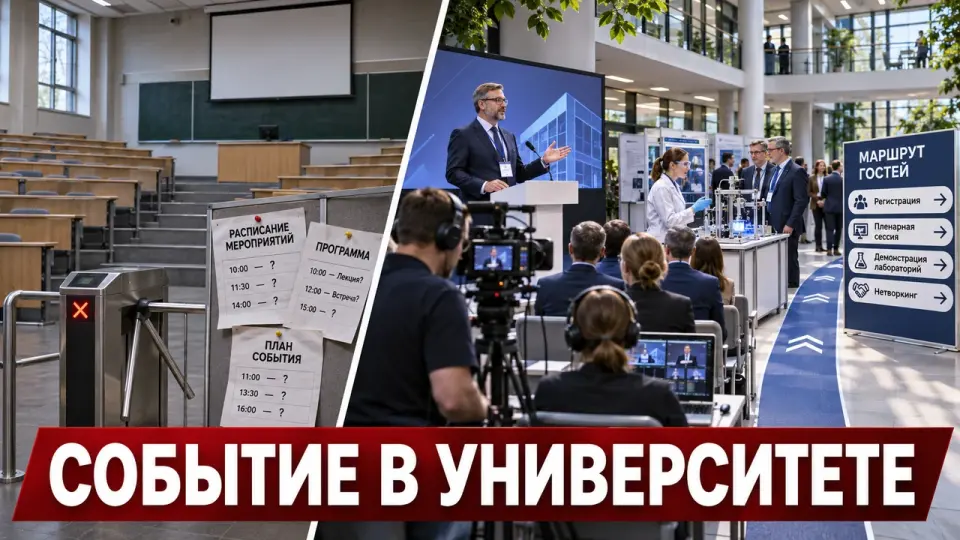
We explain how to choose a university for a business event and coordinate experts, laboratories, security and guest management.
In short: an event at a university gives a company a substantive environment, access to experts and the chance to show research live. But a university cannot be chosen like an ordinary conference hall. First we check who manages the premises, how access is arranged, which laboratories are ready to receive guests and what is permitted to be filmed.
A university venue often looks ready on the very first tour: there is a lecture hall, a screen is mounted, and a laboratory operates in the neighbouring building. The difficulty emerges later. The academic timetable shifts the setup window, security asks for guest lists, the laboratory limits group size, and an expert cannot speak at the requested time.
At Aventura we start such a project with a map of decisions. First we identify the client and the university representative. Then we add the owners of the premises and laboratories, the technical team, security and filming. Until every question has an owner, the programme remains a draft.
Discuss a business event at a university
Why should a company hold an event at a university?
The point: a university works when the setting itself helps solve a business problem. Here you can combine talks, conversations with researchers, demonstrations of developments and introductions to future specialists. If a company only needs a hall for a few hours, an ordinary conference venue will often be simpler to produce. Here, the campus context must serve the purpose of the meeting.
We start by answering the question of what should change after the meeting. Should partners understand the technology better? Do executives want to discuss joint research? Is the company opening a learning space?
Perhaps a conversation with young specialists is needed. The answer determines the choice of university, building, experts and format.
A university is especially appropriate for four tasks:
- show the connection between a product and research and education;
- bring together an industry discussion with academics and practitioners;
- hold the opening of a lecture hall, centre or joint programme;
- introduce clients or employees to research infrastructure.
The venue has a meaning of its own. The HSE University Cultural Centre, for example, describes itself as a space where culture, science and creativity intersect. This context influences guests' expectations and the programme. You cannot put any corporate scenario into a university interior and assume that the setting will add substance on its own.
We state the goal in one sentence with an observable outcome. For example: "After the meeting, partners understand three areas of joint work and know whom to continue the conversation with." This formulation is more useful than a general wish to "show innovativeness". It can be used to select topics, speakers and route stops.
The venue starts with a map of restrictions
Practice: when choosing a university, we assess not the building as a whole, but the combination of guest, program and service areas. For each area, we check opening hours, access rules and the responsible employee. This way the event plan reflects the actual operation of the building, not just the capacity of the main auditorium. We separately note class schedules and setup windows.
The official ITMO page about workspaces shows how different the regimes can be within a single university. Opening hours depend on the area, and some rooms require a pass. Meeting booths are booked through an internal system. For the organizer, this means that a verbal "yes, we have a hall" is not enough.
At the first meeting with the university, we ask them to break down the venue into areas:
The table summarizes the key points of the section: Area, What we check, Who confirms. Use it as a quick reference when preparing the event.
| Area | What we check | Who confirms |
|---|---|---|
| Main hall | capacity, seating, stage, sound, screen, setup time | premises owner and technical service |
| Registration | entrance flow, turnstiles, lists, stands, cloakroom | building administration and security |
| Laboratories | group composition, route, accompanying staff, prohibitions | laboratory head |
| Catering | unloading, storage, water, power supply, cleaning | administration and food contractor |
| Filming | permitted areas, people, screens, samples | press service and facility owners |
| Accessible route | entrance, elevator, passages, restroom, seating | administration and accessibility specialist |
Then we map these areas onto the flow plan. Guests should not cross paths with setup, food delivery or class schedules in a narrow corridor. The speaker needs a short path to the stage. The film crew needs a place for equipment that does not block the emergency exit.
At this stage, we also outline the budget boundaries. The university may provide an auditorium and basic equipment, but additional microphones, lighting, signage, furniture or enhanced internet will require a separate solution. We ask for a written list of included resources and verify them during the site visit.
This way, the budget does not have a single line "university rental" whose meaning different parties understand differently. We separately record who is responsible for cleaning after setup, restoring furniture and removing temporary structures. These costs are easier to estimate before signing the contract than to look for a contractor in the evening after the event.
If the project includes several buildings, we check the transitions in real time. On the plan, two buildings may stand next to each other, but the actual path goes through the street, a checkpoint and a staircase. Such a transition cannot be hidden in a five-minute break.
How to vet a university before booking?
Our approach: before signing the contract, we carry out a technical and programme inspection. It is attended by people who can confirm access, installation, laboratories and security. After the inspection, the team receives a report with photos, restrictions, responsible persons and decision deadlines — not a set of verbal promises. Open issues are assigned an owner and a review date.
The inspection follows a set order.
- We match the business objective against the university's profile. A strong research school is only useful when its fields are related to the topic of the meeting.
- We request the calendar of academic and internal events for the required date. We are interested in classes, exams, thesis defences, open days and works in the building.
- We walk the guest route from drop-off to the seat in the hall. We separately walk the route of a guest with reduced mobility.
- We check the installation entrance, lifts, doorways, electrical load and connection points.
- We meet the laboratory owners. We discuss the group composition, duration, protective clothing, filming and backup options.
- We record the access control rules: what data is required, when the lists close, how foreign guests and contractors are admitted.
- We clarify the branding rules. The university may restrict fixing structures, covering surfaces and placing external advertising.
- We compile a report of decisions and open issues.
We confirm the deadlines for submitting lists, the composition of guest data, contractor access and participant substitutions with the specific university. Local access rules depend on the building and the site's security regime, so they cannot be carried over from a previous project.
We do not include the laboratory tour in the invitation until the route is confirmed in writing. A public tour on the university's website shows that such a format exists, but it does not automatically grant a corporate group access on the chosen date.
On Skoltech's page, the overview tour is described as a separate programme of about an hour and a half with campus sites designated in advance. For us this is a good reference point: the route has a duration, an age rating and content. It cannot be put together on the fly between two talks.
If an external organiser is needed, it is better to bring in business event management before the final choice of building. That way the scenario, the technical inspection and the agreements with the university develop together, rather than conflicting after booking.
An event at a university requires a single shared protocol. It must align the promises made to guests, the capabilities of the venue and the decisions of the owners of the research infrastructure.
Request a review of the venue and programme
An expert programme with no random big names
Short answer: a strong expert fits the topic, the audience and the role in the programme. We check recent work, practical experience, the ability to explain without unnecessary jargon, and willingness to follow the format. Fame helps attract attention, but it does not replace substantive relevance. Until participation is confirmed, we do not put the name in the public programme.
HSE University's material on working with experts states the basic criterion directly: a specialist must be well informed and competent in their field. A suitable person can be found through the press service of a relevant organisation, publications and recommendations. For a business event we add several more filters.
First we define the role. One academic gives an industry overview. Another explains the research method. A company representative shows the application.
The moderator connects the positions and keeps the conversation on topic. If everyone is given the same twenty-minute presentations, the programme quickly becomes monotonous.
Then we hold a short editorial call. We ask the expert to formulate three key points, give examples, show materials and identify topics that cannot be discussed publicly. The same call shows whether translation from academic language into business language is needed.
Scientometric indicators are useful as one of the reference points. An ITMO.NEWS interview explains that bibliometric databases help find current, frequently cited works and active authors. But indicators depend on the discipline. That is why we do not choose a speaker solely by index or number of publications.
A working expert brief contains:
- why their talk is in the programme;
- who is in the room and what the audience already knows;
- one main question of the talk;
- duration and format;
- permitted and off-limits topics;
- presentation requirements;
- the procedure for questions and contacts after the event.
For a conference programme we also check the balance. University representatives take part in the content part. Company representatives also get a full role and do not remain spectators at an academic lecture. A good conference or seminar is built around a common question that each side answers from its own position.
How to integrate laboratories into a business programme?
The key point of the route: the laboratory must answer the programme's question. Guests do not come there for rare equipment as a backdrop. They need to understand what task the team is solving, what exactly can be seen, and how what they see relates to the industry, product or partnership. Each stop ends with a clear takeaway for the guest.
The 2015 St Petersburg University regulations described an introductory tour as a separate process and named the participants from the Science Park and the resource centre. We use it only as an example of points to agree, and we request the current procedure from the university before the project. A laboratory demonstration depends on the people responsible for the equipment, research and safety. The venue administration cannot confirm it on their behalf.
We build the route as a small standalone programme:
- We formulate one question for each stop. For example: “How is the material property that matters to production measured?”
- We define the visible object: an installation, a sample, a test rig, a safe demonstration or a screen with results.
- We appoint a speaker who works in that laboratory and knows its limitations.
- We limit the scope of the explanation. The guest should leave with one clear idea, not a summary of a university course.
- We divide the flow into groups according to the confirmed capacity of the area.
- We appoint a group host and a staff member who brings up the rear.
- We check the transitions, protective equipment, storage for outerwear and personal belongings.
- We prepare a backup module in the main hall.
A backup is needed even with good coordination. A research installation may be in use, access to the room may be temporarily restricted, and a specialist may be called away on a work task. Instead of an empty slot, we prepare a conversation with a researcher, video material, a safe sample or a data review. The backup must preserve the meaning of the programme, not just fill time.
We run groups in slots. While one group is on the route, another takes part in a case study, meets an expert or joins a discussion with a moderator. This parallel scenario reduces the load on the corridors and helps avoid a queue at the secure door.
The photographer and videographer receive a separate brief. It lists the permitted rooms, angles, people, screens and samples. The phrase “you can shoot” is too general. A working record, personal data on a monitor or an object that cannot be shown publicly may end up in the frame.
Case AV55: opening of the Bayer computer classroom at OmGAU
Fact: our portfolio includes the opening of a Bayer classroom at Omsk State Agrarian University named after P. A. Stolypin. The event was attended by 150 guests. The project combined the opening of a new computer classroom, a formal ceremony, a press conference and photo and video production. The public project card confirms these details.
This case is useful because it shows what a university opening involves without unnecessary speculation. There is a physical facility, an official moment, work with the media and content after the event. Each block requires its own scenario and its own team.
The ceremony answers the question of what is being opened and why it matters to the parties involved. The press conference gives journalists facts and an opportunity to ask questions. The production team is responsible for sound and timing, guides guests and coordinates transitions. Photo and video capture the event for further communication.
We deliberately do not attribute a laboratory tour or a business outcome to the project. This is not on the portfolio page. For a new programme, the case serves as confirmation of experience in university openings, while a laboratory route is designed separately for each specific university.
If a company opens a classroom, a centre or a shared space, it is useful to link the ceremony to the future life of the facility. The programme can give the floor to those who will use the space, present a learning objective and explain the terms of the partnership. But all such elements must be confirmed by the client and the university.
For projects of this type, the service of organising presentations and openings is suitable. We combine the official scenario, guest management, the press block and technical production while respecting the rules of the university venue.
Safety, accessibility and guest rules
Important: safety is verified against the actual scenario, not merely the existence of the building. Layout, temporary structures, cables, registration desks, catering and crowd flows change the conditions of the venue. The university and the organizer must agree in advance on who is responsible for inspections, duty cover, evacuation and informing guests. We record these roles in the team's overall scenario.
The fire safety regulations set separate requirements for events with large numbers of people. For an event with 50 or more participants, the head of the organization ensures that the premises are inspected before the start and that responsible persons are on duty on stage and in the hall areas. Before the project, the current version of the regulations and the venue's internal instructions must be checked.
We discuss five practical questions with the university:
- who carries out the pre-event inspection;
- who is on duty in the hall and along the route;
- which aisles and doors must be kept clear;
- how the team receives the evacuation signal;
- who decides to stop the programme.
We also assess accessibility along the entire route. Rosstandart publishes the current SP 59.13330.2020 on accessibility of buildings and structures for people with limited mobility. For the organizer, the check starts at the drop-off point and ends at the seat in the hall, the laboratory, the cloakroom and the restroom.
A ramp at the main entrance does not solve the problem if beyond it there is a heavy door, a staircase with no alternative or a narrow passage to the laboratory. We walk the route together with a representative of the venue, measure the time and note the places where staff assistance is needed. If part of the programme is inaccessible, we prepare an equivalent substantive alternative and communicate the conditions honestly before registration.
We send the guest rules in advance. On the Skoltech campus tour page, for example, it separately states the advance purchase of tickets, the submission of participants' full names as in their passports, the passport itself for entry and the age restriction for the specific route. For a business format the list will be different, but the principle is the same: documents, clothing, lateness, accompaniment and prohibitions must be clear before arrival.
At the registration desk there is a short memo for the team, not a legal tome. It lists the contacts of the responsible persons, the entry procedure, guests' special needs and actions to take if the route changes.
What needs to be agreed for filming, data and catering?
Answer: these three areas require dedicated owners and written rules. Registration involves personal data, filming involves people and objects in frame, and catering involves food safety and building infrastructure. A general "the university has no objections" is not enough for them. We fix decisions before registration and production begin.
Registration and personal data
Article 9 of Federal Law No. 152-FZ governs the subject's consent to personal data processing. We do not replace a lawyer and do not offer a one-size-fits-all form. At the start of the project, the parties fix the purposes, the composition of data and operations with it, while the actual roles of the operator and persons processing the data are determined together with a lawyer. The conditions for providing information and the storage period are also agreed there.
If the university needs a list for passes, we separate registration data and access data. The guest should understand why each field is requested. The list is not forwarded via general chats or printed unnecessarily.
Photo and video
Before the event, we draw up a filming map. It marks the main hall, stage, interviews, laboratories, screens, samples and no-camera zones. We separately check people's consents and the client's rules. For subsequent publication, a pre-approved list of storylines is useful: opening, comments from the parties, experts at work, general shots and details of the venue.
Photo and video filming of the event starts with an editorial brief. Then the team shoots material for a report, media or social networks, rather than simply accumulating hours of random video.
Catering
Rospotrebnadzor, in its guidance on safe catering, writes about process traceability and the division of responsibility during production, transportation, storage and sale of products. At a university venue, we translate this into a specific checklist:
- where the vehicle is unloaded;
- who admits staff and when;
- where food, dishes and packaging are stored;
- what water and power supply are available;
- who is responsible for temperature and timing;
- how the area and waste are cleaned;
- what happens to leftovers after the event.
We place the coffee break where it does not block the flow of students and exits. Smell, clatter of dishes and queues also affect nearby classes. Sometimes it is better to open two small stations than one large one in a narrow lobby.
Role matrix and event day
An organization becomes manageable when every decision has a single owner. We build the role matrix before registration opens and update it after the technical meeting. On the event day, the team works from a shared scenario where access, equipment, security, and responsible persons are listed alongside the program.
The minimum composition of the matrix is as follows:
The table summarizes the key points of the section: Decision, Client, University. Use it as a quick reference when preparing the event.
| Decision | Client | University | Aventura | Expert or laboratory |
|---|---|---|---|---|
| Goal and audience | approves | advises | translates into format | clarifies relevance |
| Venues and date | agrees | confirms | checks scenario and setup | confirms access |
| Program | approves | agrees | assembles and directs | prepares content |
| Passes | provides guest requirements | sets procedure | builds the process | submits employee lists |
| Security | accepts rules | responsible for the venue | integrates requirements into production | complies with zone regulations |
| Filming | sets publication goals | authorizes zones | prepares brief and production | confirms display objects |
A few days before the event, we hold a general dispatch meeting. We do not re-read the entire project. We focus only on handover points: who opens the setup entrance, when speakers arrive, who meets laboratory groups, where the backup presentation is stored, and who is notified of a route change.
In the director's script, each block has four lines: what the guest sees, what the team does, what equipment is running, and who makes the decision. For the laboratory route, we add group composition and return time. For the press approach - speakers, background, order of questions, and end of filming.
On the event day, we maintain a single operational communication channel. Long discussions go to responsible pairs, while the general channel receives only the decision. This reduces noise and helps quickly understand which version of the program is currently in effect.
After registration closes, the team checks the hall, signage, lists, available route, laboratory readiness, and backup. If one point is not ready, we change the program before guests arrive rather than explaining the problem at the door.
How do you know the format worked?
Results are assessed against the goal of the meeting. The criterion depends on the objective. For a partner event, we look at follow-up negotiations and who owns the next steps. For an opening, we assess the clarity of the message and the quality of the materials. After an expert conference, we review the questions, contacts and topics for follow-up. We choose the metrics before the event together with the client.
We don't stop at the number of registrations and a full room. These figures show interest and attendance, but say nothing about the quality of the conversation. Before the event, the client selects several observable signs of success.
For different objectives, they will be as follows:
- partners chose directions for the next working meeting;
- experts shared materials and contacts to continue the dialogue;
- guests understood the purpose of the open space;
- the press office received approved comments and visual materials;
- the university team and the company identified the owners of further actions;
- participants gave feedback on the content, the route and the organisation.
After the event, we hold a short debrief with the client and the university. We check the facts: where the timing changed, which questions came up repeatedly, whether there was enough time in the laboratories, whether the contingency plan worked, whether there were any access issues. We immediately turn the findings into an action list with owners.
It is better to prepare substantive follow-up before the event date. This could be a closed meeting on one direction, sending approved materials, a series of interviews or a working group. That way, the event at the university doesn't end with the last slide.
If you need to bring the venue, experts, laboratory route and production together into a single plan, we will prepare a concept, an approvals map and a budget without unconfirmed promises to guests.
Frequently asked questions
We start by answering the question of what should change after the meeting. Should partners gain a better understanding of the technology? Do executives want to discuss joint research? Is the company opening a learning space?
The official ITMO page on workspaces shows how different the rules can be within a single university. Opening hours depend on the zone, and some rooms require a pass. Meeting booths are booked through an internal system. For an organiser, this means a verbal "yes, we have a hall" is not enough.
The check follows a specific order.
HSE University's material on working with experts states the basic criterion plainly: a specialist must be well informed and competent in their field. A suitable person can be found through the press office of a relevant organisation, publications and recommendations. For a business event, we add a few more filters.
St Petersburg University's 2015 regulations described an introductory tour as a separate process and named the participants from the Science Park and the resource centre. We use it only as an example of the questions to be agreed, and we request the current procedure from the university before the project. A laboratory demonstration depends on the people responsible for the equipment, the research and safety. The hall's administration cannot confirm it on their behalf.
This case study is useful because it shows the makeup of a university opening without unnecessary speculation. There is a physical object, an official moment, work with the media and content after the event. Each block requires its own scenario and its own team.
Sources
- HSE University Cultural Centre
- ITMO: spaces for work
- Skoltech: campus tour
- St Petersburg University 2015 regulations on introductory tours of the Science Park
- Fire safety regulations: requirements for mass events
- SP 59.13330.2020 on building accessibility
- Federal Law No. 152-FZ, Article 9
- Rospotrebnadzor: safe catering
- HSE University: how to work with experts
- ITMO.NEWS: how to use bibliometrics
- AV55 portfolio: opening of the Bayer lecture hall at Omsk State Agrarian University
Contents
Was this article helpful?