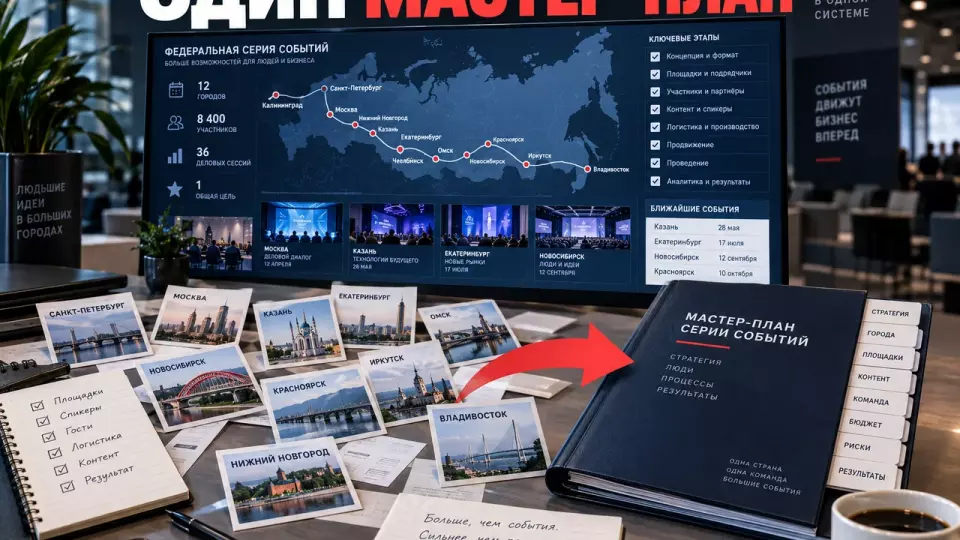
A practical framework for a company with events in multiple cities: a single core, local roles, a city passport, rehearsal, and a shared report.
A series of corporate events in different cities is not just a few identical presentations. In one city, the venue will admit guests through a common entrance; in another, an access list will be required. In some places, the program starts after the work shift; in others, participants come from the region. If each stop is organized separately, the differences will quickly affect logistics, the message, and the reporting data.
At Aventura, we suggest viewing the series as one master project with local versions. The goal, content core, roles, checkpoints, and report format remain common. We adapt the venue, schedule, part of the program, and guest journey to each city. Below is a working framework without invented standards for timelines, staffing, and budget.
Why a series is one project
Briefly: a series of corporate events in different cities requires one goal owner, a common version of the program, and a single decision cycle. City budgets and teams remain independent, but they work within the overall architecture. Otherwise, the client receives incomparable events and cannot explain the outcome of the entire program.
First, we fix the result of the series. This could be introducing employees to a new strategy, product launch for partners, training regional teams, or collecting feedback. The formulation should answer the question: what action will the participant be able to perform after the stop?
Then we define the mandatory core: the key message, part of the program, requirements for the visual system, guest journey, security, and data. A city can propose an adaptation, but does not change the core without a common decision.
Google describes DevFest as events of local communities with common formats: practical sessions, expert content, and networking. Red Hat unites regional events under the Summit: Connect brand, and publishes details for each city. These examples show the connection of a common platform with local implementation. They do not set a universal standard for business.
The main unit of management is the version of the master project. In it, you can see which decisions are made, what changes locally, and what correction should be included in the next stops.
Common core and local version
For the series, the goal, mandatory program blocks, brand, definitions of metrics, and readiness criteria should be unified. The local team adapts the venue, timing, transportation, some speakers, menu, and staff work. Central and local teams define the boundary between the common core and the local version before preparation begins so that changes do not break the standard.
The table summarizes the key points of the section: Layer, Common for the series, Adapted in the city. Use it as a quick reference when preparing the event.
| Layer | Common for the series | Adapted in the city |
|---|---|---|
| Meaning | goal, message, mandatory outcome | examples, local context, questions |
| Program | framework and key blocks | start time, breaks, local speakers |
| Brand | master templates and rules | address, directions, contacts |
| Guest journey | registration statuses | badge, desks, signage |
| Production | technical minimum and rehearsal | equipment, setup window, staff |
| Analytics | metrics dictionary | actual data and reasons for deviations |
Full identity across cities is rarely useful. Participants need a recognizable project adapted to the specific venue. If the central scenario requires registration one hour before the start, but the entrance is combined with security screening for another flow, the local team changes the guest timing. The key message remains the same.
For changeable blocks, we set limits. The local moderator can replace an example but does not change the meaning of the key message. The venue can propose a different lighting plan if mandatory materials are still clearly visible. The team evaluates the boundaries of the solution instead of taste preferences.
How to Divide Team Roles
The central team is responsible for the series' goal, overall standard, master documents, and version management. The local team confirms the actual conditions of the city, venue, and guest journey. Joint decisions are made on program, technical aspects, registration, risks, and reporting. Each decision should have one owner, even if one person combines multiple functions.
The table summarizes key division points: Area, Central Team, Local Team. Use it as a quick reference when preparing your event.
| Area | Central Team | Local Team | Joint Decision |
|---|---|---|---|
| Goal and program | defines the outcome and core | checks applicability | approves the local program |
| Brand and content | produces master layouts | adds confirmed data | reviews the file before production |
| Venue and technical | sets the minimum | inspects the facility | accepts the configuration |
| Registration | defines statuses and fields | sets up the entrance | tests the guest journey |
| Risks | sets the scale | adds city-specific risks | approves the reserve |
| Report | sets the vocabulary | collects data | updates the standard |
The matrix shows decisions and responsibilities. The phrase "marketing approves materials" is too broad. It is more useful to separate the production of the master layout, verification of local data, final approval, and handover to print.
We separately appoint an owner of changes. This person maintains a version log and checks which cities are affected by a new decision. Without this role, a fix for the next stop may not reach the already-started preparation of two other cities.
If you need to connect roles, common format, and materials for cities into one preparation scheme, request a series estimate. We will clarify geography, audiences, the mandatory core, and venue limitations.
You can follow corporate and business event practices in the Telegram channel of Aventura.
Series Working Kit
The series working kit stores current rules, master documents, and links to city versions. It includes the goal, program core, roles, decision calendar, technical minimum, registration, risks, readiness criteria, and report template. Related files get owners and version numbers, so the team quickly distinguishes the mandatory standard from the local appendix.
The kit includes:
- the goal of the series and the outcome of the stop;
- the mandatory program core;
- allowed local modules;
- the matrix of roles and escalations;
- the decision calendar and freeze points;
- file versioning rules;
- the technical minimum and rehearsal format;
- registration statuses and the guest journey;
- risk and reserve cards;
- city readiness criteria;
- city passport template;
- the metrics dictionary and report;
- the review procedure between stops.
Inside the team, such a kit is sometimes called a master playbook. In contracts and letters, we use a clear name: the unified series working kit.
The kit has an index. It lists the current version, owner, date of change, and the cities where it applies. Content, venue layout, and participant list may be stored in different systems. The index keeps them connected.
Why a City Needs a Separate Passport
A separate city passport links the overall program with the actual conditions of the venue, transportation, installation, accessibility, and local contacts. A unified template helps compare stops, while the filled-in version applies only to a specific city. The local coordinator verifies the passport after inspection and walking through the routes for guests, team, and equipment.
The passport includes the address and venue zones, installation window, guest and team routes, internet, power supply, accessibility, noise and construction restrictions, local time, and backup solutions. Service routes, security data, and personal contacts do not appear in public materials.
The local coordinator checks the passport. A photo of the entrance or a plan from a commercial proposal does not replace an inspection. The team walks the path of a guest, speaker, equipment, and emergency exit. Comments get an owner and a date for re-inspection.
Oracle AI World Tour has a common series page and separate instructions for each city. The local guide may include transportation, parking, hotels, badge rules, and venue measures. For a corporate series, the principle of two levels of information is useful. The requirements of another event cannot be transferred directly.
Decision calendar and freeze points
For each layer, we assign its own freeze point: first for the venue and layout, then for the program, equipment, guest data, printing, and broadcast content. After the control point, the decision owner checks the impact of the change on budget, timeline, safety, and related tasks. This order protects the series from silent changes in the latest file.
First, the central and local teams approve the venue and basic layout. Then the program framework, technical scheme, guest data for production, printed materials, and broadcast content. The sequence depends on the format and contracts. There is no universal "two weeks before" date.
Change route:
- describe what changes and why;
- specify affected cities and files;
- assess the impact on timeline, budget, and risks;
- assign a decision owner;
- release a new version;
- confirm receipt by local teams.
We have discussed dependencies and freeze points in detail in the article about event approval calendar.
How to arrange registration
For the series, a common model of registration statuses and a minimum set of data are needed, while each city adapts the entrance and access control. The team keeps the current list in one place, describes in advance actions for guests not on the list, and separately defines the purpose of each processing of personal data. This maintains comparability of analytics and takes into account venue conditions.
Common statuses can describe invitation, confirmation, waiting list, cancellation, and actual entry. If one city considers a confirmed guest as a participant, while another only counts those who have been scanned, the consolidated analytics lose meaning.
According to Article 5 of Law No. 152-FZ, the purposes of processing are determined in advance, and the composition of data is limited to what is necessary for these purposes. If processing is based on consent, Part 1 of Article 9 requires that it be specific, substantive, informed, conscious, and unambiguous, and be executed separately from other information and documents that the participant confirms or signs. For participation, mailing, transfer of data to third parties, and distribution of images, separate purposes and legal grounds are first determined, and then, when required, the relevant consents are obtained. The grounds and texts of documents are checked by the company's lawyer according to the current version of the law.
The field about special needs may reveal health information - a special category of personal data under Article 10 of Law No. 152-FZ. Do not use a free-form field by default for such information. Before collection, define the specific purpose, the minimum list of data, and the legal basis for processing provided by law, limit access and storage period. The form of the question, the basis for processing, and the need for separate consent are checked by the company's lawyer.
Before the event, we test the main and backup entrance. We check confirmation, guest search, badge printing, exception handling, and attendance export. The full scheme can be checked against the guide on event participant registration.
Rehearsal for Each Stop
A local rehearsal is needed in every city because the venue, equipment, people, routes, and facility restrictions change. During the rehearsal, we check how people, equipment, and the script work together: guest entry, speaker entrance, content launch, questions, remote sessions, and the program conclusion. We close a remark only after a repeated test in the actual configuration.
During the technical run-through of key transitions, the team checks guest entry, speaker entrance, presentation and video launch, questions from the audience, remote participation, scene changes, and the program conclusion. The team sees who gives the command, who confirms the action, and what happens in case of failure.
A remark is considered closed after a repeated test. The message "we will replace the cable by morning" records an intention but not readiness. Before opening, the technical director decides whether the critical blocks are ready for launch and notes the limitations.
The scenario of the previous city can be taken as a basis, but it does not automatically become correct. The practical procedure is described in the article about the technical rehearsal of the event.
Accessibility, Safety, and Backup
For the entire series, we set a unified minimum for accessibility, safety, and backups, but the actual plan is drawn up for each venue. The team checks the entrance, routes, stage, restrooms, queues, exit, and communication. The backup preserves the mandatory result of the program even if the main technical or organizational solution becomes unavailable.
W3C recommends checking the accessibility of the entrance, premises, stage, and restrooms, asking participants and speakers about their needs, using microphones and subtitles, and providing materials in adaptable formats. A single PDF does not suit everyone. These recommendations are not Russian legal norms but provide a practical minimum for the brief.
The British Health and Safety Executive divides crowd management into arrival and entry, movement within the venue, as well as exit and dispersal. This is a useful engineering logic. The team checks Russian requirements and facility rules separately for each city.
The local risk card answers four questions:
- what can disrupt the mandatory result;
- by what signal the team notices a problem;
- who makes the decision;
- what backup can be activated in time.
If a speaker does not arrive, a moderated remote session or a prepared module can serve as a backup. If the main entrance is unavailable, the flow cannot be directed to a service door without checking safety and accessibility. For common risks, we update the event crisis plan.
ISO 20121:2024 describes a management system for the environmental, social, and economic impacts of events. Giving up plastic cups does not provide grounds to claim compliance with the standard. In the work plan, transportation, printing, procurement, and food waste can be measured without loud promises.
What to analyze between cities
After the stop, the team decides what to keep, what to change locally, and what to update for the whole series. Based on the meeting results, we release a new version of the working kit with owners and deadlines. We transfer observations from the chat into tasks. A solution is considered transferable if it suits the next venue and does not depend on the accidental success of one stop.
Five questions for analysis:
- whether the required result was achieved or not;
- which deviation will repeat in the next city;
- what was specific to the particular venue;
- which solution changes the overall standard;
- who will check the new version and when.
Not every improvement needs to be scaled. A successful local activity may depend on the audience or the speaker. First, we separate the transferable principle from the accidental result. Decisions affecting the contract, security, data, or budget are confirmed by the owners of these areas.
The version after analysis receives a number and a list of changes. The next city confirms that it uses exactly this version. That way the series learns between stops but remains manageable.
Comparable series report
To compare cities, we define common metric definitions and a single data structure in advance. Each city submits facts, explains deviations, and records next actions. The series summary separates measured results from interpretation. Before the start, we link metrics to the goal so that attendance and program ratings do not replace the business result.
Before the start, we define metrics linked to the goal. For training, this could be a completed action after the session. For a partner program, an agreed next step and the person responsible for it. Registration, attendance, and program rating are useful, but they do not prove the business result by themselves.
In the city report, we record:
- the stop's goal;
- invitations, confirmations, and actual entry;
- participation in required blocks;
- questions and substantive signals;
- completed actions;
- deviations and reasons;
- next steps and owners.
Comparing cities by a single summary metric is dangerous. They have different audience sizes, transportation, and participant composition. First, we check comparability. We have outlined the logic for choosing corporate event KPIs in a separate guide.
What to provide for the estimate
To prepare the estimate, we need the goal, list of cities, target audiences, participant range, event window, and the mandatory core of the program. Also provide requirements for registration, branding, data handling, access control, reporting, and any known venue restrictions. You don't have to select all venues in advance: a preliminary estimate can be built on assumptions and refined after logistics check.
Prepare:
- the goal of the series and the expected action after each city;
- the list of cities or selection criteria;
- target audiences and the working range of participants;
- the event window and the order of stops;
- mandatory program blocks;
- brand and product materials;
- requirements for registration, data handling, and access control;
- known venue restrictions;
- the reporting format for management;
- stakeholders approving the program, budget, and safety.
Based on this, we will propose a master format, a role model, the contents of the city package, and preparation stages. The estimate will become more accurate after venue and logistics verification. In the preliminary estimate, we will list all assumptions separately.
Frequently Asked Questions
In short: a series of corporate events across different cities requires a single owner of the goal, a common program version, and a unified decision cycle. City budgets and teams remain independent but work within the shared architecture. Otherwise, the client ends up with incomparable events and cannot explain the overall outcome of the program.
For the series, the goal, mandatory program blocks, brand, definitions of metrics, and readiness criteria should be unified. The local team adapts the venue, timing, transportation, some speakers, menu, and staffing. The central and local teams set the boundary between the common core and the local version before preparation begins, so that changes do not break the standard.
The central team is responsible for the series goal, the common standard, master documents, and version control. The local team confirms the actual conditions of the city, the venue, and the guest journey. We make joint decisions on the program, technical setup, registration, risks, and reporting. Each decision must have one owner, even if one person combines multiple roles.
The series working kit contains current rules, master documents, and links to city versions. It includes the goal, program core, roles, decision calendar, technical minimum, registration, risks, readiness criteria, and report template. Linked files receive owners and version numbers, so the team quickly distinguishes the mandatory standard from the local application.
A separate city passport links the overall program with the actual conditions of the venue, transportation, setup, accessibility, and local contacts. A unified template helps compare stops, while the filled-in version applies only to a specific city. The local coordinator reviews the passport after inspecting and walking through the routes for guests, crew, and equipment.
For each layer, we set its own freeze point: first for the venue and layout, then for the program, technical setup, guest data, printing, and content for broadcast. After a checkpoint, the decision owner assesses the impact of a change on budget, timeline, safety, and related tasks. This order protects the series from silent changes in the latest file.
Planning a series of corporate events in different cities for branches, partners, or clients? Request a budget and preparation plan. We will break the project down into a master format, city packages, milestones, and a consolidated report.
Sources
- Google for Developers: DevFest
- Oracle AI World Tour
- Oracle AI World Tour: planning guide
- Red Hat Summit: Connect
- Microsoft Event Code of Conduct
- W3C WAI: Making Events Accessible
- HSE: Put crowd controls in place
- Federal Law No. 152-FZ, Article 5
- Federal Law No. 152-FZ, Article 9
- ISO: ISO 20121
Contents
Was this article helpful?