A working structure for the annual corporate events plan: goals, audiences, formats, budget scenarios, calendar dependencies, KPIs and quarterly review.
An annual corporate events plan is not about filling every free date in advance. It helps link events to company objectives, eliminate duplication, see the workload on teams and protect the budget.
Usually departments build their calendars separately: HR plans internal events, marketing prepares client meetings, and managers schedule strategy sessions. Procurement only learns about some of the tasks just before the tender. As a result, the same participants receive several invitations in a row, and production deadlines overlap.
At Aventura, we suggest starting with a single register of initiatives. First the company decides who each event is for and why it is being held. Then it chooses the format, its place in the calendar, the budget scenario and the way it will be evaluated.
Leave a request and we'll discuss your task
We'll clarify the event format and suggest the next step.
Where should you start with an annual event plan?
Start with the company's goals for the year, not with a list of holidays. Write down the changes that need to happen among employees, clients, partners or managers. Then determine which joint action will actually help. Only after this check should you discuss the event, the format and its place in the calendar.
For each goal, ask five questions:
- What decision or change does the company need?
- Who should take part?
- What should the audience understand, discuss or do?
- Why does this require an in-person, online or hybrid format specifically?
- Who will use the result after the event?
For example, a strategy session isn't needed because it's held once a year. It's needed if managers have to choose priorities, agree on decision owners and set actions in motion. We covered how to prepare for this format in detail in our piece on the strategy session for a company.
An event isn't always the best answer: a project status can be shared by email, and a training recording can be made available on request. A meeting is worth keeping in the plan if being together in person changes the quality of the decision, the exchange of experience or the relationships between people.
In short: a good line in an annual plan starts with a goal and an audience. The date and format come later.
An event portfolio instead of a list of holidays
In the overall programme for the year, every event needs its own role. A single portfolio helps compare initiatives, spot duplication and see competition for audience or resources. On this basis, the company decides what to keep, merge, move, test at a smaller scale or cancel. This overview is needed before the budget is allocated.
Divide future events by area. For a large company, a working map might look like this:
The table brings together the key points of the section: Area, Possible objective, Example formats. Use it as a quick reference when preparing an event.
| Area | Possible objective | Example formats |
|---|---|---|
| Strategy and management | make decisions, align executives | strategy session, executive council, results presentation |
| People and culture | onboarding, recognition, team interaction | employee festival, Family Day, sports day, team building |
| Learning and practice | transfer a skill, review case studies | seminar, workshop, professional competition |
| Clients and partners | share plans, develop relationships, demonstrate the product | client day, dealer conference, presentation |
| Brand and industry | public agenda, expert exchange | forum, conference, press event |
These are not five independent calendars. All rows stay in one portfolio so you can see shared audiences, executive availability, procurement workload, venue availability and the load on the internal team.
Separately mark mandatory, strategic and experimental events. A mandatory event cannot simply be removed because of a budget cut. Strategic events are protected through their link to a goal, while experimental ones are run at a limited scale. For an experiment, decide in advance on the criteria for continuing it.
Which events should go on the calendar?
Include an event if it has a distinct objective, a clearly defined audience and an outcome that cannot be achieved more simply. Check the owner, the production horizon and what happens after the finale. Repeating last year's format is not in itself a reason to include it in the new plan. This check filters out events that are included out of inertia.
Collect requests from departments in a single format. Then check each one against four filters:
- Relevance. The event is tied to a company or departmental priority.
- Distinctiveness. It does not duplicate another meeting, training session or communication channel.
- Feasibility. There is an owner, team time, a production horizon and a budget source.
- Follow-through. It is clear what will happen after the finale and who will take the result forward.
Recurring events also go through this check. In the client day project for Ekoniva, the formal part was combined with an informal follow-up. For an annual portfolio, the principle itself matters: a repeatable format must support a current objective each time, rather than exist out of inertia.
If several departments are targeting the same audience, try combining the initiatives. A joint day for partners could include a plenary session, product tracks and negotiations. But combining is only justified when the programme remains coherent and participants do not have to choose between equally important blocks.
Leave a request - let's discuss your task
We'll clarify the event format and suggest the next step.
What should be recorded in the event card?
The event card holds the minimum data needed to compare and launch a project. It should be short but sufficient for HR, marketing, finance, procurement and the production team. A single format makes gaps easy to spot, lets you compare initiatives and send an approved idea into a detailed brief. The decision becomes clear to every function.
Use the same set of fields for all initiatives:
The table summarises the key points of this section: Field, What to record. Use it as a quick reference when preparing an event.
| Field | What to record |
|---|---|
| Name | a working title without promotional wording |
| Objective | the solution or change the event supports |
| Audience | segments, expected number of participants, geography |
| Format | in-person, online or hybrid; business, team, client |
| Owner | one employee responsible for the decision and status |
| Period | the delivery window and the deadline for key decisions |
| Budget | the base scenario and the source of funds |
| Dependencies | procurement, contract, venue, speakers, registration, content |
| Risks | conditions that could change the timeline, composition or cost |
| Metrics | what we measure, where the data comes from, who uses the report |
| Next step | the decision, action or communication after the event |
The card does not replace the brief and the production plan, but it helps decide whether to start preparation. Once approved, its data moves into the detailed documents.
At Aventura, we link the card to the entire project journey: from brief and concept to production and the final report. If a company needs a single contractor for a series of internal events, the scope of work can be clarified on the turnkey corporate party organisation page.
Annual budget: three scenarios
We recommend preparing three working scenarios for the annual budget: base, reduced and expanded. This comparison shows which goals and audiences are protected under different conditions. For each scenario, record the assumptions, the mix of events and the consequences of any change, not just the total amount. That way, cuts remain manageable.
The table summarises the key points of this section: Scenario, What we record, Management question. Use it as a quick reference when preparing an event.
| Scenario | What we record | Management question |
|---|---|---|
| Base | priority portfolio under expected conditions | which goals and audiences we cover |
| Reduced | mandatory minimum and protected tasks | what we combine, reduce or postpone |
| Expanded | additional formats or production quality | what result could justify the increased resources |
Don't cut every line by the same percentage. Sometimes it is wiser to keep one flagship event and cancel two weak ones. In other cases, a large meeting can be split into several regional formats. The decision depends on the audience, the objective and the cost per contact, not on habit.
Scenarios need explicit assumptions: the number of participants, cities, broadcast format, venue requirements, build-out scope, logistics and procurement timelines. A budget for an individual project can be prepared using our breakdown of the corporate event budget.
In the annual plan, separate commitments already made from funds not yet contracted. Then the quarterly review will not disrupt signed contracts and will allow only the available part of the budget to be reallocated.
How do you build a calendar without conflicts?
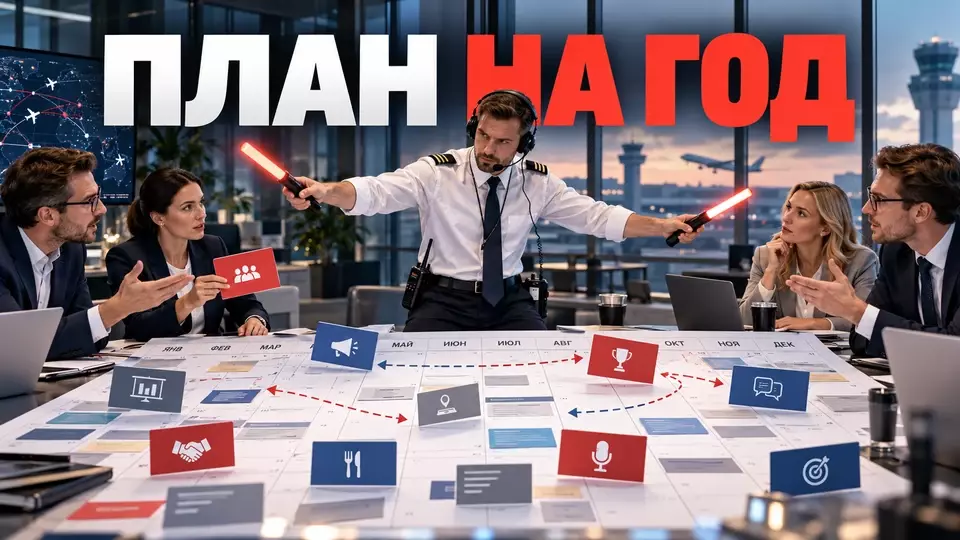
In our experience, a calendar shows the day of the event and the chain of decisions leading up to it. The date on the poster is the last milestone on a long production journey. If earlier decisions are not visible, the team notices conflicts in procurement, content, venues and key participants' availability too late. A shared timeline makes these overlaps visible.
For a large event, mark:
- approval of the task and the owner;
- budget decision;
- procurement procedure and contract;
- choice of venue and date;
- development of the concept and programme;
- confirmation of speakers, performers and contractors;
- launch of invitations and registration;
- production of content, decor and technical solutions;
- setup, rehearsal and delivery;
- post-event communication, documents and report.
Different lines will have different lengths. For an intimate internal format, some stages are shorter. For a conference, forum or client day, key decisions are made earlier. Our business event management service shows how many workstreams can come together in a single project: registration, technical equipment, branding, logistics and programme.
Then overlay the projects on top of each other. Look not only for overlapping dates. Conflicts often arise during the preparation stage, when several teams are simultaneously approving design, purchasing production or requiring the involvement of the same manager.
Important: an annual calendar should show the decision window. If it only contains the event date, it does not help manage workload.
The format follows the audience's objective
Choose the participation mechanic after defining the outcome and the audience's real influence. A stage and presentations are good for conveying a shared framework, but they do little to help develop a solution together or exchange practice. US EPA guidance uses similar logic when choosing the level of stakeholder participation. The promise made to participants must match their authority.
For the annual plan we use our own working scale of four levels. It helps match the format to the objective, but it does not replicate the official EPA scale:
- Informing. Participants need to learn the facts and the overall position.
- Discussion. The audience's questions, objections and experience need to be heard.
- Collaboration. The group creates a solution, a plan or a set of ideas.
- Practice. Participants try out a skill and receive feedback.
A single project can combine levels. At a conference, the plenary sets the context, industry tracks examine the issues, and working groups prepare proposals. For a team task you can use corporate team building if the mechanic is tied to a real team goal rather than existing separately from it.
Do not promise the audience influence it does not have. If the decision has already been made, call the meeting an information session and leave time for questions. If participants are choosing between options, explain the scope of the choice and how the result will be recorded in advance.
Metrics and annual reporting
Metrics should be chosen before the event launches; otherwise the team will only measure what is easy to count. The AMEC framework separates execution, audience response, changes and broader impact. For each line of the annual plan, specify the report user, the data source and the decision they will make. Extra metrics only make collection harder.
Collect metrics by level:
The table summarises the key points of this section: Level, Example questions. Use it as a quick reference when preparing an event.
| Level | Example questions |
|---|---|
| Resources | how much time, money and people were required |
| Execution | whether the programme took place, who took part, what was delivered |
| Response and understanding | what the audience understood, what questions remained |
| Action | what participants did after the event |
| Contribution to the objective | what part of the change can reasonably be linked to the programme |
Attendance does not prove a change in behaviour. A high survey score does not confirm sales. If a metric depends on several channels, write about the event's contribution, not full causality.
We have put together a practical matrix — "objective - metric - data source - action" — in the article on corporate event KPIs. For an annual portfolio, add common fields so that events can be compared without trying to reduce different objectives to a single number.
After each major project, update the annual forecast. The actual budget, attendance, timelines and conclusions become input for the next decisions.
What to do between major events
Between flagship events, maintain useful practice rather than constant noise. The Wenger-Trayner approach describes a community through a shared domain, people interacting, and accumulated practice. So a chat or newsletter needs a topic, an owner, repeatable actions and useful working materials. Without these, the channel quickly goes quiet.
Short case reviews work well for following up on a partner conference. An executive programme can be supported by exchanging working templates and holding meetings on request. Participants in a professional competition will benefit from a library of solutions and a space for mutual help.
Check three elements:
- Domain. Participants understand the shared professional topic.
- Community. People interact regularly and get to know each other.
- Practice. Ways of working, examples, templates and answers to real questions accumulate.
If one element is missing, the channel quickly turns into a feed of announcements. That format may also be needed, but it should not be treated as a community.
Quarterly portfolio review
Once a quarter, compare the baseline plan with actuals and new conditions. The Performance.gov approach is useful for its very logic of regularly reviewing data, owners and obstacles. The meeting should end with concrete decisions on the rest of the year and an updated forecast. Otherwise the review does not change the portfolio.
Before the review, prepare:
- events held and results closed;
- budget plan vs. actual and forecast to year-end;
- changes in business priorities;
- new constraints on people, deadlines and procurement;
- events without an owner, goal or confirmed budget;
- conflicts between audiences and production resources;
- findings from reports and feedback.
At the meeting, decide what to continue, merge, postpone, reduce, expand or stop. Each decision gets an owner and a date for the next check.
Do not rebuild the whole year from scratch. Keep the baseline version and a change log. That way the team can see why an event disappeared, where a new priority came from and where the budget moved.
After a completed project, use the facts from the report and closing documents. The procedure for this stage is set out in the material on the final budget and documents.
Final checklist for the annual plan
Before approving, check that management decisions are complete. Every line should have a goal, audience, owner, budget scenario, timeline, dependencies and metrics. If even one key field is empty, record who is responsible and the date by which the gap will be closed. Ambiguity must not be carried forward silently.
- The company's goals for the year are translated into goals for specific audiences.
- All departmental initiatives are collected in a single register.
- Duplicates and competing events are merged or separated.
- Each event has a single owner.
- The format is tied to the action required from the audience.
- Base, reduced and expanded budget scenarios are specified.
- The assumptions behind the calculation are recorded and available to everyone involved in approval.
- The calendar includes decisions and dependencies up to the event date.
- The workload on managers, procurement and production teams has been checked.
- Metrics are chosen before launch, and the report's user is defined.
- Follow-up after the finale is planned for major events.
- Quarterly review dates and the rules for changing the portfolio are approved.
A finished annual plan remains a working document. It changes along with the company's priorities, but every change goes through the goal, audience, resources and expected result.
Frequently asked questions
Start with the company's goals for the year, not with a list of holidays. Write down the changes that should happen among employees, clients, partners or managers. Then determine which joint action will actually help. Only after this check should you discuss the event, format and place in the calendar.
In the overall programme for the year, each event needs its own role. A single portfolio helps compare initiatives, find repetitions and see competition for audience or resources. On this basis, the company decides what to keep, merge, postpone, test at a smaller scale or cancel. This review is needed before the budget is allocated.
Include an event if it has a distinct objective, a clear audience and a result that cannot be achieved in a simpler way. Check the owner, the production horizon and the action after the finale. Repeating last year's format alone is not a reason to include it in the new plan. This check filters out events that are included out of inertia.
The event card holds the minimum data needed for comparison and project launch. It should be short but sufficient for HR, marketing, finance, procurement and the production team. A single format makes gaps easy to spot, allows initiatives to be compared and sends an approved idea into a detailed brief. The decision becomes clear to every function.
We recommend building three working scenarios for the annual budget: base, reduced and expanded. Such a comparison shows which goals and audiences are protected under different conditions. For each scenario, record the assumptions, the set of events and the consequences of the change, not just the total amount. This keeps cuts manageable.
In our experience, the calendar shows the day of the event and the chain of decisions leading up to it. The date on the poster is the last milestone of a long production route. If early decisions are not visible, the team notices conflicts in procurement, content, venues and key participants' availability too late. A shared timeline makes these overlaps visible.
Leave a request — let's discuss your task
We'll clarify the event format and suggest the next step.
Sources
- AMEC: Barcelona Principles 4.0
- AMEC: Integrated Evaluation Framework
- US EPA: choosing the level of audience participation
- Wenger-Trayner: Communities of Practice Within and Across Organizations, second edition 2023
- Performance.gov: performance management system
Contents
Was this article helpful?