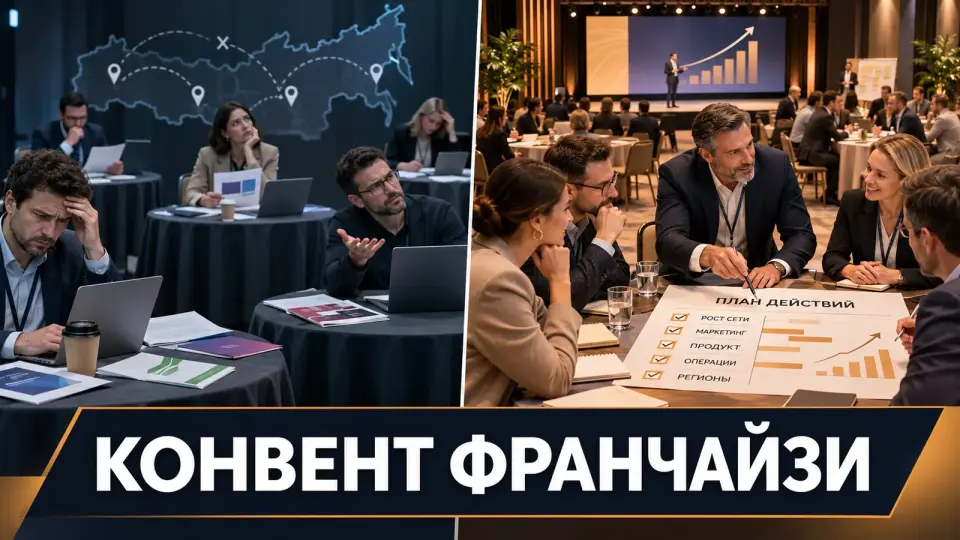
We look at how to build an annual franchisee meeting around the network's objectives: from the agenda and working groups to decisions, owners and the post-event plan.
After the annual meeting, a partner should understand what will change at their location and who will help with implementation. In practice, a convention often ends differently: executives present results and plans, while questions about operations, local marketing, support and standards go unanswered.
The reason is simple: the management company and location owners come with different expectations. The centre needs to explain the direction and changes. Franchisees want to understand what will change in day-to-day work, what resources will be required and which decisions they can influence.
At Aventura, we start a franchisee convention with a decision map. The network identifies topics for information, discussion and practical testing. We then design working formats and a way to pass the outcomes on to location teams. The stage, meetings, awards and evening programme then emerge within this logic.
Leave a request — let's discuss your task
We'll clarify the event format and suggest the next step.
What task should the annual meeting accomplish for the network?
The annual franchisee meeting helps the management company and its partners reach a shared understanding of changes, verify how those changes are applied at locations, and agree on next steps. Frame the goal as an observable outcome: what participants will understand, discuss, try, decide, and pass on to their teams. Such a goal immediately shapes the programme and the criteria for the final minutes.
In a franchise relationship, franchisees are typically independent business owners rather than divisions of the management company. They operate under the network's brand, follow its model and rules, and their specific legal status depends on the contracts and the parties' relationship. So the main stage should not be structured as an internal meeting where headquarters issues instructions down a single chain of command.
First, split the expected outcomes into five types:
- Understand. Partners receive a single version of the strategy, product changes, standards and support.
- Discuss. The network gathers arguments before a decision or clarifies contested implementation terms.
- Verify. Participants try a new process, tool or scenario in a hands-on format.
- Decide. A working group selects an option, assigns an owner or sets up a pilot.
- Pass on to the location. The participant receives materials and a plan for a conversation with their team.
This classification helps choose the format. A general stage suits information sharing; a moderated group suits discussion. A new process can be tested in a clinic, a laboratory or at a demonstration station. An issue specific to one location is best handled in a separate consultation.
Not every question has to end with a decision in the room. Sometimes the honest outcome is a named owner, a list of missing data and a date for the next contact. That result is more useful than a promise to "look into it" that no one entered into the decision log.
Separately, define the boundary of the format. The company's partner summit works with the broader ecosystem and joint initiatives involving different types of partners. A dealer conference is more often tied to the sales channel, the product and terms of doing business. A franchisee convention focuses on a shared understanding and application of the model at locations: standards, operations, local practice, support and the relationship between the network and business owners.
If the task boils down to a single training module, an annual convention may be overkill. If you only need to share news, part of the audience can join online. A large in-person format is justified when partners need to work together and discuss decisions directly with senior managers. A newsletter will not replace that.
Audience: roles, maturity and location context
A single programme for the whole network is usually not enough. Split participants by role, business maturity, location size and the stage of the specific change, then offer them different tracks. Consider geography only where it affects supplies, hiring, local marketing, travel or the application of standards. Segmentation should support the work, not attach labels.
The owner of a single new location needs a basic model framework, launch support and access to the people responsible for mandatory processes. The owner of several mature locations is interested in portfolio management, delegation, system constraints and developing multiple teams. The marketer needs local adaptation of campaigns. The operations manager needs changes to standards and control over implementation.
Don't print sensitive categories on a badge. Wording like "problem location" or "weak partner" humiliates the participant and lowers the quality of the conversation. Segmentation is needed by the project team to recommend a track and prepare closed formats where they are needed.
The table summarises the key points of this section: Segmentation layer, Examples, What changes in the programme. Use it as a quick reference when preparing the event.
| Segmentation layer | Examples | What changes in the programme | Practical outcome |
|---|---|---|---|
| Role | owner, operations director, manager, marketing, training, finance, information technology | language, depth of data, mix of experts | action within the participant's area of responsibility |
| Location maturity | launch, first period of operation, stable location, growth, relaunch | basic processes, operational efficiency, development, correcting deviations | a track that doesn't repeat what has already been mastered |
| Scale | one location, several locations, large multi-location owner, regional partner | personal operational work, delegation, management layer | a decision suited to the scale of the business |
| Geography | large city, small city, remote region, international market | supplies, hiring, local marketing, travel and time zones | accounting for local constraints without changing the network's mandatory rules |
| Initiative stage | idea, consultation, pilot, scaling, mandatory change | discussion, forming a pilot group, training or monitoring | a clear status and next step |
We build the track around the participant's future action. The owner needs to understand decisions and risks. The manager needs to embed the change into the work of the shift or location. The marketer needs to prepare local application. The training specialist needs to obtain materials and a scenario for passing knowledge on to the team.
Leave session choice open, but add a mandatory core, recommended tracks and sign-up formats. Otherwise the most visible topics fill the room while important practical sessions are left without the people who need them.
Tracks also help with venue planning. The number of registrations doesn't yet tell you how many people will be in each room at the same time. The calculation needs transitions, mandatory blocks, popular alternatives, closed rooms and a buffer for changes in choice.
What to collect from partners before designing the programme?
The agenda for the annual meeting is not put together only inside the management company. Before approving the programme, ask franchisees for specific situations, review recurring support requests, operational barriers and the topics the centre is ready to discuss. Then sort the inputs into general questions, individual cases, ideas for a pilot and changes on which a decision has already been made.
A survey asking "what would you like to hear about?" produces answers that are too broad. It is better to ask a partner to name a specific situation: which change is unclear, where a standard is hard to apply, which question the team keeps asking, which practice the location is ready to discuss with colleagues.
We collect inputs from several channels: one source is not enough. Active partners readily respond to a survey but do not represent the whole network. The franchisee council sees systemic topics but remains an advisory group. Support knows the frequent requests but does not always see their business context. Function heads may overestimate the readiness of materials and processes.
The table summarises the key points of this section: Input, How to obtain, What to use it for. Use it as a quick reference when preparing the event.
| Input | How to obtain | What to use it for | What not to do |
|---|---|---|---|
| Questions from locations | a short survey with a field for the situation and the desired outcome | main hall topics, answers to frequent questions, clinics and consultations | promise a public answer to every individual question |
| Recurring requests | anonymised analysis of support and work channels | identify systemic gaps in standards or communication | put personal data and correspondence into the presentation |
| Network changes | interviews with the owners of product, operations, marketing and training | define the mandatory core of the programme | put on stage a change that has no owner and no materials |
| Franchisee practices | submissions using a single case template | exchange of practices between franchisees and themed tables | select talks based only on the owner's prominence |
| Controversial topics | the franchisee council, closed interviews, aggregated requests | consultations, closed groups, pilots | call an already-made decision a consultation |
| Participation data | role, maturity, geography, attendance format | routes, capacity, logistics | collect financial and medical information "just in case" |
For each change, state the status in advance. Decision made - the management company explains the rationale, timeline and rollout procedure. Options exist - the network gathers arguments before choosing. Pilot needed - a working group defines the participants and criteria. Local practice - locations compare approaches but are not obliged to unify them.
This way partners immediately understand where they can influence a decision and where they are only discussing how it will be rolled out. If a decision has already been approved, you cannot invite the room to "co-design" it. Participants quickly notice a pretence of influence. It is better to explain the reasons honestly and give them the chance to work through the consequences for different types of locations.
Partner case studies also require preparation. We propose a single template covering the initial challenge, the action and the conditions for applying it. Separately, the author states which results can be disclosed, which constraints matter and what material colleagues will receive. Without such a framework, the audience sees a polished outcome but does not understand whether the practice can be transferred to their own context.
The participant journey: from a shared decision to action at the location
The programme should take participants along a clear path: first explain the change, then help them apply it to their own location, record the next step and prepare a conversation with their team. These parts build on one another. If there is no link between the main stage and what happens after people return, participants take the materials home but leave without a workable decision.
On the main stage, the management company explains what is changing, why it is happening, what is mandatory for everyone and where a location can adapt the approach.
Participants then work through situations by role and level of experience, try out the tools and ask questions of the relevant functional leaders.
At the end of the working session, the team records the outcome: the action agreed, a proposal to test, a pilot, an open question or a decision to drop an idea. Next to it they note the owner, the deadline and the recipients.
Before leaving, each participant receives a short kit for their team: an explanation of the decision, the first action, materials, a channel for questions and the date of the next update.
The table summarises the key points of this section: Programme stage, Suitable format, What the participant gets. Use it as a quick reference when planning your event.
| Programme stage | Suitable format | What the participant gets | What the team records |
|---|---|---|---|
| Shared context | short opening, network data, explanation of the changes, questions to management | an understanding of the reasons, the status and the implications | questions that need an answer or separate discussion |
| Application | role-based tracks, segment groups, clinics, demonstrations | a draft action, a skill or a list of barriers | observations, common mistakes, requests to head office |
| Joint work | themed tables, franchisee council, pilot groups | a decision, a proposal or testing criteria | what was decided, who is responsible, by when and what the work depends on |
| Individual access | consultations and one-to-one meetings | an answer for their own location or a route to follow up | a brief summary without disclosing confidential data |
| Recognition and connections | awards, experience sharing between franchisees, informal part | examples of useful behaviour and new contacts | approved materials, an agreed next contact |
| Return to the location | final wrap-up, manager's pack, local scenario | a plan for the conversation with their team | a list of recipients and a follow-up date |
The exact number of days depends on the scale of the changes, the make-up of the network and geography. There is no universal duration. One network may need only a compact day with a shared framework and a few tracks. Another needs additional consultations, a closed council meeting, practical stations and time for regional groups to work.
Do not try to fit every function into a continuous plenary flow. Participants get tired not only from the length of the presentations. They get tired of the same mode: listening, having no influence and not applying anything. The rhythm changes when, after the shared context, a person moves on to the question of their own role and then records an action.
Leave a request and we'll discuss your task
We'll clarify the event format and suggest the next step.
How to prepare executive presentations without lengthy reports?
Have the executive explain the decision, its impact on the location, and the next step. A detailed report is better sent in advance or kept in the internal database, while face-to-face time should be devoted to context, contentious issues, and discussion of consequences. For each presentation, define in advance one key message, the necessary data, the boundaries of discussion, and the action participants should take after the session.
Every important change should have a card. It helps the speaker avoid delving into the project's history and not hide the main point at the end of the presentation:
- What is changing.
- Why the network is changing its approach.
- Who is affected by the change.
- What is mandatory for everyone.
- Where local adaptation is permissible.
- What resources, training, or materials the location receives.
- When the change takes effect.
- Who answers questions and approves exceptions.
If part of the decision is still under discussion, this should be shown on the slide and stated. For example: "the principle is approved, the implementation method is being tested" or "we are assembling a pilot group." Such precision reduces the number of conflicts after the event.
It is better to collect executives' materials by a single editorial team. Otherwise, each department brings its own terms, repeats the introductory part, and sets different dates. We align presentations into a unified logic, check transitions, and flag in advance issues that cannot be resolved from the stage.
A Q&A session with a moderator requires as much preparation as a report. Before the event, the team groups questions by topic, removes duplicates, and determines who answers. In the hall, the moderator distinguishes between a factual question, a suggestion, and a private dispute. If an answer requires verification, it is entered into a register with an owner and a deadline.
Discuss financial, contractual, and personal issues separately from the general stage. Limit attendance, choose a closed room, and record the outcome without data from a specific location.
Working formats: tracks, clinics, consultations and awards
First define the outcome of the block, then choose the format. A separate session suits applying a change by role, a clinic suits a recurring problem, and a personal consultation suits a question about a specific location. Reserve awards for examples of behaviour that the network wants to support and can confirm with clear criteria, a period and a data source.
Role-based tracks work when the actions of the owner, the marketer and the operations manager differ. Level-based tracks are needed when a new location and the owner of several mature locations cannot usefully work at the same pace. You should not open a parallel track just because the venue has a free hall.
A clinic is built around a recurring situation. A participant brings a question or chooses a typical scenario. An expert helps analyse the causes, constraints and the next step. A clinic must not turn into a public audit of a specific franchisee. Sensitive data stays within the closed group.
A practical station is needed when a change can be tried out: a new tool, process, training material, service format or communication scenario. A station has a short task, a completion criterion, feedback and a fallback option in case of a technical failure.
The table summarises the key points of the section: Format, When to use, Outcome. Use it as a quick reference when preparing the event.
| Format | When to use | Outcome | Mandatory rule |
|---|---|---|---|
| Role-based track | different functions need different actions | an application plan by role | the shared context must not contradict other tracks |
| Level-based group | locations are at different stages | a solution for your own scale and maturity | do not label a participant with a demeaning category |
| Clinic | the problem recurs at many locations | a diagnosis of the situation and the next step | do not disclose data about a specific location without grounds |
| Practical station | an action can be performed or rehearsed | an attempt, feedback, material | check equipment and capacity in advance |
| Topic table | an exchange of arguments or practices is needed | a card with a question, proposals or a pilot | one question, a moderator and an allowed type of outcome |
| One-on-one meeting | the question relates to a specific contract, territory or metric | an answer or a handover to the person responsible | topic, time, stage of work and a deadline for follow-up |
| Awards | the network wants to recognise a verifiable contribution | a clear example for other participants | criteria, period, data source and rules for disputed cases |
Do not turn the awards into a popularity contest and do not use them instead of clear convention outcomes. Criteria are announced before the event. Incomparable scales are best separated. Winning solely on the largest turnover sends the network a narrow signal: size matters more than quality, teams, service and contribution to colleagues' development.
Recognition can be built around operational quality, team development, application of the standard, customer experience, mentoring or a local practice with a verifiable result. The specific categories depend on the network's data and policies. We do not offer a ready-made list without checking that the metrics are comparable and cleared for public use.
For a complex multi-hall programme, organising conferences and forums is useful: the programme architecture must be connected from the outset with sound, screens, moderators, navigation, recording and the work of coordinators in each hall.
How to design networking within a single network
Networking at a franchise convention is designed around work tasks, not the number of introductions. Help owners and store teams find colleagues with a similar question in advance, get to the relevant executive and agree on a follow-up. To do this, combine scheduled consultations, small groups of comparable scale, themed tables and a separate orientation for new partners.
A random coffee break works for participants who already know each other and are outgoing. A newcomer, a remote region or someone with a complex question may never meet the right person to talk to. That is why some connections are better designed before the event.
For individual questions, schedule consultations in advance. The partner chooses a topic and describes the desired outcome. The team confirms the counterpart, time, place and who may attend. After the meeting, the coordinator records a brief summary: the partner got an answer, needs to send data, is waiting for a response from another specialist or has agreed on a next conversation.
Bring owners of comparable scale together in small closed groups. Owners of a single store and large multi-store networks face different management challenges. In a small closed group, they can discuss delegation, hiring, local marketing or rolling out a standard without having to present to the entire network.
Build a themed table around a single question: a launch, supply or implementing a change. The region remains context. The working topic is set by a specific problem at the stores.
Hold a short orientation for new partners before the general opening. They get to know the support system, the programme rules and the people they can turn to. This lowers the barrier to entry and saves the main stage from having to explain basic context to the whole audience.
Do not put the content of closed conversations into a shared table. For management, the topic, the person responsible, the status and the deadline are enough. Financial data, contractual details and personal correspondence stay with those who need them to resolve the issue.
Logistics follow the programme
Choose the city, venue and transport once the participant mix and working formats are set. A convention needs more than seats in the main hall: it needs rooms for parallel sessions, closed rooms, consultation areas, clear routes between them and time for conversations. The geography of your guests and the programme will tell you whether you need one central convention, a regional series or a hybrid route.
Start by mapping the geography. Where partners are travelling from, how long the real journey takes, whether there are connections, seasonal peaks, mandatory audits or launches. One network suits a single national convention. For another, a regional series or a combination of an in-person core with remote blocks is more accessible.
For remote participants, design a separate route within the hybrid event. A camera in the main hall does not create participation. Online audiences need navigation, a moderator, support, accessible materials and a clear way to ask a question.
The team checks the room plan against the programme. In the main hall, it checks sightlines, sound and aisles; between parallel sessions, acoustic separation and walking time. For consultations, it provides private rooms; for practical stations, power, network, material storage and queue management. The awards ceremony needs a separate exit scenario and verified data.
Do not schedule a significant working block immediately after the arrival wave. A delayed flight or transfer must not deprive a participant of essential context. The franchisee council, newcomers, speakers and the main audience may need different arrival windows.
Registration also supports the programme. On the badge and in their personal route, participants see mandatory blocks, selected tracks and scheduled meetings. The exceptions desk must not hold up the general flow. The team decides in advance who handles access issues, participant substitutions or changes to consultations.
Catering and breaks are part of the working rhythm. If everyone heads to one line, the delay eats into track time. If breaks are too short, networking exists only in the presentation. If the evening programme ends late, the morning practical blocks lose their audience.
Safety is reviewed together with the venue and the relevant responsible parties. The layout of decor, registration, catering and technical equipment must not block evacuation routes and exits. The operational plan needs contacts, team roles and incident procedures, not just a diagram on the wall.
What data is needed and how to make participation accessible?
Registration collects only the data needed for the stated purposes of participation, and the team restricts access to it in advance. For each purpose, define the scope of information, the legal basis, and the staff who work with the information. Design accessibility before approving the venue and materials: ask about the person's needs, not their diagnosis, and include solutions in the budget.
A project may have several processing purposes: confirm participation, arrange travel, select meals, provide access to a closed session, organize photos and videos, send materials after the event. Article 5 of Federal Law No. 152-FZ links the composition and volume of data to the stated purposes and prohibits excessive processing or combining incompatible purposes.
Article 9 requires that the operator be able to confirm consent or another legal basis for processing. Article 7 restricts the disclosure and dissemination of personal data without consent or another basis, and Article 19 concerns protection measures. The client verifies the specific set of documents and measures with lawyers. The project team reduces fields to the necessary minimum and separates access.
Use restricted access for consultations and confidential matters. A shared list may contain only the topic, the responsible person, and the work stage. Do not include venue documents, financial indicators, phone numbers, and contractual details in a table visible to coordinators, speakers, and other participants.
At registration, ask a neutral question: what does the person need for full participation. The answer may concern the route, an assistant, the format of materials, subtitles, or hearing support. Separately clarify meals and additional time for transitions.
The World Wide Web Consortium W3C recommends checking the accessibility of the venue and digital materials in advance, using microphones for questions, providing subtitles or transcripts, and describing significant visual information. These decisions affect the budget, the technical specification, and the work of speakers, so they cannot be left until the day of setup.
Check the entire route: transport, entrance, registration, main hall, tracks, consultations, meals, restrooms, and the evening area. A ramp at the main entrance does not help if the working session is held on an inaccessible floor.
Speakers may also have accessibility needs. They are given requirements in advance for contrast, text size, video, description of charts, and microphone use. Materials are best provided in a format that can be opened not only within the presentation.
Post-event cycle: decisions, owners and control
Work on the outcomes continues after the stage is dismantled. The team shares every decision, the name of the person responsible, the deadline and the list of recipients with the network, and then checks the next step. A presentation archive alone is not enough: the point owner needs a short kit for a conversation with the team, while the management company needs a single register of decisions, questions, pilots and mandatory actions.
The presentation archive is useful as a reference, but it does not replace the handover of decisions to point teams. The point owner returns to a team that did not hear the context, questions and explanations. They need a short package for a local conversation.
The minimum kit may include:
- A decision register with date, status and owner.
- A list of open questions and response deadlines.
- Pilot cards with hypothesis, participants, criteria and stop condition.
- A point manager's package: a short presentation, a meeting script and answers to frequently asked questions.
- Role instructions for the owner, manager, marketing and training.
- Records and materials with clear access rights and version date.
- A table of mandatory action completion and identified barriers.
Statuses must be distinguished. "Discussed" is not the same as "decided". "Proposed" is not the same as "approved". "Handed over for action" does not mean "completed". A common vocabulary reduces disputes between the centre and the points.
The network determines the control rhythm itself. Immediately after the event, the team sends a draft list of outcomes and the date of the final protocol. Then it shares the verified materials, holds a local team meeting, reviews the first barriers and separately monitors the pilots. To agree on deadlines and responsible persons, the approach from the article on follow-up after a B2B event and marketing and sales SLA will be useful. Specific intervals depend on the complexity of changes and the network's management cycle.
Metrics are also tied to decisions, not just to satisfaction. It is useful to see whether the necessary roles were represented, whether consultations took place, whether point owners' questions were received, whether points held local meetings, whether mandatory actions were completed and what the pilots showed.
Sales or profit growth cannot be automatically attributed to the event. Such a conclusion requires a pre-agreed rule by which the result is linked to the event, comparable data and consideration of other factors. The general methodology can be checked against the material on key performance indicators of a corporate event, and in the convention project only leave indicators related to network decisions.
After the convention, we also conduct a production review. The team records where participants lost their route, which halls were overloaded, which questions were repeated, which materials arrived late and where the backup failed. The team uses these observations when preparing the next meeting, rather than leaving them in the coordinators' correspondence.
What should the brief and preliminary estimate include?
The first calculation does not require a finished scenario. Share the network's goal, participant profile, geography, working formats, constraints and budget guidance. Add the proposed dates, number of venues, travel format and approval owners. The clearer these inputs, the more accurately the team can compare programme and estimate options, set out assumptions and identify the decisions the client will need to make.
At Aventura, we start with a short brief. After the kick-off meeting, we turn it into a project map: stages, owners, dependencies, dates and decision points. This document helps compare options on a like-for-like scope of work.
The table summarises the key points of this section: Brief section, What to provide, What it affects in the programme and estimate. Use it as a quick reference when preparing your event.
| Brief section | What to provide | What it affects in the programme and estimate |
|---|---|---|
| Network goal | what participants should understand, discuss, test and do after the meeting | content mix, moderation, final materials |
| Audience | number of franchisees and guests, roles, maturity, scale, geography | routes, halls, communications, logistics |
| Agenda | changes, contentious issues, case studies, pilots and consultation topics | speakers, tracks, closed-door formats, preparation of materials |
| Format | in-person, hybrid, regional series, number of days and proposed dates | venue, equipment, broadcast, team and calendar |
| Working zones | main hall, tracks, clinics, stations, one-to-one meetings, franchisee council, awards | floor space, furniture, sound, screens, moderators and coordinators |
| Travel | departure cities, accommodation, transfers, arrival and departure waves | travel logistics, command centre, guest support and contingency |
| Data and access | registration fields, access levels, accessibility, filming | platform, documents, staff and technical solutions |
| Brand and content | visual system, language, templates, approval owners | design, editing, production and revision timelines |
| Budget | guidance, essential core, desirable elements, decision deadline | number of options, priorities and booking calendar |
We divide the estimate into clear sections: programme and materials, venue and catering, technical production, registration and communications, logistics, team, evening programme and contingency. A final price means little without the scope of work.
For example, one option may include editing presentations and moderating tracks, while another covers only hall hire and equipment. In one proposal, consultation rooms are included in the venue package; in another, they are charged separately. You need to compare assumptions, working hours, number of zones, team composition and change rules.
The basic option includes everything without which the meeting will not achieve its goal: a shared context, the right working formats, participant access and documented decisions. The extended option may add more hands-on stations, content recording, complex stage design or an additional evening programme. If the budget is cut, the priority is to protect meaning, safety and accessibility rather than decorative elements.
Organising a project like this is closest to a business event for a partner network. The venue, stage direction and service matter, but they must support the decision map, not replace it.
Twelve questions to ask about the programme before registration opens
Before registration opens, check whether the programme connects the network's goal, participant journeys, business outcomes, logistics, data and post-event actions. For each question below, the team must give a specific answer, name the person responsible and show where this is reflected in the programme or project plan. It is better to resolve uncertainties now than to compensate for them with extra presentations on the day of the convention.
Review the draft:
- Is it clear why the network is meeting in person and what should change after the meeting?
- Does the programme distinguish between owners, operational roles, marketing, training and the different stages of location development?
- Were partners' questions collected before the agenda was approved?
- Is it marked where a decision is made, where consultation is underway and where a pilot is needed?
- Does each block have an observable outcome, an owner and a way to record it?
- Are sensitive issues kept separate from the main stage and open materials?
- Will participants get access to leaders and colleagues with similar tasks?
- Does the venue support real flows, transitions, privacy and accessibility?
- Does registration collect only the necessary data with clear purposes?
- Will the location receive materials and an action plan after the participant returns?
- Are budget options compared on the same scope and assumptions?
- Will the network retain a register of decisions, not just photos and presentations?
Frequently asked questions
An annual franchisee meeting helps the management company and its partners reach a shared understanding of changes, check how they are applied at locations and agree on next steps. Frame the goal as an observable outcome: what participants will understand, discuss, try, decide and pass on to their teams. Such a goal immediately shapes the programme and the criteria for the final minutes.
A single programme for the whole network is usually not enough. Split participants by role, business maturity, location size and the stage of a specific change, then offer them different tracks. Consider geography only where it affects supplies, hiring, local marketing, travel or the application of standards. Segmentation should support the work, not attach labels.
The agenda for the annual meeting is not put together inside the management company alone. Before approving the programme, ask franchisees for specific situations, study recurring support requests, operational barriers and the topics the centre is ready to discuss. Then sort the input into common issues, individual cases, ideas for a pilot and changes on which a decision has already been made.
The programme should take participants along a clear path: first explain the change, then help them apply it to their own location, record the next step and prepare a conversation with their team. These parts build on one another. If there is no link between the main stage and what happens after the return, participants take home materials but no workable solution.
Let the executive explain the decision, its impact on the location and the next step. A detailed report is better sent in advance or kept in the internal database, while face-to-face time is given to context, contentious issues and discussion of the consequences. For each presentation, define in advance one key message, the data needed, the boundaries of the discussion and the action participants should take after the session.
First define the outcome of the block, then choose the format. A separate session by role suits applying a change, a clinic suits a typical problem, and a one-to-one consultation suits a question about a specific location. Reserve the awards for examples of behaviour the network wants to encourage and can confirm with clear criteria, a period and a data source.
Leave a request and we will discuss your task
We will clarify the format of the event and suggest the next step.
Sources
- International Franchise Association: engaging franchisee convention participants
- International Franchise Association: content should determine the meeting format
- International Franchise Association: the role of franchisee associations and councils
- International Franchise Association: IFA Legal Symposium 2017 material on implementing changes and new network standards
- ERIC: Adult Learning Planning Framework - transferring learning into action
- W3C WAI: accessibility of events and presentations
- Federal Law No. 152-FZ, Article 5: purposes, scope and non-excessiveness of processing
- Federal Law No. 152-FZ, Article 7: confidentiality of personal data
- Federal Law No. 152-FZ, Article 9: consent to the processing of personal data
- Federal Law No. 152-FZ, Article 19: measures to ensure the security of personal data
- Federal Law No. 123-FZ, Article 89: requirements for evacuation routes and exits
Contents
Was this article helpful?