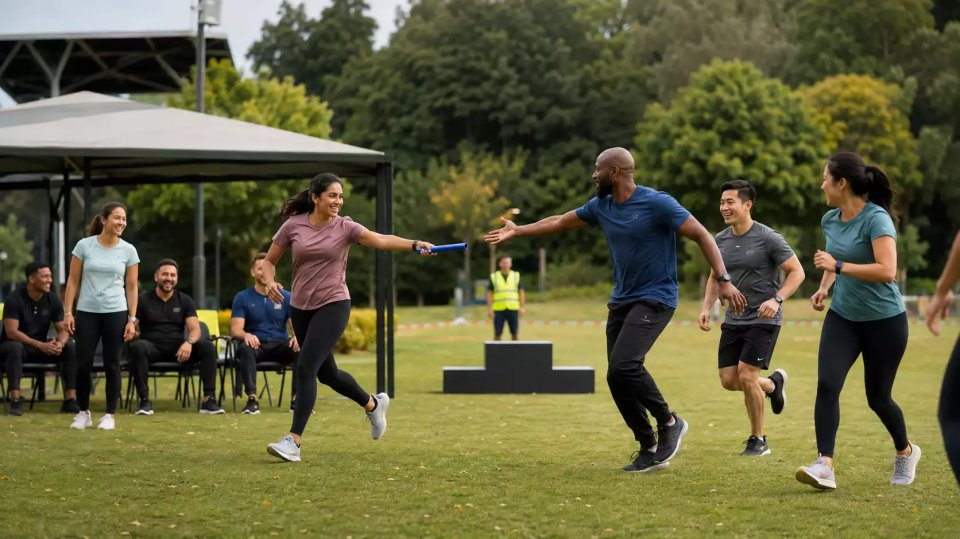
A practical plan for a corporate sports day: how to put together an accessible program, prepare the venue, and stay in control on the day of the event.
Corporate sports day works when employees have a choice of workload, and the organizing team has a map of solutions in case of rain, heat, or a halt to an individual activity. It's best to start with business objectives and participant composition, not with a list of relay races.
How to define the objective and participant composition?
In short: a corporate sports day begins with answering two questions - who the company wants to engage and why. For one team, a competitive day between departments is needed; for another, a general festival with family-friendly and calm activities. This fork determines the venue, duration, judging and communication.
Assemble a working group of HR, internal communications, venue services and the organizer. Before choosing disciplines, record the number, geography of participants, age restrictions, format of participation for employees with shift schedules and the role of spectators. Participation must be voluntary: for part of the team, it is more important to support colleagues, take a master class or spend time in the family zone.
If a company has several venues or branches, decide in advance whether a single final or local qualifiers are needed. This choice changes the logistics budget and the awards scenario.
What activities should be included in the program?
In short: the corporate sports day program should offer parallel ways to participate. Strength and speed disciplines are not suitable for everyone, so alongside relays there should be tasks for accuracy, coordination, team decision-making and calm family stations. This way the number of participants grows without pressure on those who are not ready for high exertion.
Divide activities into three areas: sports, cooperative and free. The sports area includes short relays and games with clear rules. The cooperative area is built on tasks where the result depends on role distribution. The free area gives the opportunity to come with children, socialize or join a master class without registering for a team.
| Objective | Suitable format | What to check in advance |
|---|---|---|
| Engage a mixed team | accuracy and coordination stations | clear rules and several difficulty levels |
| Create excitement between departments | short relay or team game | judge, zone boundaries, time for team changes |
| Welcome families | free activities and kids' zone | separate flow, age restrictions, adult chaperones |
| Support the employer brand | opening, photo route, awards ceremony | agreed visual style and host script |
When planning activities, do not disguise a difficult discipline as "entertainment for everyone". Each station needs a card: purpose, participant limit, equipment, duration, person responsible, venue boundaries and the reason to stop the game.
How to choose a venue and build a zone map?
In brief: choose a venue based on the participant's route, not just capacity. The entrance, registration, activities, water, food, medical station, restrooms and transport should each have separate points on the map. For a sports facility, it is useful to check the information in the All-Russian Register of Sports Facilities of the Russian Ministry of Sports.
At an off-site autumn event, the surface, lighting, backup room, catering points and the ability to quickly separate players, spectators and service vehicles are especially important. Before signing the contract, walk the venue together with the property owner and take photos of the zones that will be included in the program.
For a general assessment of the space, use the material where to hold a corporate event in Moscow. For a sports format, the condition of the surface, warm-up area, navigation and safe access for emergency services are added.
How to prepare safety and a medical plan?
In brief: safety consists of risk assessment, clear roles and the ability to stop a specific activity. The medical contractor, instructors, venue and organizer must know their contacts, duty location, access and information transfer procedure. A format should not be announced as an official competition if it does not have that status.
WHO recommends that organizers of mass events identify threats, assess risk and determine measures to reduce it in advance. For a corporate sports day, it is convenient to keep a simple table on weather, injuries, crowd flows, food, equipment and evacuation. The Russian Emergencies Ministry reminds that passages and evacuation exits must remain clear.
For high-intensity disciplines, agree in advance with the medical contractor on the admission procedure, duty staffing and response algorithm for requests. The organizer does not need to collect diagnoses or other medical information of participants: the procedure for processing it is determined by the medical contractor and applicable requirements. Do not promise that one document is mandatory for every participant: the requirements depend on the format, venue and chosen activity.
Important: the authorized safety manager must have the right, enshrined in the response plan, to stop an individual station according to pre-agreed criteria if the weather, surface or participant's condition changes.
How to plan for weather and a backup scenario?
In short: Plan B is a pre-agreed version of the program, not a cancellation on the day of the event. For rain, heat, and strong wind, you need clear decision thresholds, backup zones, and activities that can be moved without losing meaning. Participants and contractors should receive this procedure before arrival.
Rospotrebnadzor publishes recommendations on organizing work in hot weather, including access to water and breaks. For an event, this is a guideline for placing water, shade, and reducing intensity during the hottest hours, not an individual medical norm for all guests. In an open area, before arrival, separately check the sanitary preparation of the site and the requirements stipulated in the contract with the venue and contractors.
The backup package typically includes an indoor area, shortened versions of relay races, coordination tasks, and intellectual stations. The decision to switch is made by one responsible person at a designated time, not by several contractors in different chats.
How to organize registration, flows, and timing?
In short: the day of the event becomes calmer when a participant knows their route in advance, from transfer to award ceremony. Registration, warm-up, start, food, and return transport should not begin at the same point and at the same minute. The schedule needs buffer time for changing clothes, switching stations, and short briefings.
- Separate pre-registration, distribution of starter kits, and entry to the venue.
- Assign volunteers or coordinators to key junctions of the route.
- Give team captains a brief instruction on rules, water, medical post, and emergency signal.
- Stagger food queues and game transitions.
- Check the evening departure: who and where boards transport if the program ends at the same time.
The program benefits from short transitions. If the venue is large, add one clear map and repeat color coding on signs, bracelets, or badges.
Leave a request - we'll discuss the task
We'll clarify the event format and suggest the next step.
Subscribe to the Aventura Telegram channel to receive analyses of corporate event formats and organizational solutions.
How to distribute roles between the client and contractors?
In short: the agreement "the venue takes on everything" creates gaps. Before setup, a responsibility matrix is needed: who is responsible for flooring, equipment, judges, medical care, security, catering, transport, communications, and halting activities. One coordinator consolidates decisions into a single operational plan.
The client usually confirms the goal, audience, and internal communication. The venue is responsible for the condition of the provided areas and its own regulations. The organizer assembles the scenario, timing, contractors, and coordination. The boundaries depend on the contract, so it is important to confirm them in writing before purchases.
If a company needs a format with activities and team dynamics, also see the analysis of team building and team spirit formation. A sports day can be part of this task, but it does not have to replace all tools for working with the team.
How to run the event day?
In short: on the day of the sports festival, the most valuable things are a repeat walkthrough of the venue, a short team briefing, and a working communication channel. Before guests arrive, check the flooring, fastenings, navigation, water, medical station, free passageways, and actual weather. Any change is recorded by the coordinator and communicated to the judges.
Start with a general warm-up or a safe introductory activity, then spread the teams across the tracks. The host maintains the pace but should not push participants to a load that does not suit them. The judges record the results according to transparent rules, and the coordinator monitors transitions and queues.
For safety in any corporate format, a separate material is useful: rules and methods for ensuring safety at events.
How to wrap up and measure participation?
In short: the results of a corporate sports day are measured not only by positions in the standings. After the event, it is useful to collect registration reach, actual participation by discipline, feedback, aggregated operational data on the medical team's work, and the reasons for stopping activities. These data help make the next program more convenient and safer.
Do not turn the questionnaire into a long survey. It is enough to ask which zones the participant chose, how clear the navigation was, and whether they would like to participate again. After the event, the organizing team holds a short debrief: what worked in the timing, where queues appeared, and what decisions the weather backup required.
The award ceremony ends the day better when it recognizes not only the winners. Nominations for team support, accuracy, participation, and the family format help acknowledge the contribution of different groups without pressure on athletic results.
What to check before the start of a corporate sports day?
In short: the final check should confirm not the beauty of the venue, but the readiness of the route and the team. Before registration opens, the organizer should have a map of zones, contacts of responsible persons, a weather decision, a medical plan, and clear evacuation routes. If at least one of these points is not confirmed, it is better to adjust the program before guests arrive.
| Block | Check | Owner |
|---|---|---|
| Program | each activity has a description card and a clear intensity level | program producer |
| Venue | surface, walkways, lighting, sanitary zones, and backup are confirmed | venue coordinator |
| Safety | medical station, communication, evacuation routes, and the right to stop are agreed | safety manager |
| Logistics | registration, water, food, transport, and navigation are kept separate | operations coordinator |
| Communication | participants and captains have received the route and rules | HR or internal communications |
Sources
- WHO: managing health risks at mass gatherings
- EMERCOM of Russia
- ConsultantPlus: regulatory documents
- GOST R 52024-2024
- American Red Cross: staying safe during physical activity in the heat
Turnkey organization of corporate, business and client events includes developing the concept, scenario and on-site supervision. Submit a request to Aventura if you need a workable format for a corporate sports day for your team.
Contents
Was this article helpful?