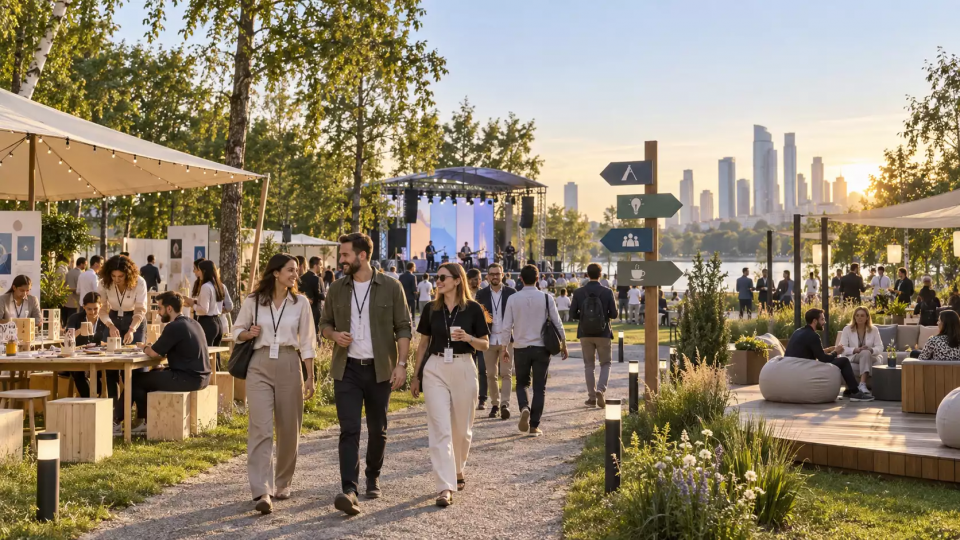
A corporate festival is built around the guest journey, not around a random set of activities. We break down how to connect the program, zones, flows, and a backup scenario in a single plan.
A corporate festival for employees is not about a long list of entertainment. A guest should quickly understand where to go after entering, where to take a break, how to join an activity, and when to gather with everyone. If this route is missing, even good zones start competing with each other for attention and space on the site.
How does a corporate festival for employees begin?
Important: first, the team defines the goal, guest list, and format of participation. After that, they choose a venue and put together the program. This order helps avoid buying beautiful activities that do not address the objectives of HR or internal communications.
It is better to write the goal in one sentence. For example: to introduce employees from different departments, to celebrate a professional achievement, to hold a family day off, or to give the team a calm general meeting after a busy period. These tasks have different logic for the day.
The guest list also changes the plan. Employees may come with children, some people will be ready for activities, while others will choose conversation, food, and a concert. There is no need to convince everyone to participate in the same way. Clear participation scenarios are needed.
What zones are needed at a corporate festival?
Important: a festival usually has an entrance zone, active zone, quiet zone, family zone, service zone, and common zone. Each answers a specific guest question: where to get oriented, what to do, where to rest, where to ask for help, and where to gather together.
It is convenient to describe the zones before choosing contractors. Then the plan immediately shows which activities are adjacent, where queues will appear, and where a team member will be needed.
The table summarizes the key points of the section: Zone, Guest Task, What to Check Before Opening. Use it as a quick reference when preparing the event.
| Zone | Guest Task | What to Check Before Opening |
|---|---|---|
| Entrance and Navigation | Quick orientation | registration, map, clear route |
| Activities | Choose participation at your own pace | schedule, rules, waiting area |
| Family Area | Engage guests of different ages | visibility, rest, responsible coordinator |
| Quiet Zone | Take a break without noise | seating, shade or shelter, water |
| Food and Service | Recharge and get help | flows, sanitary points, medical contact |
| Common Area | Gather for the key moment | approaches, exits, sound, host's work |
For the family format, it is useful to check the material how to organize an open day for employees' families. If the program includes competitions, a separate plan for a corporate sports day will be useful.
How to build a program without competing activities?
Important: a program works better when it has an overall rhythm: a soft start, free choice, a few short unifying moments, and a finale. The most attractive activities should be spaced out in time or location.
At the start, guests shouldn't have to choose between three events happening in one narrow spot. First, it's better to give them time to check in, look at the map, grab a drink, and choose their first zone. After that, you can open parallel activities.
Build the day in the following sequence:
- Open the entrance area and give guests time to get oriented.
- Launch free-form formats with short rules and clear time slots.
- Bring people together for a shared moment: a welcome, an award ceremony, a performance, or a joint activity.
- Return the choice between quiet and active zones.
- End the program so that the exit doesn't coincide with the closing of all services.
Such a framework doesn't replace the script. It helps the scriptwriter, the venue, and the coordinators talk about the same day.
For ideas on internal communications and formats, follow the Aventura Telegram channel.
How to separate guest flows and queues?
Important: flow needs to be planned for entry, movement within the venue, and exit. A queue near one popular area can block the route to food, the stage, or a service point, so it's best not to group attractions in one passage.
For each popular format, it is useful to answer four questions in advance: where people come from, where they wait, how they exit, and who redirects the flow if the queue grows. The British HSE specifically recommends assessing entry, movement, and exit routes, as well as spaces around the stage, services, and other attractions.
The venue map marks not only decor and activities. The team needs entrances, exits, service routes, water points, a first-aid station, sanitary zones, assembly points, and people responsible for each area. Such a map works on the day of the event, when the host, technician, and coordinator quickly check their actions.
How to account for different participation options and accessibility?
Important: the festival should offer a choice between active participation, observation, a family route, and relaxation. Accessibility is checked from arrival at the venue to key areas, not just at the main entrance.
Not all guests find it comfortable to stand by the stage for a long time, take part in a relay race, or be in a loud crowd. The program needs places where you can sit down, talk calmly, get water, and return to the event without feeling that they have fallen out of the day.
For a temporary venue, the team walks the route literally on foot: from transport and the entrance to toilets, food, a quiet zone, the medical point, and the main activities. After rain, the surface that looked fine in the morning may change the route for some guests. This is worth checking before the zones open.
What to include in the weather contingency plan?
Important: the backup scenario describes trigger conditions, responsible persons, and the action for each outdoor zone. Wording like "we'll move it under the canopy" is not enough if the team doesn't know exactly where to direct people and who will make the decision.
Rain, wind, heat, and thunderstorms each need a separate decision sheet. It records which zones close first, which activities can be moved, where permanent shelters are located, how to notify guests, and who monitors the forecast.
The table brings together the key points of the section: Condition, Decision before the event, Action on the day of the festival. Use it as a quick reference when preparing the event.
| Condition | Decision before the event | Action on the day of the festival |
|---|---|---|
| Rain | prepare sheltered routes and portable formats | close the problematic area and redirect guests |
| Wind | agree the operating conditions for temporary structures with the technical team | follow the agreed plan |
| Thunderstorm | identify a safe shelter and notification channel | stop outdoor activities and direct people along the route |
| Heat or cold | provide water, rest, shade, or a warm zone | adjust active blocks and service |
An ordinary tent helps against rain, but it cannot be passed off as safe shelter during a thunderstorm. The US National Weather Service recommends identifying permanent enclosed premises or vehicles with metal bodies in advance for such a scenario.
Who makes decisions on site?
Important: the team must have a single event lead and a clear distribution of roles. Zone coordinators, the technical team, security, medics, the host, and the person responsible for weather must know whom to notify when the situation changes.
Before opening, it is useful to hold a short general briefing. The team checks the time, communications, routes, the procedure for calling for help, backup decisions, and the rules for passing information to guests. This is easier to do before the first wave of guests than to look for contacts during a disruption.
It is better to keep the risk register practical: risk, measure, responsible person, decision signal. Such a document does not promise the absence of problems. It helps the team act in a coordinated way when conditions change.
How to connect a festival with corporate culture?
Important: corporate culture emerges in a festival through clear occasions for communication and a shared context, not through a logo on every surface. The program can support the company's values if they are turned into tasks, stories, recognition, and joint actions.
If connections between departments matter, activities mix teams and give tasks where roles are distributed naturally. If the company wants to celebrate a professional result, part of the program is built around recognition of people and teams. If a family format is needed, adults and children receive overlapping but not identical routes.
At the idea stage, it is useful to look at Aventura's portfolio and choose a format that suits a specific audience. For the evening general block, you can open the artist catalog in advance and discuss candidates together with the script, rather than separately from it.
How to collect feedback after a festival?
Important: after the event, you need two feedback loops: a short voluntary guest survey and a team debrief. The first shows participants' impressions; the second captures queues, timing, navigation, and decisions worth repeating or changing.
In the survey, it's enough to ask guests a few specific questions: was it easy to find the zones, which formats did they choose, where did they lack comfort, what would they like to keep next year. Don't take a single high rating as proof of impact for the HR brand.
In the internal debrief, the team looks at actual queues, overcrowded zones, weather-related decisions, visits to the medical station, contractor performance, and unused resources. HSE recommends debriefing an event after it takes place, especially if the venue or procedures changed or incidents occurred.
When should you bring in an event agency for preparation?
Important: it's useful to bring in an agency before incompatible activities are chosen and a contract with the venue is signed. At an early stage, it's easier to combine the goal, zone layout, scenario, technical constraints, and backup solutions into a single document.
The Aventura team organizes corporate, business, and client events from concept and scenario to on-site coordination. For a first conversation, it's enough to describe the goal, city, approximate guest count, season, and what must not be lost in the program.
Frequently asked questions
The goal is best written in one phrase. For example: to introduce employees from different departments, to celebrate a professional achievement, to hold a family day off, or to give the team a calm shared gathering after a busy period. These goals have different logic for the day.
It is convenient to describe the zones before choosing contractors. Then the plan immediately shows which activities are adjacent, where queues will appear, and where a team member will be needed.
At the start, guests should not have to choose between three events taking place in one narrow spot. First, it is better to give them time to check in, look at the map, get a drink, and choose their first zone. After that, parallel activities can open.
For each popular format, it is useful to answer four questions in advance: where people come from, where they wait, how they exit, and who redirects the flow if the queue grows. The British HSE specifically recommends assessing entry, movement, and exit routes, as well as the spaces around the stage, services, and other attractions.
Not all guests are comfortable standing near the stage for a long time, taking part in a relay race, or being in a loud crowd. The program needs places where people can sit down, talk calmly, get water, and return to the event without feeling that they have dropped out of the shared day.
For rain, wind, heat, and thunderstorms, a separate decision sheet is needed. It records which zones close first, which activities can be moved, where permanent shelters are located, how to notify guests, and who monitors the forecast.
Sources
- Health and Safety Executive: guest flow risk assessment
- Health and Safety Executive: venue site design
- Health and Safety Executive: managing an event
- ADA National Network: accessibility of temporary events
- National Weather Service: lightning safety for outdoor activities
- World Health Organization: risk assessment for mass gatherings
Contents
Was this article helpful?