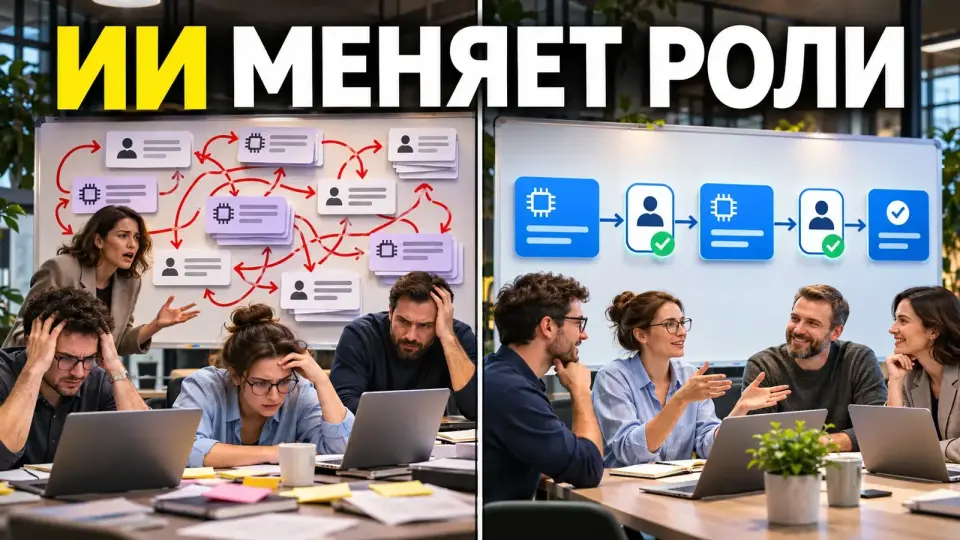
A practical blueprint for a single-workflow AI lab: a map, a hypothesis, a limited test, human oversight and a team decision.
When a company discusses artificial intelligence (AI) at the level of job titles and departments all at once, the conversation quickly becomes too broad. Participants talk about tools, impact and data. Meanwhile, employees are trying to understand what will change in their day-to-day work. An AI workflow lab narrows the task down to a single process or step and ends with a decision that can be tested.
At Aventura, we design this format as a closed business event. The team describes the current work and builds a map. It then formulates a single hypothesis, prepares a limited test and assigns human oversight. At the end, participants choose the next step.
We put together the meeting programme, prepare the working materials and facilitate the discussion. We also select the venue and record the team's decisions. Technical, HR and legal decisions remain with the client's owners.
What is an AI workflow lab?
This is the name for a session focused on a single workflow with AI. Participants describe their current work, choose an area to test a hypothesis, build a test plan and define human oversight. At the end, the team decides whether to continue. This format helps change a specific piece of work without jumping from an idea straight to scaling.
The unit of analysis becomes an observable workflow node. It has an input and participants, then actions and decisions. The map also shows the handover of results and exceptions.
The team can analyse the preparation of a response to an inquiry or the approval of a document. Other options include verifying an application and compiling a management report. The name of the tool at this stage is secondary.
In our published material about AI Day for employees, we cover a broad educational format: general rules, workshops and the collection of initiatives. The lab is narrower and deeper. It works with one selected task and the people who own or perform the process.
The lab differs from the AI agent management session in what it decides. The agent session defines rights, owners and stop rules for an autonomous scenario. Here the team first rebuilds the process and roles themselves, even if the future AI remains an assistant and does not get the right to perform actions independently.
For the client, this is a type of business event organisation. Function owners are responsible for the content, and we turn it into a programme: we distribute work across tables, facilitate discussion, restrict access to materials and prepare a single set of decisions.
The boundary of the format: one process
A lab produces a workable result when its boundaries can be held on a single map. Trying to rebuild the entire company in one meeting brings participants back to general talking points. That is why, before the programme, we pin down the process, the start and end of the review, the roles involved, the known constraints and the decision the group is entitled to make.
The boundary can run along a single stage of a large process. If a company wants to change the entire customer journey, it makes more sense for the first lab to pick a specific node: classifying an incoming request, preparing a draft response or handing a complex case over to an expert. After the test, the team will decide whether to move on to the adjacent stages.
In the brief, we ask you to answer five questions:
- What result does the internal or external user of the process get?
- Where does the process start and what observable event ends it?
- Which roles actually do the work and make the decisions?
- Which error does the team consider significant?
- What decision must be made after the lab?
The last question protects the meeting from endless exploration. The ending can be modest: approve preparation of a test, send the hypothesis back for revision or drop it. A lab does not have to end with an AI launch.
A general strategic session for the company addresses a broader range of issues. Its mechanics are useful for working with the executive sponsor and decision owners, but the subject of the new lab is narrower: one process and a verifiable change within it.
Which node should you start with?
For a first lab, a suitable node has a clear entry and exit, repeatable work and an accessible process owner. The cost of an error should be visible, and the test should remain reversible. A task involving closed data, lacking quality criteria or spanning dozens of uncoordinated systems requires preliminary preparation. For the first working day, it is better to choose a different node.
Candidates are conveniently compared in a single table. Scores are optional. What matters more to the team is seeing the differences and honestly naming the limitations.
The table brings together the key points of the section: Criterion, Suitable first node, Risky first node. Use it as a quick guide when preparing the event.
| Criterion | Suitable first node | Risky first node |
|---|---|---|
| Boundary | start and end are observable | the process blurs between functions |
| Repeatability | similar cases occur regularly | each case is structured differently |
| Quality | criteria for checking the result exist | quality is determined only by general impression |
| Data | a permitted dataset can be prepared | unnecessary personal or confidential information is required |
| Error | the consequence is limited and correctable | the action is hard to undo or affects people and rights |
| Owner | an authorised person takes part in the work | the decision is deferred to a function that is absent |
| Test | can be run in a limited environment | the test immediately enters the live workflow |
The International Labour Organization (ILO) recommends examining individual tasks within a profession. The applicability of AI to several operations does not yet describe the profession as a whole. That is why at the lab we identify which actions remain with people, which change and where new verification responsibilities arise.
A strong candidate is not necessarily the simplest one. Sometimes the value of a lab lies in quickly discovering a lack of readiness: no data owner, no quality criteria or no exception route. Such a result saves the next work cycle, even though the hypothesis does not reach the test stage.
We publish breakdowns of business programmes and working formats in the Aventura Telegram channel. If the node has already been chosen, we will help turn it into a programme with a process map, workstations and a single decision at the output.
Process map before choosing a tool
The map shows how the work actually happens before any future solution is discussed. It needs people's actions and decisions, as well as data and handovers between roles. Waiting and exceptions are marked separately. If you start with product capabilities, the team will shape the description to fit the demo and skip the parts of the process where the main workload or risk arises.
We suggest building the map from left to right. Participants take one typical route and then add branches and complex cases. On a wall or shared board, every step should have an action owner, an input, an output and a way to verify it.
The table summarises the key points of this section: Map layer, What we record, Working question. Use it as a quick reference when preparing your event.
| Map layer | What we record | Working question |
|---|---|---|
| Trigger event | what starts the work | where the task comes from |
| Input | documents, data, request and context | what is missing to begin |
| Action | what a specific role does | which part can be observed |
| Decision | where an option is chosen or approval is given | who bears the consequences of the choice |
| Check | how quality is confirmed | which errors are found now |
| Handover | to whom and in what form the result goes | what is lost between roles |
| Exception | when the usual route does not work | who handles the non-standard case |
| Completion | which result is considered ready | who confirms the end of the process |
After the first pass, the team marks four types of workload: manual search, re-entry, draft preparation and checking. These marks do not yet mean that the task should be handed to AI. They show the places where it is worth testing the hypothesis and calculating the full cycle.
On the map, it is useful to mark invisible work separately. An employee may spend time restoring context, clarifying an incomplete request, reconciling two sources and explaining a decision to another department. If the test measures only the speed of text generation, this part will disappear from the assessment, even though it is precisely what determines the quality of the process.
Participants finish the map with a list of facts and assumptions. A fact can be confirmed by observation, a log or an approved rule. An assumption requires verification. This separation helps prevent a manager's opinion or an employee's impression from becoming a ready-made description of the process.
How can team roles be restructured?
Team roles are restructured around decisions and accountability. For each step, participants identify the doer, the checker, the decision owner and the risk owner. They then allocate context preparation, result evaluation, exception handling and logging. The revision of working rules also gets its own owner with clear authority.
One employee can combine several roles, especially in a pilot. Even so, the titles are better kept separate. Otherwise "the person checks" remains a vague phrase with no answer to who exactly sees the result, on what grounds they reject it, and whom they pass a complex case to.
The table summarises the key points of this section: Role in the process, What they do before the change, What may change. Use it as a quick reference when preparing your event.
| Role in the process | What they do before the change | What may change | What must not be lost |
|---|---|---|---|
| Doer | gathers input and prepares the result | receives a draft, a hint or a search | knowledge of the context and the right to report an error |
| Checker | verifies quality and rules | evaluates the AI result and the reasons for rejection | time, competence and independence of the check |
| Decision owner | approves significant choices | determines the permitted AI mode | accountability for the consequence |
| Process owner | changes the workflow | agrees the new scheme of roles and handovers | integrity of the whole process; local speed is secondary |
| Data owner | authorises sources and access | sets the test set and restrictions | control over the purpose and composition of data |
| Process support | handles exceptions and incidents | receives a new procedure for handing over complex cases | authority to stop or revert to manual mode |
The doer takes part in the work before the decision is chosen. The person who deals with exceptions every day often sees conditions that are not in the regulations or the project owner's presentation. Their observations help describe complex cases, verification requirements and the route for passing a task to an expert more precisely.
Training is also tied to the role. The user needs the skill to prepare context and spot a weak answer. The checker needs quality criteria and a procedure for handing over a complex case. The decision owner needs an understanding of limitations, risks and evidence of readiness.
The process owner needs the ability to link a local test to the full workflow.
We do not recommend discussing role reductions before the map and the test. Such a conversation raises anxiety and pushes participants to defend current practices instead of exploring the process. Changes to headcount and working conditions require a separate decision by the client, involving HR specialists, managers and the relevant control functions.
Hypothesis and safe test conditions
A good hypothesis links a single process change to an observable result, constraints and an expected next step. The test checks the full journey on pre-approved data. A polished first answer is not enough. Before starting, the team records baseline metrics, quality criteria, human work, exceptions and a stop condition.
The working formula for a hypothesis:
If in step [step name] AI is used for [limited action],
then [role] will be able to [observable process change],
provided that [data, verification and constraints].
We will verify this against [full-cycle metrics],
and we will stop the test if [risk or unacceptable quality condition].
The wording "speed up the department's work" is too broad. A testable version describes a specific action: prepare a draft classification for subsequent review by an employee, or find fragments in an approved document set. The human decision and the exception path remain visible.
The test conditions answer the following questions in advance:
- Which cases are included in the sample, and which are excluded?
- Which data is permitted, and who confirmed its use?
- What does the AI receive as input, and what must it return?
- Who reviews the result, and against which criteria?
- How are corrections, rework and rejection of the result recorded?
- What happens if there is not enough data or the sources contradict each other?
- Who stops the test, and on what signal?
In practice, you can use the mechanics of master classes and workstations. Each station has one question, the same instructions, a prepared set of materials and a result form. The facilitator keeps the work on track, and the relevant owner confirms the content.
The working fork looks like this: AI helps prepare material, recommends an option or performs an action. For each mode, the team defines in advance the human's authority and the evidence of readiness. The closer the scenario is to a significant decision and an irreversible consequence, the stricter the verification and stop conditions.
Important. A demonstration on a convenient example does not prove the process is ready. If the test excluded complex cases, its conclusion applies only to the selected conditions.
How to set up human oversight
Human oversight works when the reviewer understands the task, sees enough context, has time to assess it, and can reject the result without being penalised for a "low approval rate". There also needs to be a technical way to stop an action or return the process to manual mode. A single confirmation button without these conditions creates only the appearance of control.
For each AI-enabled step, the team fills in an oversight card:
The table summarises the key points of this section: Field, What to record. Use it as a quick reference when preparing your event.
| Field | What to record |
|---|---|
| Object of review | the answer or classification; the document, recommendation or action |
| Basis | the rule or source; the quality criterion or professional judgement |
| Context | what the reviewer must see alongside the result |
| Authority | to accept or correct; to reject, escalate or stop |
| Timing | when the review takes place and what is blocked until then |
| Exception | which cases go straight to the relevant expert |
| Log | what is recorded for analysis and process review |
| Return | how the process continues after a correction or stop |
The European Artificial Intelligence Act (EU AI Act) sets requirements for human oversight of high-risk AI systems. This rule does not become a direct obligation for every office scenario. In the lab we use the principle itself: a person understands the system's limitations, notices anomalies, and can ignore, override or stop the result under the prescribed conditions.
Key performance indicators (KPIs) increase the risk of automatic approval. If reviewers are assessed only on speed and approval rate, the formal right to reject a result may not work in practice. That is why in the lab we consider the interface together with workload, incentives, competencies and the procedure for escalating a disputed case.
Oversight does not have to be the same for every operation. A low-risk, reversible step can be checked selectively after it is completed. A significant decision may require confirmation before the action. Uncertainty, conflicting sources or sensitive data can send the task straight back to a human.
A Lab Working Day: Agenda
The working day moves from the shared boundary to the map, the hypothesis, the test and the decision. Shared introductions take up a limited part of the programme. Participants spend most of their time at work tables focused on a single process, while the sponsoring manager and function owners join at the points where authority and choices are needed.
The table summarises the key points of this section: Block, What participants do, Outcome. Use it as a quick reference when preparing the event.
| Block | What participants do | Outcome |
|---|---|---|
| Framing | confirm the process and the goal; then the boundaries and the decision for the day | lab passport |
| Current journey | map out actions and decisions; mark handovers and exceptions | process map before AI |
| Roles and workload | mark execution and review; assign owners | map of roles and problem nodes |
| Hypothesis | choose one limited change | hypothesis card |
| Test conditions | define data and sample; describe the check and the stop criteria | test plan |
| Human oversight | define context and authority; describe the handover of complex cases | oversight card |
| Complex case review | walk through exceptions and conflict scenarios | list of refinements and limitations |
| Decision | choose the next step, the owner and the review date | decision record |
With several processes, it is better to organise parallel tables using a single template, as in conferences, forums and seminars with workstreams. Processes can be compared once each table has checked the same criteria and prepared the same set of working documents.
The composition depends on the node. Typically you need a sponsoring manager, a process owner, front-line staff and information technology (IT) specialists. The data owner, HR specialists and control functions join if the risk of the selected process requires them.
The facilitator does not make decisions on behalf of the participants. They hold the boundaries, surface hidden disagreements and ensure the final wording is recorded precisely.
We prepare an attendance map in advance. Not every expert needs to take part in every block. The data owner joins the discussion of test conditions, the HR specialist is involved in changing roles, and the sponsoring manager opens the meeting and makes the final decision. The process core stays in the room and retains the working context.
For a broad funnel of ideas, you can hold a separate corporate innovation day. The lab starts later, once a specific node has been selected and there are people who have the authority to change how it works.
Which metrics show the effect?
The effect is assessed across the entire task path: from preparing the input data to review, correction and completion. The speed of the first draft may improve while the total time stays the same because of review and rework. That is why baseline figures are collected before the test using the same process boundary, including approvals and exception handling.
It is convenient to divide the metrics into four groups:
The table summarises the key points of this section: Group, What we check, Examples of observations. Use it as a quick reference when preparing your event.
| Group | What we check | Examples of observations |
|---|---|---|
| Process | whether the full route has changed | full-cycle time; waiting and number of handoffs |
| Quality | whether the result meets the criteria | errors and corrections; returns and incomplete answers |
| Control | whether the person can cope | review time and share of deviations; escalations to experts and missed exceptions |
| Team work | how the role has changed | new workload and access to training; clarity of responsibility and the ability to stop |
The share of accepted results is dangerous on its own. A high value may mean good quality, weak review or pressure on the employee. A low value may indicate a poor hypothesis, a difficult sample or useful caution on the reviewer's part. The metric requires a root-cause analysis.
The International Labour Organization's review of empirical studies links the result to the type of task, review, training and work organisation. At the same time as introducing AI, a company may change the team, deadlines, performance indicators, programmes and management. That is why at the lab we record such changes separately and do not attribute the entire result to the system.
We add a question about the distribution of the gain to the final sheet. If some time has been freed up, the team must decide where it goes: to complex cases, training, reducing the queue, improving quality or new workload. Without this decision, local acceleration may simply increase the work quota.
Decision after the test: scale, refine, stop
The lab concludes with a decision based on predefined criteria. The team separately reviews governance, data, performance and ongoing monitoring, then chooses one next step. The decision has an owner, constraints, required evidence and an agreed review date. The team records all of this in the final protocol.
Decision options:
- Prepare a limited pilot. The hypothesis is clear and the data is permitted. Oversight is feasible and the risks fit within the defined conditions.
- Refine the process before testing. Quality criteria and the owner need to be clarified. Data, the reviewer role or the exceptions route may require separate work.
- Continue research. The team lacks observations about current work or comparable baseline metrics.
- Stop the hypothesis. The cost of error or the review burden do not justify continuing. Other reasons are lack of data and weak benefit.
- Escalate the decision to another level. The issue affects working conditions and people's rights. Safety, contracts or corporate policy are outside the group's authority.
Before the final decision, we check four groups of criteria: governance, data, performance and ongoing monitoring. If one group is not ready, the protocol names the gap, the owner and the evidence that will allow the decision to be revisited. This is how the overall impression from the demo becomes a verifiable next step.
The final package consists of a process passport, a current-work map, a hypothesis card, a test plan, a human oversight scheme and a decision protocol. The discussion transcript does not replace these documents. The participant needs a workable next step, and the programme owner needs to be able to check the status without reconstructing the entire discussion.
Frequently asked questions
That is what we call a session focused on a single workflow with AI. Participants describe the current work, choose an area to test a hypothesis, put together a test plan and define human oversight. At the end, the team decides whether to continue. This format helps change a specific piece of work without jumping straight from an idea to scaling.
The lab delivers a working result when its boundaries can be kept on a single map. Trying to rebuild the entire company in one meeting brings participants back to general statements. That is why, before the programme, we fix the process, the start and end of the review, the roles involved, the known constraints and the decision the group is authorised to make.
For the first lab, a suitable node has a clear input and output, repeatable work and an available process owner. The cost of an error should be visible, and the test should remain reversible. A task with closed data, no quality criteria or dozens of uncoordinated systems requires preliminary preparation. For the first working day, it is better to choose another node.
The map shows the real work before any discussion of a future solution. It needs people's actions and decisions, as well as data and handovers between roles. Waiting and exceptions are marked separately. If you start with product capabilities, the team will tailor the description to the demo and miss the parts of the process where the main workload or risk arises.
Team roles are rebuilt around decisions and accountability. For each step, participants define the doer, the checker, the decision owner and the risk owner. Then they allocate context preparation, result evaluation, exception handling and log keeping. The revision of working rules also gets its own owner with clear authority.
A good hypothesis links one process change to an observable result, constraints and an expected next step. The test checks the full route on pre-approved data. A nice first answer is not enough. Before starting, the team records baseline metrics, quality criteria, human work, exceptions and the stop condition.
Sources
- NIST: Artificial Intelligence Risk Management Framework Core
- European Commission AI Act Service Desk: Article 14 - Human oversight
- European Commission: Regulatory framework for artificial intelligence
- International Labour Organization: Generative AI and Jobs - A 2025 Update
- International Labour Organization: The impact of GenAI on jobs, productivity and work organization
- GOV.UK: Data and AI Ethics Framework
- United Nations: Governing AI for Humanity
Contents
Was this article helpful?