A practical event command post framework: who makes decisions, how to split radio channels, test communications on site, and keep an event log.
When registration, the stage, technical crew, catering, security and transport are all working on site at the same time, a general chat is no longer enough. A message can go unread, and the same problem reaches several managers at once. The team loses time because the information route is unclear: who listens, who decides and who confirms the action.
At Aventura, we set up the event command post as a working management loop. The command post has a location, a shift supervisor, a role map, radio communication rules, a log and a backup communication method. Radios help transmit short messages quickly, but they do not replace authority, a venue plan and trained people.
If you need to connect the programme, the venue, contractors and the client's services into a single framework, request an event management quote. We will clarify the format, zones and team composition, and propose an on-site management structure.
What is an event control centre and why is it needed?
An event control centre is a dedicated point where important information is gathered, the overall picture is verified, and coordinated decisions are issued to the team. It is needed not only during an incident. In normal mode, the control centre monitors the readiness of zones, programme changes, guest flows, technical statuses, and contractor requests so that participants do not manage the event through random calls and personal agreements.
Physically, the control centre can be a separate room, a service area, or an equipped place outside the guest flow. The choice depends on the scale and layout of the venue. More importantly, the control centre must have reliable communication, up-to-date documents, access to responsible people, and the ability to calmly record a message. A table near a loud stage is rarely suitable for this role.
The British regulator Health and Safety Executive (HSE) recommends providing a central control point that helps key participants see the overall situation, coordinate staff, and interact with external services. The Event Control practice at Wembley demonstrates the same principle at a large venue: information from the site flows to the centre, where different functions compare it and return a decision to the team.
For a corporate event, the control centre does not need to be copied from a stadium. We take the logic itself: one picture, clear roles, a fixed escalation route, and a single version of the decision. In a project for organising a business event, the control centre connects the programme, guest services, venue, and production, but does not take away the responsibility of specialised professionals.
The control centre starts working before guests arrive. The team checks access, installation, registration, stage, catering, navigation, and backup solutions. After the programme closes, the control centre remains in touch until dismantling is completed or the venue is handed over, if this period is included in the operational plan.
Command team composition and decision-making boundaries
The command team needs decision-making functions, not every project manager at once. We appoint in advance a shift lead, a communications dispatcher, representatives for the programme, venue, technical production, guest services and security. The exact composition changes with the risks of the event, but each participant must have their own area of decision-making and a clear deputy.
A working role map might look like this:
The table brings together the key points of this section: Function, What they oversee and decide, What they escalate or refer to a specialist. Use it as a quick reference when preparing an event.
| Function | What they oversee and decide | What they escalate or refer to a specialist |
|---|---|---|
| Shift lead | overall readiness, priorities, changes to the operational plan | decisions beyond agreed authority or affecting safety |
| Command team dispatcher | incoming messages, recipients, execution status, radio log | disputed, repeated and urgent requests to the shift lead |
| Programme producer | timing, speakers, host, changes to the stage plan | changes to content, promises to participants and client decisions |
| Technical lead | sound, lighting, video, equipment power, technical transitions | venue operations matters and decisions by specialist engineers |
| Guest services coordinator | registration, navigation, cloakroom, catering, help points | mass route changes or communications to participants |
| Venue representative | access, venue services, rooms, operational restrictions | matters for the venue's authorised services |
| Security officer | observations, access, flows and actions within the approved plan | serious incidents and decisions by authorised services |
One person can combine functions at a small event. But the functions should still be documented separately. The wording "all matters through the manager" quickly breaks down: the manager is simultaneously greeting the client, answering a contractor and trying to work out who can authorise moving a barrier.
We set out decision-making boundaries separately. The producer can shorten a stage pause within a pre-agreed range, but cannot override a venue requirement. The technical lead changes how a signal is delivered, but does not make medical or security decisions. The registration coordinator manages the queue in their area, but does not open a closed entrance without permission from the venue officer.
Every critical function must have a deputy or a clear procedure for temporarily handing over the role. If the shift lead has gone to a meeting, the team should not have to guess who is issuing decisions. The handover is recorded in the log and briefly announced to those it affects.
It is useful to cross-check the command team composition against the overall event approval calendar. Roles on site arise from decisions made earlier: who approved the programme, who is responsible for the contract with the venue, who signs off technical readiness and who approves communications to participants.
How should radio channels be divided between teams?
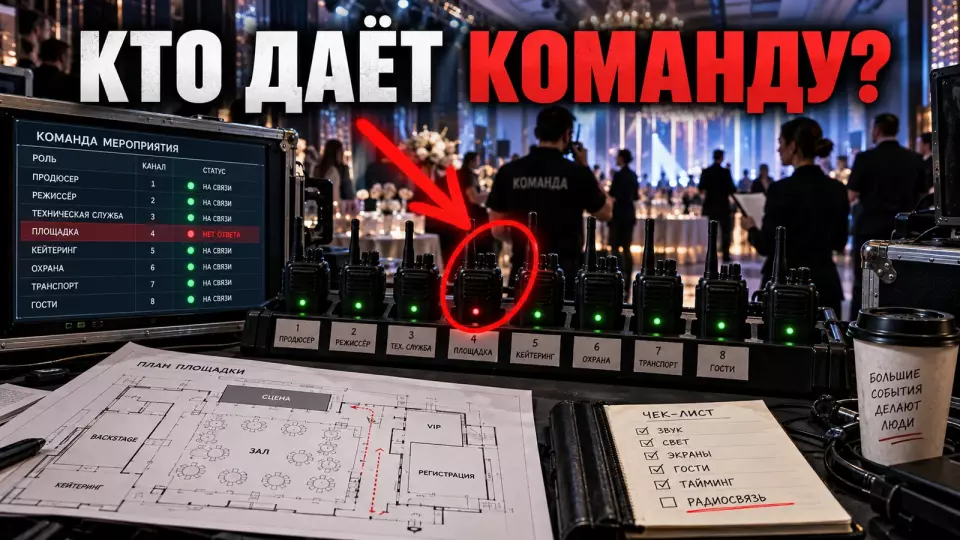
Radio channels are divided by function and traffic density, not by each employee's job title. Typically, a team needs a command loop for managers, operational channels for zones, and a separate technical channel. The exact scheme depends on the venue and equipment. It is recorded in the communications plan, tested on site, and not changed during the event without notifying all affected groups.
The main risk of a single shared channel is competition for airtime. A registration staff member reports a guest, a technician calls an assistant, logistics confirms a car, and the shift manager tries to relay a programme change. As a result, an important message has to be repeated, and no one is sure whether the recipient heard it.
Excessive fragmentation also gets in the way. If every small group has its own channel, the manager loses the big picture and carries several devices. That is why we start with the tasks that require constant communication and link the channels through function managers.
The communications plan only needs to specify:
- a clear channel name without publishing technical parameters in the general version of the document;
- the channel's purpose and the list of functions that monitor it;
- the primary call sign of each function;
- who manages communications discipline;
- where lengthy discussions are moved to;
- which channel or communication method is used in the event of a failure;
- who has the authority to announce a change of scheme.
The US Federal Emergency Management Agency uses Form ICS 205 as a single plan for radio channel and function assignments for an operational period. We do not transfer the agency form wholesale into a corporate event, but we use a useful principle: the channel assignment, recipient, period of validity and special instructions should all be in one up-to-date document.
At a conference, the stage team receives only messages related to the stage and the programme. The transfer coordinator monitors their own operational channel. At the same time, function managers remain connected to the command loop. This scheme is especially useful when organising conferences and forums, where the programme, registration, several halls and technical services operate in parallel.
We publish practical breakdowns of venue and team preparation in the Aventura Telegram channel. There you can save materials for a brief, rehearsal and work with contractors.
Short radio message: recipient, location, fact, action
A radio message must be short, unambiguous and suitable for confirmation. First, call the recipient and identify yourself, then state the location, the observed fact and the required action. If the decision affects the programme or safety, the recipient repeats the key part. Lengthy discussion is moved to a private conversation, phone or command centre, freeing up the channel for others.
The basic template looks like this:
"Command centre, this is Registration-1. Main entrance. The queue has gone beyond the inner markings. Need the senior guest services manager at the location. Over."
The message contains everything needed for an initial decision: to whom, from whom, where, what is happening and what assistance is required. The phrase "we have a problem, come urgently" will force the command centre to ask clarifying questions and will occupy the airwaves for longer.
We ask the team to follow several rules:
- press the transmit button, pause briefly and only then speak;
- use agreed call signs and zone names;
- transmit one question at a time;
- describe the observed fact without guesses or emotional judgements;
- state the action or the required recipient;
- confirm the task received and report when it is completed;
- do not hold the transmit button while thinking or during an unrelated conversation;
- do not discuss personal or other sensitive information on the open channel.
An event team does not need a set of departmental codes. We agree in advance on simple words and short confirmation commands: "repeat", "received", "done", "stand by" and "switch to backup communication".
A problem must be given a status. "Received" means the message was heard and understood. "In progress" indicates that someone has been assigned. "Done" closes the task. If a decision is postponed, the dispatcher states who is responsible and when to expect the next message. Without a status, the sender starts repeating the call or looking for another manager.
We check stage cues and critical transitions during the technical rehearsal of the event. During the run-through it is important to hear not only the sound in the hall, but also the working exchange between the director, the stage, the command centre and the technical stations.
How to prepare radios before the venue opens
Radio preparation starts with a device and role register and ends with a personal check of every handover. The team programs an agreed scheme, charges batteries, labels devices, selects headsets, assigns spares and records the recipient. Before opening, each staff member turns on their radio, selects their working channel, checks the volume and makes a test call from their zone.
We do not determine the number of devices by a universal norm. It depends on the number of zones, roles, shifts, reserve, duration of operation and the ability to quickly replace a faulty radio. First we build a communication map, then we count who needs constant access to the air, who only needs communication through a supervisor and where a spare device will be required.
It is convenient to keep the following in the handover register:
- the radio's internal number;
- the recipient's role and call sign;
- working and backup channels;
- the type of headset or other accessory;
- the battery condition at handover;
- the time of issue and return;
- any recorded fault or replacement;
- the name of the staff member who accepted the device back.
Labelling must be quick to read and must not be confused with the channel number. We use a separate device number and a role card. If a radio is passed between shifts, the new recipient repeats the call sign, channel and limits of authority, and the dispatcher updates the register.
Manufacturer manuals, including those from Motorola Solutions and Hytera, describe battery checks, channel selection, indicator operation, charging and programmable functions. The specific procedure is taken from the documentation for the chosen model. Button combinations, indications or charging rules must not be carried over from one radio to another.
Headsets are tested in real noise and in work clothing. The cable must not catch on equipment, the push-to-talk button must be accessible, and the earpiece must not prevent the staff member from hearing what is happening around them. If the role requires constant contact with guests or monitoring of a zone, the way the headset is worn is agreed with the task and the venue's rules.
If the project requires a separate technical circuit, its composition is recorded in the technical plan. Radios cannot be added to the budget as a single line without a plan for channels, accessories, charging, handover and on-site support.
Coverage testing and backup communication
Coverage is tested at the specific venue along real working routes, not based on a promised range in the specifications. The team walks through entrances, halls, service corridors, the loading area, parking, technical rooms and outdoor points. In each zone, they place a call to the command post and between linked posts, record reception quality and choose a backup communication method in advance.
Radio communication is affected by the building's construction, elevation changes, basement areas, nearby equipment, crowd density and the employee's position. That is why an advertised range does not answer the question of whether the command post will hear the coordinator at the freight elevator or at a distant transport boarding point.
We run the test along a single route and with a single recording form:
- We confirm the points where communication is needed for a real operation, not just for demonstration.
- We place one employee at the command post and send a second one along the role's route.
- At each point, we transmit a short check message and receive confirmation.
- We test communication in both directions, the headset's operation and speech intelligibility at normal volume.
- We mark the dead or unstable zone on the venue plan.
- We change the post's position, the communication method or the technical configuration together with a specialist.
- We repeat the route after installation and before opening if conditions at the site have changed.
- We record a backup for each critical point and explain it to the employee.
The backup may include another agreed radio circuit, a landline phone, mobile communication, a wired intercom system, a liaison employee or a personal relay of the message to the command post. The choice depends on the site. A single messenger app cannot be considered a sufficient backup if there is no stable internet in the service areas or employees cannot constantly look at a screen.
The official NSW Government guide recommends describing in advance the methods of communication with emergency services, the protocols and the responsible persons. For an event, this means a simple thing: the backup must be assigned, tested and known to people before an incident. A note saying "call if there is a failure" is useless without a number, a responsible person and a check of availability.
Communication testing is part of the overall event crisis management plan. The plan describes not only a radio failure but also the consequences: who is left without information, which operations are suspended and who informs the team about switching to the backup.
How does the command center handover work on the event day?
The command center handover follows a repeating cycle: take over the venue status, confirm communications, observe, log, assign actions and close tasks. The lead should not have to rebuild the picture after every message. To make this work, the dispatcher keeps a log, functions report statuses at agreed moments, and decisions are issued through one clear loop.
We structure the work as follows:
- Take over the shift. The lead and the dispatcher receive the current programme, venue plan, role list, open tasks, site constraints and contacts.
- Check readiness. Functions confirm staff at posts, radios, access, equipment and backup communication methods.
- Open the radio network. The dispatcher calls key call signs, checks channels and announces the start of the working period.
- Collect the starting status. Registration, stage, technical, venue, service and security give short reports for their zones.
- Maintain the overall picture. The dispatcher logs significant events, decisions, owners and deadlines for the next update.
- Manage changes. The shift lead assesses the impact on guests, the programme and adjacent functions, then issues one agreed decision.
- Confirm execution. The task owner reports the result, and the command center closes the entry or assigns the next step.
- Hand over to the next shift. Open issues, scheme changes and issued devices pass to the new team with a verbal briefing and a log entry.
- Close the working period. The command center confirms the end of guest operations, return of devices and the further communication mode during dismantling.
The command center should have regular checkpoints, but the airwaves must not turn into roll call for roll call's sake. The frequency of statuses is chosen based on the project's dynamics. Before opening, the start of a key block, a mass transition and venue closing, a general check-in is usually more important than during a quiet period of the programme.
Programme changes go through an impact assessment. If a performance shifts, the command center checks the readiness of the stage, host, next speaker, catering, transfer and guest messaging. Only after that does the team receive a single version. A personal request to "stretch it a little longer" must not quietly become the new timing.
During operations, it helps to separate fact from decision. The message "the bus is delayed" records a fact. The decision will be a specific action: keep the group in the hall, change the departure time, move the start of the block or use backup transport. Such a decision is made by the assigned function within its authority.
Serious incidents and sensitive information
In a serious incident, the event team follows the venue's plan and the instructions of the authorised services. Only information needed for immediate coordination is transmitted over the radio: the location, the observed fact, the presence of immediate danger and the assistance required. Names, contacts, diagnoses, personal details and unconfirmed versions must not be heard on the open channel.
This article does not replace the safety plan, the venue's instructions or professional training. The procedure for calling emergency services, evacuation, first aid and interaction with them is determined by qualified specialists and the venue's current rules. The event control centre helps to pass on information and carry out an agreed decision, but does not replace specialist management.
A neutral structure is enough for a radio message:
"Control, this is Hall-2. A person needs assistance at the north entrance. The passage is clear. We need the venue's responsible person and the relevant service. Over."
The dispatcher confirms the location, assigns the action provided for in the plan and clears the channel. If personal or sensitive information is needed, it is transmitted via an approved secure channel to those entitled to receive it. We do not give details over the open radio channel that could identify the person affected.
Rumours and assumptions are dangerous even in a less serious situation. Phrases like "I think the structure is about to collapse" or "it's probably a fire" create unnecessary alarm. An employee reports what they see: an unusual sound, smoke, a blocked passage, a barrier moving, a crowd gathering. Decisions and assessments are left to the responsible specialists.
Public announcements to participants are made by the designated person. Security, hostesses, technicians and the host must not give different explanations. The control centre agrees on a short wording, the channel and the moment of the announcement. If an external service or the venue takes control, the event team follows the established procedure.
The overall preparation framework should be checked against the article on safety at events. It covers roles, routes and interaction with the venue without replacing special requirements and professional instructions.
The radio log preserves decisions and helps review a shift
The radio log records significant events, commands and changes, so routine operational calls do not go into it. Each entry needs the time, source, location, a brief fact, the decision made, the owner, the deadline for the next status update and the outcome. Such a log helps the command team avoid losing open tasks, hand over a shift and, after the event, review the causes of failures by the sequence of actions.
The form can be simple:
The table summarises the key points of the section: Time, Source and location, Fact or request. Use it as a quick reference when preparing an event.
| Time | Source and location | Fact or request | Decision and owner | Next status | Outcome |
|---|---|---|---|---|---|
The ICS 214 form of the US Federal Emergency Management Agency is designed to record notable actions and messages. For an ordinary event we use a shortened version without agency-specific fields. The principle itself is useful: the log is kept as work proceeds, is handed over together with the shift and becomes the basis for a subsequent review.
Not every message requires a line. A headset check, a routine call to an employee or a household question would quickly overload the document. We record programme changes, readiness violations, recurring problems, decisions by the shift supervisor, switching to backup, requests from specialist services and tasks that remain open.
After the event, the log is compared with the master timing and the observations of the function teams. The review answers practical questions: where a message was delayed, who lacked authority, which zone lost communication, which name turned out to be unclear, why a task had to be handed over again and which backup worked.
The result of the review is a list of amendments. We update the role map, call signs, channel plan, test route, equipment list and log form. We replace an unsuccessful wording, remove an unnecessary channel and add an unstable point to the mandatory patrol. This way the next shift gets an improved process rather than the general conclusion that "we need to communicate better".
Frequently Asked Questions
An event control centre is a dedicated point where important information is gathered, the overall picture is verified and agreed decisions are issued to the team. It is needed not only during an incident. In normal mode, the control centre monitors the readiness of zones, programme changes, guest flows, technical statuses and contractor requests, so that participants do not manage the event through random calls and personal arrangements.
The control centre needs decision-making functions, not all project managers at once. We appoint in advance a shift supervisor, a communications dispatcher, and representatives for the programme, venue, technical production, guest services and security. The exact composition changes with the risks of the event, but each participant must have their own area of decision-making and a clear deputy.
Radio channels are divided by function and traffic density, not by the position of each employee. Typically, a team needs a command loop for managers, operational channels for zones and a separate technical exchange. The exact scheme depends on the venue and equipment. It is recorded in the communications plan, tested on site and not changed during the event without notifying all affected groups.
A radio message must be short, unambiguous and suitable for confirmation. First, the recipient is called and the sender identifies themselves, then the location, the observed fact and the required action are stated. If the decision affects the programme or safety, the recipient repeats the key part. A long discussion is moved to a private conversation, phone or the control centre, freeing up the channel for others.
Radio preparation starts with a register of devices and roles, and ends with a personal check of each issued unit. The team programmes the agreed scheme, charges the batteries, labels the devices, selects headsets, assigns spares and records the recipient. Before opening, each employee turns on the radio, selects their working channel, checks the volume and makes a test call from their zone.
Coverage is tested at the specific venue along real working routes, not based on the range promised in the specifications. The team walks through entrances, halls, service corridors, the loading area, parking, technical rooms and outdoor points. In each zone, a call is made to the control centre and between linked posts, the reception quality is recorded and a backup communication method is chosen in advance.
If you would like to put together a control centre scheme, a radio communications plan and a rehearsal for a specific venue, submit a request for event management. We will link roles, zones, the technical team and backup to the event programme.
Sources
- HSE: Crowd controls inside the venue
- FEMA: ICS Form 205, Incident Radio Communications Plan
- FEMA: ICS Form 205A, Communications List
- FEMA: ICS Form 214, Activity Log
- NSW Government: Communication for your public and outdoor event
- NSW Government: Safety and security for your event
- Motorola Solutions: MOTOTRBO CP200d Portable Radio User Guide
- Hytera: PD98X Digital Portable Radio User Manual
- Wembley Stadium: Wembley prepares for the play-offs
Contents
Was this article helpful?