A practical framework for opening a factory or a new production site: from goals and passes to the guest route and plan B.
A factory opening is an event for partners, the team, the media and regional representatives, but it takes place at a facility with its own regime, equipment and responsible departments. A working scenario begins with the guest route and access rules, and then grows with a ceremony, visual solutions and communications.
If you need a team that will put together the concept, programme and on-site coordination, submit a request to Aventura — we'll discuss the task and propose a working format.
Where to start with a plant opening scenario?
In short: first agree on the purpose of the ceremony and access boundaries. A production opening can be a presentation of an investment project, an introduction of partners to the site, an event for employees, or a press occasion. Each objective has its own guest list, route, program duration, and set of approvals.
At the first meeting, bring together the site manager, production, security, occupational health and safety, fire safety, HR, PR, and the event organizer. Identify one person who has the authority to stop the program or close a section of the route. This way, decisions about guests do not end up disconnected from the actual operating regime of the enterprise.
It is useful to immediately write down three questions: what guests should understand about the launch, whom to invite, and which areas are available for viewing. This turns a vague "make it beautiful" into a technical brief.
How to plan a guest route through the enterprise?
In short: the route should be short, clear, and coordinated with production. Arrival, the checkpoint, registration, the main program, the tour, catering, and exit are designed separately. Each transition needs a person in charge, a time buffer, and a clear meeting point.
The logic of industrial tourism can be used as a foundation: a route has a purpose, stops, timing, and guides. The Agency for Strategic Initiatives publishes a methodology for developing industrial tourism, in which the route is treated as a standalone product.
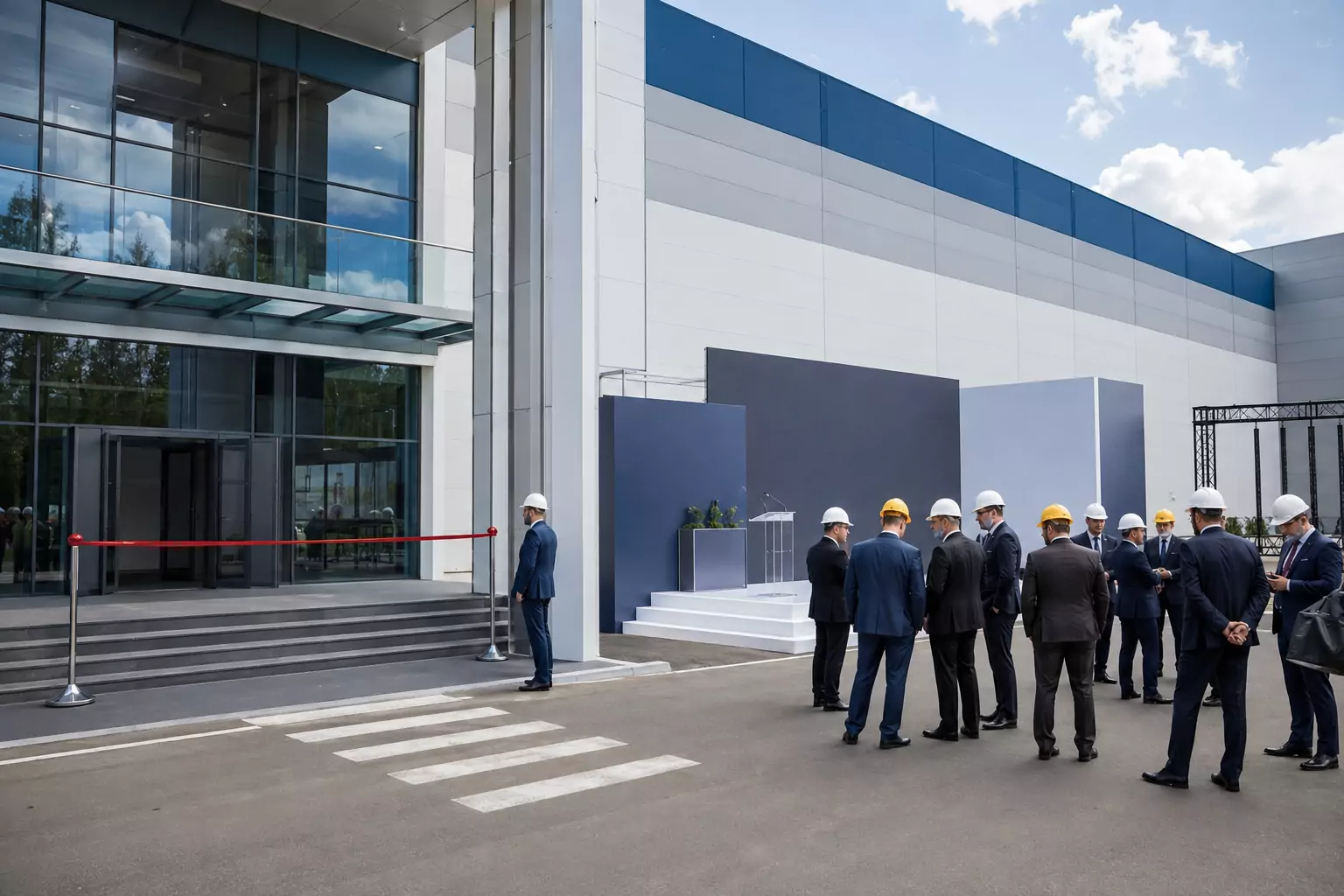
For a large group, it is better to split the flows in advance. Partners and VIP guests can enter the hall through a separate entrance, the media get a filming spot without going into the aisles, and tour groups move in small parties with a guide. For general preparation, materials on choosing a venue for an event will be useful.
Which zones need to be separated before installation?
In short: registration, ceremony, press zone, catering, excursion route and service passages cannot be planned on one free square meter. First the venue confirms boundaries and evacuation routes, then the stage, furniture, lighting and branding appear.
Fire safety regulations were approved by Decree of the Government of the Russian Federation No. 1479. The list of the Russian Ministry of Emergency Situations includes codes of practice on evacuation routes and exits, warning systems and temporary structures for mass gatherings. The organizer should not interpret the norms independently: before ordering structures, it is necessary to conduct a site walkthrough with the responsible representatives of the venue.
How to prepare access, briefing and PPE for guests?
In short: a guest does not replace an employee, and a short briefing does not replace mandatory employee training. For visitors, a separate clear regulation is needed: what data is required for entry, where not to go, what personal protective equipment (PPE) is issued and what to do on an alarm signal.
Rules for visitors are drawn up separately from the duties and training of employees. The production facility approves the route, escorts and photo restrictions, and the event team communicates them to guests in advance and on site.
A practical set for registration: deadline for lists, a unified data template for the checkpoint, a contact for replacements, arrival time with a buffer and a dress code message. If helmets, vests or glasses are needed, check sizes, stock and issuing point before the event day.
How to put together a ceremony without long speeches?
In short: the central moment should explain the launch and give guests a clear picture of what is happening. A short welcome, one substantive speech, a safe demonstration of the technology, and a symbolic action that can be filmed and shown in the company news are enough.
The symbolic action could be the launch of a display, the unveiling of a branded panel, the handover of the first unit of production, or another form approved by the production team. The decision is made after a technical check, not at a rehearsal with guests. For the protocol part, it is useful to distribute the order of speeches in advance and the positions where speakers, interpreters, and photographers stand.
The opening of a plant is part of a larger business communications task. Organizing a business event helps combine the program, guest services, and the business goal without excessive decoration.
Where to place catering and how to account for accessibility?
In short: food and guest comfort require a separate area and separate approval. The location for the coffee break is chosen based on logistics, sanitary conditions, and the capabilities of the venue. Accessibility is checked along the entire chain: arrival, registration, hall, restroom, route, and exit.
Rospotrebnadzor points to the requirements of SanPiN 2.3/2.4.3590-20 and TR CU 021/2011 for public catering organizations, including separate equipment and utensils for finished and raw products. The catering provider must confirm the service scheme, storage, and cleaning conditions. A buffet at the workshop gates without infrastructure rarely resolves these issues.
In the invitation, you can invite guests to indicate any assistance they need to take part. Accessibility is checked along the entire route: a ramp at the entrance does not make the entire program accessible.
How to work with the guest list, photos and video?
In short: the list for the checkpoint, the registration form and the publication of photos are different processes. For each of them, the purpose, the minimum set of data, the person responsible and the retention period are determined in advance. This way the team doesn't collect excess information and doesn't ask guests to deal with documents at the entrance.
Roskomnadzor reminds that to publish photos and videos with people, you need to determine in advance the purposes, the composition of data and the procedure for obtaining consent. It is better to check the specific form and legal basis with the client's lawyer. It is important for the organizer to integrate this issue into the guest journey: before registration, not after the camera is already on.
Agree in advance: whether the production line can be filmed, whether no-filming zones are needed, where the press point is located and who approves materials for publication. The same procedure is useful when preparing event security.
What to check at the rehearsal and in plan B?
In short: the rehearsal should follow the actual route and use real access procedures. The team checks the timing on foot, communication between departments, visibility of signage and the ability to quickly change the program if a production area becomes unavailable.
It is better to draw up plan B for guest delays, bad weather, equipment failure, queues at the checkpoint, a medical incident, cancellation of catering and changes in the production schedule. Each scenario needs a solution, a responsible person and a communication channel. Industry recommendations on event safety emphasize: requirements may differ by region, so the format, territory and expected guest flow should be checked locally.
After the rehearsal, update the timing and do not add new elements 'just in case'. On the day of the opening, clear roles, short transitions and the ability to calmly make a decision are most valuable.
Checklist for opening production before inviting guests
The table contains the key points of the section: Zone, What to check, Who confirms. Use it as a quick guide when preparing the event.
| Zone | What to check | Who confirms |
|---|---|---|
| Registration | The queue does not block the passage, there is signage and a waiting area | Security and venue |
| Ceremony | Stage visibility, exits, cables and media areas | Production and fire safety |
| Tour | Access, PPE, group size and stop points | Occupational safety and production |
| Catering | Water, electricity, food storage and cleaning | Venue and food supplier |
In short: invitations should be sent after the facility has confirmed the route, zones and responsible persons. The table helps to quickly check the key areas before installation and rehearsal.
- The purpose of the ceremony and the guest list have been agreed.
- Production has confirmed the route, available zones and filming rules.
- The checkpoint has received the format and deadline for the lists.
- Occupational safety has determined the rules for briefing, escorts and PPE.
- Fire safety has checked zoning and temporary structures.
- Catering has confirmed the service location, logistics and working conditions.
- Navigation, contacts and assistance if needed are provided for guests.
- The program, press plan and plan B have been checked at the rehearsal.
The opening of a plant becomes a convincing event when guests see a working facility, a clear purpose for the launch and a well-coordinated team. Aventura takes on the development of the concept, script and coordination on site — leave a request for a consultation.
Leave a request - let's discuss your task
We'll clarify the event format and suggest the next step.
Materials and next steps
If you need examples of implemented solutions, take a look at Aventura's portfolio. For a ceremony with an artistic program, you can view the catalog of artists. We publish news and analyses of new projects in the agency's Telegram channel.
Sources
Contents
Was this article helpful?