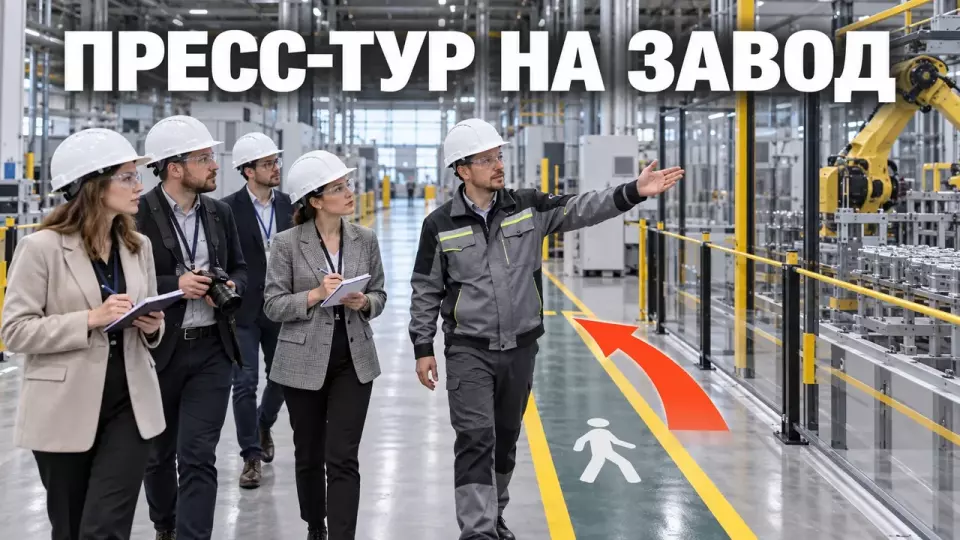
A production press tour requires a shared route for PR, the shop floor, and security. We cover accreditation, filming, briefing, and rehearsal.
A press tour of a production facility helps show the process where a standard press release is not enough. Journalists see the line, ask engineers questions, and get their own material for publication. But the plant remains an operating facility. That's why at Aventura, we first define the purpose of the visit, access rules, and a route that doesn't disrupt operations.
In this article, a press tour means an organized visit by media representatives to a facility with a program, speakers, filming, and pre-agreed restrictions.
What to decide before inviting journalists?
In short: Before inviting media outlets, the client approves the main idea of the press tour and the boundaries of what will be shown. Then, based on this task, they select guests, route, speakers, and the time of the visit. The public relations department (PR department), production director, and security service coordinate decisions in advance, otherwise disagreements will surface at the entrance.
The phrase “show the factory” is too broad. A working goal should be more specific: explain the launch of a new line, demonstrate quality control, present localized production, or give journalists material about a new facility. One visit can cover several related points, but it should have a key takeaway for the media.
We put the goal on one page. Alongside, we note what the journalist should see, who to get a comment from, and what facts they can verify on site. If the key message cannot be supported by the route or documents, the program turns into a presentation in front of the workshop.
Before the announcement, we agree on five decisions:
- The main news hook and acceptable wording.
- Media categories and accreditation requirements.
- Areas that can be shown and filmed.
- Speakers and the topics they cover.
- The rule for canceling or changing the route in case of production risk.
Article 48 of the Russian Federation Law “On Mass Media” regulates the accreditation of journalists nominated by editorial offices: the organization sets the rules, and the editorial office must comply with them. For bloggers, industry authors, and other guests, the registration and admission procedure is determined by the venue itself. At Aventura, we recommend communicating uniform organizational rules to all invited guests in advance. The data composition, legal basis, retention period, and procedure for informing guests are agreed by the operator with the person responsible for personal data and the lawyer.
Roles and Single Route Owner
One person is responsible for the program. They consolidate decisions from all departments, keep the current route up to date, and communicate agreed changes to the group. Otherwise, journalists will hear different rules, and the production shift will find out about the visit too late. At the same time, specialists retain responsibility for their own areas on site.
We assemble a working group and record areas of responsibility in a table. This way, each department sees in advance its decision before the visit and its task on the day of the press tour.
The table summarizes the key points of the section: Role, Decision before the visit, Work on the day of the press tour. Use it as a quick reference when preparing for the event.
| Role | Decision before the visit | Work on the day of the press tour |
|---|---|---|
| program manager | route version, timing, contacts | receives changes and maintains the common channel |
| PR department | list of media outlets, topics, press kit | meets journalists and collects requests |
| production | available processes and speakers | confirms the state of the line |
| security | passes, restricted areas, escort | controls access and filming |
| occupational safety | protective equipment and traffic rules | conducts briefing and monitors the route |
| group coordinator | gathering, headcount, and pace | leads the group between points |
Each decision gets a deadline and an owner. The phrase "coordinate with the plant" is not suitable: it is unclear who is responsible and what counts as a result. It is better to write: "the shop manager confirms by 15:00 that the line is operational and the group's stopping point is safe."
We link the route to the event approval calendar. In it, we note the final guest list, pass issuance, readiness of equipment, speakers, transportation, catering, and the backup date. A later change to one point immediately shows the related tasks.
How to build a safe route?
In short: A safe route is built in the actual workshop together with production and occupational safety. The team walks the route, checking entrances, crossings, noise, visibility, floor covering, and stopping points. The group must not cross vehicle traffic, block an emergency exit, or gather where employees perform work operations.
First, mark the mandatory points: entrance, briefing area, PPE issuance, sanitary zone, production stops, a room for questions, and the exit. Then connect them with the shortest clear path. For a nice angle, guests should not be led through a working corridor with a forklift.
The British Health and Safety Executive (HSE) describes three stages of managing people flows at an event: arrival and entry, movement around the site, exit and dispersal. This is not a special standard for factory press tours. At Aventura, we use this scheme as a verification framework for the route and separately look at where the group waits for passes, moves between points, and exits after the program.
We check the route step by step:
- Walk it at the same shift time as the planned visit.
- Measure the time including stops and questions.
- Check if the coordinator and speaker can be heard.
- Choose places where the group can stop as a whole.
- Note stairs, narrow passages, and slippery areas.
- Check an accessible route option and a place for an accompanying person.
- Clarify actions in case of alarm, line failure, or appearance of vehicles.
- Re-walk the route after corrections.
Do not set the group size by habit. It is limited by the width of the safe zone, the number of escorts, site rules, and the ability to keep every guest in sight. If a point holds fewer people, we divide participants into flows and stagger them over time.
If you need to connect the route, logistics, speakers, and team work on site, request a quote from us. In the request, specify the city, type of production, news hook, number of editorial offices, and access mode.
We publish reviews of business and corporate events in the Aventura Telegram channel. There you will find practical solutions for programs, venues, and team work.
Shooting Map and Closed Zones
The shooting map shows where photos, video, and audio recording are allowed, and where equipment must be removed. It is agreed upon before inviting journalists and reiterated at the briefing. Such a document helps reduce the risk of commercially sensitive processes and personal data appearing in the frame. The legal grounds for shooting and use of materials are determined separately by the client.
We divide the route into green, yellow, and closed points. In the green zone, you can shoot the general plan and process details. In the yellow zone, shooting is only allowed from an agreed location or in a specified direction. In the closed zone, cameras and phones are put away. The color scheme is convenient only as a reminder; the legal and regulatory rules are formulated by the facility owner.
Federal Law No. 98-FZ links the protection of trade secrets with an established confidentiality regime. The simple phrase "everything here is secret" does not replace the list of protected information and access measures. Within the law, the information holder determines the protected data and translates this list into specific restrictions for the route and shooting.
We notify employees about the shooting in advance. Article 152.1 of the Civil Code regulates the use of a citizen's image and contains exceptions, but the team should not independently interpret them for controversial shots. The procedure for consents and notifications is approved by the client's lawyer. People who are not participating in the program are given the opportunity not to appear in close-ups.
We format the shooting map as a table with five fields: point, permitted angle, prohibited object, responsible person, and example of material. The operator and photographer receive it before the visit. New permission on site is issued by the appointed decision owner upon the coordinator's request.
How to build the program without rushing?
In the program, we alternate short explanations, observation of the process, and questions. Between blocks we leave time for transitions, equipment, and possible delay at the entrance. If every minute is planned for the presentation, the first question will shift the route and make the production wait for the group. The buffer protects the agreed time of the workshop.
It is better to start the program outside the noisy area. Here participants go through registration, receive the rules, equipment, and general context. The speaker explains what the journalists will see, why this particular route was chosen, and what restrictions apply.
We build the main part around three or four meaningful stops. At each stop we need one responsible speaker and one clear point. A long introduction near the equipment bothers both guests and employees. The details can be moved to a quiet room after the tour.
The working order looks like this:
- Gathering and checking the list.
- Briefing and issuance of equipment.
- A short introductory speech.
- Tour of the production points.
- Demonstration of the product or quality control.
- Questions to the manager and experts.
- Receiving materials and collecting additional requests.
- Organized exit and return of equipment.
Transportation, meals, and time for personal conversations are also included in the program. They are not hidden in the notes. If the bus is late for the start of the shift, the entire route may become unavailable. We set a control departure time and a separate contact for those who travel on their own.
Speakers, Facts, and Materials for Media Outlets
Each speaker is responsible for their own topic and relies on a verified fact sheet. Before the visit, they know the expected questions and the limits of information disclosure. Requests outside their area of expertise are forwarded to a designated specialist. The media kit supplements the conversation with verified names, positions, facts, photos, and contacts without discrepancies.
At the production site, the specialist who knows the process and can explain it in simple terms speaks. Strategic questions are left to the company's CEO, technological ones to the engineer, and quality control to the relevant expert. One person rarely answers all topics with equal confidence.
We prepare a speaker brief: the topic's objective, three key messages, supporting facts, off-limit topics, and the name of the specialist to handle difficult questions. The wording is reviewed by the PR team and the relevant manager. Figures are assigned a unit of measurement, time period, and internal source. If a metric cannot be confirmed, it is removed from public statements.
The press kit is conveniently compiled in a single link accessible from a phone. It includes:
- a brief overview of the company and the site;
- the visit program and filming rules;
- names and positions of the speakers;
- verified facts and terminology;
- photos approved for publication;
- a contact for follow-up questions;
- image captions and source attribution guidelines.
For a general discussion with speakers, the structure from the article on the company's press conference works well. In a press tour, it is better to place it after the route: journalists have already seen the process and ask specific questions.
Rehearsal, Communication, and Contingency Scenario
During the rehearsal, the team walks through the entire route from accreditation to exit, including briefing and production stops. Then they practice one disruption: a closed line, a delayed bus, an unavailable speaker, or a ban on a stop. For each note, we record the person responsible and the deadline for re-checking. The fix is confirmed using the same scenario.
We conduct the rehearsal with the participation of PR, the coordinator, production, and security. One person plays the journalist and asks inconvenient organizational questions. Another keeps track of time. A workshop representative checks whether the group interferes with operations. A security specialist verifies that everyone understands the commands.
We include this run-through in the overall technical rehearsal of the event. In the notes log, we record the exact action: 'move the second commentary from the workshop to the meeting room; owner - PR; re-check - 16:00'.
The team has one working channel and a short list of call signs or roles. Substantive points are not discussed on the fly. The coordinator reports the group's status, production confirms the readiness of the stop, and the program manager approves route changes.
We prepare a contingency scenario for at least four situations:
- the line has stopped or is unavailable;
- part of the route has been closed by security;
- the main speaker is delayed;
- transport or the group is running late.
Instead of a canceled stop, you can show a finished sample, a laboratory, an approved recording of the process, or arrange a conversation with an engineer. We choose a replacement that reveals the original point. It's convenient to link the general roles during a disruption to the event crisis plan.
Press Tour Day at the Production Site
On the day of the visit, the program manager first confirms the route status, then opens registration. The group receives one version of the rules and moves with two escorts. One leads, the other brings up the rear. After a stop, the coordinator recounts the participants and gets confirmation for the next point. Changes are approved by the route owner.
The team arrives before the guests and checks the readiness of each point: from the entrance and the list to equipment, communications, and materials. The production confirms that the line shown in the program is operational and the route is clear. If conditions have changed, all responsible parties receive the updated version before registration begins.
During the briefing, we briefly explain the route, signals, filming rules, and what to do if someone falls behind or feels unwell. Then we ask a check question to make sure the rules are understood.
HSE advises monitoring the distribution of people and bottlenecks to notice overcrowding early. For a small group, the principle is the same: the trailing coordinator sees the tail, and the leader does not start moving until the group has gathered. At stairs, the entrance, and the equipment distribution point, there should be no oncoming traffic.
We leave journalists time for their own observations and questions. The program should not turn the visit into a line of guests following the leader. At the same time, free movement around the production site is not allowed. For additional shots, we schedule a separate window and an escort.
What to do after the visit?
After the press tour, the PR team collects requests, sends the promised materials, and provides contacts of the responsible persons. The team does not ask the editorial team to approve the text without good reason. It quickly clarifies facts, checks captions for official images, and notes topics that required explanations. Responses go through a single agreed-upon channel.
Before guests depart, we check that everyone received the link to the press kit and knows the contact for questions. Equipment is collected according to the site's rules. The coordinator notes unresolved requests: a photo of a specific component, an engineer's comment, a technical specification, or confirmation of a position.
Responses are collected through a single owner. This way, the editorial team does not receive different numbers from the marketing department and the workshop. We state the response time honestly. If a fact requires verification, we say so and come back with a confirmed wording.
After publications, we evaluate not only their number. We look at whether the material revealed the main thesis of the visit, what questions were repeated, and whether the editorial teams had enough factual material. We separately review the organization: the entrance, the pace of the route, the equipment, communication, and the speakers' work. These conclusions become the basis for the next brief.
Frequently asked questions
The wording "show the plant" is too broad. A working goal sounds more specific: explain the launch of a new line, show quality control, present localized production, or give journalists factual material about the new site. One visit can cover several related theses, but it must have a main answer for the editorial team.
One person is responsible for the program. They consolidate decisions from all departments, keep the current route, and communicate agreed-upon changes to the group. Otherwise, journalists will hear different rules, and the production shift will learn about the visit too late. Specialists still retain responsibility for their areas on site.
First, we mark the mandatory points: entrance, briefing area, distribution of personal protective equipment, sanitary zone, production stops, room for questions, and exit. Then we connect them with the shortest clear path. For the sake of a nice angle, guests cannot be led through a working corridor with a forklift.
The shooting map shows where photos, video, and audio recording are allowed, and where equipment must be put away. It is agreed upon before inviting journalists and repeated during the briefing. Such a document helps reduce the risk of commercially sensitive processes and personal data appearing in the frame. The legal grounds for shooting and using materials are determined separately by the client.
In the program, we alternate short explanations, observation of the process, and questions. Between blocks, we leave time for transitions, equipment, and possible delays at the entrance. If every minute is scheduled for a report, the first question will shift the route and make the production wait for the group. The buffer protects the agreed-upon time for the workshop.
Each speaker is responsible for their block and relies on a verified fact sheet. Before the visit, they know the expected questions and the limits of data disclosure. A request outside their competence goes to a designated specialist. The package of materials for editorial teams (press kit) complements the conversation with verified names, positions, facts, photos, and contacts without discrepancies.
To prepare a press tour together with production, safety, logistics and speaker management, request a quote from us. We will clarify the task, the facility mode, media composition and available showcase points.
Sources
- Article 48 of the Russian Federation Law 'On Mass Media': Accreditation.
- Federal Law No. 98-FZ 'On Commercial Secrets'.
- Article 152.1 of the Civil Code of the Russian Federation: Protection of a Citizen's Image.
- HSE: Entrances, Exits and Guest Movement Management.
- HSE: Flow Monitoring and Bottlenecks.
- W3C WAI: Accessible Routes and Materials for Events.
- Unisender: Definition and Objectives of a Press Tour.
- Sverdlovsk Regional Entrepreneurship Support Fund: Announcement of a Press Tour to the Production Facility.
Contents
Was this article helpful?