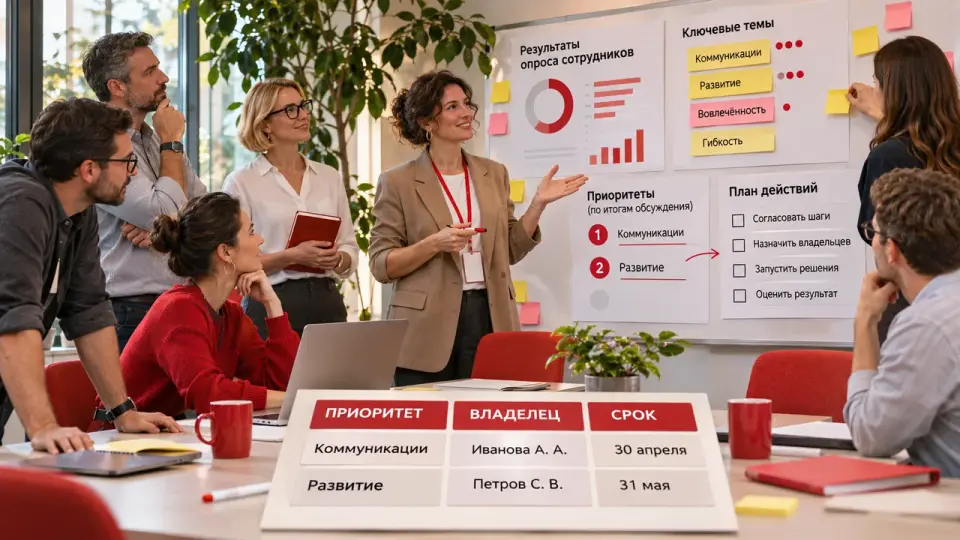
A practical session scenario based on an employee survey: how to present the data, discuss the causes, choose priorities and lock in a workable action plan.
A session on the results of an employee survey helps participants reach a shared understanding of the data, test the real causes and agree on actions. By the end of the meeting there should be priorities, owners, deadlines and a way to check progress.
At Aventura we treat such a session as a business event with a sensitive topic. The screen, timing and facilitation are not the only things that matter here. You need to define the boundaries of the conversation in advance, protect anonymity, prepare managers and give every participant a safe way to speak up.
A survey on its own does not change the working environment. Change begins when the company presents the results, gathers feedback on the causes, chooses feasible steps and comes back to employees with an update. This sequence is supported by the OPM and Cabinet Office guidance on working with results and planning actions.
Leave a request — let's discuss your task
We'll clarify the event format and suggest the next step.
Where does the format end?
A session on employee survey results begins with deciding what the meeting can change and what lies beyond its scope. Without such a framework, participants quickly move to general complaints, personal accusations or promises that the project team has no authority to make. Establish the group's mandate, separate channels for individual cases and the expected outcome of the meeting.
A session on employee survey results should address a limited set of tasks. For this meeting we define four outcomes:
- Present the key survey results in plain language.
- Check how employees explain individual signals.
- Choose a limited number of priorities.
- Draw up an action plan or a package of proposals for the next level of decision-making.
It does not replace an investigation of a specific conflict, a one-on-one meeting with HR, a channel for reporting a violation or a management strategy session on all company issues. If the comments contain information about a possible violation, a security threat or a personal situation, it is passed on through a separate process. Public discussion in the group is not suitable for this.
It is important to state the level of authority in advance. A department team can change the frequency of meetings, the way tasks are handed over or the format for recognising contributions. But revising the reward system, the staffing structure or corporate policy is often at a different level. In that case, the outcome of the session will be a formalised proposal with an owner for further review.
The meeting should not turn into a defence of the manager. Phrases like "we'll now explain why employees misunderstood the situation" shut down the conversation. A manager can provide context, but first participants must see the data and describe their own experience.
Preparation before the meeting
A high-quality session starts with editorial work on the data. A full analyst report is rarely suitable for showing as is. Participants need a short set of slides: the purpose of the survey, coverage without disclosing small groups, key themes, strengths, areas for attention and rules of interpretation. Before the meeting, authority, roles and the format of the final minutes also need to be agreed.
OPM recommends sharing results and inviting employee input, then moving on to action. In practice, we divide preparation into content, participant composition and meeting logistics.
The table summarises the key points of this section: What to prepare, Check question, Outcome before the meeting. Use it as a quick guide when preparing your event.
| What to prepare | Check question | Outcome before the meeting |
|---|---|---|
| Data cut | can it be shown in a way that makes it impossible to identify an individual or a small group? | an approved set of charts and wording |
| Context | what is it appropriate to compare the result with? | an explanation of the period, comparison base and limitations |
| Comments | how do we remove personal and identifiable details? | a thematic summary instead of a selection of “sharp” quotes |
| Authority | what decisions can participants make? | a list of areas: “decide here”, “escalate”, “do not discuss publicly” |
| Participants | who needs a voice, and who needs an expert or owner role? | group composition and roles at the session |
| Scenario | what outcome is needed after each block? | a minute-by-minute agenda and instructions for the facilitator |
| Documentation | what do we record, and who will see the records? | a minutes template without personal statements |
| Follow-up | when will employees receive an update? | the date of the first message after the meeting |
A separate meeting with the client and the manager is useful before the session. We check whether they are ready to hear uncomfortable versions of the causes without immediately arguing. We also discuss questions that do not yet have an answer. An honest phrase — “no decision has been made; we will come back with an answer by the specified date” — is safer than a hasty promise.
The facilitator needs more than a report. They are also given the history of previous surveys, initiatives already under way, structural changes and topics that must not be mixed. For example, a drop in the communications score after a reorganisation does not prove one specific cause. It is a hypothesis that can be discussed but must not be presented as a data finding.
If the session is part of broader internal communication, it can be linked to a company town hall. A general meeting is suitable for transparently communicating results and management decisions. A small working group is better suited to analysing causes and developing actions. These formats serve different purposes.
How can you present results without pressure?
Start with the rules for reading the data. A survey shows how people perceive things at a particular moment. It helps to reveal themes and differences, but it does not automatically explain all the causes. A single metric must not be turned into a diagnosis of a department or an assessment of a particular manager without an agreed methodology and a sufficient base.
The order in which you present things affects the tone of the conversation. We recommend moving from the general to the specific and not opening the discussion until the limitations of the data have been explained:
- Remind people why the survey was conducted and how the results will be used.
- Explain what data the group can see and what limitations apply.
- Show the strengths that are important to preserve.
- Show several areas for attention without ranking the “best” and “worst” people.
- Allow time for individuals to write down their observations.
- Only then open the discussion.
Do not display a long feed of anonymous comments on screen. Even without a name, the style, job title, project or described situation can make the author recognisable. One striking phrase can easily take over the whole conversation, even though it does not reflect the majority view. It is safer to group comments by theme and remove details that could identify a person.
Slides should separate fact from interpretation. “The score for the theme has declined relative to the chosen baseline” is an observation. “Employees do not trust management” is already a conclusion that needs to be tested. During the session, you can offer several hypotheses and ask what participants see in their day-to-day work.
Do not ask people to answer a sensitive question in turn. A mandatory spoken answer creates pressure and reinforces the influence of status. It is better to allow quiet time first, then collect cards or responses in a digital field, and after that discuss the themes without identifying the authors.
The CIPD Good Work Index looks at the quality of work through several aspects of the work experience. For a team, this is a useful framework: workload, relationships, employee voice, development and working conditions require different actions. That is why it is important to keep the structure of the themes on the slides and not reduce the whole conversation to a single average value.
Leave a request and we will discuss your task
We will clarify the format of the event and suggest the next step.
Participants and anonymity rules
The size and composition of the group depend on the goal. Developing actions requires a working group that includes employees, managers and the owners of possible changes. If only managers are invited, the plan may fail to reflect day-to-day experience. If only employees are gathered without decision-makers, ideas will have no path to implementation.
The table summarises the key points of this section: Participant, Role in the session, What is important to agree in advance. Use it as a quick reference when preparing the event.
| Participant | Role in the session | What is important to agree in advance |
|---|---|---|
| Survey owner or HR | explains the methodology and data boundaries | does not disclose small segments or the identities of comment authors |
| Manager | provides context and makes the decisions available to them | does not argue with personal experience or try to identify the authors of criticism |
| Employee representatives | describe work situations and test hypotheses | talk about processes, not about people's presumed motives |
| Function owner | assesses the feasibility of actions | distinguishes a quick decision from an initiative that requires approval |
| Facilitator | runs the process and ensures equal participation | does not substitute the group's substantive decisions with their own |
| Secretary | records topics, decisions and open questions | does not record personal statements unless necessary |
Survey anonymity and the closed nature of the session are not the same thing. Participants in a working meeting see each other. Therefore, full anonymity of their spoken remarks cannot be promised. Other rules can be established: not attributing ideas to specific people in the final report, not quoting without consent, not discussing private stories outside the group.
If the group includes a manager and their direct reports, add ways to participate without an immediate public response. Individual cards, an anonymous digital board or work in small mixed groups will work well. The tool itself does not solve the problem. The facilitator must stop attempts to identify the author and bring the conversation back to the topic.
For small departments, data should be aggregated. The exact disclosure threshold is set by the research owner according to the adopted methodology. The event team does not determine it independently. If a particular segment cannot be shown safely, the group works with a broader category or a general topic.
How to build a 2-3 hour program?
For such working meetings, our business event management service is a good fit: it ties the agenda, facilitation, venue, equipment and materials into a single production plan. The program should guide the group from a shared understanding of the data to a few decisions, and each block should end with a documented outcome.
In two hours, you can understand the results, choose one or two topics and draft actions. With three hours, there is more time for root causes, feasibility checks and action plan design. Don't try to cover the entire report. Depth matters more than the number of charts.
The table summarizes the key points of the section: Time, Block, Outcome. Use it as a quick reference when preparing the event.
| Time | Block | Outcome |
|---|---|---|
| 00:00-00:15 | opening, goal and ground rules | participants understand the boundaries and how decisions will be recorded |
| 00:15-00:35 | survey results | the group sees the big picture and data limitations |
| 00:35-00:50 | quiet individual work | observations are collected without the pressure of the first answer |
| 00:50-01:20 | grouping topics | recurring signals and questions are identified |
| 01:20-01:30 | break | participants reset before analyzing root causes |
| 01:30-02:00 | root cause facilitation | a set of testable hypotheses is formed |
| 02:00-02:25 | prioritization | topics are selected for action and escalation |
| 02:25-02:50 | action plan | owners, deadlines and progress indicators are assigned |
| 02:50-03:00 | closing | next steps and communication date are confirmed |
For a two-hour version, shorten the presentation and focus on one topic. Do not remove the quiet work and closing. These are the blocks that help balance participation and secure follow-up.
It is useful to conclude the preparation of such meetings with a technical rehearsal. During the rehearsal, we check the screen, sound, remote participant connections and a backup scenario.
We prepare slides, group work templates, a timer, table transition rules and a final minutes template in advance. If there are many participants, you need group facilitators with identical instructions. Before the start, they go through a short briefing so they don't set different rules or promise solutions on behalf of the company.
Facilitating causes without looking for someone to blame
Survey results point to a topic, but action requires understanding the mechanism behind it. For example, a low score on awareness may stem from infrequent updates, overloaded channels, late decisions, or a lack of conversation with one's direct manager. Each cause calls for its own response. Facilitation helps turn people's ratings into descriptions of real work situations and testable hypotheses.
Start with work situations. The question "why is our communication so bad?" is too broad and invites judgments. It is more useful to ask: "At what point does an employee lack the information they need to do their work?", "What happens next?", "What should the right process look like today?"
To dig into causes, we use a single sequence. It keeps the conversation focused on work situations and testable hypotheses:
- Pick one signal from the results.
- Describe the observed situation without names or judgments about people.
- Ask what happens before and after it.
- Gather several possible causes.
- Separate confirmed facts from assumptions.
- Identify what can be tested quickly.
- Formulate an action at the process level.
The "five whys" method can be used with care. It helps deepen the analysis, but it does not always lead to a single root cause. In an organisational setting, several factors are often at play. That is why we do not force the group to arrive at a single explanation when there is not enough data to support one.
The facilitator watches the language. "They're lazy" is replaced with a question about behaviour, conditions and process. "Management doesn't listen" is clarified: where do employees make suggestions, who responds, within what timeframe, and what happens to rejected ideas.
This specificity does not dismiss the emotion. It makes the problem actionable.
If the conversation turns to a person, the facilitator brings the group back to the role or the process. A private conflict is recorded as a separate item for the appropriate channel. It is unacceptable to discuss a colleague who is not present in front of the group and call it a root cause analysis.
How to choose priorities?
After the discussion, there are usually more ideas than the company can deliver. Prioritisation protects the plan from a long list without owners. The group should assess the link to data, the impact on the employee experience, manageability and the resources required. A strong priority can be explained to employees, launched within the team's authority and reviewed before the next major survey wave.
The table summarises the key points of this section: Criterion, Question for the group, Sign of a strong priority. Use it as a quick reference when preparing your event.
| Criterion | Question for the group | Sign of a strong priority |
|---|---|---|
| Link to results | does the action respond to a clear survey signal? | you can show which topic it changes |
| Impact | will employees feel the change in their daily work? | a specific process or experience changes |
| Manageability | does the group have the authority to start the action? | the decision owner is named |
| Feasibility | are time, people and budget available? | dependencies and constraints are clear |
| Measurability | can progress be seen before the next major survey? | there is an early indicator and a review date |
| Trust | does the action respond to what the company heard? | the link can be explained to employees in simple terms |
First, select the actions that meet the mandatory criteria. Then compare the remaining options. Dot voting is good for gathering opinions, but it should not automatically make the decision.
A popular idea may fall outside the team's authority or have no link to the root cause. The final choice is confirmed by the decision owner after discussing the constraints.
For the final decision, we use three buckets. This split shows what is being launched now, what needs testing and what is being passed to another level:
- Do. There is an owner, resources and a clear first step.
- Test. More data, interviews or a small test are needed.
- Escalate. The issue requires a decision at another level or function.
Do not use a "not doing" category without explanation. If a suggestion is rejected, employees should understand why: there is no link to the data, the action creates another risk, a related initiative is already under way, or a decision is not yet possible. Ideas quietly disappearing undermines trust in the next survey.
Action plan: owners, deadlines and review
The action plan shows what will change, who is responsible for driving it forward, what the first step is and when the team will review progress. OPM and Cabinet Office guidance suggests linking the chosen actions to owners, deadlines and ongoing communication. For the session we use a compact action card.
The table summarises the key points of this section: Field, What to record, Example wording. Use it as a quick reference when preparing the event.
| Field | What to record | Example wording |
|---|---|---|
| Problem signal | an observation from the results and discussion | employees learn late about changes that affect their tasks |
| Hypothesis about the cause | what the group considers a possible mechanism | decisions are passed on without a single communication owner |
| Action | a specific process change | add a short update after the weekly leadership meeting |
| Owner | one person responsible for driving it forward | head of the internal communications function |
| Participants | who helps carry out the action | HR, department heads, channel editor |
| First deadline | the nearest reviewable date | prepare the format and publish the first issue |
| Resource | what is needed to launch | editor's time, template, recipient list |
| Sign of progress | what can be seen before the next survey | updates go out on schedule, questions get owners |
| Review date | when the decision is assessed and changed | a working meeting of the owners after an agreed period |
Every action must have one owner. This does not mean that they do all the work. They bring the participants together, remove blockers and report status. The wording "HR and managers" hides accountability if no one within the group is responsible for the next step.
It is better to break the deadline into stages. A distant completion date does not show whether work has started. Specify the date of the first step, the review date and the expected decision point. For a large initiative, you can set up a pilot in one department before scaling up.
Indicators do not have to repeat the survey questions. Before the next wave you can observe how the process is being carried out: the regularity of meetings, response time, the share of closed questions or the existence of an agreed route. The choice depends on the action. The evaluation of the event itself can be linked to the approach in the article on corporate event KPIs: assess the organisation of the session, the quality of participation and the subsequent changes separately, rather than mixing them into a single indicator.
At the end of the meeting, the owner of each action confirms the wording out loud. The secretary records open dependencies. If an owner cannot accept a task, it cannot be left in the plan as accepted.
What Changes in a Hybrid Format?
Hybrid makes equal participation harder. People in the room join the conversation faster, see non-verbal reactions and can discuss the topic during a break. Remote participants depend on audio, camera, interface and the moderator's work. That is why hybrid requires a dedicated participation plan, not just a live stream connection.
The table summarises the key points of this section: Question, Single format, Hybrid format. Use it as a quick reference when preparing your event.
| Question | Single format | Hybrid format |
|---|---|---|
| Order of turns to speak | everyone can see the queue and reactions more easily | an online moderator separately manages the chat and requests to speak |
| Group work | identical materials and conditions | a digital environment or an equal alternative is needed for remote participants |
| Technical risk | one set of equipment and one venue | audio, video, connection and backup channel are checked separately |
| Informal participation | shared breaks and the same context | remote participants need an explicit opportunity to rejoin the conversation after a break |
For a small, sensitive session it is often better to choose a single mode: everyone in person or everyone joining individually. If hybrid is necessary, appoint a dedicated online moderator. They monitor the chat, the queue, the digital whiteboard and questions from remote participants.
Accessibility for participants
Accessibility is planned before invitations and the technical rehearsal. Participants need a private way to communicate their needs, and organisers need time to arrange physical access, materials, sound, captions or other support. One universal tool does not suit everyone, so every digital mechanic needs an equal alternative.
The W3C recommendations on accessible presentations and meetings suggest asking participants about their needs in advance, making materials readable, describing visual information, ensuring good sound and giving access to materials. We translate these principles into concrete actions before and during the session. For our programme we use the following checklist:
- Send the programme, rules and available materials in advance.
- Give participants a way to communicate their needs without a public explanation.
- Check the venue's physical access, navigation, lighting and acoustics.
- Use large text, sufficient contrast and clear chart labels.
- Say aloud the values that the facilitator shows on a chart.
- Add captions or another agreed way to support speech perception.
- Do not make colour the only way to distinguish categories.
- Provide breaks and a quiet place.
- Check the accessibility of the digital whiteboard or offer an equal alternative.
Do not transfer sensitive data to a random online service. Before the meeting, the client checks access, storage and the list of information that can be entered into the tool. For group work, neutral topics and codes without employees' original comments are often sufficient.
What should be communicated after the session?
Silence after the meeting devalues both the survey and the participants' work. The first message does not have to wait for the full plan to be implemented. It should confirm that the company has listened, which topics were selected and what will happen next. Employees also need topic owners, the date of the next update and a clear channel for questions.
The final message should be short and verifiable. We include eight elements:
- What was discussed and who took part, by role.
- Which strengths are important to preserve.
- Which topics were selected for action.
- Which actions have already been taken.
- Which questions require verification or a decision from above.
- Who owns each area.
- When the next update will be.
- Where employees can ask a question or provide additional feedback.
Do not publish the raw minutes. They may contain identifiable details, unfinished hypotheses and personal wording. The final document is edited into a clear decision map. Session participants can check that the meaning has not been distorted, but the final text must be understandable to people who did not attend the meeting.
OPM emphasises the importance of communicating results and involving employees in the discussion. The next mandatory step is a visible follow-through. Even if an action is delayed, it is better to report the status and the obstacle than to disappear until the next survey.
The communication rhythm is set when the plan is approved. Each update needs a date, audience, sender and content. Separately decide how the company will close the questions escalated above. The phrase "sent to management" is not an outcome until a deadline for a response or the next review is specified.
Budget and project brief
The cost of a session depends on the scope of preparation and the complexity of the meeting itself. The estimate is affected by the number of groups, the format of participation, venue requirements, the composition of facilitators, equipment, materials and editing of the outcomes. That is why we start with a brief and first separate essential costs from decisions that can be scaled after the task is agreed.
The table summarises the key points of this section: Budget item, What may be included, What affects the cost. Use it as a quick reference when preparing your event.
| Budget item | What may be included | What affects the cost |
|---|---|---|
| Preparation | brief, analysis of materials, interviews with owners, scenario | number of topics, departments and approval cycles |
| Facilitation | lead facilitator, group moderators, team brief | number of participants and parallel streams |
| Venue | rental, furniture, zoning, signage | city, access duration and venue requirements |
| Equipment | screens, sound, microphones, connection of remote participants | in-person, online or hybrid format |
| Materials | slides, cards, digital board, printing | volume of data and closed-work rules |
| On-site work | registration, coordinators, stage management, recording of decisions | scale of the event and number of roles |
| After the meeting | editing of the minutes, action map, communication package | depth of the document and number of approvers |
The initial brief helps estimate the scope of preparation and the team composition. We collect it using ten questions:
- When was the survey conducted and what materials are already available?
- What is the goal of the session: interpretation, prioritisation or a ready action plan?
- Which departments and employee levels are involved?
- What anonymity and minimum slice size rules apply?
- Who has the authority to make decisions at the meeting?
- Which topics already require a separate HR or legal process?
- How many participants will attend in person and online?
- Are parallel groups, translation or accessibility measures needed?
- What final document does the client need?
- When should employees receive the first update?
If the project includes a venue, technical support and several streams, it is convenient to organise it as a turnkey corporate event. We start with a brief, then propose the programme architecture, team composition and a preliminary budget. An entertainment element is optional here: the value is created by a clear process, safe participation and an actionable plan.
Frequently Asked Questions
A session based on employee survey results begins with deciding what the meeting can change and what lies beyond its scope. Without such a framework, participants quickly move to general complaints, personal accusations or promises the project team has no authority to make. Establish the group's mandate, separate channels for individual cases and the expected outcome of the meeting.
A high-quality session starts with editorial work on the data. A full analyst report is rarely suitable for showing unchanged. Participants need a short set of slides: the purpose of the survey, coverage without disclosing small groups, key themes, strengths, areas of concern and rules for interpretation. Before the meeting, you also need to agree on the mandate, roles and the format of the final minutes.
Start with the rules for reading the data. A survey shows how people perceive things at a particular moment. It helps to see themes and differences, but it does not automatically explain all the causes. A single metric must not be turned into a diagnosis of a department or an assessment of a particular manager without an agreed methodology and a sufficient base.
The size and composition of the group depend on the goal. Developing actions requires a working group that includes employees, managers and owners of possible changes. If only managers are invited, the plan may not take everyday experience into account. If only employees are gathered without decision-makers, ideas will have no path to implementation.
For such working meetings, our business event management service is a good fit: it links the scenario, facilitation, venue, equipment and materials into a single production plan. The programme should guide the group from a shared understanding of the data to a few decisions, and each block should end with a documented outcome.
A survey result points to a theme, but action requires understanding the mechanism. For example, a low awareness score may be linked to infrequent updates, overloaded channels, late decisions or a lack of conversation with one's direct manager. Each cause needs its own response. Facilitation helps translate people's assessments into a description of work situations and testable hypotheses.
Leave a request - let's discuss your task
We'll clarify the event format and suggest the next step.
Sources
- U.S. Office of Personnel Management - Employee Survey Playbook
- U.S. Office of Personnel Management - Share Results and Solicit Input
- UK Cabinet Office - Civil Service People Survey: Action Planning How-to Guide
- CIPD - Good Work Index 2025
- W3C Web Accessibility Initiative - Making Events Accessible
Contents
Was this article helpful?