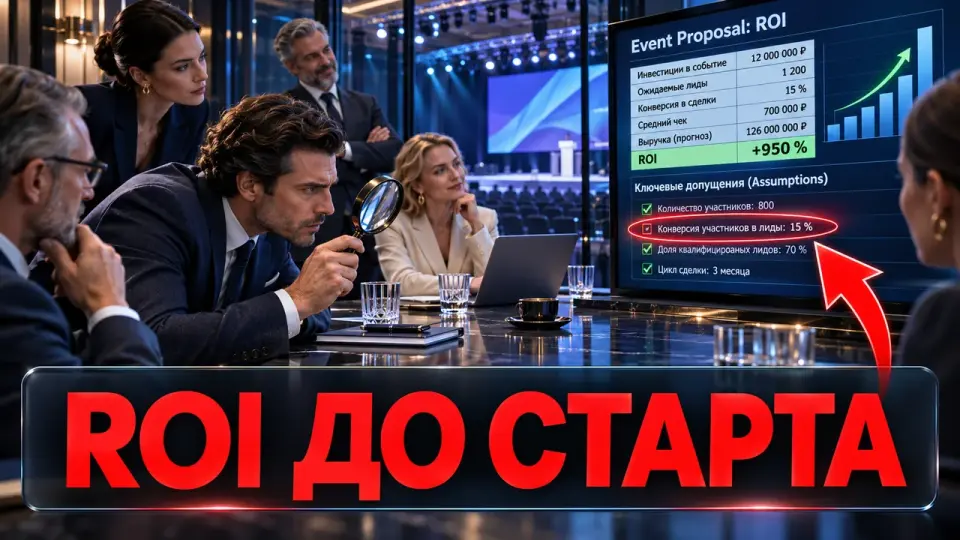
The framework for a B2B event business case: goals, total cost, benefits, scenarios, owners and a measurement plan before choosing a format.
Teams can start justifying a B2B event budget too late. The team has already chosen a format, sketched out a programme and requested quotes, while the CFO still does not understand which company decision the event will support and where the effect will come from.
At Aventura, we suggest changing the order. First you need a short business case with the task, costs, benefits and a way to verify them. The format, venue and contractors come after that. The quote then becomes a calculation of the chosen solution rather than an attempt to justify a favoured idea after the fact.
If the project is already under discussion, start with the business task and the budget boundaries. When organising a business event, we can hold a working briefing, link the concept to a measurable result and only then move on to the programme and the production model.
What does ROI before an event mean?
ROI (return on investment) before a B2B event is a scenario-based estimate of the expected return relative to the full cost of the project. It helps you make an investment decision when data is incomplete. Such a calculation does not predict the result with precision and does not replace the business case for the project: it shows the assumptions, boundaries and conditions under which the project makes sense.
The basic formula looks like this:
Projected ROI = (expected monetary benefit attributable to the project - full cost) / full cost × 100%The numerator includes only the portion of the monetary benefit that, under an agreed rule, can be attributed to the project. Benefit and cost are calculated over the same period. Non-monetary results are shown alongside but are not plugged into the formula. The break-even point is reached when the monetary benefit attributable to the project equals the full cost and ROI is zero.
Before the event, the team has no actual revenue, no confirmed guest behaviour and no final cost of the changes. Therefore, a single figure without scenarios creates false confidence. We treat ROI as the output of the model, not its starting point.
Before calculating, you need to agree on three things:
- Which business decision the event should support.
- Which benefits can be reasonably linked to that decision.
- Which costs, risks and alternatives are included in the comparison.
The detailed catalogue of corporate event KPIs helps you choose metrics for different types of events. This article is limited to the data needed before launch to make the investment decision; the full KPI catalogue remains in a separate material.
A business case starts with a decision, not a format
The first section of a business case must name the problem, the change required and the decision owner. The phrase "hold a conference for clients" describes an activity. The option "give selected clients verifiable grounds to move to a technical review of the new solution" already defines the outcome, the audience and the boundary of the event's responsibility within the company.
The HM Treasury guidance on preparing project justifications uses the Five Case Model: strategic, economic, commercial, financial and management cases. For a B2B event, this logic can be adapted to a single working page.
The table summarises the key points of the section: Section, What question it answers, What we fix before the start. Use it as a quick reference when preparing an event.
| Section | What question it answers | What we fix before the start |
|---|---|---|
| Strategic case | Why are changes needed and how is the proposal linked to strategy? | problem or opportunity, goals, boundaries, expected benefits and risks |
| Economic case | Which option gives the best balance of benefits, costs and risks? | baseline scenario, alternatives, comparison criteria and preferred option |
| Commercial case | Can the required resources and services be obtained on acceptable terms? | procurement method, supplier requirements, allocation of commercial risks |
| Financial case | Is the project affordable and where will the funding come from? | cash flows, funding sources, contingency and affordability limit |
| Management case | How will the project be delivered, managed and verified? | roles, work plan, risk management, arrangements for verifying benefits and outcomes |
Such a framework helps avoid premature detail. Before the reason for the investment is agreed, arguing about the number of halls or the decor has little value. Without a named benefits owner, a beautiful forecast remains nobody's promise.
Comparing an event with alternatives
An event should be compared with the baseline scenario and real alternatives, not with abstract inaction. The baseline scenario shows what will happen without the project. Alternatives may include a series of one-to-one meetings, a webinar, a research study with a presentation, account team work, or a combination of several channels within one project.
The Green Book is the UK government's guidance on evaluating public projects and decisions. It is not a standard for events. We adapt its principle: consider options, costs, benefits, risks and uncertainty before choosing a solution. That is why the comparison starts with the task and the possible ways to solve it, not with a favourite format.
The table summarises the key points of this section: Option, When it makes sense, What we compare. Use it as a quick reference when preparing an event.
| Option | When it makes sense | What we compare |
|---|---|---|
| Baseline scenario | the company continues its current work | current costs, speed, reach, unresolved problem |
| Targeted work without an event | deep contact with a small number of companies is needed | cost of experts' time, number of meetings, cycle length |
| A single B2B event | a shared context and several types of interaction are needed | project cost, audience composition, access to roles, data for decisions |
| A series of related activities | the solution requires several touchpoints | total cost, team workload, transitions between stages |
If a conference, an exhibition and a business breakfast are being compared, the debate has already shifted to format. At this stage it is more useful to compare ways of achieving the result. Organising a conference or exhibiting at a trade show may turn out to be the right decision later, once the business case has set the required breadth of contact and depth of conversation.
How to calculate the full cost before requesting quotes
Full cost includes external expenses, internal labour, use of assets and measurement preparation costs. Before contractors are selected there is no precise estimate, so the team calculates a range by major groups and explicitly records its assumptions. This model is needed to decide on an acceptable scale, not for procurement.
We divide cost into several contours:
- Design. Brief, audience research, development of the programme, content and mechanics.
- Production. Venue, equipment, build, catering, logistics, staff and security.
- Communication. Invitations, registration, materials, participant management and speaker support.
- Internal resources. Time of marketing, sales, experts, managers, lawyers, procurement and analysts.
- Measurement. Setting up fields, collecting the baseline, data quality control and preparing the report.
- Contingency and uncertainty. The range of possible changes that cannot be clarified until a solution is chosen.
Internal time is easy to miss in the calculation. Then two options with the same external estimate look equal, although one requires noticeably more hours of experts and managers. A preliminary comparison needs a single methodology: common cost categories, one period and agreed accounting rules.
Important. The contingency should not be hidden inside line items. A separate line shows management which part of the budget is linked to uncertainty and what must happen for the range to narrow.
If you need to put together a business case and a production model in one brief, request a working discussion and a preliminary estimate. We will help you separate the mandatory contour, scale options and assumptions before choosing a venue.
Which benefits can be included in the calculation?
Only benefits with a clear mechanism of occurrence, an owner and a method of verification are included in the calculation. Monetary benefits can be used in ROI if the team has justified the link and the period. Non-monetary results remain in the business case separately: they should not be forcibly converted into rubles for the sake of an impressive percentage.
It is useful to divide benefits into three groups:
The table summarises the key points of the section: Group, Example result, How to treat it in the model. Use it as a quick reference when preparing an event.
| Group | Example result | How to treat it in the model |
|---|---|---|
| Direct monetary | confirmed savings or additional margin under an adopted rule | include in ROI with a clear source and assumptions |
| Indirect monetary | reduced time costs, fewer repeat actions, faster agreed process | calculate separately and show the valuation method |
| Non-monetary | access to the right roles, hypothesis testing, quality of dialogue, readiness of materials | keep in the metrics table, do not present as a monetary effect |
For a new B2B product, an event can support awareness of the solution, technical validation or onboarding of members of the buying committee. But the forecast should not automatically turn every registration into a deal. The article on the buying committee at a B2B event will help determine which roles and evidence are needed for the next corporate step.
Every benefit must have a logical chain:
Event action -> recorded result -> participant's conclusion or decision -> change in work -> business effectThe further a benefit is from the observed action, the more cautious its contribution to the financial model should be. Revenue depends on the offer, price, sales performance, procurement procedure and other touchpoints. Therefore, in the preliminary justification of the project it is better to show several levels and not attribute the entire late result to the event.
Three scenarios instead of one promised number
A scenario model shows how the conclusion changes under different assumptions. In our working model we use a downside, base and upside scenario; this is a practical choice, not a universal minimum. In each scenario the team changes only the key variables. This way management can see how robust the model is and which hypothesis carries the most risk.
The working table might look like this:
The table summarises the key points of this section: Variable, Downside, Base. Use it as a quick reference when preparing your event.
| Variable | Downside | Base | Upside | Basis |
|---|---|---|---|---|
| Share of the target audience | conservative estimate | working estimate | upper bound | data from past campaigns or a confirmed list |
| Number of target interactions | minimum | plan | capacity limit of the programme | capacity of meetings, tracks and experts |
| Share of confirmed next steps | lower bound | expected | upper bound | our own history of similar activities |
| Monetary value of the outcome | conservative | agreed | optimistic | the client's financial model |
| Total cost | upper bound | working range | lower bound | preliminary estimates and constraints |
Scenarios do not require inventing industry percentages. If a company has no history, use a range that can be explained by the available capacity of the programme and verifiable conditions. For example, the number of scheduled meetings is limited by slots, the number of experts and the length of each conversation. This is more reliable than taking a random conversion rate from someone else's case study.
After the scenarios, run a sensitivity analysis: change one variable at a time and see when the decision changes. If the project becomes unacceptable with a small increase in cost, the budget is too fragile. If the conclusion holds even under a conservative estimate of the benefits, the business case is more robust.
Benefit and Data Owners
Every significant benefit needs a business-side owner with authority and access to data. The organizer is responsible for the prepared event mechanism. Marketing, sales, product, account teams and finance are responsible for different parts of the business impact. Without this allocation, ROI turns into a general forecast with no personal accountability.
Northern Ireland Finance defines the senior benefit owner as the business representative responsible for achieving the benefit after the project deliverable is handed over, and the operational owner as the business representative responsible for measuring and realizing the benefit. For a B2B event, this is a useful boundary: the project team creates the conditions, and the result is embedded in the department's work.
The table summarizes the key points of this section: Item, Possible owner, What is confirmed before the start. Use it as a quick reference when preparing your event.
| Item | Possible owner | What is confirmed before the start |
|---|---|---|
| Target audience composition | marketing or account owner | selection criteria and list source |
| Substantive contact | program team and organizer | format, capacity, method of recording |
| Next corporate step | sales, product or account team | permissible actions and confirmation criterion |
| Monetary valuation of the benefit | finance and business owner | formula, period and exclusions |
| Data quality | analyst or CRM owner | fields, reference data, validation rules |
At Aventura, we define the boundary directly in the brief. We can design the program, meetings, registration, guest journey and the way to capture an observable outcome. The account's commercial priority, the value of the benefit and the decision on the deal stage remain with the client.
How do you build a results measurement framework before launch?
A results measurement framework describes the question, the metric, the baseline, the data source, the owner and the point of measurement. It is agreed together with the project rationale. If the team discusses data for the first time after the event, some of the required fields may be unavailable, and the baseline will have to be reconstructed with greater uncertainty.
The Magenta Book recommends designing the evaluation before the intervention is launched. The AMEC Integrated Evaluation Framework starts with objectives, audiences and measurable targets, and then links direct outputs, audience perception, changes in behaviour or state, and the final impact. For a B2B event, this chain separates the activity performed from the change the project is funded to achieve.
The minimum plan looks like this:
The table summarises the key points of this section: Question, Metric, Baseline. Use it as a quick reference when preparing an event.
| Question | Metric | Baseline | Source | Owner | When we check |
|---|---|---|---|---|---|
| Did the right audience attend? | accounts and roles by agreed criteria | current list and role coverage | registration and account list | marketing | before invitations go out and at the event |
| Did the right contact happen? | confirmed meetings or actions | available capacity and current relationships | schedule and result record | event team | during the project |
| Has a next step emerged? | action with an owner and a rationale | status before the event | client's working system | sales or account team | within the agreed window |
| Has the stated benefit been realised? | financial or operational result | metric before the intervention | financial or operational system | benefit owner | within the business case timeline |
NIST's metrics guide suggests linking measures to objectives and defining collection, analysis and reporting in advance. For an event, this means a metric without a data source and an owner is not considered ready.
Setting up attribution in the CRM is beyond the scope of this article. Before launch, it is enough to agree which touchpoints need to be distinguished, by what rule the company attributes benefit to the event, and who confirms the monetary result.
When should a business case be stopped or rebuilt?
A project should be sent back for revision if the team cannot yet name the solution, the baseline scenario, the benefit owner, the full cost or the way to verify it. An additional signal is when ROI rests only on an optimistic assumption without justification. An early review usually requires fewer resources than changing a project after contracting.
We use five questions to decide whether to continue a project:
- Is there a problem or opportunity confirmed by the business owner?
- Is it shown why the event is preferable to the available alternatives?
- Does the calculation include the full range of costs and internal resources?
- Does the key benefit have a mechanism, an owner, a data source and a period?
- Does the solution remain acceptable in an adverse scenario or after a reasonable change to the key variable?
A "no" on format or scale means the justification can be rebuilt. An unconfirmed problem gives grounds to postpone the purchase and continue verification. If there is insufficient data for a monetary ROI, the project can be assessed by strategic necessity and non-monetary results, but the limitation must be clearly shown to management.
Such a check does not replace the subsequent report. It sets a starting point for comparison with actuals. The overall event-led growth model looks at the link between events and the commercial system, while the marketing and sales follow-up SLA covers the handover of actions after a conversation. Here the boundary ends with an approved justification and a results verification scheme before the format is chosen.
A one-page template for budget sign-off
This template should let a manager understand the decision without a presentation of dozens of slides and unnecessary explanations. The page keeps the problem, options, cost, benefits, scenarios, risks, owners and a results review plan. Appendices may contain calculations, but the conclusion and approval conditions must be visible immediately.
1. Decision and owner
What problem or opportunity does the project support?
What decision must management make now?

2. Base case and options
What will happen without the project?
What alternatives were compared and why was the current path chosen?

3. Full cost
Range of external expenses:
Internal resources:
Measurement and analytics:
Reserve and key assumptions:

4. Benefits
Monetary benefits with formula and owner:
Indirect benefits:
Non-monetary outcomes:

5. Scenarios and sensitivity
Downside / base / upside scenario:
Which variable changes the decision?

6. Results review plan
Questions, metrics, baseline, data sources, owners and deadlines:

7. Risks and approval conditions
What must be confirmed before choosing the format, venue and contractors?
When does the project return for review or stop?
At the first working session, there is no need to fill in every line definitively. The goal is to uncover gaps before they become expensive. Once the business case is approved, the team can move on to the format and requests for proposals while keeping the same cost and outcome boundaries.
Frequently asked questions
ROI (return on investment) before a B2B event is a scenario-based estimate of the expected return relative to the full cost of the project. It helps you make an investment decision when data is incomplete. Such a calculation does not predict the result with precision and does not replace the project rationale: it shows the assumptions, boundaries and conditions under which the project makes sense.
The first section of the business case should name the problem, the change needed and the decision owner. The phrase "hold a conference for clients" describes an activity. The option "give selected clients verifiable grounds to move to a technical review of the new solution" already sets the result, the audience and the boundary of the event's responsibility within the company.
An event should be compared with the baseline scenario and real alternatives, not with abstract inaction. The baseline scenario shows what will happen without the project. Alternatives may include a series of one-to-one meetings, a webinar, a research study with a presentation, the work of account teams, or a combination of several channels in one project.
The full cost includes external expenses, internal labour, use of assets and the cost of preparing measurement. Before contractors are selected there is no precise estimate, so the team calculates a range by major groups and explicitly records the assumptions. This model is needed to decide on an acceptable scale, not for procurement.
Only benefits with a clear mechanism of occurrence, an owner and a way to verify them are included in the calculation. Monetary benefits can be used in ROI if the team has justified the link and the period. Non-monetary results remain in the business case separately: they should not be forced into rubles for the sake of an attractive percentage.
A scenario model shows how the conclusion changes under different assumptions. In our working model we use a downside, base and upside scenario; this is a practical choice, not a universal minimum. In each scenario the team changes only the key variables. This way management sees the robustness of the model and the main risky hypothesis.
At Aventura we can manage this transition from a business task to a working event. If you need to defend your budget and then put together a realistic programme, request a project discussion and a preliminary estimate. At the meeting we will separate the mandatory results, scale options, constraints and data for verification.
Sources
- AMEC - Integrated Evaluation Framework
- Magenta Book (HM Treasury)
- Green Book 2026 (HM Treasury)
- Guidance on developing business cases - HM Treasury
- Northern Ireland Finance - Benefit owners
- NIST - Measurement Guide for Information Security, Volume 1
Contents
Was this article helpful?