A practical plan for a signing ceremony: from document readiness and seating to the central moment, filming, and backup.
A signing ceremony doesn't last long, but it ties a legal document to a public event. A mistake in a name, folder, or host's line is immediately caught on camera. That's why we first confirm three things in writing: what exactly is being signed, who is signing, and what can be announced publicly. Then we move on to decor and the stage.
At Aventura, we turn data confirmed by lawyers and PR teams into a director's script. The team prepares the space, participants' movements, sound, lighting, filming, press route, and rehearsal. The legal meaning of the document remains the responsibility of the parties.
Leave a request – let's discuss the task
We'll clarify the event format and suggest the next step.
What should be ready before staging the ceremony?
The agreement signing ceremony moves to staging after written confirmation of the final version of the document and the signatories' authority. The parties also agree on the number of original copies, language versions, and the public wording. Until the lawyers confirm this information, we can prepare the venue, but we do not finalize the host's lines, captions, or the procedure for handling the copies.
Article 160 of the Civil Code of Russia refers to a document that expresses the content of the transaction and is signed by the persons making it or by duly authorized representatives. We do not verify the legal validity of the document on behalf of the lawyers. In the preparation plan, we set a checkpoint and do not bring an unconfirmed version onto the stage.
Before the technical specification, we compile a document card:
- exact title without editorial abbreviations;
- document status and moment of entry into force as worded by the lawyers;
- full names, positions, and order of introduction of the signatories;
- number of original copies and distribution among the parties;
- language of each copy;
- permissible quotes, captions, and background for filming;
- contact of the person who gives final approval for bringing out the folders.
For electronic signing, we determine in advance exactly what happens on stage. The Federal Tax Service of Russia explains that an enhanced qualified electronic signature, subject to certain conditions, can be the equivalent of a handwritten signature. The parties' lawyers must determine in writing whether the participants are signing a legally significant electronic document or presenting an already completed procedure to the audience. The host uses the same wording.
If coordination continues, a separate stop signal appears in the script. The folders remain backstage until the responsible person confirms the version. This way, we do not try to guess the lawyers' decision while the executives are making their entrance.
For a project of this level, the mechanics of a business event are suitable: a single command center, script, decision owners, and exact readiness time for each service.
Roles and Boundaries of Responsibility
The signing ceremony of an agreement requires coordinated work in four areas: document, protocol, public communication, and production. One person is responsible for each area. Lawyers confirm the text and authority. The protocol service determines the order of parties and seating. The press service is responsible for the public part, while the director assembles the approved decisions into a single script and technical plan.
The press service approves the public wording and media relations. We link these decisions with the stage, timing, technology, and movement of people.
The UN protocol service separately handles delegation registration, preliminary walk-throughs, seating, and photo positioning. For a corporate project, this is a useful observation: protocol tasks are better distributed among responsible persons before the rehearsal.
The distribution looks like this:
The table summarizes the key points of the section: Outline, Who approves, What is passed to the director. Use it as a quick reference when preparing the event.
| Outline | Who approves | What is passed to the director |
|---|---|---|
| Document | lawyers of the parties | final name, versions, copies, authority |
| Protocol | protocol service or client | seniority, order of entry, seats, address |
| Public communication | PR and press services | announcement, quotes, media list, filming restrictions |
| Production | director and technical director | script, stage, sound, lighting, cameras, backup |
| Venue | facility manager and security | access, installation, guest routes, evacuation |
We appoint a separate document coordinator. He receives folders from lawyers, checks the labeling according to the approved list, arranges them in the required sequence, and hands them over to stage assistants. This person does not combine the task with guest registration or press escort.
If foreign guests are participating, we add an interpreter. He receives exact names, positions, the name of the document, and approved talking points. For a complex setup, we check channels, headsets, and backup in advance.
How to structure the signing sequence?
The agreement signing ceremony requires a chain of specific actions rather than a general paragraph. The archival scenario plan from 2001 from a no longer valid decree of the governor of Perm Region shows the preparation of the hall, the meeting of delegations, seating arrangements, and the announcement of the start. We use it only as a historical organizational example. The working procedure below is adapted to the number of parties, documents, and cameras.
The basic scenario plan consists of ten steps:
- The coordinator receives permission to start and communicates it to the director.
- The host invites the participants and announces the approved name of the document.
- The signatories take their places according to the protocol seating chart.
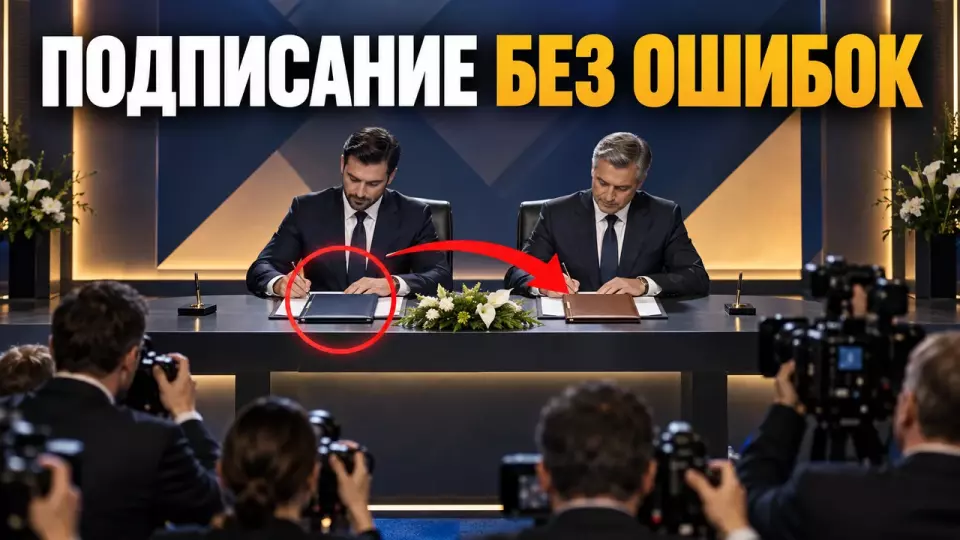
- Assistants place the required copy in front of each person and open the signature page.
- The director gives photographers a few seconds for a clean shot and instructs the audience to maintain silence.
- The signatories sign in the agreed order.
- Assistants swap or rotate the copies if the scheme requires it.
- The parties stand up, exchange folders, or display the signed document.
- Short statements or a press opportunity follow.
- The host concludes the ceremony and directs participants to the next route.
In a multilateral agreement, we first draw the movement of copies on a diagram. Each folder has a party number and a next point. The instruction 'pass it to your neighbor' is too vague: the assistant must know which document to pick up, where to place it, and at what moment to step out of the frame.
In the video recording of the European Commission, a clear sequence is visible: the documents are named, the parties sign, stand up, exchange folders, and then the host concludes the episode. We use this example as an observed sequence, not as a legal norm.
Stage, Table, and Document Flow
The scenography of the signing ceremony should support the central action. Signatories need a stable table, comfortable chairs, and even lighting on their faces. Cameras need a clean frontal shot. Assistants should have a short and clear path to the table, and guests should have a view without stands, decor, or the backs of the film crew.
Guests need visibility, and assistants need free space. Cables, stands, folders, and water should not obscure hands and logos.
We check five types of views: from the signatory's perspective, from the front row, from the main camera, from the photographers' position, and in a vertical frame for mobile publications. A busy background, a shiny table, or overly tall floral decor often look acceptable in the room but ruin the photo of the central action.
We label folders inconspicuously for the camera. We check the pens and place them in the same position. There are no drafts or extra sheets on the table. If there are multiple documents, the assistant changes the set on the director's exact cue.
To choose a space, we use the venue catalog and then check the site on location: setup access, dressing rooms, press area, lighting, internet, signatories' routes, and a backup entrance. The hall layout is approved together with camera positions, not after arranging the chairs.
What Should the Host Say?
At the signing ceremony, the host states only the agreed facts: names, positions, parties, and the exact title of the document. He announces the sequence of actions and the start of the next segment. The host does not explain legal consequences in his own words. A brief text leaves the content of the document to the parties. All wording is pre-approved by the lawyers and press services of the participants, and the host rehearses difficult names aloud.
The host's cue card contains:
- welcome and address to participants;
- one sentence about the reason for the meeting;
- precise introduction of the signatories;
- the name of the document without abbreviations;
- the command to take seats;
- announcement of the moment of signing and exchange of copies;
- transition to statements, questions, or photography;
- conclusion and next route.
If a separate comment for the press is needed, we do not stretch it within the central episode. After the photo, the signatories move to the microphones or to the press area. The format of a short briefing gives journalists a clear moment for questions and does not mix the signing with a lengthy discussion.
The host receives a phonetic transcription of difficult names and rehearses them aloud. The card contains no wording that is still under discussion. Any correction after the full rehearsal is approved by the responsible press service officer.
Photos, video and media relations
Filming of the agreement signing ceremony needs to be incorporated into the scenario before furniture setup. Photographers must be able to capture the signing and exchange of folders without stepping onto the stage. The video team receives clean audio of speeches. The press learns the access time and the moment after which questions are allowed in advance. Camera positions, mandatory shots and the group photo window are part of the director's script.
We separate three tasks:
- Protocol photography captures the central action and the composition of the parties.
- Video provides a continuous sequence without moments obscured by backs.
- The press office receives materials with accurate captions and the approved text.
Camera positions are marked on the plan. Photographers get a brief window after the exchange of folders, when the signatories are looking at the main point. Then we permit a change of angle or move on to statements. Without this instruction, everyone will simultaneously ask them to turn in different directions, and the central shot will be lost.
If a separate group of journalists works at the ceremony, we prepare a press zone for them. Accreditation, equipment checks, seating and distribution of materials are organized separately. The preparation of questions can be cross-checked with the company press conference program. Photo and video materials are prepared through event filming with a pre-agreed list of mandatory shots.
Accreditation, data, and filming rights
Accreditation and press routing are separated from the central episode of the agreement signing ceremony. The media list, access times, camera positions, and those responsible for materials are approved in advance. Only necessary data is collected during registration. The client separately verifies the possibility of using portraits in advertising or a commercial case. This procedure protects the timing and reduces the risk of publishing unapproved materials.
Article 5 of the personal data law requires determining the purpose of processing in advance and not collecting excessive information. The field composition and legal basis are confirmed by the client's responsible team.
We notify participants in advance about photo and video shooting. For portraits that will become the main object of advertising or a commercial case, the client separately verifies the basis for use. The Supreme Court of Russia points to the general rule on consent for the publication and further use of a citizen's image. The review also describes the boundaries of the exception for public events.
How to conduct a ceremony rehearsal?
The rehearsal of the agreement signing ceremony repeats the entire central episode with folder mockups, working microphones, lighting, and cameras. We check more than the soundtrack. Assistants go through the carrying out and exchange of documents. The host reads the final text, the director gives commands, and photographers check angles. The originals remain with the responsible coordinator until separate permission from the lawyers.
The run-through goes step by step:
- We check the entrance and route of each signatory.
- We verify nameplates, titles, phonetic cues, and seating.
- We go through the distribution of folders without real originals.
- We simulate the signature, exchange of copies, and group photo.
- We rehearse short statements and the transition to the press.
- We review the main camera recording and vertical shot.
- We check the translation if needed.
- We play out lateness, signatory substitution, and delay of the final version.
- We record corrections with the owner and approval time.
- We finalize the script, titles, and host texts versions.
We have detailed the rehearsal by key commands in the material about technical rehearsal of an event. For the signing, copy control is added to the usual run-through: on stage we rehearse with mockups, and originals are brought out only after lawyers' permission.
W3C advises asking participants about accessibility requirements in advance, providing microphones, good visibility, and accessible materials. The host repeats press questions into the microphone. We check paths to the table and press area for participants with limited mobility.
Reserve Scenario and Safety
The reserve scenario for the signing ceremony maintains the legal accuracy and dignity of the event. It does not mask the absence of a ready document. If the lawyers have not given permission, the host does not announce the signing. We restructure the program: we hold negotiations or statements, or we postpone the central episode. For each failure, we pre-assign a person who makes the decision, and a short neutral remark for the host.
The minimal Plan B covers the following situations:
The table contains key points of the section: Failure, Team Action, What the Host Says. Use it as a quick reference when preparing the event.
| Failure | Team Action | What the Host Says |
|---|---|---|
| final version is delayed | keep folders behind the scenes, start the approved block | only the approved neutral wording |
| signatory is late | change the program order | new order without explaining personal reasons |
| representative changes | wait for confirmation of authority and titles | name is announced after written permission |
| pen or folder is faulty | assistant provides a checked duplicate | pause without comment |
| camera loses signal | continue the protocol episode, record backup | nothing if the hall sees the action |
| evacuation or threat | execute the venue plan | clear command from security service |
Equipment and decor must not block evacuation routes. The Ministry of Emergency Situations separately reminds that aisles, exits, corridors and stairs must not be obstructed. At the venue, we check the layout with the facility manager and leave a clear route for participants and services.
The scenario specifies the people who have the right to stop the ceremony: the legal representative, the protocol head, the safety officer and the director. The reasons may vary, but the team should receive one short command, not argue in the general chat.
What to do after signing?
After the ceremony, the originals are immediately handed over to the authorized representatives of the parties according to the pre-approved distribution list. The press office receives accurate photo captions and the agreed text. We keep the final script, actual timing, and list of decisions made. Materials are published only after approval by those responsible for the document.
The final package usually includes:
- the list of copies handed over;
- the approved press release and quotes;
- photographs with names and titles of participants;
- the full video recording and a short clean clip of the signing;
- transcript of statements, if needed;
- list of media questions and those responsible for follow-up;
- report on actual timing and technical notes.
For the media, it is convenient to prepare a plan for post-event materials in advance. The central episode can be quickly shared with editorial offices, but photo captions and wording about the agreement are again checked with PR and legal teams.
Frequently Asked Questions
The signing ceremony moves to staging after written confirmation of the final version of the document and the signatories' authority. The parties also agree on the number of originals, language versions, and the public wording. Until lawyers confirm these details, we can prepare the venue but do not finalize the host's script, titles, or the procedure for handling copies.
The signing ceremony requires coordinated work in four areas: document, protocol, public announcement, and production. One person is responsible for each area. Lawyers confirm the text and authority. The protocol service determines the order of parties and seating. The press office is responsible for the public part, and the director assembles approved decisions into a single script and technical plan.
The signing ceremony requires a sequence of specific actions rather than a general paragraph. The archival script plan from 2001 from an invalid decree of the Governor of Perm Oblast shows the preparation of the hall, meeting of delegations, seating, and announcement of the start. We use it only as a historical organizational example. The working order below is adapted to the number of parties, documents, and cameras.
The scenography of the signing ceremony should support the central action. Signatories need a stable table, comfortable chairs, and equal lighting on their faces. Cameras need a clean frontal shot. Assistants are given a short and clear path to the table, and guests have an unobstructed view without stands, decorations, or the backs of the camera crew.
At the signing ceremony, the host states only agreed facts: names, titles, parties, and the exact title of the document. He announces the order of actions and the start of the next segment. The host does not explain legal consequences in his own words. The brief text leaves the document content to the parties. All wording is approved in advance by lawyers and participant press offices, and the host rehearses difficult names aloud.
Filming of the signing ceremony must be integrated into the script before furniture layout. Photographers should see the signature and exchange of folders without stepping onto the stage. The video team receives clean audio of speeches. The press knows in advance the access time and the moment after which questions can be asked. Camera positions, mandatory shots, and the window for a group photo are included in the director's script.
The signing ceremony concludes after the originals are handed over and the verified materials are published. At Aventura, we can prepare the script, stage, press work, filming, and technical part as a single process. Request an estimate via the form to discuss the parties involved, venue, and preparation timelines.
Sources
- Garant: scenario plan for the cooperation agreement signing ceremony
- ConsultantPlus: Civil Code of the Russian Federation, Article 160 "Written Form of Transaction"
- ConsultantPlus: Federal Law No. 152-FZ, Article 5 "Principles of Personal Data Processing"
- European Commission Audiovisual Service: sequence of a signing ceremony
- W3C WAI: Making Events Accessible
- Russian Ministry of Emergency Situations: fire safety during mass events
- United Nations: Behind the scenes with the Protocol and Liaison Service
- Federal Tax Service of Russia: electronic signature
- Supreme Court of Russia: review of practice on citizen's image
Contents
Was this article helpful?