A practical B2B event blueprint for the entire buying group: whom to invite, what to prove to each role, and how to secure a shared next step.
A B2B buying committee rarely fits on a single line of a registration form. The initiator may understand the task well but not be responsible for the budget, security, contract, implementation and day-to-day operations. If only they attend the event, a second round begins after the meeting: retelling the presentation to colleagues, collecting new questions and hunting for materials that weren't available at the event.
At Aventura, we design this format around the decision and the roles surrounding it. First we identify who articulates the need, who evaluates the solution, and who can support or stop it. Then we connect each participant with a question, a piece of evidence and an authority. The event format emerges from this map.
If the task is already in the plan, request a discussion and a preliminary estimate. We will review the buying group's composition, the programme and the materials before choosing a venue.
What is a B2B buying committee?
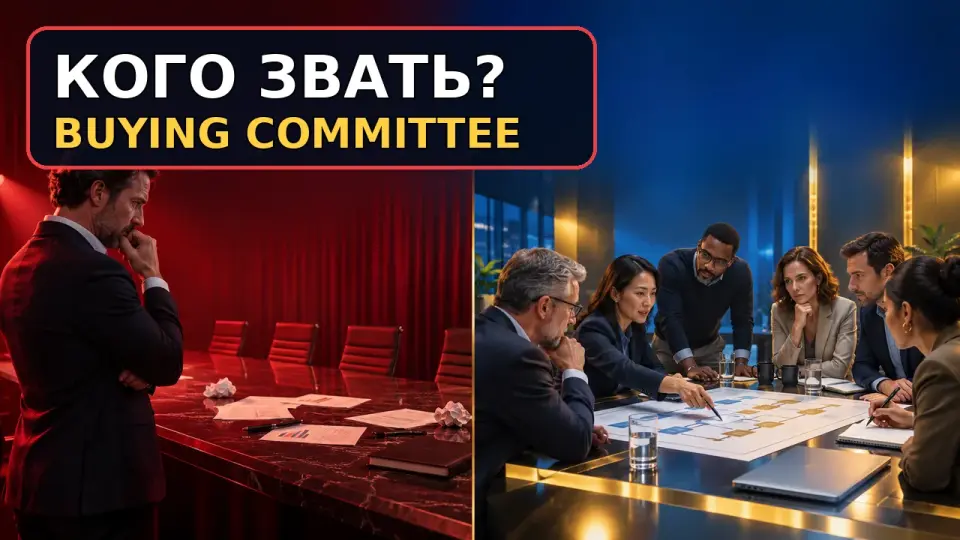
A B2B buying committee is the group of people involved in selecting, vetting, approving, purchasing and implementing a specific solution. An event needs a sufficient set of functions without chasing the number of job titles. That way, participants can test different sides of the proposal and agree on what data is still missing for the next step.
In Russian, a buying committee can be called a decision-making group. Its composition depends on what is being purchased. When choosing a software platform, the business owner, users, IT, security, finance, procurement and legal are all relevant.
For manufacturing equipment, operations, engineering, occupational health and safety, and logistics are added. There is no universal list for every case.
Forrester research describes a broader buying network that includes internal and external participants. Figures from a recent sample are useful as a signal of complexity, but they cannot be turned into a norm for every Russian deal. The practical takeaway is simpler: one active contact does not show the entire circle of influence.
An event offers a rare opportunity to bring part of this group together in one context. People hear the same problem statement, test their criteria and see their colleagues' questions. In the article on event-led growth in B2B, we look at the place of the event in the overall commercial system. Here the focus is narrower: the composition of the committee and the path to a shared decision.
First the decision, then the guest list
The guest list starts with a clear statement of the decision the company is considering. While the subject is vague, roles are chosen by familiar job titles and status. Once the subject is named, it becomes clear who owns the problem, who is accountable for the money and who will do the work after approval. That is how a buying committee forms around a real corporate step.
The phrase "let's invite industry executives" does not define a useful composition. Executives may be responsible for different issues and have nothing to do with the purchase under discussion. A working statement is more specific: the company is choosing how to automate a process, changing its service model, launching new equipment or looking for a contractor for a complex programme.
Before drawing up the list, we pin down five elements. This framework links the guests to the decision:
- what change the company is discussing;
- what outcome the business needs;
- what constraints are already known;
- which functions the decision will affect;
- what corporate step should follow the event.
This boundary protects the programme from two mistakes. The first is gathering many high-status guests who have nothing to decide together. The second is inviting only users and leaving outside the event the people who will later review cost, risks and terms of engagement.
For several selected companies, it is useful first to define the logic of an ABM event for target accounts. That article answers the question of which accounts and role journeys to combine in one programme. Here we go deeper inside a single decision and assemble the functions without which it will remain one-sided.
If you need to bring roles, content and venue mechanics together in one project, discuss your business event with our team. We will start with a map of questions and evidence, then propose a format.
Who should be invited from the company?
Build the list based on each role's function in the decision, not on job titles. You need the problem owner, an internal champion, users, technical and operational review, the budget holder, a leader with a mandate, procurement, legal and risk functions. One person can cover several roles if their authority is confirmed.
The problem owner articulates why the current situation requires change. The internal champion helps move the topic through the company and rally colleagues. These roles often overlap, but not always. The initiator may see the problem without having the time or influence for internal coordination.
The user checks how day-to-day work will change. The technical evaluator looks at integration, support and constraints. The implementation owner is responsible for the transition, resources and dependencies. These participants quickly spot the gap between a polished demo and real-world operation.
The budget holder assesses the cost and where the project sits among other priorities. The leader with a mandate ties the choice to strategy and removes cross-functional barriers. Procurement checks the procedure, the composition of the proposal and commercial terms. Legal, security, data protection and control functions assess obligations and risk.
The table summarises the key points of this section: Role in the decision, Key question at the event, Useful evidence. Use it as a quick reference when preparing your event.
| Role in the decision | Key question at the event | Useful evidence | Acceptable outcome |
|---|---|---|---|
| Problem owner | What change will the business get? | business context, success criteria, project scope | a refined task and an owner for the next step |
| User | How will my work change? | scenario-based demo, process prototype, training conditions | a list of requirements or a validation scenario |
| Technical evaluator | Can the solution be integrated and supported? | architecture, integrations, constraints, support model | a technical session or a list of data requirements |
| Implementation owner | Who will carry out the transition and what depends on the client? | stages, roles of the parties, dependencies, acceptance criteria | a working validation plan |
| Budget holder | Are the costs and assumptions justified? | cost breakdown, impact ranges, source data | a request for a calculation or clarification of scope |
| Procurement and legal | Can the solution be procured through the procedure? | scope of supply, contractual route, open terms | a list of documents and disputed points |
| Security and risk | What risks arise and how will they be checked? | data model, access control, documents, measure owners | a separate review with subject-matter specialists |
| Leader with a mandate | Should the company make a commitment? | a brief summary of outcome, risk, resources and options | a decision on the next corporate step |
You don't have to seat everyone at one table all day. What matters is that each critical function gets a suitable slot and can contribute its output to the overall picture.
Gaps in the roster and the right to stop a purchase
A missing role matters more than an extra guest. If no one at the event is checking security, the contract, the budget or implementation, the group can only reach a conditional agreement. Before sending invitations, mark the essential functions, role overlaps and veto rights. Turn each gap into a separate next step.
The most visible participants are usually tied to the product or the business challenge. They ask questions, register and talk to the speakers. LinkedIn B2B Institute draws attention to less visible process experts: procurement, finance, legal and operations. They leave fewer public signals, but they assess the supplier's reliability and whether the deal is permissible.
We use a gap map. For each critical function we assign one of four statuses: represented, combined, to be brought in after the event, absent with no owner. The last status requires a decision before the programme launches. Otherwise the team may mistake one person's interest for the whole company's consent.
It is useful to record the stop conditions separately. Security may halt an option because of data handling. Procurement may reject the delivery model. Finance may not accept the calculation assumptions.
The operations team may see resources that are unavailable. These issues do not spoil the event. They reveal the real route to a decision.
In the invitation you can directly suggest that the recipient bring in a colleague. The wording should explain why: "The programme includes a session on integrations and access requirements. If another specialist handles these matters, invite them to the dedicated session." This way the roster grows for a reason, without trying to gather every employee in the company.
What criteria and evidence does each role need?
Each role needs its own answer, but the evidence must add up to a single version of the decision. The user needs a working scenario, the technical team needs constraints and integrations, finance needs cost assumptions, and risk functions need documents and measure owners. A general presentation does not replace this matrix and often leaves the hardest questions outside the room.
A criterion answers the question "what will we use to evaluate the option?" Evidence answers the question "what will make it possible to verify the claim?" They need to be assembled before the scenario. Otherwise the programme quickly fills up with speakers and topics but does not close the path to a decision.
We start with a short matrix: role, mandatory criterion, verification format, answer owner and status after the event. For example, a promise of savings on its own does not help the finance participant. You need source data, cost structure, assumptions and the boundaries of the calculation. A demonstration does not close the technical check unless integrations, exceptions and support requirements are shown.
Forrester, G2 and TrustRadius record buyer demand for verifiable materials, self-guided research, demonstrations and trial formats. The G2 and TrustRadius figures relate to technology-market samples. We use them only as a market signal.
Participants want to verify the evidence and forward it to colleagues; a verbal pitch is not enough for that. A similar task of packaging facts for different roles is addressed by an industry research presentation.
To prepare materials, ask four questions for each role. The answers will go into the verification matrix:
- Name the decision that the person must support, reject or send for review.
- Record two or three criteria for which this role is responsible.
- Select evidence that can be verified at the event or after it.
- Assign the answer owner and the format for recording an open question.
- Separate what is confirmed from a hypothesis, a future pilot and a contractual obligation.
The result is a map that shows the programme team where the gaps are. If there is no answer owner for security, it is not worth promising to close the topic from the stage. It is better to plan a dedicated session and honestly set out the boundaries.
A role-based programme instead of a single presentation
The general session should give the buying committee a shared working language at the meeting. The main validation happens in role-specific episodes. Executives need a short conversation about outcomes and risk; users need a working scenario. Technical and control functions need details, documents and the opportunity to ask questions of a subject-matter expert.
At the end, the findings return to the common protocol. This way, different sessions produce a single result.
The first block of the programme synchronises the group. It answers four questions: what problem are we solving, what will change, what constraints are known, and what outcome of the meeting is acceptable. A full product overview is rarely needed here. The purpose of the introductory part is to create a shared frame before the different validation sessions.
Then participants split into formats. For the business side, a review of outcomes, price and resources works well. Users work through the scenario. Technical roles explore architecture, integrations and operations.
Procurement, legal and security get a closed Q&A with documents and a list of open terms. The outcome of the session is recorded in a common template.
A large programme with a general session and parallel tracks can be put together with the help of a conference, forum or seminar. If some experts and participants cannot travel, a hybrid format allows them to join specific sessions. Hybrid should not turn into a broadcast of the whole day for everyone. The remote role needs its own slot, materials and a way to ask a question.
The result of each episode is recorded the same way: confirmed, still open, additional evidence required, who is responsible and where the answer will go. A single template helps bring different tracks together without losing meaning.
Consensus Protocol: How to Reconcile Different Positions
Consensus does not mean that all participants are equally satisfied. The group needs to see the overall outcome, mandatory criteria, open risks, conditions for withdrawal, and owners of next actions. The moderator does not lead people toward an artificial "yes." They help separate what is confirmed from what is disputed and record the corporate step the group is ready to take.
G2 data on consensus refers to a sample of software buyers. It is a signal from the technology market that cannot be considered a universal norm for every industry: collective alignment goes hand in hand with the final authority of executives and finance functions. That is why an event needs both a working reconciliation of roles and a clear approval route.
We propose a simple protocol for a general session. It separates facts from open questions:
- Restate the decision in one sentence without marketing language.
- Collect the confirmed criteria of each role in a shared table.
- Record open questions and the evidence that is not yet available.
- Note the risks and the conditions under which the option cannot proceed.
- Check which critical roles are missing and who will bring them in.
- Name the next corporate step: a review, calculation, pilot, procurement procedure, or executive decision.
- Assign action owners and deadlines only where the participants have agreed on them.
The protocol must have a single editor. This can be the moderator, the account owner, or a representative of the client's project team. If each track keeps separate notes without a shared document, disagreements will surface after the event.
The final session does not have to end with the selection of a vendor. A valid outcome may be a decision to request data, conduct a technical review, change the scope, involve lawyers, or stop the option. A clear rejection is more useful than polite uncertainty.
The decision pack participants will take back to their colleagues
A decision pack is a single package for internal discussion after the event. It includes a short version for the executive, role-specific appendices, calculation assumptions, a risk map, an implementation plan and a question log. The pack must maintain one version of the solution for all functions and help the buying committee continue its review without losing context.
Some members of the buying committee will not attend the event. Some will join later, some will receive materials from a colleague, and some will appear only at the contractual or technical review stage. Therefore, a verbal presentation is not enough. The participant needs a package that can be forwarded without additional explanation.
The minimum composition of a decision pack includes seven parts. All of them refer to one version of the solution:
- A short memo for the executive: the challenge, the proposed outcome, the key risk and the next step.
- A business appendix: impact criteria, source data, costs and assumptions.
- A technical appendix: architecture, integrations, limitations and support.
- A security and legal appendix: data, access, documents and open terms.
- An implementation plan: stages, dependencies, roles of the parties and acceptance criteria.
- A risk register: issue, evidence, owner and status.
- A log of open questions and a single record of the agreed continuation.
The pack must not portray a completed review if none took place. Mark what was confirmed at the event, what requires client data, what will become the subject of a pilot, and what can be included in the contract only after approval.
We also check version consistency. If the executive receives one promised deadline, the technical team another, and procurement sees a third scope of delivery, personalization destroys trust. Role-specific appendices may differ in depth but must refer to a common protocol.
The event format depends on the committee's composition
The format is chosen based on which buying committee roles need to meet on each side and how deep the validation will be. A conference provides an overall framework and parallel tracks. A business breakfast is suitable for a brief conversation among executives. A working session is needed for criteria, evidence validation and a shared plan.
A hybrid format connects an expert who cannot travel. They are given a separate slot.
If you need to bring together many roles from several companies, a common programme with tracks and scheduled meetings is convenient. For a single strategic account, a closed working session works better. For executives who need a brief conversation about priorities and risks, a business breakfast is suitable. It does not replace technical validation, but it can open a route to it.
When choosing a format, we look at four parameters: the number of accounts, the number of roles, the closed nature of the issues and the volume of evidence. The more closed conditions and documents there are, the less useful a large stage is. The more participants need a shared industry context, the more useful the plenary part is.
The organisation of the business event itself begins after this fork. Then the venue, duration, hall layout, registration and technical solution all serve the committee's composition.
How to measure results without promising a deal?
Results are measured by the completeness of the group, closed criteria, open risks and the agreed next step. Attendance only shows presence. A deal depends on budget, competition, procedures and further work. An event can be honestly assessed by whether it helped the group see the big picture and move to the next corporate stage.
We do not attribute a company-wide decision to the event. The project's scope covers the prepared composition, access to the right experts, role-based episodes, capturing issues and a single package. Commercial follow-up remains a joint effort of marketing, sales, the account team and the client's specialists.
Group-level indicators are suitable for reporting. They show the buying committee's path to the next step:
- completeness of mandatory roles;
- participation of critical functions;
- share of criteria with confirmed evidence;
- number of open blocking issues;
- an owner for each action;
- agreement on the next corporate step;
- use of the decision pack within the account;
- engagement of roles that were not at the event after the meeting.
Adobe offers metrics for buying group completeness and engagement at the account level. This logic serves as a guide. The vendor model needs to be tailored to the specific solution. The set of mandatory roles and criteria is determined by the project itself.
Frequently asked questions
A B2B buying committee is the group of people involved in selecting, vetting, approving, purchasing and implementing a specific solution. An event needs a sufficient set of functions rather than a chase for the number of job titles. That way participants can test different sides of the proposal and agree on what data is still missing for the next step.
The guest list starts with a statement of the decision the company is considering. While the subject is vague, roles are chosen by familiar job titles and status. Once the subject is named, it becomes clear who owns the problem, who is accountable for the money and who will do the work after approval. That is how a buying committee forms around a real corporate step.
Build the roster around each role's function in the decision, not around job titles. You need the problem owner, an internal champion, users, technical and operational review, the budget holder, an executive with a mandate, procurement, legal and risk functions. One person can combine several roles if their authority is confirmed.
A missing role matters more than an extra guest. If no one at the event checks security, the contract, the budget or implementation, the group can only reach a conditional agreement. Before sending invitations, mark the mandatory functions, role overlaps and veto rights. Turn each gap into a separate next step.
Each role needs its own answer, but the evidence must add up to a single version of the solution. Users need a working scenario, the technical team needs constraints and integrations, finance needs cost assumptions, and risk functions need documents and measure owners. A general presentation does not replace this matrix and often leaves the hardest questions outside the door.
The plenary session should give the buying committee a shared working language for the meeting. The main testing happens in role-based sessions. Executives need a short conversation about outcomes and risk, while users need a working scenario. Technical and control functions need details, documents and the opportunity to ask questions of a subject-matter expert.
If you need to build a B2B event around a decision-making group, request a quote and a working discussion. We will help you connect roles, evidence, the programme, the minutes and the materials package into a single scenario.
Sources
- Forrester: The State of Business Buying 2026
- Forrester: B2B buying group roles
- LinkedIn B2B Institute: The Hidden Buyer Gap
- Adobe: Buying group-based marketing and journey management
- G2: Buyer Behavior Report 2024
- TrustRadius: B2B Buying Disconnect Report 2024
- NIST: Cybersecurity Framework 2.0
Contents
Was this article helpful?