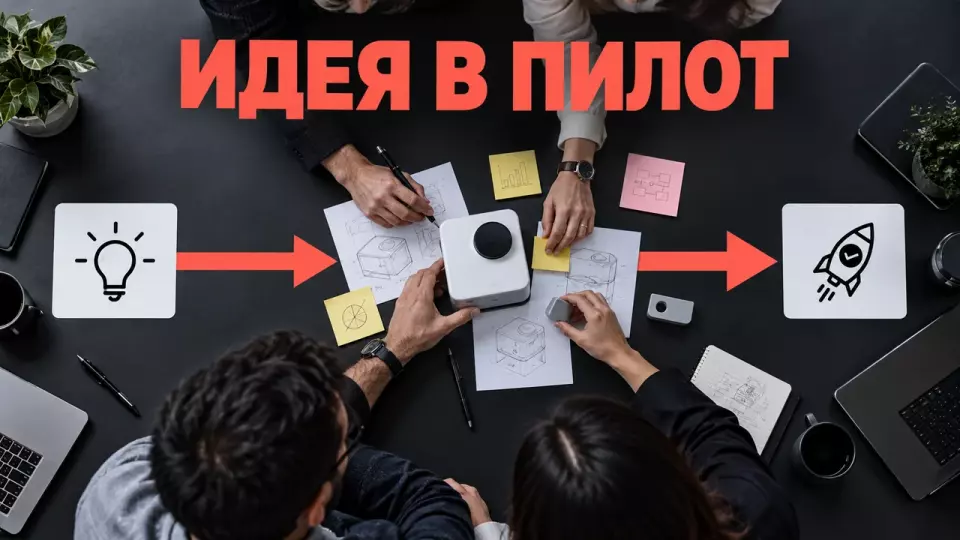
A corporate hackathon gives teams time and an environment to test a real problem. We break down the program, roles, criteria, and the path from prototype to pilot.
A corporate hackathon is not about a timer, pizza, and final presentations. It gives employees limited time, a working environment, and access to experts to test a solution to a real problem. At Aventura, we start preparation with a question: what decision should management make after the demo? The answer connects the program, technology, and venue with the testable outcome.
What is a corporate hackathon and when is it needed?
A corporate hackathon is a short team format for validating a solution to a real company problem. It is suitable when there is a problem owner, available source data, employees with different competencies, and a willingness to consider continuation after the final. If the client only wants to collect proposals, it is simpler to hold an idea session without a complex production loop.
A hackathon is not necessarily related only to programming. Teams can build a digital prototype, a new service route, a process mock-up, an analytical model, or a hardware stand. It is important that the result can be shown and verified. A set of slides without a working scenario rarely answers the main question: does the idea remove the original problem?
The format is useful for tasks that require combining several functions. For example, a product needs data and development, a service process needs operational expertise and design, an internal tool needs participation of future users and information security. The composition of the team is determined by the task.
Before starting preparation, check three conditions:
- The task has an employee with the right to provide context and make a decision based on the result.
- Teams will receive data, environment, and experts within the permitted access.
- Management is ready after the demo to close the idea, request additional verification, or allocate resources for a pilot.
If the third condition is absent, the hackathon can be left as a training format. Then say so to the participants. Do not promise a path to implementation that the company is not yet ready to support.
Hackathon, Innovation Day, and Strategic Session
A corporate hackathon, Innovation Day, and strategic session may share the same stage and meeting rooms, but they produce different outcomes. A hackathon creates and tests a prototype, Innovation Day helps select prepared projects. At a strategic session, leaders choose a direction and agree on actions. A mistake in the format will already show in participants' expectations.
The table summarizes key points of the section: Format, Main question, What participants do. Use it as a quick reference when preparing your event.
| Format | Main question | What participants do | Result |
|---|---|---|---|
| Corporate hackathon | How to test a solution for this problem | Form a team, create and test a prototype | Demo, evidence, risks, and decision on the next step |
| Innovation Day | Which initiatives deserve to continue | Present prepared projects and answer questions | A register of decisions on the idea portfolio |
| Strategic session | Which direction the company chooses | Compare facts, options, and constraints | Management decision, owner, and first step |
If projects already exist, use Innovation Day and idea selection. If you first need to decide where to move, a strategic session for the company is more useful. A hackathon starts where participants themselves must assemble a testable version of the solution under given conditions.
You can combine formats into a single flow. A strategic session selects problems, a hackathon tests solutions, and Innovation Day presents the portfolio to management. In this case, each stage retains its own decision and its own owner. A shared stage should not turn three different processes into a long series of presentations.
What result to define before the start?
Before the announcement, fix the artifact for the finale and the client's decision: a clickable scenario, a model on a test set, or a physical prototype. The level of the result should correspond to the time and available environment so that team expectations match the event's capabilities. A full-fledged product cannot be promised in two days.
We distinguish four levels of result:
The table summarizes the key points of the section: Level, What can already be verified, What cannot yet be asserted. Use it as a quick reference when preparing the event.
| Level | What can already be verified | What cannot yet be asserted |
|---|---|---|
| Concept | User, problem, value and key assumptions | That the solution works |
| Prototype | Key scenario and user reaction | That the system will withstand real-world operation |
| Feasibility check | The most risky technical element | That all integrations and processes are ready |
| Pilot | Limited work with real users and metrics | That the solution is ready for scaling |
A corporate hackathon usually ends with a prototype or a feasibility check. After that, security, integrations, load, support, legal issues, and data quality remain. In the GOV.UK guide, the prototype is explicitly separated from production code. On the Global Hackathon page, Microsoft writes that many teams continue working on projects for a year.
It is convenient to write the final task in one phrase: «The team must show... so that the jury can verify...» If the sentence does not end with an observable action, the task should be clarified. Phrasings like «rethink efficiency» or «apply artificial intelligence» are too broad for a fair comparison.
If you want to connect the task, program, venue, and final demo in one plan, request a quote from us. We will start with a brief and separately show which decisions affect the production of the event.
Subscribe to Aventura's Telegram channel to receive new materials from the agency.
Roles of the client, teams, mentors, and jury
A corporate hackathon has several centers of responsibility. The problem owner provides context and decides the fate of the result, while the mentor helps the team see gaps. The jury applies pre-announced criteria. The coordinator manages timing, access, and versions of materials so that the corporate hackathon maintains uniform working rules for everyone.
Problem owner is responsible for the reality of the problem. They present the initial situation, explain constraints, and answer subject-matter questions. At the final, the owner confirms that the team checked the right problem, but does not get the right to unilaterally change the criteria.
Participants are assembled by competencies. For one task, a developer, an analyst, and a subject-matter expert are needed. For another—a process designer, a future user, an engineer, and a quality assurance specialist. A cross-functional composition is more important than an equal number of people in each team.
Mentors work in designated time slots. They ask questions, help find an expert, and remove blockers. If a mentor writes the architecture or presentation themselves, comparing teams becomes meaningless. It is useful to record key recommendations so that the jury understands which part of the solution appeared with external help.
Jury includes those who understand the user, business value, technical aspects, and implementation constraints. A single manager can quickly choose a flashy idea but miss data risk. A purely technical commission can overestimate complexity and underestimate benefit.
Organizational team is responsible for registration and work zones. It coordinates equipment, catering, and the final demo. The client representative keeps decisions that cannot be handed over to a contractor: data access, rights, criteria, and the budget for the next step.
How to formulate a hackathon task?
A good task describes the user, the observed problem, the desired effect, available materials, constraints, and the demonstration method. A corporate hackathon gives participants the freedom to choose a solution. An overly narrow technical specification turns teams into parallel executors. An overly broad slogan yields incomparable ideas that cannot be fairly evaluated by uniform rules.
Include seven points in the brief:
- Who encounters the problem and in what situation.
- What is happening now and how it hinders work.
- What effect is important to the company.
- What data, interfaces, equipment, and experts are available.
- What is prohibited due to security, rights, and information regime.
- What exactly the team must show at the demo.
- By what criteria the decision will be made.
The draft task must be checked before publication. Give it to a subject matter expert, a future participant, a data specialist, and someone who does not know the project. If they understand the user or the result differently, the dispute will also arise among teams.
Do not hide basic constraints before the start. Participants need anonymized data examples, environment description, submission template, allowed libraries, and the procedure for accessing experts. Otherwise, the first day will be spent on requests to services and account setup.
Check the opposite extreme as well. A fully ready architecture, mandatory stack, and step-by-step scenario leave little room for hypothesis. The company will receive several variations of one order. Different approaches will remain untested.
Preparation roadmap from task to launch
It is more convenient to manage preparation through freeze points. One long list of deadlines does not show dependencies. The client first approves the task and the owner, then checks the data and criteria. After the call for entries is opened, changing the task will affect the corporate hackathon as a whole, so its impact is assessed before the teams start working.
The working sequence looks like this:
- Approve the problem, user, and solution after the demo.
- Assign the task owner, sponsor, and possible pilot owner.
- Check data, licenses, personal information, and security requirements.
- Agree on the artifact, criteria, submission template, and conflict-of-interest rules.
- Collect applications and form cross-functional teams.
- Prepare workspaces, repositories, test environments, and help channels.
- Check registrations, access rights, equipment, timer, and backup.
- Before the final, conduct a technical rehearsal of the demos and jury work.
- Prepare a decision form for each project in advance.
We manage these points as a dependency map. The detailed principle is discussed in the article about the event approval calendar. There is no universal preparation period: a closed production task with data requires a separate access scheme, while an open hackathon on training datasets is simpler.
The application form also depends on the goal. Usually, you need role, competencies, chosen task, time availability, and participation conditions. Do not collect information "just in case". For more details on statuses, the route, and the minimum set of fields, read the material about event participant registration.
How to build a two-day program?
A two-day corporate hackathon leaves time for two working loops: hypothesis and first prototype, then testing and demo preparation. Briefings should be short. Expert checks happen in designated windows, otherwise participants wait for the right employee or receive conflicting advice. The exact schedule changes with the complexity of the task and the venue mode.
The table collects the key points of the section: Time, Block, What remains. Use it as a quick reference when preparing the event.
| Time | Block | What remains |
|---|---|---|
| 1 / 09:30 | Goal, rules, criteria and safety | Unified understanding of the frame |
| 1 / 10:15 | User context and available materials | List of facts, questions and limitations |
| 1 / 11:00 | Team formation and hypothesis selection | Problem and effect card |
| 1 / 12:00 | Approach selection | One leading hypothesis |
| 1 / 14:00 | Assembly of the first scenario | Draft prototype |
| 1 / 16:30 | Check with mentors | Decision to continue, change or stop the approach |
| 1 / 18:00 | Test with the task owner | Observations and list of edits |
| 2 / 09:30 | Technical clinic | Removed blockers |
| 2 / 10:30 | Assembly and retest | Working version and log of limitations |
| 2 / 13:00 | Second expert review | Honest boundary of what was done |
| 2 / 14:00 | Demo rehearsal | Verified demonstration and reserve |
| 2 / 16:00 | Demo and jury questions | Prototype, evidence and risks |
| 2 / 17:30 | Pilot board | Status of each decision and owner of the next step |
Night mode is not mandatory. It changes requirements for the venue, catering, rest, transportation, safety and the working regime of employees. If continuous work isn't needed, you can plan two working days with an overnight break.
In the final presentation, include the problem, a live demo, the verification method, found limitations, and the next step. A long story about the process reduces time for questions. HSE University in a public case evaluated practicality, technological elaboration, transparency of logic and quality of defense as separate aspects of the project.
Venue, data and accessibility
A corporate hackathon requires a venue for parallel team work, consultations, and safe demos. Work tables, a stable network, and quiet places for calls are needed. The expert area is connected to the presentation room with a clear route, and access categories are assigned for closed tasks. A beautiful common room does not compensate for weak internet and lack of backup presentation.
The technical list depends on the result. For software projects, network, power, test environments, and image output are needed. For physical prototypes - tables, tools, supplies, electrical safety, and a testing area. For a service process - a space for role-play testing and future users.
The client grants the minimum necessary access to data. Whenever possible, teams work with test or anonymized datasets in a separate environment. Terms for using open source code and materials are announced before registration. The legal status of the result is determined by law, employment duties, and contracts of the specific project; before the start, it is reviewed by the client's lawyers.
Accessibility runs through the entire route. W3C advises to ask about participation conditions in advance, check the venue and remote platform, use microphones, and prepare materials in accessible formats. A remote team needs full working access to experts, data, and defense. We described a detailed technical route in the article about accessible event streaming.
Before the final, we test the demo the same way the team will show it to the jury. We go through connection, sound, screen, timer, questions, and clearing the space. Fixes are closed with a retest. The full procedure is in the guide on technical rehearsal of the event.
How to evaluate prototypes without a presentation contest?
The rubric should separate solution value, evidence, and functionality; pilot feasibility and risks are assessed separately. Criteria and weights are published before the start. This way, a corporate hackathon gives teams a shared understanding of the result, and judges do not change the task during the defense. A compelling speech remains part of the presentation, but cannot hide a weak prototype.
Example of a working rubric:
The table summarizes the key points of the section: Criterion, Weight, What the jury checks. Use it as a quick reference when preparing the event.
| Criterion | Weight | What the jury checks |
|---|---|---|
| Alignment with the task and value | 25% | Does the approach solve the stated problem |
| Evidence of need | 15% | On what data and tests the hypothesis is based |
| Prototype functionality | 20% | Can the key scenario be completed |
| Pilot feasibility | 20% | Are integrations, resources, and support realistic |
| Data, security, and legal risks | 10% | Are limitations and verification methods identified |
| Clarity of demo | 10% | Does the team distinguish what is done from what is promised |
Weights are not a universal standard. The company adjusts them to the task before publishing the rules: for a regulated process, risk may outweigh novelty. For an internal service, involvement of the future user is more important. The key is not to change the proportions after seeing a strong presentation.
Each judge leaves a brief rationale and a question. The coordinator consolidates the evaluations into one version. If a judge has a connection to the team or the solution, the conflict is flagged in advance. The audience choice award can remain a separate category, but the room vote should not replace the pilot decision.
Demo and advice on pilots
The final demo concludes the corporate hackathon, but work with the results continues. After the presentation, a small committee decides which hypothesis to close or investigate further. Strong parts of several projects can be combined, and a separate solution can be handed over for a pilot. The winning place and readiness for a pilot may not coincide, so they are recorded separately.
For each project, fill out a card:
- Which hypothesis the team tested.
- What the prototype showed and on what data.
- Which limitations remained unknown.
- Which risks need to be checked before real users.
- What status is assigned to the project.
- Who is responsible for the next step.
- When the team receives a decision or a new task.
The advice should not promise implementation from the stage. Even a strong prototype may need a security check, cost estimation, a new user test, or a decision from the system owner. Refusal is also normal if it is based on facts and saves resources.
Awards are separated from the project status. You can recognize the quality of research, the usefulness of the prototype, teamwork, or test honesty, if the grounds are announced in advance. Names, images, prototype screens, and task details are published only according to approved rules. We have discussed recognition issues in detail in the article about employee awards.
What is included in the corporate hackathon budget?
The budget depends not only on the number of participants: it is affected by the number of tasks, the venue mode, and access to data. Equipment, expert work, and remote connections are counted separately. First, you need to approve the event structure. Then the client will see which solution changes the cost and what can be cut without losing the main validation.
The table summarizes the key points of the section: Block, What may be included, Key factor. Use it as a quick reference when preparing the event.
| Block | What may be included | Key factor |
|---|---|---|
| Methodology and content | Task briefs, criteria, templates, work with experts | Number of tasks and validation complexity |
| Venue | Work areas, meeting rooms, demo hall, access mode | Work format and duration |
| Equipment | Network, power, screens, sound, recording, backup | Type of prototypes and final presentation |
| Registration and access | Questionnaire, roles, badges, checking restricted areas | Level of confidentiality and participant composition |
| Team | Project manager, coordinators, technical support, moderators | Number of streams and zones |
| Experts and jury | Preparation, consultation windows, evaluation | Number of tasks and competencies |
| Food and logistics | Coffee, lunches, evening hours, transportation | Schedule and venue location |
| Post-event materials | Report, decision cards, photos and videos according to rules | Requirements for reporting and publicity |
Do not cut first the block that produces the working result. If the task requires a secure environment and experts, an expensive stage will not replace them. Sometimes it is wiser to simplify the decor but keep the network, backup, consultations, and time for a repeat test.
For a preliminary estimate, you need the city, approximate date, number of participants, type of tasks, data requirements, work format, and expected demo. The exact amount appears after checking the venue and technical scheme. Promising a single price per participant without these inputs is dishonest.
Transferring the Selected Solution to Pilot
The pilot begins after a separate management decision. The card records the owner, users, and data boundaries. It also retains the main risk, the initial metric, and the review date. The prototype does not become a ready-made product: the corporate hackathon provides a limited next step for a new business validation.
The card should include:
- the owner from the business and technical team;
- the problem and user group;
- one testable hypothesis;
- the allowed data set and environment;
- the pilot’s functional boundary;
- the baseline value and success criterion;
- security, rights, and operational risks;
- resources and budget, if approved;
- the date of the next review;
- the stop condition.
After the event, the coordinator passes the card to the owners and saves the decisions in a single register. After an agreed period, the company checks the status: closed, awaiting data, preparing for pilot, piloting, or stopped. The number of ideas alone says little. It is more useful to see which hypotheses have been tested and why the next decision was made.
Frequently Asked Questions
A corporate hackathon is a short team-based format for testing a solution to a real company problem. It works when there is a problem owner, available source data, employees with diverse competencies, and willingness to consider a follow-up after the final. If the client only wants to collect proposals, it's simpler to hold an idea session without a complex production environment.
A corporate hackathon, Innovation Day, and strategic session may use the same stage and meeting rooms, but they produce different outcomes. A hackathon creates and validates a prototype, Innovation Day helps select prepared projects. During a strategic session, leaders choose a direction and agree on actions. A mistake in format will show up in participant expectations.
Before the announcement, define the final artifact and the client's decision: a clickable scenario, a model on a test set, or a physical prototype. The level of the result should match the time and available environment so that team expectations align with the event's capabilities. A full-fledged product cannot be promised in two days.
A corporate hackathon has several centers of responsibility. The task owner provides context and decides the fate of the result, while the mentor helps the team see gaps. The jury applies pre-announced criteria. The coordinator manages timing, access, and versions of materials to ensure the corporate hackathon maintains uniform working rules for everyone.
A good challenge describes the user, the observed problem, the desired effect, available materials, constraints, and the demonstration method. A corporate hackathon gives participants the freedom to choose a solution. An overly narrow technical specification turns teams into parallel executors. An overly broad slogan produces incomparable ideas that cannot be fairly evaluated against unified rules.
Preparation is easier to manage through freeze points. A single long list of deadlines does not show dependencies. The client first approves the challenge and the owner, then checks data and criteria. Once recruitment opens, changing the challenge will affect the entire corporate hackathon, so its impact is assessed before teams start working.
We handle the organizational part of the hackathon—venue, equipment, catering, registration, and demo day—as a turnkey business event.
If you are planning a corporate hackathon and want to connect the challenge, teams, venue, equipment, and demo into one working scheme, check out our portfolio and request a quote. We will clarify constraints and propose a program with clear decision points.
Sources
- European Commission: DigiEduHack Host Guide
- NASA: International Space Apps Challenge
- NIST: Tech to Protect Challenge
- HSE University: AI Hackathon program and criteria
- GOV.UK Service Manual: creating prototypes
- Microsoft Garage: Global Hackathon and project continuation
- W3C WAI: accessibility of meetings, conferences, and hybrid events
- Academic review: hackathon preparation and continuation model
- ConsultantPlus: Article 1295 of the Civil Code of the Russian Federation on employee works
Contents
Was this article helpful?