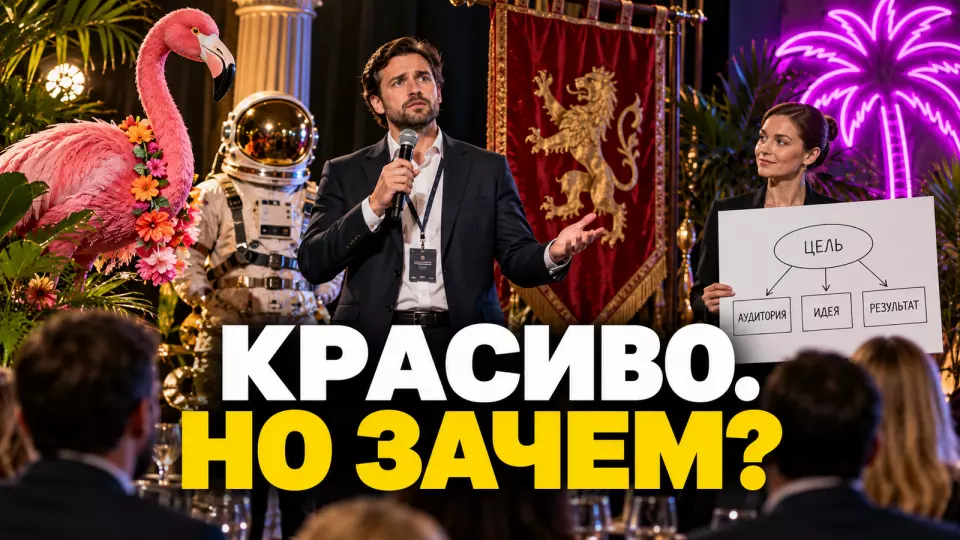
A practical path from the business challenge and audience insight to the big idea, testing and defending the creative concept of an event.
A creative event concept often begins with the phrase "we want something unusual." That phrase sets a mood but doesn't help make a decision. It's unclear who the event is being created for, what should change afterwards, and by what criteria the client will choose a strong idea.
At Aventura, we start with the business challenge and audience behaviour. Then we look for a tension or expectation that the event can respond to. Only after that do we formulate the big idea, test it for feasibility and put together a presentation. This order protects the project from a random theme that looks good on the first slide but doesn't hold up to questions about meaning, budget and mechanics.
Leave a request - let's discuss your challenge
We'll clarify the event format and suggest the next step.
What is a creative event concept?
A creative event concept is a coherent solution that translates a business objective into an attendee experience. It answers the questions: why does a person come, what should they feel, understand or do, what big idea unites content and form, and why the chosen techniques suit this particular audience.
A concept is broader than a theme or a slogan. A theme might be “city of the future,” “new heights,” or “time to act.” On its own, it does not yet explain how the event will be structured. A slogan does not replace the concept either. It only briefly expresses its meaning, if that meaning has already been found.
A working concept connects several levels:
- the client's business objective;
- the audience and its context;
- the insight on which the solution is built;
- the big idea and the promise to the attendee;
- the principles of the programme, space, communication and visual language;
- the criteria by which the team will verify implementation.
We do not start with the stage, decor or a list of activities. These elements appear later and are given a role within the overall logic. For a business event, the concept can connect the company's strategy, the content of the presentations and the attendee journey. For a corporate event, it helps turn an internal objective into a clear shared experience.
The table summarises the key points of this section: Document, What question it answers, What it records. Use it as a quick reference when preparing an event.
| Document | What question it answers | What it records |
|---|---|---|
| brief | what task we are solving and within what boundaries | goal, audience, constraints, inputs |
| creative concept | what idea will deliver the required experience | insight, big idea, principles of implementation |
| programme | what happens and in what sequence | blocks, formats, participants, duration |
| director's script | who acts, when and on what cue | stage, equipment, lines, cues, contingency |
This boundary is needed from the first discussion. The concept must not pretend in advance to be a finished script. Its job is to prove the direction and give the team a basis for the next stage of development.
The brief sets the framework for the idea
A strong brief describes the solution to be achieved and the space of acceptable options. It includes the business task, audience, occasion, format, constraints, mandatory messages, and approval process. The clearer this data, the less likely creative work will turn into guessing preferences.
The first question in a brief sounds simple: what should change after the event? The answer “hold an anniversary celebration” describes the occasion. The answer “help employees see the shared result of several departments and feel their role” already sets a direction. For a client event, the outcome might be understanding the product, starting a conversation with the team, or willingness to consider the next step.
We separate facts, hypotheses, and wishes. Fact: the room will include employees from different cities. Hypothesis: there is little direct communication between teams. Wish: use a travel motif. If these levels are mixed, the creative theme will start driving the task too early.
The brief must contain answers to the key questions:
- What business task does the event support?
- Who are the participants and in what context will they come?
- What action or change do we want to see after the event?
- Which messages are mandatory and which can be rethought?
- What has already been promised to the audience, management, partners, or speakers?
- What constraints are set by the venue, deadlines, budget, brand, and safety?
- Who makes the decision and who influences approval?
- By what criteria will the team select the concept?
Sometimes the client brings a ready-made theme. We still return to the task. The theme can stay if it helps solve it. If the connection is weak, we suggest clarifying or replacing the direction before decorations, videos, and texts are built around it.
How to find an insight rather than a pretty theme
An insight describes a meaningful tension in the audience's experience. A person wants something but runs into a habit, a fear, fatigue, distrust or another obstacle. A creative concept responds to that tension and offers participants a new way to see the situation or act within it.
We look for material in interviews with the client, questions from employees, feedback from past events, the language of internal communications and real participation scenarios. We are interested in more than preferences. The phrase "they like music" is too general. The observation "employees know their team's results but rarely see the contribution of neighbouring departments" can already become the basis for an idea of a shared route.
IDEO's approach to design thinking is useful as a validation framework: a solution must take into account desirability for people, feasibility with the team's resources and viability for the organisation. For an event, this means that a striking idea must at the same time be understandable to the audience, achievable at the venue and connected to the client's objective.
A working formulation of an insight can be put together like this:
The audience wants <desired outcome>,
but runs into <real barrier>,
because <context or habitual explanation>.
The event can help through <new experience or point of view>.
The template does not give you a ready-made idea. It forces you to name the connection between the observation and the solution. If any fashionable word can easily be slotted into the last line, the insight is still too general.
After the first three sections, it is useful to pause and check the direction together. Request a working session and a quote. At Aventura we will help you separate the objective from the wish list, gather criteria and prepare several meaningful directions without premature detail.
The big idea and its conceptual framework
A big idea is a short principle that explains the entire participant experience and helps with decision-making. It does not have to be a slogan. A good formulation shows exactly what a person will experience at the event and how that experience connects to the business objective, the content of the programme and the character of the audience.
We test the big idea with a simple question: does it help us choose? If the idea justifies a business conference, a music festival and a family day equally well, it lacks specificity. If it can help you decide which format fits, which one looks out of place and how the finale should work, the idea is doing its job.
The conceptual framework usually includes:
- audience tension — what is preventing people from getting the desired experience right now;
- the event's promise — what new perspective or action will become available;
- the participant's role — observer, explorer, co-author, decision-maker;
- the dramaturgy of the experience — what state a person moves from and to;
- principles of form — how the idea manifests in the programme, the space and communications;
- boundaries — which techniques contradict the meaning or tone of the brand.
For example, the idea of moving together can manifest in the route between zones, the logic of the presentations, the collective gathering of results and the final action. It does not require literally painting roads on every surface. The stronger the concept, the less it needs direct decorative repetition.
At this stage we think about accessibility separately. The W3C recommends planning the accessibility of the event and materials in advance, taking into account in-person, remote and hybrid formats, and sharing materials with participants and specialists before the event. The concept must allow for different ways of perceiving and participating. If the core meaning works only through a single visual effect or a quick movement along a complex route, the solution needs to be expanded.
For a conference, forum or seminar, the imaginative part works together with the business content. The visual language helps connect the tracks and the participant's journey, but it must not mask a weak programme or make access to materials more difficult.
We publish selections of working observations on concepts, programmes and venues in Aventura's Telegram channel.
How to develop several concepts and choose one?
First, create several distinct concepts, then compare them against a single set of criteria. The difference must be meaningful, not cosmetic. Three versions of one theme with different names give the client no real choice and trigger debates about colours, references and personal preferences.
We differentiate concepts by the core experience mechanism. One may be built around exploration and discovery. Another around collaborative problem-solving. A third around recognising contribution. Each concept has its own insight, participant role, narrative and way of expressing the brand.
For the initial shortlist we use a matrix:
The table summarises the key points of this section: Criterion, Check question, Sign of a weak concept. Use it as a quick guide when preparing your event.
| Criterion | Check question | Sign of a weak concept |
|---|---|---|
| link to the objective | how the idea supports the desired change | the link takes a long time to explain |
| relevance to the audience | does a person recognise their own context | it could be addressed to any group |
| coherence | does the idea unite the programme and the form | it lives only in decor or a slogan |
| participation | does the guest have a clear role | the participant remains a spectator for no reason |
| feasibility | can it be delivered within the given constraints | it relies on a single expensive or risky device |
| scalability | will the meaning hold across different zones and channels | it works only on a single slide |
| distinctiveness | is there an original twist | the concept is assembled from familiar clichés |
| defensibility | can the choice be explained through the brief | the argument boils down to "we like it" |
Scoring does not replace professional judgement. It shows where the team is arguing about facts and where about tastes. If one option wins on the beauty of its references but loses on objective, audience and feasibility, it is not worth rescuing with extra slides.
Names and verbal formulas also go through a check. Before a public launch, it is useful to search for similar designations in Rospatent's official search platform and refer disputed points to a specialist. A search is not a legal opinion, but it helps to spot an obvious conflict early and avoid building all communication around a risky name.
Validating the concept before expensive development
A concept needs to be tested on simple models before producing complex materials. The team walks through the participant journey, builds a rough screen or a fragment of the space, tests the mechanic on a small group, and asks uncomfortable questions. An early prototype reveals the gap between a beautiful description and real action.
We validate the concept at several levels. First, we read it without a visual presentation. If the meaning disappears without references, the wording is not yet complete. Then we break down the participant journey from invitation to exit. After that, we take a key episode and describe what a person sees, hears, does, and understands.
The validation sequence is as follows:
- Formulate the task, insight, and big idea on one page.
- Describe the participant's role using simple verbs.
- Map the journey across the main touchpoints.
- Test one key episode in rough form.
- Check the direction against the brand, venue, timeline, and budget framework.
- Identify dependency on a single person, file, technology, or effect.
- Show the concept to someone who was not involved in its development.
- Record the questions and adjust the meaning before detailing.
We separately check photos, videos, and user-generated materials. Article 152.1 of the Civil Code of the Russian Federation governs the publication and further use of a citizen's image and contains conditions and exceptions. The concept may include filming, employee portraits, or publication of guest materials, but the procedure for consents and use must be determined with the client's lawyer before launching the mechanic.
Such validation does not eliminate all risks. It makes them visible while changes do not yet require redoing the scenography, videos, website, and the entire communication chain.
A presentation you can defend
A concept presentation should show the reasoning process, not just the final picture. The client needs to see how the task led to an insight, the insight to a big idea, and the idea to the principles of the programme and space. That way, the discussion is grounded in the brief and criteria, not a random reaction to a reference.
We structure the presentation as follows:
- Context and task. What should change as a result of the event.
- Audience. Who is taking part and with what expectations.
- Insight. What tension underpins the solution.
- Big idea. One clear sentence without marketing fluff.
- Participant's role. What the person does within the concept.
- Dramaturgy of the experience. How the state changes from entry to finale.
- Manifestations. Programme, space, visual language, communication.
- Feasibility check. Constraints, dependencies and open questions.
- Next stage. What decisions the team makes after choosing a direction.
References are needed to discuss a principle: scale, rhythm, material, light, type of interaction. We specify exactly what we are taking from each example. Otherwise, one participant will see colour, another will see budget, and a third will see a specific construction. A moodboard without explanations creates more interpretations than clarity.
For a corporate event, the presentation must take into account the company's internal language. If the big idea sounds like an external advertising campaign and is not recognised by employees, it will be difficult to accept even with a strong visual component.
The defence ends with a decision. The minutes record the chosen direction, mandatory elements, contentious issues, owners of further work and criteria for the next review. The phrase "we liked the second option" is too weak. The team needs to understand what exactly has been chosen and what cannot be lost during revisions.
How do you respond to revisions and keep the idea intact?
Every revision needs to be tied back to the objective and the criteria. The team clarifies what problem the comment solves, what level of the concept it affects, and what will change in the participant experience. This kind of review helps distinguish a useful constraint from a matter of taste and prevents the logic from being broken by a mass of local edits.
We divide comments into four types:
- objective - the goal, audience or mandatory message has changed;
- constraint - new information has emerged about the venue, timeline, brand or resources;
- understanding - the idea or the participant's role has been explained unclearly;
- preference - someone prefers a different image, colour, name or technique.
The first two types may require a rebuild. The third is often solved by clearer wording or a new example. The fourth is checked against the criteria agreed at the brief. A personal preference can be taken into account, but it should not automatically override the link between the idea and the objective.
It helps to keep a decision log. It is enough to record the comment, the reason, the action taken and the impact on adjacent elements. If the participant's role changes, the team must review the programme and the communications. If a key visual technique is removed, you need to make sure the big idea still comes across.
At the presentation, we do not promise that the first version will remain unchanged. We defend the cause-and-effect relationship. The client can choose a different path if they see the cost of the decision and understand the consequences. That conversation is shorter than an argument over "like it or don't like it" and gives the project a stable foundation.
The Next Document: From Concept to Script
Once approved, the concept becomes a brief for the programme, design, communications and staging. The team locks in the big idea, the participant's role, the dramaturgy, the mandatory principles and the boundaries. Each workstream then translates these decisions into concrete materials, timelines, owners and checks.
The programme comes first: which blocks are needed, what the participant does and how the rhythm shifts. The team then refines the venue, zoning, visual system, invitation, content and technical requirements. At this stage the concept works as a filter. It helps to see which proposals support the direction and which simply add volume.
The director's script is created later. It describes the already approved episodes, service crews, lines, media materials and contingency. We covered the composition of this document in detail in the article on the event director's script. The concept is responsible for meaning and experience, while the script turns the chosen decision into an executable course of the event.
Before handing over to development, we put together a short concept passport:
- objective and audience;
- insight;
- big idea;
- promise to the participant;
- participant's role;
- stages of the experience;
- principles of the programme and space;
- mandatory elements;
- constraints and risks;
- criteria for reviewing the following documents.
This passport does not replace the presentation. It preserves the decision after it. New team members get a single reference version and can check their part of the project without retelling the entire development story.
Frequently asked questions
A creative event concept is a coherent solution that translates a business objective into an attendee experience. It answers the questions: why does a person come, what should they feel, understand or do, what big idea unites content and form, and why the chosen techniques suit this particular audience.
A strong brief describes the solution that needs to be delivered and the space of acceptable options. It contains the business objective, the audience, the occasion, the format, the constraints, the mandatory messages and the approval process. The clearer this data, the lower the chance that creative work turns into guessing personal tastes.
An insight describes a meaningful contradiction in the audience's experience. A person wants something but runs into a habit, a fear, fatigue, distrust or another obstacle. A creative concept responds to this tension and offers the attendee a new way to see the situation or act within it.
The Big Idea is a short principle that explains the entire attendee experience and helps make decisions. It does not have to be a slogan. A good formulation shows what exactly a person will live through at the event and how this experience connects to the business objective, the content of the programme and the character of the audience.
First create several distinct directions, then compare them against common criteria. The difference must be substantive, not cosmetic. Three versions of the same theme with different names give the client no real choice and provoke discussion of colours, references and personal preferences.
The concept needs to be tested on simple models before producing complex materials. The team walks through the attendee journey, builds a rough screen or a fragment of the space, tests the mechanic on a small group and asks uncomfortable questions. An early prototype reveals the gap between a beautiful description and real action.
Sources
- IDEO: Design Thinking
- W3C Web Accessibility Initiative: Making Events Accessible
- Rospatent: search platform
- Civil Code of the Russian Federation, Article 152.1: protection of a citizen's image
Contents
Was this article helpful?