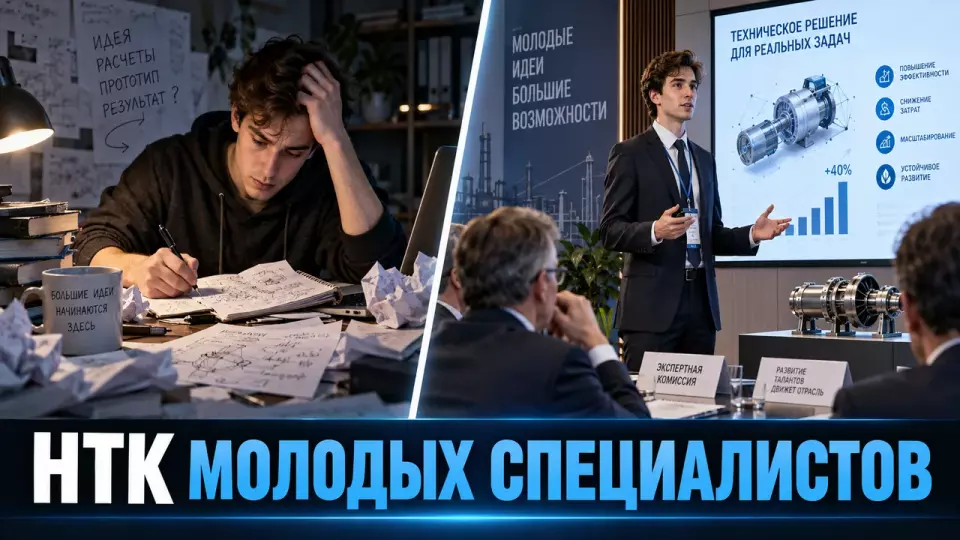
A practical framework for a corporate scientific and technical conference (STC): from the regulations and selection of papers to their defense, written appraisal, and the next step for strong projects.
A scientific and technical conference for young professionals helps a company identify strong engineering papers, verify their evidence base, and chart the way forward. At the heart of the program is the author's work: the problem, method, calculations, experiment, limitations, and practical significance. The event component creates conditions for a fair defense, but the client's expert panel makes the decision on technical value.
At Aventura, we handle the program and section routes, registration, and technical production. Separately, we prepare the script, rehearsals, and record the outcomes. The client appoints the program committee, reviewers, patent specialists, and owners of future pilots. This division reduces the risk that stage presentation will substitute for scientific and technical expertise.
Leave a request - let's discuss the task
We will clarify the event format and suggest the next step.
What distinguishes the Young Specialists' Scientific and Technical Conference from related formats?
The Scientific and Technical Conference of Young Specialists is built around original work and formalized expertise. A participant submits abstracts or an article, presents the method and evidence, and answers the committee's questions. In our proposed model, after the defense, they receive a written decision. A youth rally addresses broader tasks of adaptation and networking, while a professional skills competition evaluates the performance of a practical operation.
The main object of the conference is a scientific and technical work. This can be research, engineering development, a calculation model, a technology improvement, a software solution, a control method, or a proposal for a new product. The company itself sets requirements for the participant's status and experience. It is better not to transfer a universal age limit from someone else's regulations.
The boundaries of the format can be conveniently checked by the result.
The table summarizes the key points of the section: Format, What is evaluated, What remains after the event. Use it as a quick reference when preparing the event.
| Format | What is evaluated | What remains after the event |
|---|---|---|
| Young Specialists' Scientific and Technical Conference | problem statement, method, evidence, novelty and applicability | commission conclusion and the next stage of work |
| Young Specialists' Gathering | integration into the company, connections and team projects | contacts, project tasks and development route |
| Internal Experts Conference | transfer of accumulated practice to employees | materials and knowledge base |
| Research and Development Day (R&D Day) | state of the research portfolio | decision on the next stage of the project |
| Professional Skills Competition | performance of an operation according to uniform rules | skill assessment and test results |
A detailed program of a broad youth event is discussed in the material about Young Specialists' Gathering. If the task is to exchange ready expertise without a competitive defense of scientific and technical works, the format of the Internal Experts Conference is closer.
Conference outcomes for the company and the author
An STC should have several outcomes, and the overall ranking is just one of them. The company receives a verified register of works and understands which projects require refinement, patent analysis, piloting, or closure. We recommend that the author be provided with written feedback, the contact of the person responsible for the next stage, and a specific action instead of just a diploma.
We suggest describing the acceptable decisions of the commission in advance. Then the participant understands what will happen after the defense, and departments do not promise implementation before verification.
- Allow the work to proceed to the next corporate stage.
- Return to the author for revision with a list of missing data.
- Submit the material for patent review or access mode verification.
- Assign a limited experiment or pilot.
- Recommend publication in an internal or open collection.
- Close the work with a written explanation of the reason.
It is useful for the company to distinguish between the forecast effect, confirmation in the pilot, and the actual result after implementation. News about the winner or the jury's decision does not prove the production effect. Process owners confirm it later according to the methodology adopted by the company.
How to draft the regulations and announce the call for submissions?
The regulations establish the rules before applications appear: the audience, areas, set of materials, acceptance criteria, calendar, rights of the parties, publication mode, and options for the commission's decisions. The more precise the document, the fewer manual exceptions after selection. It is better to link topics to real needs of production, research, digitalization, quality, and safety.
The announcement of the call for submissions should answer the author's questions without correspondence with the organizing committee. It should specify:
- who can participate and how the status of a young specialist is confirmed;
- which areas and tasks are of interest to the company;
- whether co-authorship and mentor participation are allowed;
- which files are needed at the first and subsequent stages;
- who checks the technical content;
- which materials may be published;
- how the defense is conducted and when the author receives the decision;
- where to send questions about confidentiality and intellectual property.
The participation procedure posted by St. Petersburg State University shows one of the possible sets: full work, shortened report, presentation, information about authors, abstract, problem statement, conclusions, references, and proposals for practical use. This is a historical example and not a ready-made regulation for 2026. The company adapts the composition to its processes and requirements.
We publish short notes about business event programs in the Aventura Telegram channel.
Application Route and Mentor's Role
In our experience, it is better to structure the application route in stages rather than require a perfect presentation from the author at the start. First, the committee checks compliance with the topic and completeness of the initial data. Then the reviewer evaluates the method and evidence, the patent team decides on disclosure, and the program editor helps to assemble a clear defense.
The working sequence looks like this:
- The author submits a work passport and a brief abstract.
- The local group checks the topic, authorship, and completeness.
- The subject reviewer returns substantive comments.
- The author refines the calculations, experiment, or method description.
- The patent service and the information owner determine the presentation mode.
- The program committee assigns the section and defense format.
- The author prepares abstracts, slides, poster, or demonstration.
- The team conducts a substantive and technical rehearsal.
- After the defense, the author receives a written conclusion if such an order is established in the regulations.
The mentor helps to formulate the question, choose the method, and check the logic, but should not replace the author. In the application, it is useful to separately record the contribution of the participant, mentor, and co-authors. A committee member with direct involvement in the work declares a conflict of interest and does not evaluate it alone.
How to Conduct Scientific and Technical Review?
The review process checks the content before it reaches the stage. One specialist evaluates the problem statement, method, data, limitations, and conclusions. A separate track checks safety, rights, confidentiality, and appropriateness for open publication. These decisions cannot be replaced by a general 'approved' status, because technical correctness does not mean permission for disclosure.
In the review, it is useful to separate blocking and developmental comments. Blocking ones do not allow the work to be admitted to the defense: no initial data, the conclusion does not follow from the method, safety requirements are violated, authorship is not defined, or the publication mode is not resolved. Developmental ones help the author strengthen evidence and explanation.
A minimal review form can include:
The table summarizes the key points of the section: Field, Reviewer's question. Use it as a quick reference when preparing the event.
| Field | Reviewer's question |
|---|---|
| Problem | Is the task formulated and its significance confirmed? |
| Method | Can the calculation, experiment, or analysis be repeated? |
| Data | Are the sources, measurements, and assumptions sufficient? |
| Novelty | What exactly does the work add compared to known practice? |
| Applicability | Where can the solution be tested, and what conditions limit transfer? |
| Risks | What safety, quality, and access requirements are affected? |
| Next step | Is refinement, experiment, patent check, pilot, or publication needed? |
The reviewer is not obliged to turn the work into a ready-made implementation project. His task is to give the committee a verifiable basis for decision and to identify gaps that the author still needs to close.
Sections, program committee, and expert commissions
Sections group works by subject-matter expertise, while the program committee maintains uniform conference rules. Corporate scientific and technical conferences (STC) often feature tracks on production, new materials, digital solutions, quality, safety, energy, and new products. Materials from TMK and ChTPZ on similar youth scientific and practical formats show a combination of a broad agenda and narrow technical tracks.
The program committee includes track owners, the program editor, a representative of the youth council or HR, and the event coordinator. The expert commission for a specific section should understand the subject of the works. If necessary, an economist, a security, quality, or intellectual property specialist is added to it.
Before the conference, the commission needs calibration. Experts review several trial applications and agree on how to interpret novelty, evidence, applicability, and the quality of the defense. A research work, an engineering improvement, and a finished project cannot be mechanically compared on a single scale without adjusting for the type of result.
For several sections, conference organization is suitable. We connect registration, the main stage, parallel defense sessions, commission rooms, the poster area, and the final ceremony. The composition of experts, technical criteria, and decisions about works remain with the client.
How to protect intellectual property and confidential data?
Intellectual property checks are carried out before publishing the program, abstracts, posters, and video recordings. WIPO warns that public disclosure of invention details before filing an application may affect novelty in some jurisdictions. This rule should be fixed in the conference regulations. Therefore, a potentially patentable work cannot be automatically included in an open collection or broadcast.
For each work, the client determines the mode:
- Open. Abstracts, defense, and recording are allowed after editorial review.
- Internal. Materials are available to employees in an approved system.
- Restricted. The defense takes place for an authorized group without free recording.
- Pending decision. The work does not enter the program until a patent or security specialist gives a conclusion.
The check applies not only to formulas and drawings. Confidential data may end up in the background of a photo, a table, a file name, a document number, a system interface, or the author's answer to a question from the audience. The moderator needs a clear route to stop the discussion if a question leads the participant beyond the agreed boundaries.
We do not provide legal qualification of the invention and do not decide who owns the rights. The event team transfers the approved restrictions to access rights, navigation, filming, the scenario, and storage of materials.
Abstracts, poster, and collection of materials
Abstracts and the collection are a separate product of the conference. They require a template, an editor, verification of links, rights, and access level. The announcement of the 17th Conference of Young Scientists and Specialists of TsNIIchermet provides for the acceptance of abstracts and the subsequent publication of the proceedings. This shows one of the options for releasing final materials. In a corporate scientific and technical conference, open publication is possible only after substantive and security clearance.
One work can have different versions:
- full internal text with calculations and appendices;
- abbreviated abstracts for the collection;
- presentation for the defense;
- poster for discussion during breaks;
- permitted recording of the report;
- project card for internal search for solutions.
The format of the defense depends on the maturity of the work. An oral presentation is suitable for completed argumentation. A poster is convenient for discussing the method and intermediate results. A closed session is needed for sensitive materials. A demonstration should be added only when it proves the technical thesis and passes safety requirements.
For photos, videos, and recordings of defenses, agree in advance on production of materials after the event. The operator receives a map of permitted zones and a list of works that cannot be filmed or published. Final files undergo review before distribution to a wide audience.
How to assemble the day's program and participant journey?
The day's program leads the participant from the general framework to the subject-specific defense, feedback, and the next step. The general session explains the rules and criteria. The main time is given to sections, posters, and committees. The finale announces confirmed decisions, but does not disclose sensitive remarks and does not promise implementation of every recognized work.
One working option:
The table collects the key points of the section: Block, Action, Result. Use it as a quick reference when preparing the event.
| Block | Action | Result |
|---|---|---|
| Opening | participants hear the tasks and rules | unified framework of the scientific and technical conference |
| Keynote report | technical leader sets the context | connection of works with company priorities |
| Section defenses | authors present the method and conclusions | evaluations and questions from the committee |
| Poster session | participants discuss works with authors | contacts and clarifications |
| Closed committees | experts compile evaluations and remarks | written decisions |
| General finale | results and routes are announced | clear next stage |
| Award ceremony | works and authors' contributions are recognized | recognition without substituting the technical solution |
If branches and external reviewers participate, you can add a hybrid format. A remote author needs a verified communication channel, a backup presentation, a moderator, and equal time for questions. A closed work cannot be included in the general broadcast just for the convenience of the schedule.
Defense of works: regulations and a unified evaluation form
The defense regulations should be equally clear to the author, the commission, and the technical team. In the historical order of participation posted by St. Petersburg State University, the presentation time and jury questions were set separately. The company determines the specific minutes itself, but the participant is informed in advance of the structure of the presentation, demonstration rules, and the procedure for receiving feedback.
It is better to divide the evaluation form into content and defense. The scientific and technical part includes the problem, method, evidence, novelty, limitations, and applicability. The communication part checks the clarity of the report, the quality of visual materials, and answers to questions. A strong stage should not compensate for weak data.
The technical rehearsal checks the file, fonts, video, microphone, remote connection, change of speakers, and backup. A detailed route is available in the article about technical rehearsal of the event. For the scientific and technical conference (STC), disclosure mode, filming restrictions, and the version of the material approved by the commission are added.
What happens to strong works after the conference?
In our proposed model, a strong work receives an owner for the next stage and a checkpoint. In the materials of TMK and ChTPZ on youth scientific and practical formats, projects that enterprises implement or prepare for scaling are described. Such statements show a possible route, but do not replace an independent verification of the effect. The company confirms the result after testing and adopting the change.
It is useful to record in the protocol:
The table summarizes the key points of the section: Field, What to record. Use it as a quick reference when preparing the event.
| Field | What to record |
|---|---|
| Work | title, authors, and section |
| Decision | revision, patent check, experiment, pilot, publication, or closure |
| Basis | key conclusions and commission limitations |
| Owner | one department or a specific role |
| Data | what needs to be collected before the next decision |
| Deadline | a checkpoint, not a promise of implementation |
| Document | where the conclusion and materials are stored |
| Access | who sees the full and abbreviated versions |
After a few months, a short internal demo day can be held. Authors show the status of the experiment, the process owner's comments, and the decision on continuation. In this way, the STC connects with employee development and the work of the technical loop without promises of career growth based on a single event.
Venue, budget and organizer's area of responsibility
The budget is primarily influenced by the number of sections, the format of defenses, and technical requirements. We separately account for the poster area, hybrid connections, access mode, and filming. A single hall does not solve the problem if you also need quiet rooms for committees, a closed section, a rehearsal area, and a space for poster discussions.
At the first briefing, we at Aventura clarify:
- How many authors, reviewers, and guests participate.
- Which sections and defense formats are planned.
- Which works require a closed mode.
- Whether remote connections and recording are needed.
- How registration and access control are organized.
- Which versions of materials are prepared after the event.
- Who approves the script, technical equipment, filming, and publication.
- What outcome each author and committee should achieve.
After the briefing, we put together a spatial layout, timing, routes, technical plan, script, and responsibility matrix. The client's program committee is responsible for the regulations, reviewing, and decisions on works. We coordinate the work of the venue, sections, stage, committees, and the final materials team according to the approved model. We work out the points of responsibility transfer in advance.
Frequently Asked Questions
The Young Professionals' Science and Technology Conference is built around original work and formalized peer review. The participant submits abstracts or a paper, presents the method and evidence, and answers the commission's questions. In our proposed model, they receive a written decision after the defense. A youth rally addresses broader goals of adaptation and networking, while a professional skills competition evaluates the performance of a practical task.
An STC should have multiple outcomes, and the overall ranking is just one of them. The company receives a validated registry of works and understands which projects need refinement, patent analysis, piloting, or closure. We recommend providing the author with written feedback, the contact of the person responsible for the next stage, and a concrete action instead of just a certificate.
The regulations establish the rules before applications arrive: target audience, tracks, required materials, eligibility criteria, calendar, parties' rights, publication policy, and possible committee decisions. The more precise the document, the fewer ad hoc exceptions after selection. Topics should be linked to real needs in production, research, digitalization, quality, and safety.
In our experience, it's better to structure the application route in stages rather than requiring a perfect presentation from the author at the start. First, the commission checks relevance to the topic and completeness of initial data. Then a reviewer evaluates the method and evidence, the patent counsel decides on disclosure, and the program editor helps assemble a clear defense.
Peer review checks the content before it reaches the stage. One expert evaluates the problem statement, method, data, limitations, and conclusions. A separate track verifies safety, rights, confidentiality, and the permissibility of public disclosure. These decisions cannot be replaced by a general 'approved' status because technical correctness does not imply permission to disclose.
Sections group works by subject matter expertise, while the program committee maintains uniform conference rules. Corporate STCs often feature tracks on production, new materials, digital solutions, quality, safety, energy, and new products. Materials from TMK and ChTPZ on similar youth scientific and practical formats show a combination of a broad agenda and narrow technical tracks.
Leave a request – we'll discuss your task
We'll clarify the event format and suggest the next step.
Sources
- SPbU: an example of the procedure for student participation in a scientific and technical conference
- ChelPipe: youth scientific and practical conference and thematic tracks
- TMK: forum of young specialists and youth scientific and practical conference
- Transneft: international scientific and technical conference of youth
- MIEM HSE: scientific and technical conference named after E. V. Armensky
- WIPO: answers about patents and invention disclosure
- WIPO: questions on technology transfer and confidentiality
- TsNIIchermet: conference of young scientists and specialists
Contents
Was this article helpful?