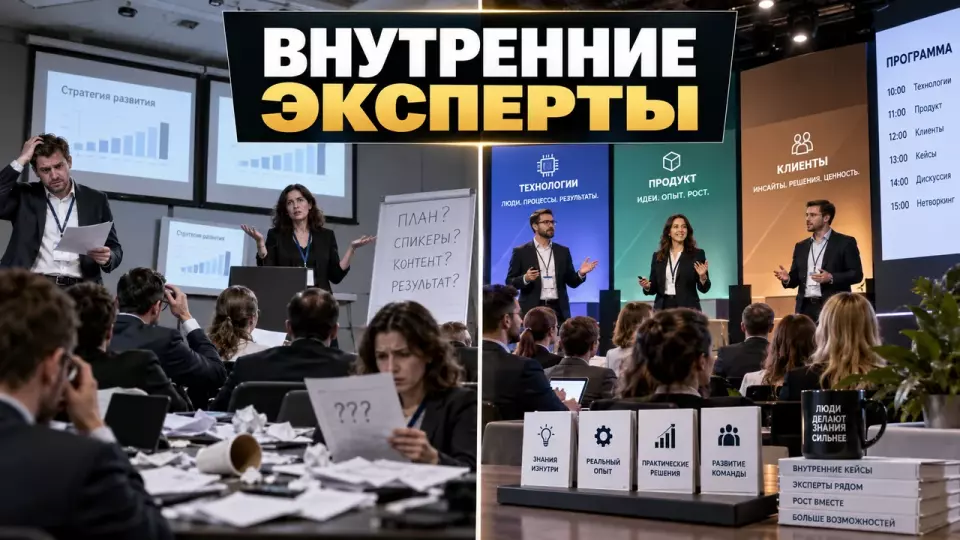
We break down the full cycle of an internal experts conference: from collecting topics and preparing speakers to multi-track programs, recordings, and a knowledge base.
A strong internal experts conference starts long before the stage. The company needs to find useful topics, separate real experience from a general department presentation, help authors prepare material, and decide in advance what will remain after the talk. At Aventura, we see such an event as an entry point into a knowledge-sharing cycle. A talk should lead to a clear takeaway, a working contact, or a next action.
If this task is already on your plan, request a quote for an internal experts conference. We will clarify audiences, topic areas, number of tracks, recording mode, and the set of materials before developing the scenario.
What is an internal expert conference?
An internal expert conference is an in-person or hybrid program where employees share verifiable professional experience with colleagues. They demonstrate working approaches, solutions, limitations, and conclusions that emerged within a specific organization. The company collects topics, conducts meaningful selection, prepares authors, organizes discussion, and preserves applicable results in the accepted knowledge system.
The speaker can be an engineer, technologist, analyst, salesperson, lawyer, project manager, or back-office specialist. A permanent teaching role is not required. Value is created by knowledge of the subject and willingness to rework it for the audience.
Internal Trainers Forum addresses a different question: how to train colleagues, design a session, work with a group, and evaluate learning outcomes. The expert conference focuses on what the company wants to transfer between functions. An internal trainer can help the author with methodology, but does not replace the subject matter expert.
The table summarizes the key points of the section: Criterion, Internal Expert Conference, Internal Trainers Forum. Use it as a quick reference when preparing the event.
| Criterion | Internal Expert Conference | Internal Trainers Forum |
|---|---|---|
| Program focus | professional knowledge, solutions, and working limitations | training methodology and group work |
| Typical author | function, product, technology, or process expert | trainer, instructional designer, mentor |
| Main artifact | case, knowledge page, instruction, recording, or solution | training module, exercise, trainer's tool |
| Main question | what to share with colleagues and where to apply it | how to help colleagues master the material |
A single external presentation does not change the nature of the event. An invited specialist can provide an industry framework, while internal authors will show how the topic works in the company's context. The core of the program is still built on internal knowledge and connections.
Goals and results: what should change after the event
The goal of a conference describes the future use of knowledge, not the fact of holding it. A suitable formulation connects the audience, topics, artifacts, and the next step: collecting applicable cases, introducing departments to experts, updating internal instructions, or opening work on common problems. The formula “hold a conference and increase engagement” is too broad for a scenario and evaluation.
We start with four questions:
- What knowledge is currently locked inside individual teams?
- Who needs them for work or decisions?
- In what form can they be safely transferred?
- Who is responsible for applying and updating the material after the event?
The answers help choose the scale. Sometimes one common stream and several deep dives are needed. In another company, parallel sections for different functions are more useful. The number of rooms should not become a goal in itself.
We separately define the boundaries. The conference does not replace ongoing training, document management, or communities of practice. It creates a point of concentration: employees find authors, compare approaches, and agree on what will be included in working materials.
Preparation can be carried out as organization of a corporate forum, if the program includes common context, thematic sections, work with speakers, and a common package of results. At the start, it is also useful to check the technical specification for a corporate forum: audiences, roles, venue, streams, technology, and expected artifacts.
How to conduct a call for papers?
A call for papers is a managed collection of topics, not a request to submit ready-made presentations. At the first step, it is important for the program committee to understand the problem, audience, main thesis, practical basis, and limitations. The quality of slides and confidence of the presentation are checked later. This order expands the circle of authors and does not cut off strong experience due to a weak initial submission.
In the call for papers guidelines, we recommend specifying:
- the goal of the conference and its audiences;
- thematic areas and acceptable formats;
- application fields and selection criteria;
- stages of review, editing, and rehearsals;
- rules of confidentiality, recording, and publication;
- decision deadlines and feedback route;
- author's obligations after topic acceptance.
The application card may contain a working title, audience, problem, key thesis, experience or data, limitations, expected outcome for the listener, co-authors, and desired format. It is better not to require a finished presentation: the idea is checked first.
It is convenient to conduct the collection process step by step:
- Define directions. The team sets boundaries and examples of suitable topics.
- Open a short form. The author does not need to prepare a report before the first decision.
- Hold introductory meetings. Potential speakers can clarify the concept and find a co-author.
- Do initial screening. The team marks duplicates, sensitive information, and overly broad formulations.
- Pass topics for review. All reviewers use one criteria form.
- Communicate the decision. The author receives a clear next step, not just the word "accepted" or "rejected".
Top-down assignment is permissible for a mandatory message from management, but it should not replace the open call. Otherwise, employees quickly understand that the program was distributed in advance and stop bringing new topics.
We publish analyses of corporate and business formats on Aventura's Telegram channel.
Content review and program committee
Review checks the usefulness and safety of the content before the presentation is produced. Reviewers look at alignment with the goal, clarity of the thesis, factual accuracy, applicability, limitations, and the risk of disclosure. The program committee then assembles a coherent program: resolves duplicates, changes formats, and determines which materials are better kept in the knowledge base without a stage presentation.
Author status does not replace the criteria. A functional leader may propose an important topic, but the program must explain who needs it and why. An employee without public speaking experience can bring strong material and prepare it with an editor.
The table summarizes the key points of this section: Application decision, When it fits, Next step. Use it as a quick reference when preparing your event.
| Application decision | When it fits | Next step |
|---|---|---|
| Accept | the topic aligns with the goal and is ready for editing | assign a curator and checkpoints |
| Accept after revision | there is value, but the thesis or audience is unclear | conduct an interview and a second review |
| Combine | several submissions address the same problem | arrange a discussion, a joint case study, or a series of short talks |
| Change format | the topic is useful, but a stage presentation is not suitable | make a roundtable, consultation, workshop, or knowledge page |
| Move without presentation | the material is needed, but the program is overloaded | create a guide, FAQ, or demo recording |
| Reject | the topic is out of scope, duplicates the program, or discloses something unacceptable | explain the criterion and suggest an alternative route |
Conflicts of interest should be flagged before assigning a reviewer. A direct manager, co-author, or participant in a contentious project can provide useful commentary, but should not single-handedly decide the fate of an application.
Feedback must be specific. Phrases like “it doesn't grab” and “it needs to be brighter” don't help. The reviewer writes where the audience is unclear, which conclusion is unsupported, what needs to be anonymized, and which part can be applied by other teams.
Architecture of a multi-track program
Tracks are built around the participant's choice logic, not by available rooms. The name of a track should explain its theme, level, and audience. We first sort accepted submissions into thematic lines, then check for repetitions, transitions, and conflicts, and only after that do we assemble the schedule. This way the schedule supports the content rather than dictating it.
For tracks, you can choose one of the principles that is clear to the participant:
- professional function: production, sales, data, product;
- type of task: client, quality, automation, risk management;
- level of immersion: introductory overview, practice, deep dive;
- stage of process: problem, solution, implementation, support;
- work format: short case studies, demonstrations, clinics, and consultations.
In one program, it is better not to mix different principles without explanation. If the first track is named by function, the second by job title, and the third by format, it becomes difficult for participants to compare options.
The table summarizes the key points of the section: Element, What to define, Pre-publication check. Use it as a quick reference when preparing the event.
| Element | What to define | Pre-publication check |
|---|---|---|
| Track | theme, audience, and boundaries | difference from adjacent tracks is clear without explanation |
| Session | thesis, format, and outcome | material does not repeat an adjacent talk |
| Moderator | role, questions, and transitions | moderator is familiar with the content in advance |
| Break | time for transition and discussion | participant has time to change rooms or connections |
| Recording | priority and access mode | author and audience understand the rules |
| Card | description, level, and prerequisites | participant can consciously choose a session |
The program committee is not obliged to give the stage to every strong submission. A narrow deep dive may work better as a closed consultation. Several similar case studies can be usefully combined into a panel or clinic, where participants can compare solutions on the same questions.
For such a project, business event organization is suitable: content, script, venue, and speaker management are brought together in a single production pipeline.
How to prepare internal speakers?
Preparation starts with a thesis, not with slide design. The expert formulates one main idea, describes the initial situation, presents the solution and evidence, states the limitations, and concludes with a next action for the audience. The editor helps maintain this line. The subject-matter reviewer is responsible for content, not stagecraft.
The workflow might look like this:
- Clarify the audience and one main idea.
- Check facts, figures, rights to materials, and disclosure requirements.
- Assemble the logic: context, solution, evidence, limitations, conclusion.
- Remove internal abbreviations or explain them at first use.
- Prepare a draft of materials in an accessible format.
- Conduct a substantive rehearsal with a timer and questions.
- Refine the structure based on feedback from a test audience.
- Perform a technical run-through on actual equipment or platform.
- Document the rules for recording, publishing, and updating the material.
The best specialist is not automatically the best speaker. But a weak first presentation does not mean the topic should be abandoned. Sometimes the author needs a co-author, an interview with the editor, or another format: a demonstration, a conversation with a moderator, a whiteboard discussion.
Preparation time should appear in the work calendar. A presentation that an employee puts together at night without the manager's support almost inevitably goes through review and rehearsal too late.
Moderators also rehearse. They know the session theses, prepare connecting questions in advance, and understand which topics cannot be discussed publicly. Their task is to help the audience see connections, not to repeat the speakers' biographies.
Execution, Hybrid, and Run-of-Show
On the day of the conference, the content, technical, and coordination teams work according to a single scenario. It contains final versions of presentations, speaker appearances, questions, transitions, recording modes, backup solutions, and the owner of each change. Live discussion does not cancel the scenario: the team must understand who can change the order and how to bring the program back on track.
Before the stream opens, the coordinator checks the presence of authors, materials, and approvals. The moderator receives session cards. The technical team uses only approved files to avoid searching for a new version before going live.
For parallel sessions, unified navigation is especially important. Track and room names match in the invitation, program, signage, screens, and digital interface. Unanswered questions are recorded and passed to the owner, rather than disappearing after the session closes.
If part of the audience connects remotely, the hybrid conference format is designed as a separate route. The online moderator monitors the chat and question queue. Comments from the floor are repeated into the microphone. Materials are available to remote participants, and the backup channel is checked before the event.
A company executive can open the program or answer general questions. Such a block should be linked to the conference topics and follow-up actions. Specific principles of dialogue are discussed in the article about a leadership meeting with employees.
How to plan recording, privacy, and accessibility?
The recording mode is determined before accepting the request. The author and participants must know the purpose, the composition of the recorded data, access, the possibility of downloading, the storage period, and the file owner. A private link alone does not solve the privacy issue. For a sensitive case, you can choose a private track, anonymization, text material, or a complete ban on recording.
The company checks applicable law and internal policies separately. Technical platform settings help notify participants and restrict access, but do not replace legal assessment.
Before publishing materials, we ask five questions:
- Why is the recording or data needed after the conference?
- Who will receive the original file and the processed version?
- Which fragments cannot be included in search or the general catalog?
- When will access rights and storage necessity be reviewed?
- Who is responsible for deleting, restricting, or updating the material?
Accessibility is planned before registration and slide creation. The participant needs a way to communicate their needs. Venue, platform, microphones, materials, subtitles, and description of significant visual information are part of the task of the organizer and speaker. PDF should not be the only format if the material can be provided in an adaptable form.
Recording questions from the audience requires a microphone. Otherwise, the remark will not be included in the sound, subtitles, and final material. Automatic transcription is checked before publication: it may distort terms and retain accidental personal or confidential details.
Knowledge base and follow-up after the conference
A recording without description and owner rarely becomes a working knowledge base. For a strong session, you need an applicable artifact: a maintained page, instruction, checklist, summary, Q&A, task, or restricted recording. The material is linked to processes and assigned a review date. The presentation remains a display layer, not the only source of truth.
A session card can include:
- title and brief thesis;
- author and material owner;
- audience and prerequisites;
- date of presentation and next review;
- summary and available materials;
- recording and transcript, if permitted;
- related processes, documents, and tasks;
- usage restrictions;
- answers to questions;
- status and access level.
It is useful to plan work with publication in advance. A detailed route is analyzed in the article about content after the conference: from selection of recordings and editing to navigation and reuse.
We divide follow-up into four streams:
- To participants. Materials, answers, and navigation through the knowledge base.
- To speakers. Feedback, open questions, and plan for updating the material.
- To process owners. Decisions, tasks, pilots, and changes to working documents.
- To the program team. Retrospective with actions, owners, and verification deadlines.
An email with photos does not close follow-up. If a session revealed a useful solution, it gets an owner. If a conclusion is not applicable, the reason is also recorded. The next conference starts with checking previous commitments, not from a blank page.
What to measure without made-up standards?
There is no universal percentage of successful submissions, views, or adoption. Metrics are chosen based on the company's original problem. It is useful to see the entire chain: employees learned about the topic collection, submitted an application, passed review, prepared the material, gained an audience, created an artifact, and linked it to a work action.
For call for papers, you can look at the number of completed submissions, author roles, reasons for rejection, and the need for help before review. For preparation, passing content review, rehearsals, fact-checking, and technical run-through.
For a knowledge base, the owner, review date, connections to processes, and usage facts are important. A total video counter does not show this. For follow-up, we look at open questions, assigned actions, and their status.
We do not make a causal conclusion that 'the conference increased productivity' based on attendance or satisfaction. For such a claim, baseline metrics and a separate evaluation design are needed. In the article, it is enough to honestly show the observed results of the process.
Frequently Asked Questions
A conference of internal company experts is an in-person or hybrid program where employees share verifiable professional experience with colleagues. They demonstrate working approaches, solutions, limitations, and conclusions that have emerged within a specific organization. The company collects topics, conducts substantive selection, prepares authors, organizes discussion, and preserves applicable results in the adopted knowledge system.
The goal of the conference describes the further use of knowledge, not merely the fact of holding it. A suitable formulation links the audience, topics, artifacts, and the next step: to collect applicable cases, introduce departments to experts, update internal instructions, or start working on common problems. The formula 'hold a conference and increase engagement' is too broad for scenario and evaluation.
A call for papers is a managed collection of topics, not a request to send ready-made presentations. At the first step, it is important for the program committee to understand the problem, audience, main thesis, practical basis, and limitations. Slide quality and speaking confidence are checked later. This order expands the pool of authors and does not exclude strong experience due to a weak initial submission.
The review checks the usefulness and security of the content before the report is produced. Reviewers look at alignment with the goal, clarity of the thesis, subject-matter accuracy, applicability, limitations, and disclosure risk. The program committee then assembles a cohesive program: separates duplicates, changes formats, and determines which materials are better left in the knowledge base without a stage presentation.
Tracks are built according to the participant's choice logic, not according to available halls. The name of the track should explain the topic, level, and audience. We first sort accepted submissions into thematic lines, then check for repetitions, transitions, and conflicts, and only after that assemble the schedule grid. This way the schedule supports the content rather than dictates it.
Preparation begins with the thesis, not with slide design. The expert formulates one main idea, describes the initial situation, shows the solution and evidence, names the limitations, and ends with the next action for the audience. The editor helps maintain this line. The subject-matter reviewer is responsible for the content, not for the stage form.
If you need to connect call for papers, review, speaker preparation, multi-track program, recording, and post-materials into one project, discuss the conference with us. We will start with a brief and propose a concept, scenario, and budget.
Sources
- Google re:Work: Employee-led learning principles and practice
- GitLab Handbook Usage
- NASA: Lessons Learned
- OpenReview: Conference Review Workflow Overview
- Toastmasters: Preparing a Speech
- W3C WAI: Making Events Accessible
- Zoom Support: Providing consent to be recorded
- Microsoft Learn: Manage Teams recording policies
- NIST Privacy Framework
- ICO: Data minimisation
- GOV.UK Service Manual: Agile tools and techniques
- WHO: Ensuring Accessibility
Contents
Was this article helpful?