How to vet an event contractor before paying an advance: a step-by-step check of the company register, authority, bookings, bank details and the payment decision.
How do you vet an event contractor before paying an advance when the proposal is approved and the invoice is already in your inbox? Assemble the contract, the estimate and the production terms into a single package. If you need an external review, request an estimate and a project review. We will help you verify the basis for payment and link it to the work plan.
Where selection ends and verification begins
Once the choice is made, the focus shifts to the specific deal: who receives the money, who takes on the obligation, and what work the advance sets in motion.
After selection comes document verification. First, match the contracting party with the signatory. Then check the scope, the estimate, the invoice and the bank details. Any discrepancy in the company, document version or stage halts the payment.
We start at the boundary of the process. The contractor has already been selected through a direct request or a comparison of proposals for a single task. We do not re-evaluate the concept and the team. Now we verify the specific deal and the specific transfer.
This check is not meant to give the contractor a lifetime quality mark. Public registries show only part of the picture. They do not confirm a venue booking, the availability of equipment, an agreement with an artist or the readiness of the installation crew. That is why we combine legal identity with production confirmations.
For organising a corporate party, this approach is especially useful when a single budget covers the venue, catering, technical equipment, the programme and transport. The more dependencies there are, the more dangerous it is to treat a single invoice received as sufficient grounds.
What should be checked first?
In short: Before searching the registries, check the contracting party, the invoice recipient, the signatory and the stage being paid for. Then find out what work the advance sets in motion. If the documents do not match, ask the contractor for a single, consistent package.
Start with precise identifiers. The brand name on a website may differ from the full name of the legal entity or sole proprietor. You need the INN, OGRN or OGRNIP for searching and cross-checking. The identifiers stated in the documents must not diverge; assess the absence of a mandatory detail according to the type of document.
Before checking, collect the package in a single email. It is easier to spot a gap this way than to pull data out of a long correspondence:
- Full name, INN, KPP if applicable, OGRN or OGRNIP.
- Draft contract with all annexes, specifications and the estimate.
- Full name and position of the signatory, and the basis of their authority.
- Invoice and bank details of the recipient.
- Calendar plan and the stage that the advance opens.
- Contact of the project manager and a backup contact.
- Confirmations of critical bookings or a clear procedure for obtaining them.
- List of documents required for acceptance and closing the stage.
Cross-check the scope of work against a single brief for the quote and the final proposal. Ask for the wording "technical support" to be spelled out. Separately specify delivery and installation, the team's work during the event, dismantling and overtime hours.
Check the recipient separately. A payment to another company, a sole proprietor, an individual or a payment partner does not prove fraud. But it is a reason to stop and request the contractual basis, documents and approval from accounting or legal.
Payment Readiness Card
Bring the result together in a single card: the fact, the supporting document, the open question and the person responsible for the next step. The output should be one of three statuses: "ready to pay", "clarification needed" or "payment on hold pending confirmation".
We suggest using the payment readiness card as an organisational tool rather than a mandatory legal form. It helps ensure that an important discrepancy between procurement, accounting and the project team is not overlooked.
The table summarises the key points of this section: Block, What to check, Confirmation. Use it as a quick reference when preparing an event.
| Block | What to check | Confirmation | Red flag |
|---|---|---|---|
| Contractor | who conducted the negotiations and will perform the work | proposal, correspondence, project contact | the actual performer is not named |
| Party to the contract | who assumes the obligation | contract, INN, bank statement | the invoice names a different party |
| Authority | who signs and changes the terms | EGRUL extract or power of attorney | a manager signs without grounds |
| Subject and stage | what result the client is buying | appendix, specification, estimate | the wording does not allow the work to be accepted |
| Scope and exclusions | what is included and what is paid separately | final version of the proposal | assumptions remain only in emails |
| Basis for payment | which document authorises the transfer | contract, invoice, internal approval | there is an invoice but no basis |
| What triggers the advance | booking, purchase, production or reserve | work plan, contractor confirmation | the purpose of the amount is not explained |
| Bank details | who receives the money and at which bank | contract, invoice, counterparty card | details were changed without a separate check |
| Acceptance | who will accept the stage and on what criteria | criteria in the appendix | the result is described in evaluative terms |
| Decision owner | who authorises the payment and resolves comments | approval route | there is a question but no one responsible |
The card should not be turned into a complex scoring system. One red fact can matter more than ten green ones. For example, a tidy bank statement and good reporting do not compensate for unconfirmed signatory authority or a mismatch in the recipient of the funds.
For a business event, link the card to the project plan. Organising a business event includes the programme, venue, equipment, registration, contractors and closing documents. The card should make clear which work the payment triggers.
If you need a single package of documents and checkpoints, request a project review. Simply send the task and the current version of the estimate.
How do I verify a legal entity and its authority?
Find the contractor by INN or OGRN using the Federal Tax Service (FTS) services. Check the status, address and any unreliable-data flags. Then verify the person signing the contract.
For an initial check, use the Unified State Register of Legal Entities and Individual Entrepreneurs (EGRUL and EGRIP) information service and the "Transparent Business" service. The FTS lets you find a registered entity by its exact identifier and view available information on its status, director, address, types of activity and certain risk flags.
Check in sequence:
- Find the organisation or sole proprietor by INN.
- Make sure the status is active.
- Check the full name, OGRN or OGRNIP and address.
- Match the director against the signatory of the contract.
- Look for records of unreliable data, reorganisation or liquidation.
- Save the extract or result with the date of the check.
- Record any discrepancies and request an explanation before paying.
Article 53 of the Civil Code of the Russian Federation states that a legal entity acts through its bodies. The EGRUL may list several persons who act jointly or independently. So a familiar title such as "general director" does not in itself remove the need to read the current extract.
If the contract is signed by a person acting on behalf of the legal entity without a power of attorney, check their details and the representation arrangements against the EGRUL. For any other representative, request a power of attorney. Check the right to sign the contract, change the price and assume obligations on behalf of the company.
A machine-readable power of attorney can be verified through the FTS infrastructure, and a notarised one through the service of the Federal Notarial Chamber. The absence of an ordinary paper power of attorney from public search does not in itself prove that it is invalid.
If the extract lists several signatories, joint action is required, the amount is unusual for the company, or the power of attorney contains restrictions, pass the package to a lawyer. An organisational checklist helps identify the question. It does not replace a legal assessment of the charter, transaction approval and specific powers.
Courts, debts and bankruptcy without quick labels
Check enforcement proceedings, arbitration cases, tax records and bankruptcy proceedings separately. For each record, look at the contractor's role, the subject of the dispute, the date and the current stage. A single dispute found does not settle anything on its own; a clean search result also does not guarantee performance of a specific contract.
The data bank of the Federal Bailiff Service publishes publicly available information on enforcement proceedings. For each record, check the status and the grounds for closure: the presence of a record does not always mean that the proceedings are currently ongoing. The arbitration case file helps you see court disputes and documents. "Transparent Business" contains available tax information, and the Federal Tax Service separately explains the stages of bankruptcy of a legal entity.
For each fact found, fill in a short line: source, date checked, contractor's role, subject, current stage, explanation and decision. This format is more useful than an opaque "reliability 83%" rating.
Look at the combination of signals. A recent series of similar claims for a refund of an advance payment may be more relevant than an old commercial dispute in which the contractor was the plaintiff. Enforcement proceedings over a small disputed amount and a large block of recent debts also require different responses.
Do not confuse a bankruptcy petition, a procedure introduced by a court and a declaration of bankruptcy. These are different events. If an active bankruptcy case is found or documents indicate a possible challenge to a transaction, further assessment must be carried out by a lawyer.
A red zone in the profile means "stop the payment and investigate." It does not provide grounds to publicly accuse the company of fraud or insolvency. The check is needed for a decision on your own transaction, not for publishing a label.
Does the contract match the actual project?
A clean extract confirms that the company exists, but says nothing about its readiness to deliver an event. Cross-check the contract against the brief, the budget and the schedule. For any paid stage, specify the deliverable, the deadlines, who is responsible and how substitutions are approved.
First, compare the documents against a single version of the task. The approved budget line should lead to the same scope that is described in the contract and the invoice. The final total usually differs noticeably. Changes in the scope of work are harder to spot: they hide in exclusions and assumptions.
Ask the production contractor these questions:
- Has venue availability been confirmed for the required date and the setup window?
- Have power capacity, rigging points, dimensions, unloading, noise restrictions and dismantling been taken into account?
- Who is responsible for critical subcontractors?
- Which substitutions are possible without approval, and which require a written decision from the client?
- Is there a contingency for illness, breakdowns, a venue ban or a failed delivery?
- Which costs does the contractor consider non-refundable, and how will it prove they were incurred?
For the venue, it is worth carrying out a separate technical audit of the terms. If the location has not yet been chosen, a contextual venue search is best run in parallel with the budget. Otherwise the technical calculation may rest on an assumption that changes the price after the deposit is paid.
Confirmation of a booking can be a supplier's letter, a redacted copy of a document with the price removed, or an anonymised confirmation. If such confirmation cannot be obtained, record the general contractor's liability separately in the contract. This allocates risk, but it does not prove that a booking exists.
Before payment, agree on the future acceptance: who checks the result, by what criteria the stage is deemed ready, and which document closes it. Separately distinguish remarks that can be fixed after the event from defects that make the result unacceptable.
The link to acceptance and closing documents needs to be established before the first transfer.
Tie the advance payment to a clear piece of work or obligation
In a working model, it is better to tie the advance to a clear obligation: a booking, a purchase, manufacturing, equipment reservation or a standalone stage. Record this work and the document by which the contractor will confirm it has been launched.
Ask the contractor to name the action that follows payment. For example, the venue confirms the date, production purchases the material, and the technical company reserves the equipment. For artists and transport, you need the same verifiable result.
Then check four links:
- The amount relates to a specific contract and stage.
- The stage matches the calendar plan.
- Confirmation of launch can be saved.
- The consequences of cancellation or postponement are described in the contract.
Do not designate a single percentage as "safe" for any deal. The amount depends on the procurement model, date scarcity, non-refundable bookings, custom manufacturing and negotiating position. It is more useful to break payment down by verifiable events than to look for a magic number.
Once the decision is "ready to pay", the line moves to the event payment calendar. There you can see the date, the person responsible, the work after payment and the condition for revising the deadline. Until verification, the line remains under clarification and is not disguised with an "urgent" status.
What to do when bank details change?
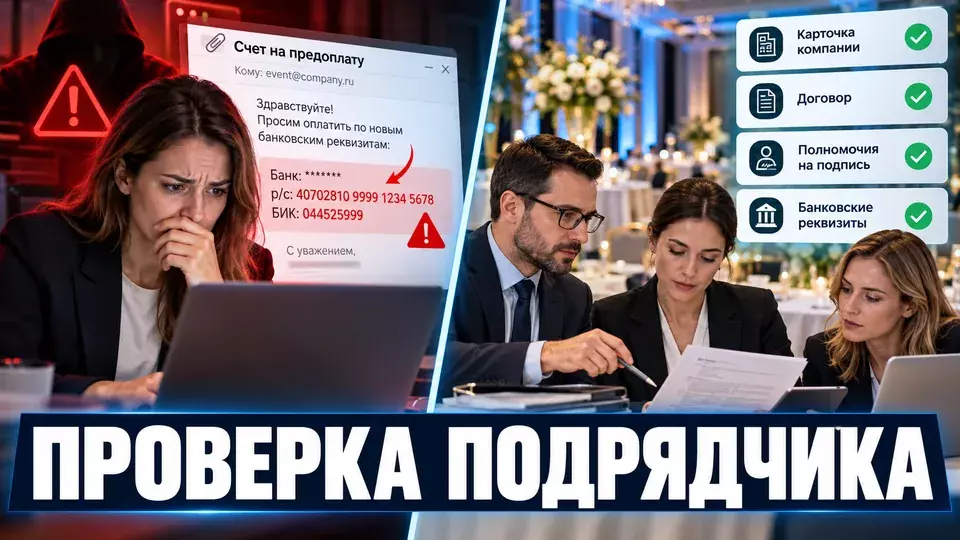
If bank details change, stop the payment and contact the contractor using a number known in advance. After the conversation, obtain a signed document, re-check the bank and record the date, communication channel and the name of the person who checked.
Payment detail substitution may use genuine business correspondence or a convincing copy of it. IC3/FBI guidance on Business Email Compromise (BEC) advises confirming changes to bank details through a second channel. For a Russian contract, this is a cybersecurity recommendation, not a rule of Russian law.
The workflow looks like this:
- Stop the payment and any change to the counterparty's record.
- Do not use the contacts from the email with the new bank details.
- Call the number from the previously signed contract or another source known in advance.
- Confirm the change with the manager or an authorised representative.
- Obtain a notification or supplementary agreement in the form and through the channel stipulated by the contract and your internal policy; if necessary, have the exact form checked by a lawyer.
- Check the authority of the person who signed the change.
- Verify the BIC and the bank against the Bank of Russia directory.
- Carry out internal approval on the two-checker principle.
- Save the date, communication channel, document and names of the employees responsible.
The Bank of Russia directory helps verify bank identifiers and the bank itself. It does not confirm that a specific settlement account belongs to the required contractor. Ownership of the bank details is confirmed by documents and independent contact with the counterparty.
If the transfer has already gone to a suspicious account, contact the bank immediately using its official number. In parallel, follow your internal information security policy and inform management. Speed matters, but the order of further steps is determined by the bank, lawyers and your company's security service.
The contract can specify in advance the agreed channel for changing bank details and the requirement for independent confirmation. The exact wording should be checked by a lawyer, especially if the company uses electronic document flow, machine-readable powers of attorney or a complex group of recipients.
Decision: pay, clarify, or stop
The check ends with one of three decisions. A green status authorises the payment, yellow sends the package back for clarification, and red stops the transfer until a specific discrepancy is resolved.
A green status is possible when the contracting party matches the payee, or the basis for paying a third party is confirmed by documents and approved. The signatory's authority has been verified, and the invoice relates to the correct stage. Critical conditions are already closed; the bank details either have not changed or have passed a separate check.
The yellow zone is appropriate for a new legal entity, a recent change of director, a single explainable dispute, significant dependence on subcontractors, or a large payment before a booking is confirmed. The decision may be to request a document, split the payment, move part of the amount to a checkpoint, or involve a lawyer.
The red zone arises when the INN or the contracting party does not match, authority is unconfirmed, a payment is made to a third party without a basis, the account is changed on the basis of a letter alone, there is an active bankruptcy procedure affecting the deal, or there is a refusal to confirm a critical booking. The status wording is neutral: "payment stopped pending confirmation".
Before sending to accounting, carry out a final check:
- The contracting party matches the payee, or the basis for paying a third party is documented and the required approvals from accounting and legal have been obtained.
- The name, INN and, for an organisation, KPP do not contradict each other in the documents where these details appear.
- The contract is signed by an authorised person.
- The invoice matches the stage and the amount.
- The bank and BIC have been checked.
- The bank details have not changed without a separate record.
- The conditions for the advance payment have been met.
- Confirmations are saved in the project package.
- A second employee has repeated the reconciliation.
- The payment has an owner of the decision.
Neither this list nor public databases rules out a future failure. They reduce the number of decisions taken on trust and show the point at which the matter should be passed to a specialist. For a complex deal, involve a lawyer, accounting, procurement, security or the bank according to their expertise.
Frequently asked questions
Once the choice is made, the focus shifts to the specific deal: who receives the money, who assumes the obligation, and what work the advance payment sets in motion.
Start with the exact identifiers. A brand name on a website may differ from the full name of the legal entity or sole proprietor. You need the INN, OGRN or OGRNIP for searching and cross-checking. The identifiers stated in the documents must not diverge; assess the absence of a mandatory detail with regard to the type of document.
Consolidate the result into a single card: the fact, the supporting document, the open question and the person responsible for the next step. The outcome must be one of three statuses: “ready for payment”, “clarifications needed” or “payment on hold until confirmation”.
Find the contractor by INN or OGRN in the Federal Tax Service (FTS) services. Check the status, address and any unreliable-information flags. Then verify the person signing the contract.
Check enforcement proceedings, arbitration cases, tax records and bankruptcy procedures separately. For each record, look at the contractor's role, the subject of the dispute, the date and the current stage. A single dispute found does not settle anything; a clean search result also does not guarantee performance of a specific contract.
A clean extract confirms that the company exists, but says nothing about its readiness to deliver an event. Cross-check the contract against the brief, the budget and the schedule. For each paid stage, specify the deliverable, the deadlines, the responsible persons and the procedure for approving substitutions.
If you want to bring contractors, the budget, contractual milestones and on-site control together in one project, request a review and event budget. At Aventura, we start with the initial brief and show you which confirmations are needed before payments are released.
Sources
- Federal Tax Service: open taxpayer information services
- Federal Tax Service: extracts from the Unified State Register of Legal Entities and the Unified State Register of Individual Entrepreneurs
- Federal Tax Service: Transparent Business
- Federal Bailiff Service: Data Bank of Enforcement Proceedings
- Arbitration Case Database
- Federal Tax Service: bankruptcy of legal entities
- Civil Code of the Russian Federation, Article 53: bodies of a legal entity
- Federal Tax Service: electronic signature and machine-readable power of attorney
- Federal Notarial Chamber: verification of powers of attorney
- Bank of Russia: payment system and BIC directory
- IC3/FBI: Business Email Compromise
Contents
Was this article helpful?