A technical seminar helps clients understand how to apply the product, test a scenario at the demo stand, and get answers from engineers. We break down the agenda, the demo zone, roles, security, and post-event follow-up.
A technical seminar for clients is needed when a standard product presentation is no longer enough. Participants need to see a working scenario, test hardware or software, discuss limitations, and get an answer from a specialist engineer. That's why the agenda for this kind of event is built around the client's tasks, not around a long line-up of talks.
At Aventura, we are responsible for the event architecture: the agenda, the venue, registration, group routes, demo zones, technical production, and coordination. The client's engineers confirm the product specifications, operating rules, and the acceptable level of information disclosure. We lock in this division of responsibilities at the start of the project.
When do you need a technical seminar for clients?
In brief: A seminar is suitable when the client needs to understand how a solution works, see it in action and discuss its application with a specialist. If the task is limited to getting to know the company and does not require training, it is better to choose a broader client format.
A technical seminar is especially useful for complex industrial equipment, engineering software, automation, measurement systems and service solutions. In these fields, the buyer evaluates more than just the benefits. They are interested in compatibility, implementation conditions, personnel requirements, maintenance, safety and limitations.
The first signal for a seminar is that the sales team has accumulated recurring technical questions. These can be turned into training modules and stations. The second signal is that clients find it difficult to evaluate a solution from a catalogue or video. The third is that a pilot, calculation or audit requires a common level of understanding.
A seminar does not have to lead directly to a sale. A realistic outcome may be a request for a configuration selection, an additional demonstration, an engineer consultation, a test or a calculation. We determine in advance what action is available to the participant after each track.
The boundary with a client day and a product launch
A technical seminar differs from neighbouring B2B formats in its subject matter. At its centre is an applied task and technical training. A stage, exhibition samples and presentations alone do not create this task.
The table summarises the key points of the section: Format, Main question of the participant, Focus of the programme. Use it as a quick guide when preparing the event.
| Format | Main question of the participant | Focus of the programme | Practical outcome |
|---|---|---|---|
| Technical seminar | How does the solution work in my conditions? | Explanation of the principle, demonstration, hands-on practice, questions to the engineer | Understanding of applicability and the next technical step |
| Client day | What does the company offer and how to work with it? | Portfolio, strategy, meetings, tour | Relationships and agreed contacts |
| Product launch | What new has come to market? | Announcement, benefits, first showing | Introduction to the new product and interest in continuing |
| Round table | How do participants assess the common problem? | Exchange of experience and discussion | Positions, questions and topics for further work |
If the overview of the company, negotiations and getting to know the production are more important for the participants, a client day for a B2B company is more useful. If the main task is to discuss practices among peer experts, it is worth considering a round table for clients.
Formats can be combined in a single event. For example, start with a general welcome, then split the guests into technical tracks and finish with consultations. The name is secondary here. It is more important to tell the participant in advance where they listen, where they work hands-on and where they discuss their own case.
What to find out from clients before assembling the program?
Working principle: First, we gather the audience's objectives, equipment versions, level of training, and questions for engineers. Then we form the talks and demonstrations. The reverse order usually produces a generic program in which the client does not recognize their own situation.
Registration does not require a long survey. Fields that change the program are useful: position and role, industry, model or version used, experience level, priority task, and willingness to participate in the hands-on part. Accessibility conditions and dietary restrictions are asked about separately.
For key groups, we offer short interviews. Five conversations with operations, designers, service, procurement, and technical managers often reveal different expectations. Some need selection. Others need diagnostics. Still others need an understanding of the lifecycle and maintenance conditions.
Sensitive schematics, configurations, and error logs cannot be collected via a standard form without an agreed-upon regime. The client determines the secure channel, access scope, and retention period. An anonymized scenario is brought to the public part, while the private review is conducted separately.
Program: from engineering framework to practice
In brief: A working program moves from principle and constraints to a live demonstration, participant action, and Q&A. Each block ends with a clear conclusion or next step.
We build the organization of forums and seminars around participant actions. First, we define the outcome of the track. Then we choose the format, duration, capacity, and technical conditions.
The basic route may consist of five parts:
- A short engineering framework: task, principle of operation, scope of application, and limitations.
- Demonstration of the full scenario without promotional gaps.
- Hands-on practice at a station or review of parameters together with an engineer.
- Questions and work with complex cases.
- Recording the conclusion and the next technical action.
It is better to separate levels. Beginners need terminology and a safe sequence. Experienced specialists need diagnostics, integration, and non-standard modes. Managers need implementation requirements, risks, and lifecycle. If you put them in one stream, part of the audience will lose pace.
Industrial training programs from Rockwell Automation, Siemens, Emerson, and Fluke use applied courses, labs, live demonstrations, and work with experts. We do not copy someone else's schedule, but we use a common principle: technical content should lead to an observable action, not just a listened-to presentation.
The demo zone as a route, not an exhibition
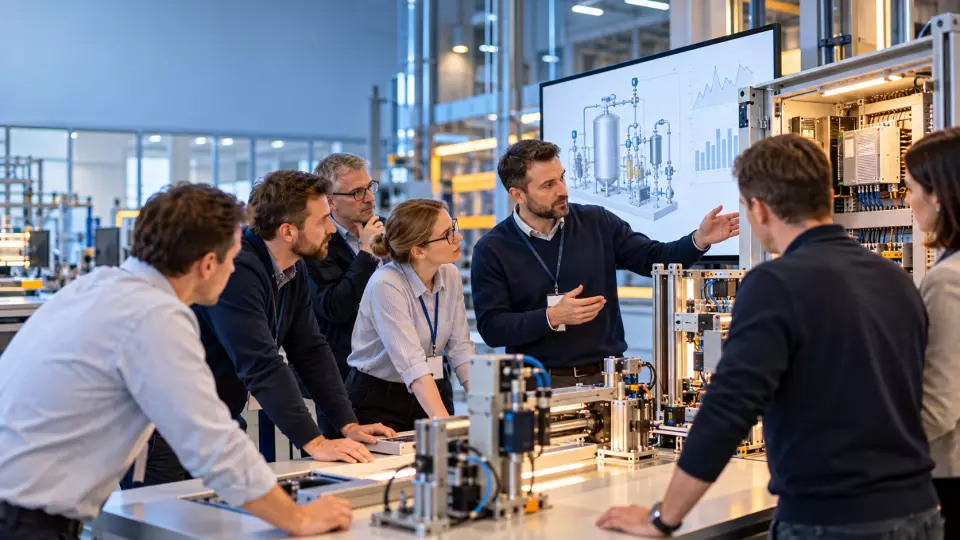
Each station must answer one clear question. “Show all the equipment” is not a task. A working formulation is more precise: select a mode, take a measurement, find a fault, compare configurations or complete a safe operation.
For each station we prepare a passport:
- goal and the participant's level of training;
- the starting state of the stand;
- equipment, software and consumables;
- the participant's action;
- expected result;
- duration and maximum capacity;
- the demo owner;
- safety rules;
- primary and backup scenario;
- follow-up materials.
We distribute flows across slots. The badge or mobile programme shows the group, starting station and transition time. For limited hands-on sessions, a waiting list and a clear participant replacement rule are needed. This protects engineers from a crowd at a single device and gives everyone time to complete the action.
In business event management we link the programme to rooms, power supply, network, screens, unloading and case storage. A demo zone requires more space than a row of chairs. Safe walkways, a waiting area and a clear view for observers are needed.
How do you prepare engineers and the moderator?
In brief: The engineer is responsible for technical accuracy, the demonstrator operates the stand, the moderator keeps to the question and time, and the technical assistant returns the system to a working state. One person should not perform all these roles at the same time.
A strong specialist does not always automatically become a clear speaker. Before the rehearsal we put together an engineering brief: who is listening, what the audience already knows, what result is needed, which limitations are important to mention and which questions must not be discussed publicly.
The moderator does not retell the product. He clarifies the question, separates the general case from the specific one and makes sure the answer does not turn into an unconfirmed promise. If there is no precise answer, the question goes into a register. There the owner, missing data and feedback procedure are indicated.
The rehearsal takes place with the stand, final files and the launch method that will be used at the event. We check switching, sound, interface scale, network failure, recovery and microphone handover. The detailed procedure for such a check is covered in the article on technical rehearsal of an event.
Safety, access and confidentiality
Important: An event scenario does not replace operational instructions. Access procedures, personal protective equipment and the right to stop an operation are approved by the client's occupational health and safety specialists.
Before the demo zone opens, a risk list is drawn up: electricity, rotating parts, pressure, temperature, radiation, chemicals, sharp edges, heavy objects and cables in walkways. Each risk needs a responsible person and a verifiable measure.
The space is divided into general, demonstration and restricted zones. Badge colour can indicate the access level but must not reveal unnecessary personal data. For the restricted part, a guest list, escort arrangements and photo or video rules are set.
Confidentiality starts before installation. Screens must not show client names, serial numbers, credentials, internal prices or non-public functions. A "no photography" rule is weak without signage, a physical boundary and clear control of materials.
HSE publishes recommendations on the safe use of work equipment and machinery, while NIST describes practices for pre-registration, identity verification, passes and escorts for non-public zones. These sources do not replace Russian regulations and venue rules. They help check the completeness of the organizational scenario.
Technical backup and hybrid participation
We test the demonstration as a chain. It includes the product version, license, account, network, power, cables, interface scale, source switching and permission to display data. Each critical link has an owner.
The backup must support the same message. For a software scenario, a local environment, screen recording or a set of sequential screenshots will work. For a physical stand, a spare device, consumables and a pre-agreed simplified demonstration are prepared. A random promotional video does not replace a practical demonstration.
Remote audiences need separate audio, a close-up of the equipment, interface capture and a chat moderator. Questions from the room are repeated into the microphone. Materials and participation rules are sent in advance. W3C recommends taking into account the accessibility of the platform, chat, screen sharing, subtitles and recording.
If the event takes place in person and online, we design the organization of a hybrid event as two connected tracks. A remote participant should not only see the stage but also receive equivalent information, ask questions and understand the next step.
Questions to engineers and personal consultations
In brief: Questions are collected before the event, during each track, and after the demonstration. They are divided into public, those requiring client data, confidential, service, and commercial.
Preliminary questions help select equipment and experts. During the seminar, the moderator records the context: model, version, application conditions, actions already taken, and expected result. Without these fields, a long question is difficult to pass on to another specialist.
For special cases, a slot-based engineering clinic is useful. A participant chooses a topic in advance and receives a list of data to bring. The client determines whether the case can be discussed in a common area or a closed room is required.
After the event, the question register becomes a working document. It contains the author, topic, confidentiality level, responsible specialist, and status. Sending everyone the same set of materials is easier, but a precise answer on the track attended is more useful.
What metrics to show the client?
The number of registrations shows interest but does not prove a technical result. Metrics are linked to the actions a participant must perform during and after the seminar.
The table summarizes the key points of the section: Stage, What to measure, What it shows. Use it as a quick reference when preparing the event.
| Stage | What to measure | What it shows |
|---|---|---|
| Before the event | slot occupancy, share of questions, distribution by level | how well the program matches the audience |
| During the event | participation at stations, completed actions, waiting time, failures | whether the practical route works |
| After the event | closed questions, requests for consultation, test or calculation | whether the agreed next step took place |
Additionally, we record the availability of materials, sound quality, clarity of navigation, and violations of the access regime. A 'liked' rating remains useful but does not replace a check of knowledge or action.
We do not promise sales growth from a single seminar. Further commercial results depend on the product, price, service, and the work of the client's team. An event can effectively transfer knowledge, collect technical signals, and create a clear path for continuation.
What does a turnkey organisation include?
In short: We connect the content, the space, the technology and the guest journey. The client remains responsible for product data, engineering tolerances and the final answers to their customers.
The scope of the project depends on its scale, but usually includes:
- a brief and a map of objectives;
- audience segmentation and programme architecture;
- venue sourcing and planning of demo zones;
- registration, invitations and group routes;
- the script, moderation and speaker preparation;
- sound, screens, network, lighting and backup;
- installation, rehearsal and on-site coordination;
- signage, catering and work on accessibility requirements;
- logging of questions and an organisational report.
To prepare a quote, we need the city, the date, the number of guests, the duration, the number of tracks, the composition of the stands and the venue's requirements. Equipment transport, reinforced power supply, internet, streaming, interpreting, photo and video are priced separately.
We publish breakdowns of programmes, venues and technical production in Aventura's Telegram channel.
The next step in preparation
Start with a short one-page document. Write down the audience, the three main technical tasks, the demonstrations available, the disclosure restrictions and the action to take after the seminar. That is enough to discuss the format and check feasibility.
Next, we will propose a participant journey, the composition of the zones, a technical plan, team roles and a preliminary estimate. If the input data is still limited, we will separately identify what needs to be clarified with the engineers and the venue before the budget is fixed.
Frequently asked questions
A technical seminar is especially useful for complex industrial equipment, engineering software, automation, measurement systems and service solutions. Buyers in these fields evaluate more than just the advantages. They are interested in compatibility, implementation conditions, staffing requirements, maintenance, safety and limitations.
A technical seminar differs from related B2B formats in the subject of work. At the centre is an applied task and technical training. A stage, exhibition samples and presentations by themselves do not create this task.
A long survey is not needed at registration. Useful fields are those that change the programme: job title and role, industry, model or version in use, level of experience, priority task and willingness to take part in the practical part. Accessibility conditions and dietary restrictions are asked about separately.
We build the organisation of forums and seminars around the participant's actions. First we determine the outcome of the track. Then we choose the format, duration, capacity and technical conditions.
Each station must answer one clear question. “To show all the equipment” is not a task. A working formulation sounds more precise: select a mode, take a measurement, find an error, compare configurations or complete a safe operation.
A strong specialist does not always automatically become a clear speaker. Before the rehearsal, we put together an engineering brief: who is listening, what the audience already knows, what outcome is needed, which limitations are important to mention and which questions must not be discussed publicly.
Sources
- Rockwell Automation: Advanced Technical Training
- Siemens: Technical Training at User2User 2026
- Emerson: OPTIMIZE 26 Conference
- Fluke: PRUFTECHNIK Alignment Bootcamp
- HSE: Work equipment and machinery
- NIST: Campus Access and Security
- W3C: Making Events Accessible
- W3C: Accessibility of Remote Meetings
Contents
Was this article helpful?