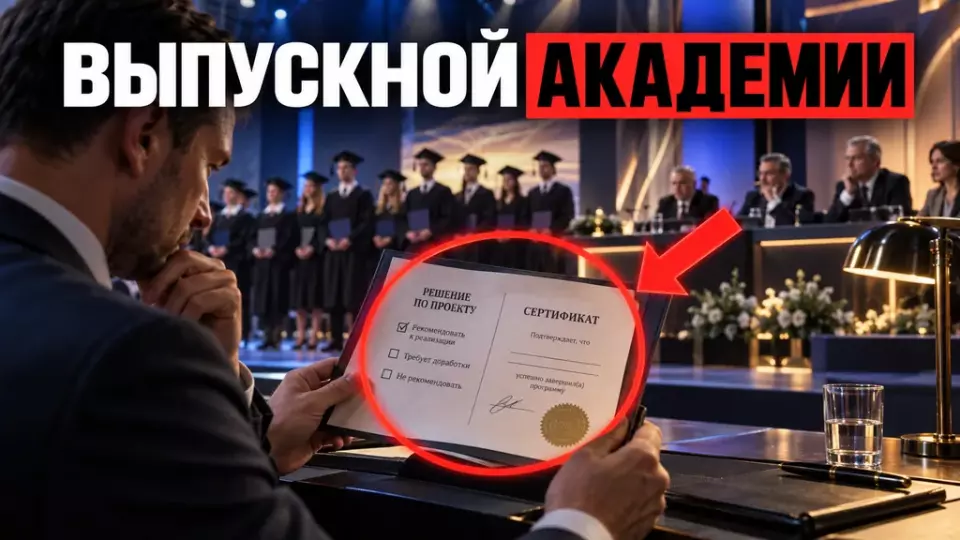
A practical plan for a corporate university graduation: the defence, three separate decisions, the ceremony, documents and post-event actions.
A corporate university graduation marks the completion of an educational track. A participant may meet the programme requirements while their project is sent back for revision. The company formalises the decision on the project and the career step separately.
At Aventura, we start such a project with graduation criteria, the procedure for reviewing projects and personnel decisions. We then translate these decisions into the programme, roles, script, documents and each participant's journey.
If the graduation date is already set, discuss the programme and get a quote. For the first conversation, it is enough to name the training format, the number of graduates, the panel composition, the city and whether broadcasting is needed.
What should a corporate university graduation confirm?
The purpose of the ceremony is to confirm that the program requirements have been met and to outline the next step for each participant in advance. Before they take the stage, the program owner completes the review of results, and the organizing team translates the approved outcome into a clear sequence of announcements, document presentations, and follow-up feedback.
A corporate university, academy, or leadership program may conclude with an exam, a project defense, an assessment of practical work, or a combination of these. The specific requirements are set by the program owner. The organizing team builds a clear procedure and reduces the risk of organizational failures. The decision on whether the material has been mastered is made by the program owner.
A graduation has its own dramaturgy:
the cohort's journey → confirmation of results → graduation decision → recognition of mentors → presentation of documents → next step
This is what distinguishes the format from related events. A corporate project demo day focuses on the fate of initiatives. A talent pool forum deals with people's readiness for roles and confidential HR feedback. An employee awards ceremony recognizes employee contributions. A learning completion confirms a decision based on the program's rules.
These elements can be combined into a single day if the grounds for decisions are not mixed up. Otherwise, applause is perceived as approval of a project, a certificate as a promise of appointment, and a special award as a substitute for the academic outcome.
Three outcomes that must not be mixed up
The decision to graduate, the fate of the project and the personnel decision have different owners, grounds and timelines. They are called by different names, recorded in separate documents and communicated through appropriate channels. This approach protects the participant from false expectations, and the company from promises that have not yet been confirmed.
The table summarises the key points of the section: Outcome, What question it answers, Who decides. Use it as a quick reference when preparing the event.
| Outcome | What question it answers | Who decides | What it is based on | How to communicate it |
|---|---|---|---|---|
| Decision to graduate | Has the participant met the programme requirements? | academic director, academic committee or programme owner | attendance, assignments, exam, defence and other approved criteria | committee decision, registry entry, certificate or diploma in the established format |
| Fate of the project | What does the company do with the proposal after the defence? | task owner, project committee or functional manager | value, data, risks, resources, feasibility and alignment with priorities | a separate status: hand over to the owner, review, revise, postpone or close |
| Personnel decision | Is the employee's role, area of responsibility or career path changing? | authorised manager and HR according to internal procedure | role requirements, work results, competency assessment, availability of a position and other corporate grounds | a one-to-one conversation and HR process, not a public announcement by default |
Such a set of outcomes is normal: the certificate confirms graduation, the project receives its status after additional review, and the personnel step requires a separate decision.
Before inviting guests, agree on the wording. For example: "graduation confirmed", "project handed over to the owner for separate review", "a one-to-one meeting has been scheduled for the participant's development". The formula "you successfully defended, so the project will be launched and you will be promoted" is acceptable only when all three decisions have been made and agreed.
The decision to graduate can be announced to the group. The project status is communicated with regard to access rules, while personnel feedback is usually given in person. We build these boundaries into the host's script, the committee's cards and the communication flow after the event.
Admission Criteria and a Unified Defense Framework
Admission requirements are announced before the ceremony and defense are prepared. Participants understand the rules in advance, mentors remain in the role of consultants, and the panel compares projects using the same logic. The document should separate mandatory assignments, project format, submission deadline, material access mode, and grounds for rescheduling the defense.
Taking the stage means the project has been admitted for review. The panel makes the decision on completion after evaluating compliance with the program requirements.
A unified framework is useful for every project:
- State the business challenge and the project boundaries.
- Show what the participant applied from the program.
- Separate verified facts from hypotheses.
- Explain the action, experiment, or solution developed.
- Show the result within the permitted scope.
- Name the limitations, risks, and what has not yet been verified.
- Formulate a request to the panel.
- Propose the next step and its possible owner.
A single form preserves the differences between projects and helps the panel see the logic of the work and the author's contribution. If a detailed project passport scheme, selection criteria, and demo zone are needed, it is better to take them from the guide on corporate demo day, while keeping the focus on completing the training in the graduation event.
The mentor helps clarify the task, check the reasoning, and prepare the participant for questions. At the defense, the author speaks and answers independently. The project customer confirms the relevance of the task. The panel evaluates the author's work according to the approved criteria.
Before the event, the HR or L&D team also determines the access mode for each project: open, internal, or available only to the panel. The panel reviews a closed project in a separate room. At the ceremony, the host announces only the permitted result.
How to assemble the panel and record the decision?
The panel must understand its role before the first defense. It is given the criteria, acceptable questions, decision options and a single recording form in advance. A chair, a secretary and an owner for each next step are appointed separately, so that a verbal discussion turns into a verifiable outcome for the participant and the program.
The composition depends on the program. It may include the learning owner, business representatives, project clients and subject-matter experts. The number of positions alone does not make an assessment high-quality. Every panel member must have a clear function.
The table summarizes the key points of the section: Role, What they do, What they do not do. Use it as a quick guide when preparing the event.
| Role | What they do | What they do not do |
|---|---|---|
| Chair or program owner | opens the panel's work, monitors the procedure, confirms the graduation outcome | does not announce a staffing decision without authority |
| Business client | checks the project's link to the task and determines the next step for the project | does not assess mastery of the entire program single-handedly |
| Subject-matter expert | asks questions about data, logic, risks and constraints | does not require disclosure of confidential information on the open stage |
| HR/L&D | checks compliance with the program rules and records the educational outcome | does not promise an appointment based solely on a strong defense |
| Panel secretary | records the decision, conditions and the owner of the next step | does not replace the agreed verdict with a brief retelling from memory |
Panel questions are best built around understanding and applicability: what has been verified, what remains a hypothesis, where the boundaries of the result are, what resource is needed, who should continue the work. The question "why haven't we rolled this out everywhere yet?" creates pressure but rarely helps assess the quality of learning.
A decision card may contain five fields: graduation, brief feedback, project status, owner of the next contact and the mode of disclosing materials. If a decision cannot be made immediately, that is also a status. Record who will continue the review and when, without promising an outcome from the stage.
In a complex program, it is better to separate the open defense from the panel's work. While guests move to a coffee break or view the project exhibition, the panel cross-checks the records. The host receives only the approved wording.
Ceremony programme: from defence to awarding
Each participant goes through three transitions: confirming the result, receiving the committee's decision and understanding the next step. That is why the programme separately includes the defence, time for finalising decisions and the ceremonial part. A real buffer is needed between them so that the host receives approved wording and the team prepares the awarding order.
The workflow looks like this:
- Open registration and the technical prologue. Graduates confirm their attendance, check their name in the documents and submit their final files. Remote participants connect in advance to test sound, image and subtitles.
- Explain the rules of the day. The host briefly outlines the stages, the Q&A rules, the material modes and the moment when decisions will be announced.
- Show the track's journey. The curator recalls the programme's goal, the main modules and the requirements, without unconfirmed claims about business impact.
- Hold the defences or an open showcase of projects. Projects that are clear to the general audience and ready for an open showcase are brought onto the main stage. The remaining projects can be placed in a poster or digital gallery.
- Give the committee time to decide. The programme needs a real buffer. It is filled with an exhibition, time with mentors or a break.
- Announce the educational outcome. A programme representative confirms graduation according to the approved list and separately explains how participants will receive personal feedback.
- Thank the mentors and clients. In the thank-you, name the specific contribution of the mentor or client.
- Hold the awarding. The host calls out a verified name, the participant walks along a clear route, receives the document and leaves the stage without a counter-flow.
- Explain what will happen to the projects next. Name only the agreed statuses and the people participants can turn to.
- Tell graduates what awaits them after the ceremony. Provide the alumni community rules, the communication channel, available materials and the date of the next activity, if all of this has been approved.
- Close the official part. After the closing words, guests move on to photos, the project exhibition or networking. Participation in filming and the publication mode are determined in advance.
This order can be shortened or split over two days. For example, closed defences take place separately, while the ceremony brings together only confirmed results. This reduces the risk of delays and allows sensitive discussions to be kept out of the hall.
The venue format depends on the programme. If a shared hall, parallel defences and a project exhibition are needed, we build the programme on the same logic as for organising conferences. If the task is broader and includes an evening programme, team recognition and guest services, the project can be put together as a turnkey corporate event with a separate educational track.
Roles of leaders, mentors and the event team
Each party is responsible for its own type of decision. Leaders set the strategic context, HR and the learning and development team confirm the program rules, and mentors prepare participants for the defense. The organizing team assembles the program and timing, prepares the stage and equipment, coordinates the services and keeps the event on the agreed schedule.
It is best to give a senior executive a substantive role. They can link the training to the company's objectives, ask a question about a project or acknowledge the cohort's contribution. An honorary presence without a clear function often leads to a long speech and a delay in the awarding.
A mentor helps the participant see weak points in advance and prepare constraints. After the defense, they review the feedback and help turn it into practice. During the presentation, the author is on their own.
At Aventura, we assemble the program and timing, plan the guest journey and the directorial script. We separately prepare the host, the venue, the equipment, the decor and the rehearsal. The client is responsible for the content of the work, the decision to graduate, the project verdict and personnel actions.
If you need to combine several cohorts, a commission, a stage and an awarding ceremony into one working script, submit a request to prepare a graduation. We will assemble the program and script, and will also flag in advance the issues that HR, the learning and development team or management need to resolve.
What to prepare for the stage and the award ceremony
For the stage you need a set of coordinated documents, not one general script. The programme explains the guest's route, the host's script sets the wording, the minute-by-minute plan distributes the team's actions, and the technical script controls files and equipment. A separate instruction describes the procedure for a delay, a communication failure or a change in the list.
Minimum set:
The table summarises the key points of this section: Document, What it contains, Who approves it. Use it as a quick reference when preparing the event.
| Document | What it contains | Who approves it |
|---|---|---|
| Guest programme | times, halls, open defences, breaks, award ceremony and access rules | HR, the learning and development team and the event manager |
| Minute-by-minute event plan | on-stage actions, transitions, duration, responsible persons and buffers | event director and producer |
| Host's script | names, job titles, announcements, Q&A rules and approved results | editor, HR/L&D and decision owners |
| Graduate register | name spelling, graduation status, document, order of appearance, special conditions | programme owner |
| Commission cards | criteria, questions, decision options and recording fields | commission chair and HR/L&D |
| Technical script | presentations, videos, microphones, lighting, captions, remote connections | technical lead |
| Contingency script | short texts for evacuation, a medical incident, a communication failure or a delay | venue, security and organiser |
The list of names is checked not only in the table. The host rehearses difficult surnames, captions are cross-checked against the documents, and the team lays out the certificates in the exact order of appearance. A typo can be corrected after the ceremony, but it spoils the meaning of the prepared ritual.
We walk the participant's route from the entrance to the stage and back. First we check the steps, the ramp or lift and the oncoming flow. Then we rehearse working with the microphone, handing over the document and the photo spot. A detailed run-through of the entrances, files and backups is described in the article about the technical rehearsal of the event.
Hybrid graduation for branch offices
Two equal participation tracks are prepared for the in-person and remote audiences. An employee from a branch office checks their connection in advance, defends their work, answers questions, hears the approved decision and takes full part in the shared finale. The online moderator manages the queue, the backup channel and direct communication with the panel.
For branch offices, the connection method, test time, format for uploading materials, backup display option and personal feedback channel are determined in advance. The online moderator represents remote graduates, monitors the question queue and confirms that the decision has been heard.
The awarding also needs to be designed. The document can be handed to a local coordinator in advance, sent after graduation is confirmed, or presented through a synchronized ritual at branch venues. The specific option depends on internal regulations and logistics.
For a program with a full remote audience, we assemble a hybrid event as two connected events. A detailed scheme for questions, recording and the work of branch locations is available in the material on the hybrid conference for branch offices.
Accessibility, personal data and recording
The conditions for accessible participation and the rules for handling data are determined before registration and rehearsal. The team checks the route to the stage, the format of materials, subtitles, the set of registration fields and access rights to recordings in advance. A late check leaves less time to replace the venue, correct presentations and approve publication.
The registration form asks only for information that changes participation: role, attendance format, access to closed sessions and any required special conditions. The full status route and backup entry are covered in the article on event participant registration.
For accessible participation, the following are checked:
- a barrier-free path from the entrance to the seat and the stage;
- the ability to receive the document without necessarily climbing steps;
- a microphone for questions from the audience;
- accessible slides with a clear structure and contrast;
- verbal explanation of important diagrams and visuals;
- subtitles or another agreed method for accessible perception of speech;
- sufficient time for a sign language interpreter, if required;
- accessible materials before or after the event in the approved mode.
W3C recommends identifying participants' needs in advance, preparing accessible materials and taking both in-person and remote formats into account. Section508.gov separately draws attention to an accessible platform, microphones, subtitles, description of visual information and early entry for technical checks.
Graduate lists, questionnaires, panel questions, defense recordings and photographs have different purposes and access levels. Each contractor receives only the part of the data they need. The venue may need an access list, the print shop may need the exact name for the document, and the technical team may need only the order of appearances and captions for titles.
For each data set, record the source, purpose and recipient. Separately specify the storage system, retention period and deletion procedure. Consents, legal grounds, cross-border services and image publication are reviewed by a lawyer or personal data specialist. This article provides the organizational framework; the legal wording is confirmed by a qualified specialist.
Publication of the recording is approved before the event. It is determined in advance which sessions can be published, who checks the facts, how screens and internal information are closed, where the source file is stored and who makes the final decision on releasing the material.
Materials and the next step after the ceremony
After graduation, a participant needs a documented educational outcome, accessible feedback and a clear contact for each follow-up. The package includes a document confirming completion of the programme, approved materials, the project status or response deadline, the alumni community rules and the name of the person responsible for the next conversation.
The graduate package may include:
- a document confirming completion of the programme in the approved format;
- brief personal feedback;
- approved materials from the cohort;
- the project status or a deadline for a separate response;
- the contact of the owner of the next step;
- the alumni community rules;
- information about further educational opportunities;
- an HR contact only when the company has provided for such a route.
The alumni community helps maintain contact after the awarding. On stage, it is enough to state the entry rules, the moderator, the channel and the nearest activity. There is no need to promise lifetime status, club access or a mentor role if the programme policy does not provide for this.
Harvard Business School Executive Education shows that alumni status is conferred according to individual programme rules. So first decide who receives such status and what rights it grants. Only after that should you announce it from the stage.
Post-event materials are planned in advance. For photographs, defence recordings, project cards and the final material, the audience and access level are defined. A reviewer and the publication owner are also appointed. The detailed approval process is described in the article about post-conference content. If interviews, a video and recordings of presentations are needed, we include photo and video production in the plan before the rehearsal.
Checklist for HR/L&D and event managers
A graduation event is ready when the venue, programme, decision owners, documents and participant routes are approved. The final check is carried out against a single list together with HR, the learning team and the organisers. Every item must have an owner, a deadline and a confirmed status, so that an open question does not surface during the defence or the award ceremony.
Before registration opens, check:
- Admission and graduation criteria are approved.
- The educational, project and HR tracks are separated.
- Owners are named for every decision.
- Open, internal and closed defences are defined.
- Participants have received a single working framework and question rules.
- The panel knows the criteria and possible wording options.
- The programme includes time for discussion and recording the decision.
- The register of names, documents and statuses has a single owner.
- A minute-by-minute event plan, host script and contingency instructions are prepared.
- Stage routes and accessibility conditions have been checked.
- A separate working route exists for branches.
- Rules for recording, publishing and storing data are in place.
- A follow-up response method is assigned for each project.
- Alumni community opportunities and HR opportunities are described without promises the company has not approved.
- The rehearsal includes the defence, questions, decision handover and award ceremony.
Go through this list together with the programme owner and the organising team. This will show which decisions have not yet been made and what can already be handed over to production. The earlier the gaps are closed, the more smoothly the panel, host and technical team can work.
Frequently asked questions
The purpose of the ceremony is to confirm that the programme requirements have been met and to set out the next step for each participant in advance. Before anyone takes the stage, the programme owner completes the review of results, and the organising team turns the approved outcome into a clear order of announcements, document handovers and follow-up feedback.
The graduation decision, the fate of the project and the staffing decision have different owners, grounds and timelines. They are referred to by different names, recorded in separate documents and communicated through appropriate channels. This approach protects the participant from false expectations and the company from promises that have not yet been confirmed.
Eligibility requirements are announced before the ceremony and the defence are prepared. Participants understand the rules in advance, mentors remain in the role of consultants, and the panel compares the projects using the same logic. The document should separate mandatory assignments, the project format, the submission deadline, the material handling rules and the grounds for rescheduling a defence.
The panel must understand its role before the first defence. It receives the criteria, acceptable questions, decision options and a single recording form in advance. A chairperson, a secretary and an owner for each next step are appointed separately, so that the verbal discussion turns into a verifiable outcome for the participant and the programme.
The participant goes through three transitions: confirming the result, receiving the panel's decision and understanding the next step. That is why the programme includes the defence, time to record decisions and the formal part as separate blocks. A real buffer is needed between them, so that the host receives the approved wording and the team prepares the order of the handover.
Each party is responsible for its own type of decision. Managers set the strategic context, HR and the learning and development team confirm the programme rules, and mentors prepare participants for the defence. The organising team puts together the programme and timing, prepares the stage and equipment, coordinates the services and keeps the event running as agreed.
The certificate confirms completion of the programme; the company formalises the project status and career trajectory separately. If you need to turn these decisions into a clear ceremony, request a quote and a preparation plan. We will prepare the programme, the script, the venue, the technical part and the rehearsal.
Sources
- Rosatom Corporate Academy: Rosatom Business Leaders programme
- Harvard Business School Executive Education: Alumni Network
- Harvard Business School: Degrees, Certifications and Alumni Status
- University of Iowa: order of events, minute-by-minute plan and script templates
- University of Bedfordshire: Order of Ceremony
- W3C WAI: Making Events Accessible
- Section508.gov: Accessible Meetings
- ICO: Privacy notice for events, seminars and workshops
- Ministry of Labour of Russia: Federal Law "On Personal Data"
- NIST Privacy Framework
Contents
Was this article helpful?