
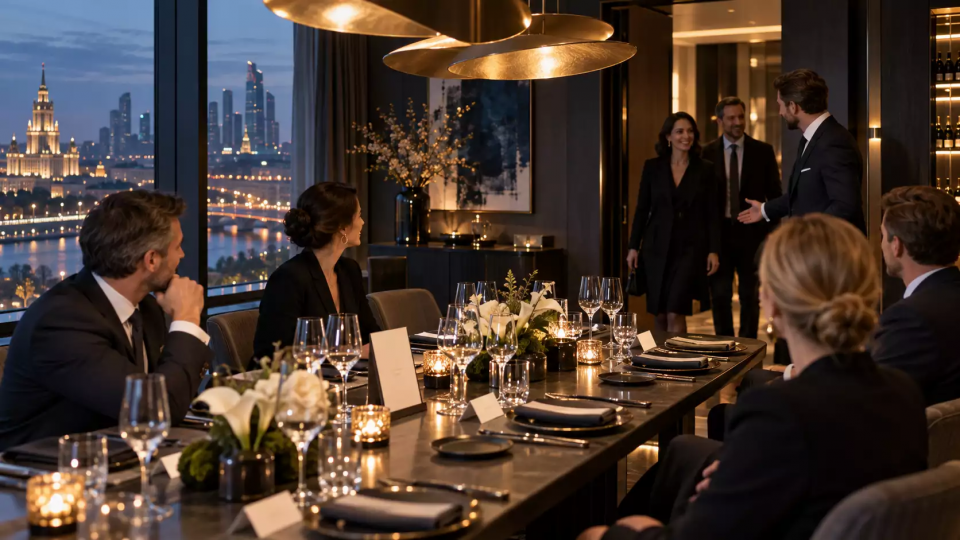
A business dinner for partners works best when it has a clear goal, a convenient guest journey, and follow-through on specific conversations after the meeting. We've put together a practical preparation framework without unnecessary formality.
Business dinner for partners rarely benefits from a long show program. Guests come for conversation, meeting people, and a clear next step. The organizer's job is to remove obstacles: inconvenient seating, noise, uncertain timing, and moments when no one knows who to talk to next.
Why does a business dinner need one specific goal?
In short: a business dinner for partners is easier to organize when the team chooses one main action after the meeting in advance. This could be an introduction to a new direction, a conversation with a key client, agreeing on the next meeting, or strengthening ties between several companies. The goal helps remove from the program everything that does not support the conversation.
The phrase 'chat with partners' is too broad for a brief. Break it down into actions: who needs to meet, what people should agree on, and who will take over communication after dinner. Then the invitation, venue, and seating all work toward one scenario.
For a broader client format, see the article about a B2B event for clients. A dinner is usually more intimate, so mistakes with the guest list and the rhythm of the evening are especially noticeable here.
Who to invite and how to build the guest list?
Practice: the guest list is built around future conversations, not formal status. Each invited guest should have a clear role: they make decisions, influence choices, represent a business line, provide expertise, or maintain relationships. Such a list helps plan seating and does not leave important contacts to chance.
First, create a working spreadsheet: name, company, role in the conversation, acquaintances at the table, and the desired next contact. There is no need to turn dinner into a meeting room with badges. This information is enough for the host of the meeting and the guest manager to understand the context.
The table collects the key points of the section: Guest role, What matters to them at the meeting, What the team prepares. Use it as a quick guide when preparing the event.
| Guest role | What matters to them at the meeting | What the team prepares |
|---|---|---|
| Company executive | Briefly understand the subject of discussion and the people at the table | A clear opening, a seat next to the right interlocutors |
| Project partner | Discuss a specific next step | Time for a substantive conversation without a loud program |
| Company expert | Answer questions and get to know colleagues | A brief briefing, materials at hand, clear timing |
| New contact | Understand who is who and why they were invited | A personal greeting at the entrance and a careful introduction |
Do not seat people at the same table based only on job titles. It is more useful to check whether each pair has a reason to start talking. If the group is large, divide guests into several conversation groups and prepare table hosts.
How to choose a venue without unnecessary formality?
Answer: a venue for a business dinner is chosen by the quality of conversation, not just the interior. You need a convenient entrance, a calm noise level, a separate area or room, clear logistics for guests, and the ability to check seating in advance. A beautiful place does not compensate for a cramped table and poor audibility.
Before confirming the booking, visit for a viewing at the same time of day as the meeting. Check the route from the entrance to the hall, the cloakroom, parking or drop-off point, lighting, connectivity and staff performance. For a partner dinner, it is also useful to find out in advance the menu terms, serving times and possible venue restrictions.
Choosing a location is part of overall event preparation. In the article how to choose a venue for an event there are basic questions that help compare options before signing a contract.
If you need to combine the purpose of the meeting, venue search, menu, guest service and team work into one plan, Aventura will prepare an estimate and scenario for your task.
If you are organizing a client or partner meeting, subscribe to Aventura's Telegram channel: there we discuss working formats and details of event preparation.
What kind of seating helps conversation?
Principle: the seating should give partners the opportunity to hear each other and get acquainted naturally. A long table is suitable for a general conversation, while several small tables are for parallel topics and freer communication. The choice depends on the composition of the guests, not on the restaurant's usual format.
Don't seat all the key people next to each other. That way they often talk within their own group, and the others remain spectators. Mix representatives of companies, but keep people who have something to discuss next to each other.
Before dinner, make a simple table plan and go through it with the host of the meeting. The plan is needed not for strict control over the guests, but so that the team can quickly help a person find their seat and start a conversation without an awkward pause.
How to structure the evening's program?
The essence: the program of a business dinner should leave the main place for communication. A short greeting, a clear reason for the meeting, a few precise introductions, and smooth transitions between courses are enough. The more mandatory speeches there are, the less time remains for useful conversations.
A working framework can be put together like this:
- Meeting the guests and a personal greeting from the host.
- A short opening: why we have gathered and what conversation is important today.
- The main part of the dinner with unobtrusive introductions of the people at the table.
- One substantive highlight: a demonstration, company news, or a conversation with an expert.
- Free time for communication and farewell with an agreement on the next contact.
Music, a host, or an interactive element are appropriate if they help people get acquainted. If an element requires the attention of the whole room for more than a few minutes, check whether it takes time away from the main reason for the meeting.
What roles does the on-site team need?
Important: a business dinner has fewer visible technical tasks, but more subtle guest moments. The team needs people who greet guests, stay in touch with the venue, know the seating plan and help the host of the meeting. Responsibilities are best assigned before the first guest arrives.
The minimum set of roles depends on the scale, but usually includes the host of the meeting, a guest manager, a venue coordinator and someone who records agreements. One employee can combine two roles if this does not make them disappear at a key moment.
Check in advance: who greets latecomers, who makes the decision when the seating changes, who talks to the restaurant about service and who passes on important agreements after the event. This kind of brief is useful for any business program, including a dealer conference.
What should be locked down before the first guest?
Before the start: a few hours before dinner, the team confirms not only the menu and the number of place settings. You need an up-to-date guest list, venue contacts, a seating plan, a timing plan, greeting details and a fallback option in case of a late arrival or a change in attendance. This reduces the number of decisions that will have to be made in the presence of partners.
Put together one short sheet for the team. It should include the time of access to the hall, those responsible, staff contact phone numbers, the sequence of the evening and a list of topics that must not be discussed in front of guests. The document does not replace live coordination, but it helps everyone act consistently.
Separately check that details are agreed with the venue: serving times, availability of a separate room, branding rules and contractor access. It is better to confirm the terms in writing so you do not have to search for them in messages on the day of the meeting.
How do you continue the conversation after dinner?
In short: the value of a business dinner lasts when the follow-up to every important conversation is scheduled before the guests leave. The team records the topic, the promised material, the person responsible, and the deadline for the next contact. One general thank-you can complement the process, but it does not replace a personal follow-up.
On the next business day, review your notes and separate general impressions from specific commitments. Do not send everyone the same email with a presentation. It is better to remind the person where you spoke, name the subject of the discussion, and keep the promise that was made at the table.
If your task goes beyond a single dinner, it is useful to define the metrics in advance: how many target meetings took place, which questions came up repeatedly, and which actions were agreed. For how to connect the event format with measuring results, read the article about corporate event KPIs.
Frequently asked questions
The phrase “to network with partners” is too broad for a brief. Break it down into actions: who needs to meet, what people need to agree on, and who will take over communication after the dinner. Then the invitation, the venue, and the seating all work toward a single scenario.
First, put together a working spreadsheet: name, company, role in the conversation, people they know at the table, and the desired next contact. There is no need to turn the dinner into a meeting room with name badges. This information is enough for the host and the guest manager to understand the context.
Before confirming the booking, visit for a viewing at the same time of day when the meeting will take place. Check the route from the entrance to the hall, the cloakroom, parking or the drop-off point, lighting, connectivity, and how the staff work. For a partner dinner, it is also useful to find out in advance the terms for the menu, serving times, and any possible venue restrictions.
Do not seat all the key people next to each other. That way they often talk within their own group, while the others remain spectators. Mix representatives from different companies, but keep people who have something to discuss next to each other.
A working framework can be put together like this:
The minimum set of roles depends on the scale, but usually includes a host, a guest manager, a venue coordinator, and a person who records the agreements. One employee can combine two roles if it does not force them to disappear at a key moment.
A business dinner can be put together calmly and without excessive ceremony. It is important to agree in advance on which meetings should happen, who is responsible for them, and how the team will continue the conversation after the venue. If you need a single plan covering the venue, guests, the program, and coordination, request a quote from Aventura.
Sources
Contents
Was this article helpful?


