
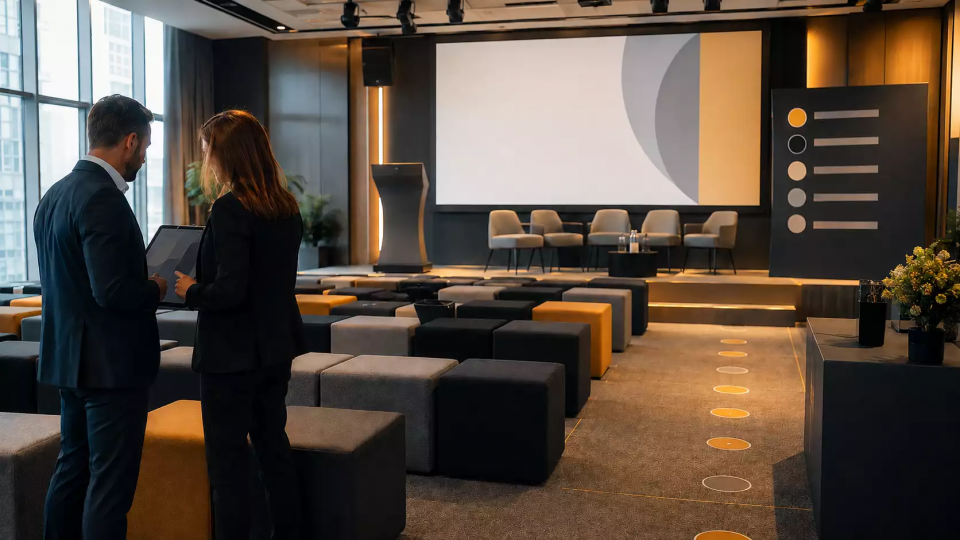
A B2B client event works when the program helps guests take the next business step. We've put together a practical preparation framework: from the brief to the conversation after the event.
A B2B client event should be built around one business action: introduce participants to a solution, collect meeting requests, strengthen relationships with partners, or open a conversation about the next project. Then the invitation, stage, guest journey, and team work come together into a single system rather than a set of separate activities.
On its Telegram channel, the Aventura team shares news and ideas for events.
Leave a request — we'll discuss your task
We'll clarify the event format and suggest the next step.
Why does a B2B client event need one measurable objective?
In short: a B2B client event is easier to plan when it has one main business outcome and several observable indicators. The wording “show the company” is too broad: it can’t be used to check the program, the guest list or how managers perform after the meeting. The team needs the goal as a filter: it’s used to evaluate every part of the program and every interaction with a guest.
Start with the phrase: “After the event, the participant should...” For example, agree to a one-on-one meeting, meet the implementation team, see a new process in action, or submit a request for a quote. This answer doesn’t promise sales, but it sets the direction for preparation.
The goal should have three parts: the audience, the action and the point of measurement. Instead of “strengthen relationships with clients,” it’s better to write: “give existing clients a reason to schedule a conversation with their account manager within a week after the forum.” This leaves room for live communication at the event, while giving the team a clear framework.
Whom to invite and how to build a useful guest list?
In short: the guest list for a B2B meeting is built around roles in future decisions. A small group with different perspectives on the task is more useful than random registrations just to fill the room. This principle helps prepare personalized context and gives managers time for a substantive conversation.
Divide the invitees into three groups: existing clients, prospective companies and partners who help launch projects. For each group, define in advance the reason to attend and the conversation that will continue after the event. An invitation to a procurement director and a project manager may be the same in tone, but their useful context is different.
The list should be reviewed together with the sales team. They see the contact history, know the communication restrictions and can advise who the meeting is truly timely for. It’s better to agree on the rules for handling participant data before sending the registration form. NIST treats privacy risk management as part of organizational management; a link to the material is provided in the sources.
The table summarizes the key points of the section: Whom we invite, Why the person should attend, What we prepare before the event. Use it as a quick reference when preparing the event.
| Whom we invite | Why the person should attend | What we prepare before the event |
|---|---|---|
| Existing client | Align plans and see how the solution is evolving | Personalized context and a meeting with the right expert |
| Prospective client | Understand the approach without pressure | A short demo and a clear next step |
| Partner | Agree on the role in the shared task | A working conversation and a list of topics for follow-up |
How to choose a format: forum, closed breakfast, or demo?
In short: the format is chosen based on the depth of conversation and the number of contacts you need. A forum is suitable for a general agenda, a closed breakfast for a confidential discussion, and a demo when it's important to show a solution in action. The format should give guests enough time to ask questions and the team enough time to secure the next step.
Check the format against three questions: how much time does a person need to understand the subject; are one-on-one conversations needed; will the team be able to continue communication after the event. If the answer involves several experts and a demonstration of the process, it's better to add demo stations and short slots for questions. If the goal is to gather the opinions of a limited group, an unnecessary stage and a long program will only get in the way.
For opening and strategic meetings, the experience of preparing a strategic session for a company will be useful: first, the decision for which the participants are gathering is fixed, and then the rhythm of the day is built. In a client-facing format, this principle helps avoid turning the program into a sequence of presentations.
How to build a program so the conversation doesn't end on stage?
In short: a good program alternates general context, a concrete example, and time for personal conversation. Each block answers the guest's question: "What does this change in my work task?". Then the stage provides the overall framework, while breaks and demos turn interest into a substantive conversation.
Open the meeting with a brief explanation of the agenda and navigation rules. Then give one substantive block with an example, followed by time for questions or a demo. It's better to end sessions with a concrete transition: who to approach, where to see the continuation of the topic, how to leave a request. Eventbrite's recommendations on event promotion suggest first defining what success looks like, and then linking the communications plan to it; the link is provided in the sources.
- Prepare one guest question and one expert answer for each block.
- Assign an owner for the transition between the stage, the demo, and personal conversations.
- Leave pauses between the main blocks: that's where introductions happen.
- Collect the questions that weren't discussed into a single list for further communication.
Example of the day's logic:
- Registration and a brief introduction to the team.
- Welcome from the manager and an explanation of why the company has gathered guests.
- Demonstration of the product or production process.
- Q&A with an expert and small meetings by interest.
- An informal part where the conversation can continue without a stage.
- Recording agreements and the method of contact after the event.
In the Ekoniva company's client day project, the business part was combined with an informal continuation - this is one option when the audience needs both content and time for networking.
After two or three substantive blocks, it's useful to give participants a simple way to discuss a future meeting. The Aventura team organizes client and business events: from concept and script to on-site coordination. Request a quote.
What to Show Guests at a Demonstration?
In short: At a demonstration, it is important to show how the product solves the client's problem. So choose two or three scenarios in advance that can be covered within the limited time available.
At a production site, guests can be shown the product journey and quality control. An IT team can walk through the workflow together with the solution's user. An equipment supplier can run a test launch and discuss implementation terms with an engineer.
Ask experts to speak the language of real work: what changes in the process, where constraints arise, what data is needed for calculation. If an answer requires confidential information, prepare an anonymized example. Do not promise what cannot be confirmed after the event.
How to Design the Guest Journey and Venue Accessibility?
In short: the guest journey begins with the invitation and continues until the next business conversation after the event. A person should know in advance where to arrive, how long the program will take, how to get help, and where to continue the conversation they need. The team makes this path clear in advance for different arrival and participation scenarios.
Map out the guest journey minute by minute: invitation, registration, cloakroom, first navigation point, hall, break, personal meeting, exit. Assign a person responsible and a backup option for each section. This helps the team notice queues, unclear signs, and places where visitors have to look for help more quickly.
Before the start, create a contact map: guest, company representative, interest, assigned area, and expected next step. Such a table helps the team prepare, but it should not turn communication into a survey. A manager does not read a script from a sheet - they use it as a support.
It is better to divide zones by noise level and communication format. Demonstrations require space and visibility, short consultations need a clear meeting point, and executives need the opportunity to talk calmly.
Accessibility should be considered in the same plan, not added at the last moment. W3C notes that accessible design improves the experience of people with different abilities and helps avoid creating barriers. For a live venue, this means clear navigation, the ability to communicate a need in advance, aisles without unnecessary obstacles, and a team ready to help. A link to W3C's introductory material is in the sources.
It is useful to review the venue plan with the technical director in advance. For a complex format, habits from preparing a corporate sports day help: every route has a person responsible, and a backup scenario is provided for critical points.
What roles does the team need on the day of the event?
In brief: every touchpoint must have an owner who makes decisions on the spot. Roles are described by outcome: who greets the guest, who keeps the timing, who connects the client with an expert. Such a list removes uncertainty at the moment when the program requires a quick change.
The minimum working team includes a project lead, a venue coordinator, a host or moderator, a technical lead, and an owner of the guest journey. The commercial team is involved as well: it needs a single procedure for notes and request handoff, not just a list of attendees after the event ends.
The table brings together the key points of the section: Event touchpoint, Owner, What they check. Use it as a quick reference when preparing the event.
| Event touchpoint | Owner | What they check |
|---|---|---|
| Registration | Guest coordinator | List, badges, special requests, and flow of people |
| Stage | Program producer | Timing, speaker readiness, and transition to the next block |
| Demonstration | Subject-matter expert | A clear example and recording of the guest's questions |
| One-on-one conversation | Manager or partner | Agreement on the next contact |
Physical safety and procedures at the venue are also discussed before setup. CISA describes an approach to protective measures for venues and public gatherings as a joint effort by organizers, facility owners, and responsible specialists. Specific measures depend on the venue and format, so the plan is agreed with its rules and relevant services. A link to the CISA material is provided in the sources.
How to prepare a Plan B without unnecessary anxiety?
In brief: a Plan B is needed for several likely disruptions that can derail a guest's route: delays, changes to the program, communication issues or access restrictions. It works when the team knows the trigger, the decision owner and how to inform participants. The document stays short, so it can be used during the event, not only at the preparatory meeting.
Create a short card for the team. Three lines per scenario are enough: what happened, who makes the decision, how the program changes. There is no need to model everything. It is better to choose the real vulnerabilities of the venue and decide which actions can be taken without a long approval chain.
For events with a production or demonstration part, the approach from the article about a professional skills competition is especially useful: the route, equipment and safety are checked as a single process. The guest should not learn about the backup plan - they should simply receive a clear next action.
What to measure after a B2B meeting?
In brief: the outcome of a B2B client event is the signs of business follow-up: conversations that took place, scheduled meetings, questions about the solution and feedback on the value of the program. This data is collected in a single format so that managers can continue the conversation without losing important context.
Before the event, agree on what exactly the team will count after it. These could be confirmed personal conversations, requests for a demo, scheduled meetings or topics that required a separate response. Do not mix them with sales into a single metric: a deal has its own cycle, and an event has its own role in the relationship.
Record several metrics:
- how many invitees came and who exactly;
- how many meetings took place according to pre-selected priorities;
- which questions were repeated among different guests;
- how many agreements turned into scheduled meetings or estimates;
- what topics should be covered in the next contact.
On the next business day, hold a short team meeting. Compare notes, assign responses and set deadlines. It is better to write to a participant about a specific conversation than to send everyone the same email. If the program helped open a substantive dialogue, the event has fulfilled its purpose.
What to send guests after the event?
Briefly: After a client day, the team should have more than just photos. Within a few business days, review the notes and sort contacts by next action: send materials, schedule a meeting, prepare a quote, refer the question to an expert, or return to the conversation later.
You can send a guest a short thank-you email with materials on their question and an agreed follow-up. You don’t need to forward the entire presentation without explanation. It’s better to remind them what you discussed with that specific person.
Separately, check that the contact and the content of the conversation can be stored and used according to company rules. If the registration form collects a name, phone number, or work email, determine the purpose of data processing and the consent text in advance. General personal data requirements are published on the Roskomnadzor website.
What to check a week before a client event?
Briefly: A week before the event, it’s useful to do a joint walkthrough of the scenario, venue, and guest list. The goal of the check is to see the handoffs between the team’s work, not to rewrite the concept at the last moment. During the walkthrough, assign an owner for each edit, a deadline, and a way to communicate the change to the rest of the team in advance.
Look at the invitation and route through the eyes of someone who knows nothing about the program. Then go through registration, entry into the hall, demonstrations, and the final conversation. Separately confirm the venue’s contacts, setup timing, access procedure, and how to notify guests of changes.
The client day is one of the formats we run as turnkey business events: program, venue, equipment, and coordination on the day of the event in one pair of hands.
Aventura’s portfolio helps you see how different events come together into a cohesive experience. If you need to discuss a client format for your audience and objective, request a quote - the team will suggest the next step without a template program.
Frequently asked questions
Start with the phrase: 'After the event, the participant should...'. For example, agree to a one-on-one meeting, meet the implementation team, see a new process in action, or submit a request for a quote. Such an answer does not promise sales, but it sets the direction for preparation.
Divide invitees into three groups: existing clients, prospective companies, and partners who help launch projects. For each group, define in advance the reason to attend and the conversation that will continue after the event. An invitation to a procurement director and to a project manager may be similar in tone, but the useful context differs for each.
Test the format against three questions: how much time does a person need to understand the subject; are one-on-one conversations needed; can the team continue communication after the event. If the answer involves several experts and a demonstration of the process, it is better to add demo stations and short slots for questions. If the goal is to gather the opinion of a limited group, an unnecessary stage and a long program will only get in the way.
Open the meeting with a brief explanation of the agenda and navigation rules. Then give one substantive block with an example, followed by time for questions or a demonstration. Sessions are best ended with a concrete transition: whom to approach, where to see the continuation of the topic, how to leave a request. Eventbrite's recommendations on event promotion suggest first defining what success looks like, and then linking the communication plan to it; the link is provided in the sources.
Map the guest journey minute by minute: invitation, registration, cloakroom, first navigation point, hall, break, personal meeting, exit. For each section, assign a person responsible and a fallback option. This way the team notices queues, unclear signs, and places where a visitor has to look for help more quickly.
The minimum working team includes a project manager, venue coordinator, host or moderator, technical manager, and guest journey owner. The sales team also takes part: it needs a unified procedure for notes and passing on requests, not just a list of attendees after the event.
A client day is needed when a company wants to move from emails and presentations to a substantive conversation. In one venue, you can show a solution, give the floor to a technical specialist, collect client questions, and understand which contact requires follow-up.
A working program relies on alternating three types of activity: a general introduction, a substantive demonstration, and personal conversations. They do not need to be repeated in a loop — it is enough to give each block its own objective.
On the day of the event, you need someone who sees the big picture. They keep an eye on timing, direct guests to the right experts, and notice if an important conversation was left without follow-up.
Sources
- W3C WAI – Introduction to accessibility
- NIST Privacy Framework
- CISA – Physical security of venues
- Eventbrite – Event promotion strategies
- Federal Law “On Personal Data” – ConsultantPlus
Contents
Was this article helpful?


