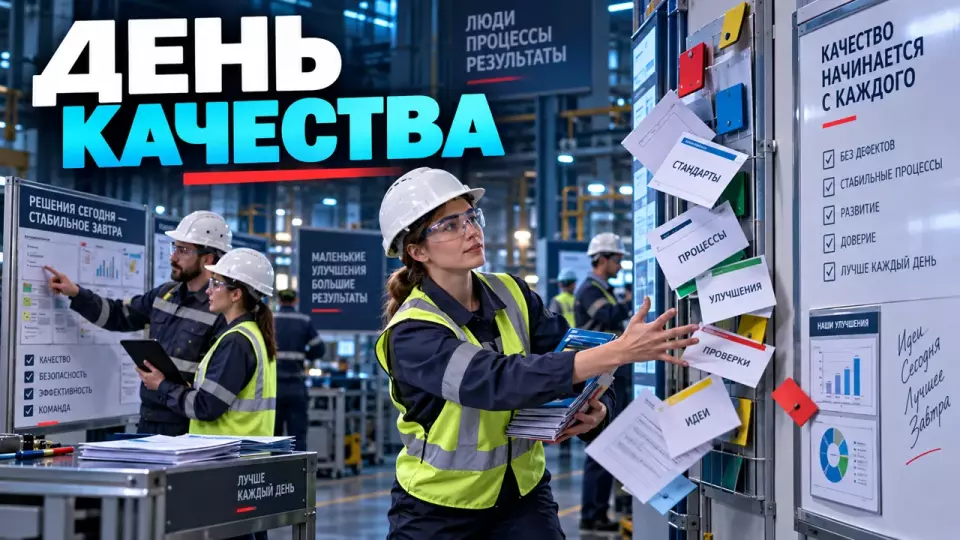
A practical plan for a company Quality Day: goal, program, stations, shift rotation, safety, and a working decision register.
A Quality Day at a company can easily turn into a series of presentations and posters, after which employees do not understand what will change in their work. To prevent this, set one result for the day in advance, build the program around real processes, and assign owners for next steps.
What should a Quality Day deliver?
In short: A Quality Day at a company should end with clear decisions: which problem we are analyzing, who tests the hypothesis, when the team will see the answer. The stage, stations, and awards help engage people in conversation, but their value is verified by the working action register after the event. The participant needs a clear next step, and the manager needs a way to bring the team the result of the verification.
First, formulate one result for the day. For example, collect recurring causes of nonconformities, show employees the customer's journey, or select ideas for process improvement. The phrase "raise the quality culture" is too broad for a program and budget.
We start with a short brief from the quality service, production, and internal communications. Each side answers one question: what should the participant understand or do differently on the next shift? The answers turn into a scenario, and conflicting expectations become visible before ordering the stage and decorations.
A Quality Day can have three layers:
- a general talk by the manager about priorities;
- work in small groups with real processes;
- recording decisions and returning answers to employees.
These layers connect the event with daily work. Entertainment can be kept if it supports the meaning and does not eat up discussion time.
Format boundary: event, meeting, and training
Quality Day combines the working content and event presentation of an enterprise. At a work meeting, process owners make a decision on a specific problem. Training develops a skill, a competition compares task performance. Quality Day involves several functions and shifts in analyzing their own processes and customer results.
The boundary is needed by the organizing team so as not to combine three programs at once. If management needs to decide what to do with a specific nonconformity, hold a work meeting. If people lack a skill, add training. Quality Day is needed when the enterprise wants to make the topic common, give employees a safe way to suggest improvements, and show the connection between functions.
The table summarizes the key points of the section: Format, Main task, Who participates. Use it as a quick reference when preparing the event.
| Format | Main task | Who participates | What remains after |
|---|---|---|---|
| Work meeting | make a decision on a specific problem | process owners and experts | minutes and actions |
| Training | master a skill or rule | target group | check of knowledge or practice |
| Quality Day | connect people, processes, and customer results | several functions and shifts | ideas, decisions, owners, feedback |
| Professional skills competition | compare the performance of a professional task | participants and jury | scores and review of criteria |
If a separate competitive track is needed, use the approach from the article on corporate professional skills competition. In the Quality Day program, a competition can occupy one independent block.
Who is on the organizing team?
In short: The core organizing team consists of the goal owner, quality department, production, and event producer. Occupational safety and internal communications are involved in routing and communications. If necessary, invite IT, logistics, or customer service specialists. Assign a single responsible person for each decision so that approvals don't drag on until setup.
Appoint a result owner on behalf of the enterprise. This person approves the goal, the list of participants, and the topics that can be discussed publicly within the company. The quality service is responsible for the factual accuracy of examples. Production checks whether people can be brought in shifts and the selected areas can be opened.
Occupational safety approves the route and demonstration rules. Internal communications prepare the invitation, question collection, and post-event materials. At Aventura, we compile these constraints into a single scenario, venue plan, and technical specification for contractors.
Distribute the work before developing the program:
- The goal owner approves the outcome and boundaries of the conversation.
- The quality service selects processes, examples, and experts.
- Production provides shift participation windows and venue limitations.
- Occupational safety checks the route, capacity, and protective equipment.
- Internal communications handle the invitation and feedback.
- The producer brings together the program, flows, equipment, and timing.
This order helps reduce the number of late changes. For dependent decisions, a event approval calendar is useful.
We also discuss new programs for production events in our Telegram channel.
Quality Day Program at the Enterprise
The Quality Day program at the enterprise is built around a common start, rotation through stations, discussion of ideas, and a short closing with decision owners. The duration depends on shifts and venue. A compact module can be repeated for several streams. This way, employees participate in the work rather than spending the entire day in a common hall.
Below is a framework that the organizing team adapts to the task. The table shows the order of blocks. The organizing team separately calculates the duration based on the number of streams, distances between zones, and the ability to release people from their workplaces.
The table summarizes key points of the section: Block, Content, Result. Use it as a quick reference when preparing the event.
| Block | Content | Result |
|---|---|---|
| Entry and navigation | registration, route, protective equipment, group assignment | participant knows their stream and rules |
| Common start | goal of the day, customer context, boundaries of open conversation | a unified framework without a lengthy report |
| Stations | process, defect, customer feedback, improvement, demonstration | observations and questions from groups |
| Working with ideas | problem cards, clarifying causes, initial selection | a list of proposals without promising to implement everything |
| Discussion | experts answer recurring questions | clear solutions and topics for verification |
| Recognition | gratitude to authors of implemented improvements | connection of recognition to real work |
| Final | owners, deadlines for the next response, feedback channel | participant understands what happens next |
Keep the common start short. The manager states the goal, one observable example, and the rules of conversation. Detailed reports are better moved to stations or to an internal knowledge base.
Build stations around participant actions. For example, a group compares two process options and notes where deviations appear. The customer journey and a proposal for change can be put into separate modules. Each demonstration should have a host, a working question, and a way to record the result; a presentation screen without action does not become a station.
To collect initiatives, you can take the mechanics from Company Innovation Day, but the criteria here are different. The process owner evaluates the idea's impact on quality, feasibility of verification, and availability of a responsible person. The effectiveness of the presentation is not included in this assessment.
How to organize stations without looking for someone to blame?
In short: The station examines the process, the signal, and the next step. Names and personal assessments stay outside it. The facilitator separates fact from a possible cause in advance, asks the group to propose a verification method, and records the owner of that verification. This language helps discuss complex issues without public confrontation and does not replace the company's official procedure.
Take one process per station. Show the input, the expected result, and the point where the deviation occurs. If the data is sensitive, anonymize the product, order, and participant. Agree on the material with the quality department before the rehearsal.
The facilitator guides the conversation with four questions:
- What do we observe and what confirms it?
- At which process step does the deviation occur?
- What cause does the team propose to verify?
- Who will provide the verification result and by what date?
Do not ask the group to name the guilty party. A public promise to 'fix everything' also does harm: some ideas will require data, testing, or approval. It is better to name the response date and the channel where employees will see the status.
Important: Quality Day does not replace an investigation, audit, mandatory briefing, or the nonconformity handling procedure. The event helps engage people and make decisions understandable, while formal processes continue to operate according to the company's rules.
Participant route and shift rotation
Calculate the route based on each shift's time window, the capacity of the narrowest zone, and the transition time between stations. We consolidate this data into a flow diagram: groups are assigned a color, number, or letter and move in one direction. A separate coordinator monitors transitions, so the station host can focus on content.
Start with a venue map. Mark the entrance, cloakroom, PPE distribution point, sanitary zones, stations, waiting area, and exit. Then plot the paths of employees and equipment. If flows intersect with production logistics, relocate the station or change the group's direction.
Organize the rotation in this order:
- Get participation windows from shift supervisors.
- Determine each station's capacity based on safe area.
- Set equal module durations.
- Add time for transitions and possible delays.
- Assign a coordinator to each junction.
- Test the route without participants and then with a test group.
If different shifts cannot meet, repeat the general start in a concise recorded or live broadcast. Collect questions in a single register so that the evening shift gets the same access to answers as the daytime shift.
What materials to prepare?
In short: the organizing team needs three key documents: a passport for each station, a flow diagram, and a decision register. The host's script and a unified glossary of terms are part of the team's working package. Participants only need a short route map and a clear way to submit questions. Other materials work behind the scenes and do not overload the program.
The station passport fits on one page. It includes the goal, host, equipment, initial data, question for the group, recording method, and action in case of failure. This document helps replace the host and conduct a repeat flow consistently.
Prepare a package:
- a general start script with verified wording;
- station passports and host cards;
- a venue plan with movement directions;
- a list of equipment and backups;
- a table of groups and shift windows;
- a form for questions or ideas;
- a decision register with statuses;
- a post-event message template.
During the technical rehearsal of the event, the team checks transitions, microphones, screens, and signals to hosts. For Quality Day, add testing of handout materials, reading group markings, and transferring cards to the unified register.
Safety and accessibility at the venue
Plan safety together with the program. The route, access, and site rules affect the number of stations and group sizes. A safety specialist checks the movement and evacuation diagram. The organizing team walks the participant journey from registration to exit, assesses accessibility, and only then approves the final plan.
If the event takes place at an active production site, separate the guest and work zones. Check where photos and videos are allowed, who accompanies the group, and how the team responds to an alarm. Demonstration equipment is operated only by a designated specialist.
Use the Safety Day plan as an adjacent checklist for flows and stations. In this program, occupational safety sets the safety framework. The content of Quality Day remains product quality and process sustainability.
Accessibility covers more than building entry. Check navigation readability, seating during long blocks, presenter audibility, material contrast, instruction clarity, and an alternative route. It is better to collect participant requests at registration to prepare solutions before the event day.
How to record decisions after the event?
In short: Each idea gets a clear status and a brief explanation. Facilitators enter accepted and verifiable items into a shared register, and the goal owner assigns a responsible person and the date of the next response. Participants see the status of each idea. This format is clearer than internal correspondence and maintains the link between question and decision.
Create the register before the event. Then station facilitators use the same fields, and the organizing team does not collect notes from flipchart photos. Minimum set: problem, signal source, proposed verification, owner, response deadline, and status.
At the end of the day, do not declare ideas that no one has evaluated as winners. You can acknowledge the authors of already implemented improvements or clarity in problem definition. The decision to launch a new idea is made by the process owner after data verification.
After the event, the team goes through four steps:
- Merge duplicates and clarify wording.
- Pass items to process owners.
- Publish the first status by the promised deadline.
- Follow up with employees after verification or implementation.
This way the event has continuity. Employees see the link between question and answer, and the quality department gets a unified list instead of scattered suggestions.
Budget: what determines the cost
Briefly: The cost is affected by the program, venue, technical production, and logistics. Within these groups, flows, stations, presenters, materials, filming, and the duration of the team's work are taken into account. Budgets can be compared after you have fixed the goal, shift schedule, and site restrictions. Otherwise, contractor proposals will describe different events.
First, define the mandatory core of the program. Then divide the budget into content, venue, equipment, decoration, personnel, logistics, and reserve. This breakdown shows what task each line solves and where a change will affect the participant.
The number of participants alone does not explain the cost. Two programs for the same audience may differ due to the number of repetitions for shifts, distance between zones, access to the site, complex demonstrations, or overnight installation. That is why we ask the client to provide a site plan and working windows before the final calculation.
If the task includes a production route, add the inputs from the material on the press tour to production: access control, filming zones, transport, and group leaders. The internal audience changes the content, but the physical restrictions of the site remain.
Frequently asked questions
First, formulate one result of the day. For example, to collect recurring reasons for non-conformities, to show employees the customer's journey, or to select ideas for process improvement. The wording "improve quality culture" is too broad for a program and budget.
Quality Day combines the working content and event presentation of the enterprise. At a working meeting, process owners make decisions on a specific problem. Training develops a skill, and a competition compares performance. Quality Day involves several functions and shifts in analyzing their own processes and customer outcomes.
Appoint an owner of the result from the enterprise. This person approves the goal, participant list, and the list of topics that can be discussed publicly within the company. The quality service is responsible for the factual accuracy of examples. Production checks whether it is possible to bring out people by shifts and open the selected zones.
The Quality Day program at the enterprise is built around a common start, rotation through stations, discussion of ideas, and a short final with decision owners. The duration depends on shifts and the venue. A compact module can be repeated for several flows. In this way, employees participate in the work rather than spend the whole day in a common hall.
Take one process per station. Show the input, expected result, and the place where a deviation occurs. If data is sensitive, anonymize the product, order, and participant. Agree on the material with the quality service before the rehearsal.
Calculate the route according to the window of each shift, the capacity of the narrowest zone, and the time for moving between stations. We compile these data into a flow diagram: groups receive a color, number, or letter and move in one direction. A separate coordinator monitors transitions, so the station presenter focuses on content.
Sources
- NIST Baldrige: employee engagement and improvement environment
- ILO: worker participation in discussing work-related decisions
- AHRQ PSNet: psychological safety for open discussion of issues
- AFNOR: quality culture barometer in organizations
- HSE: how organizations turn lessons into process changes
- StankoMashStroy: first Quality Day in 2026
- TMK and Roskachestvo: engaging employees in quality management
Contents
Was this article helpful?