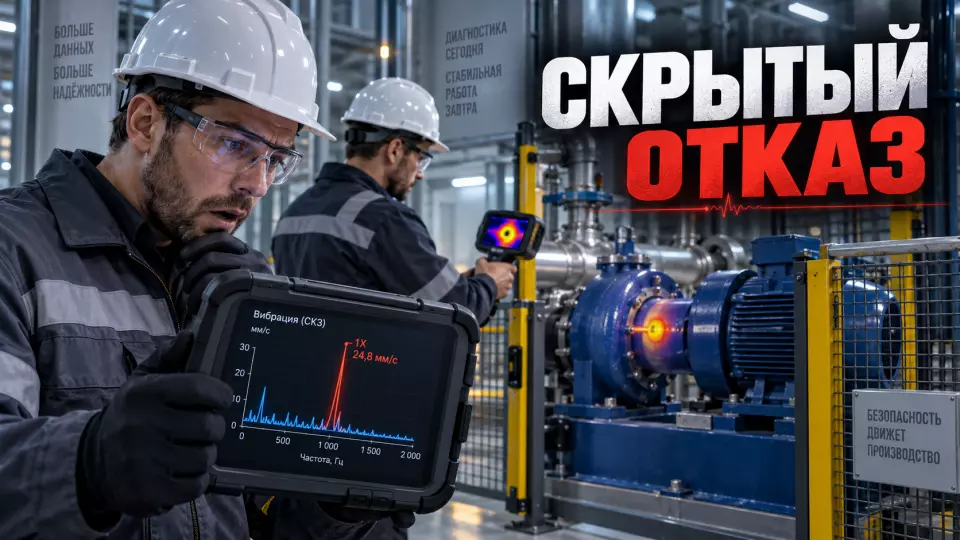
A practical agenda for an equipment reliability day: goals, stations, a safe route, roles, metrics, budget and preparation for different shifts.
Maintenance & Reliability Day is what you might call an in-house equipment reliability day. It helps maintenance, operations and production teams discuss shared challenges using specific examples. The agenda includes short talks, failure reviews, demonstration stations and a route around the plant. Each block answers a practical question: how to spot a deviation, avoid repeating a breakdown, or pass information between shifts.
If you are planning a day like this, request a preliminary outline and budget. For an initial conversation, it is enough to provide the city, the number of participants, the number of shifts and the proposed showcase areas.
Why does a company need a Maintenance & Reliability Day?
A Reliability Day is needed so that employees from different departments can align their approaches to equipment maintenance and discuss problems in a common language. Mandatory occupational safety training, technical regulations and production meetings remain separate processes. At the event itself, complex topics are shown through clear examples and discussed between departments.
Repair, operations and production may have different views of the same stoppage. A mechanic sees wear on a component, an operator sees an unstable mode, a supervisor sees lost time. The Maintenance & Reliability Day programme can bring the whole chain together: signal, decision, repair, start-up and conclusions.
Before developing the scenario, it is worth defining one main topic. For example:
- early defect detection;
- quality of planned preventive maintenance;
- reducing the number of repeat jobs;
- a culture of reporting deviations;
- interaction between production and the repair service;
- working with critical equipment and spare parts.
At Aventura we start with a brief: who is taking part, which areas can be shown, which data cannot be brought into the general programme, and where the line lies between demonstration and real work. This approach helps build a meaningful day without unnecessary activities.
Important: the site approves people's access, the condition of the equipment, protective equipment and the rules for visitors. We build the programme around these conditions and separately agree on safety measures for our team and contractors.
We link this format to the overall organisation of a business event: scenario, registration, flows, equipment and the work of the team on site.
How does Reliability Day differ from similar formats?
Reliability Day focuses on the condition of equipment and how departments interact across its lifecycle. We distinguish it from Quality Day, Occupational Safety Day and the Technologists' Forum. This distinction helps select the right experts, avoid duplicating mandatory training, and keep only topics related to operation, diagnostics and repair on the agenda.
The table summarises the key points of this section: Format, Main subject, What can be included in Reliability Day. Use it as a quick reference when preparing your event.
| Format | Main subject | What can be included in Reliability Day | What to keep separate |
|---|---|---|---|
| Quality Day | requirements for products and processes | product defects related to equipment condition | a general audit of the quality management system |
| Occupational Safety Day | hazards, working conditions, mandatory training | safe maintenance and route rules | briefings, certifications and drills |
| Technologists' Forum | production modes and product quality | the impact of operating modes on wear and the condition of components | product technology development |
| Reliability Day | equipment lifecycle | diagnostics, repair, operation and preventing recurrence | an engineering audit without inspection and calculations |
First, we define one common goal, several working topics and a list of constraints. The more precise the boundaries, the easier it is to choose the format, experts, venues and metrics.
It is worth comparing similar formats in advance. Quality Day at an enterprise focuses on product and process quality. Safety Day at an enterprise is built around risks and safe behaviour. The enterprise Technologists' Forum covers technological modes and the exchange of professional practice.
It is better to formulate the goal through the participants' actions rather than an abstract "culture improvement". For example: introduce shifts to a new defect handover procedure; analyse the causes of repeat failures; demonstrate the safe procedure for an initial inspection; collect suggestions for improving planned shutdowns.
In the event brief we suggest recording:
- Audience. Maintenance staff, operators, supervisors, engineers, managers, contractors or mixed groups.
- Scale. One site, several workshops, separate streams or connecting branches via broadcast.
- Content. Presentations, practical stations, a walkthrough, a team debrief, questions to management.
- Constraints. Restricted areas, noise, operating equipment, photo and video recording, personal data, commercial secrets.
- Completion criteria. What materials should remain after the day: a list of ideas, a record of questions, practice cards, recordings of presentations, a plan for further review.
We divide topics by access in advance. We show general materials to all participants. We keep specialised data for specialists, and exclude restricted or sensitive information from the programme. This protects the programme from late cancellations and helps form groups correctly.
If people cannot be gathered at the same time, key stations are repeated in several streams or short versions of the programme are created for different shifts. The content and safety rules remain the same.
Sample agenda for the day
A practical agenda alternates plenary blocks with small-group work and allocates dedicated time for transitions. Below is a sample for one working day; it needs to be adapted to shifts, access control and the plant's requirements.
The table summarises the key items of this section: Time, Block, Format. Use it as a quick reference when preparing the event.
| Time | Block | Format | Practical outcome |
|---|---|---|---|
| 08:30-09:00 | Registration and clearance check | Registration desk, issuing badges and PPE in line with the plant's rules | Groups formed, lists and restrictions verified |
| 09:00-09:20 | Opening of the day | Short address by the production manager and the reliability service manager | Participants understand the goal, agenda and rules |
| 09:20-10:00 | The reliability picture | Presentation without sensitive data: typical failures, repeat work, interaction bottlenecks | A common theme for discussion is set |
| 10:00-10:15 | Briefing before the practical part | Delivered by the plant's authorised specialist | Route, prohibitions and procedures confirmed |
| 10:15-12:15 | Demonstration stations | Groups rotate through 3 points of 25-30 minutes with transitions | Participants see the methods and ask experts questions |
| 12:15-13:00 | Lunch | Staggered flows if needed | Working rhythm maintained without crowding |
| 13:00-14:00 | Safe route | Tour of pre-approved points | Practices linked to the real production context |
| 14:00-14:40 | Failure case review | Facilitated group work | Hypotheses about causes and questions about the process are formulated |
| 14:40-15:10 | Collecting suggestions | Idea cards or a digital form | Suggestions recorded in a single format |
| 15:10-15:40 | Panel of managers and experts | Answers to selected questions | Topics requiring a separate review are captured |
| 15:40-16:00 | Wrap-up | Next steps, survey, reminder about the feedback channel | Participants know where to send comments after the event |
Not every reliability day requires a stage and a long plenary part. For a small group, a training room, a few stations and a facilitator are sometimes enough. For a large audience, you will need streams, radio communication for coordinators, signage and backup rooms.
When choosing a venue, we check capacity, group movement, space for PPE, amenity areas, catering and acoustics. If part of the programme takes place off-site, use our venue catalogue. We will shortlist suitable options based on the brief.
Who is responsible for what?
At the outset, we separate technical and organizational tasks. The venue confirms equipment operating hours, permits, and local requirements. Each employer is responsible for the safety of their team. We manage the scenario, timing, and flow of participants under the agreed conditions.
The table summarizes the key points of the section: Role, Area of responsibility before the event, Area of responsibility on the day of the event. Use it as a quick reference when preparing the event.
| Role | Area of responsibility before the event | Area of responsibility on the day of the event |
|---|---|---|
| Client of the project | Approves the goal, audience, budget, and composition of managers | Makes key decisions on the program |
| Production manager | Coordinates available areas and operating hours | Confirms the possibility of passage along the route |
| Reliability service or chief mechanic | Prepares topics, cases, experts, and equipment for demonstration | Answers professional questions |
| Occupational health and industrial safety | Determines visiting rules, protective equipment, and restrictions | Carries out the procedures stipulated by the venue and informs the headquarters of any changes in conditions |
| Security service | Checks lists, filming, and access control requirements | Organizes passes and access control |
| Internal communications or HR | Prepares the invitation, messages, and survey | Supports participants and collects feedback |
| We at Aventura | Assemble the scenario, registration, navigation, contractors, and timing | Coordinate flows, the host, catering, equipment, and program changes |
| Station host | Prepares the demonstration and a short explanatory text | Conducts the demonstration according to the approved scenario |
| Group coordinator | Knows the route and the composition of participants | Leads the group, counts people, maintains contact with the headquarters |
| Medical worker or designated service | Checks the response procedure | Acts according to the company's internal plan |
For key roles, we provide replacements. This is especially important for station hosts and route coordinators. If an expert is suddenly called away for a production task, the group should not wait near a dangerous or noisy area.
We recommend compiling a single headquarters sheet: name, role, phone or radio channel, location, deputy, and a list of decisions that the person is authorized to make. Only those who need it for work receive the full list of contacts.
Demonstration stations: rules of display
A safe demonstration station shows one method or one working principle without improvised interference with the equipment. It has boundaries, a presenter, a script, a clear observation point and a pre-approved stop procedure.
For each station we propose a short one-page passport:
- name and purpose of the demonstration;
- duration and maximum number of viewers;
- presenter and backup presenter;
- participants' location and safe distance;
- mandatory personal protective equipment;
- condition of the equipment during the demonstration;
- permitted actions of participants;
- prohibitions on touching, switching on, photography or recording;
- signal for immediate termination of the demonstration;
- procedure for the group's exit.
The working structure of the explanation takes 15-20 minutes: the problem, the indicator, the inspection method, interpretation and action according to internal regulations. The remaining time is left for questions and an organised transition. The presenter should avoid lecturing against a background of noise. A visual detail, a diagram or a screen is often more useful than a long speech.
Basic station rules:
- Participants stand only in the marked zone.
- Passages, doors, panels, fire extinguishing equipment and emergency exits remain clear.
- Cables are covered or routed outside the group's movement path.
- One responsible specialist is assigned to each action with the equipment.
- Guests do not press buttons or remove guards unless this is separately provided for by an approved training procedure.
- Samples of oils, chemicals, heated parts and rotating elements are not used as props without agreed protection.
- Photos and videos are permitted only after checking the filming regime.
- If the production situation changes, the demonstration is stopped without discussion on site.
To get acquainted with the methods, training mock-ups, decommissioned parts, anonymised vibration graphs, photographs of defects and a simulation of a request in the maintenance system can be used. This reduces the programme's dependence on the current state of the line and helps repeat the station for several groups.
We publish more examples of business and production formats in the AVENTURA EVENTS Telegram channel. The channel can be used as a source of ideas, but the specific rules of a station are always determined by the company's documents.
A Safe Route Through the Facility
In our organizational checklist, a safe route is a pre-verified path with checkpoints and a fallback exit from the program. The set of approving departments is determined by the venue according to its own local rules and the nature of the site.
The route is first walked through without guests. During the inspection, we record:
- the width of passages and places where oncoming traffic is possible;
- stairs, thresholds, slippery areas and changes in height;
- noisy zones and areas with poor audibility;
- the movement of forklifts, cranes and other vehicles;
- hot surfaces, open areas and weather risks;
- the quality of lighting;
- access to emergency exits;
- points where photography and group stops are prohibited;
- the meeting point if the route is cancelled or interrupted.
We form groups in advance and, if necessary, mark them by color on badges. Each group has a lead coordinator and a sweep. The coordinator receives the list of participants, a map, the schedule and the command center's contact details. Before setting off, they count the people, remind everyone of the rules and check equipment. After returning, the count is repeated.
There should be no "random" stops along the route. Each point answers one question and has a time limit. If a participant falls behind, the coordinator follows a pre-agreed procedure. The group does not wait in the passage. If the production situation changes, the command center moves the flow to a backup route or into an auditorium.
Escape routes and exits must not be obstructed by stands, catering, boxes, equipment or a queue of participants. The employer is also obliged to provide safe conditions, information about risks and the necessary occupational health and safety training. These requirements take priority over the scenario and timing of the event.
Before the start, we hold a short organizational briefing: we explain the group color and the order of transitions. Certain occupational health and safety procedures apply only to those participants for whom they are mandatory by law and the venue's rules; the content is determined by an authorized specialist.
How do you measure the value of the day?
We assess the day using several groups of indicators: participation, understanding of the material, quality of suggestions and follow-up work with them. The event itself cannot guarantee a reduction in accident rates or downtime, because these indicators are influenced by many production factors.
Before the event, baseline data is recorded that the enterprise is prepared to use without disclosing sensitive information. After the reliability day, the team compares participants' assessments and the actions recorded.
The table summarises the key points of the section: Level, Example metric, How to calculate. Use it as a quick reference when preparing the event.
| Level | Example metric | How to calculate |
|---|---|---|
| Reach | Share of invitees who took part | Number of participants / number of invitees × 100% |
| Completion | Share of participants who completed all mandatory stations | Those who completed the full route / registered × 100% |
| Understanding | Change in short test results before and after the programme | Average final score minus starting score |
| Engagement | Number of substantive questions and suggestions | Count only entries with a described problem or idea |
| Quality of ideas | Share of suggestions accepted for review | Accepted for action / all correctly submitted suggestions × 100% |
| Feedback | Rating of the usefulness of individual stations | Survey for each station, not just for the day as a whole |
| Follow-up | Share of questions with an assigned owner and response deadline | Questions with a responsible person / all questions requiring a response × 100% |
It is not worth promising that one day will reduce downtime by a given percentage. It is more accurate to check whether participants have developed shared definitions, a clear channel for reporting defects and a list of topics for further work. Production indicators can be monitored later if the enterprise has defined the period in advance and excluded other major changes.
We offer a short survey: which block will be useful in your work, what remained unclear and which problem should be passed to the process owner. Open-ended responses are reviewed together with the reliability service.
If you need examples of how we put together complex corporate and business projects, take a look at our portfolio. Case studies help assess our approach to logistics and coordination, but the reliability day programme is still developed for a specific enterprise.
Budget and preparation timeline
We build the budget around the main parts of the project and start preparation once the goal, date and approval owners are confirmed. The final cost depends on the number of streams, duration, technical equipment, geography, access arrangements and the amount of build-out.
Main budget items:
The table summarises the key points of this section: Block, What it may include, What affects the cost most. Use it as a quick reference when preparing your event.
| Block | What it may include | What affects the cost most |
|---|---|---|
| Concept and management | Brief, scenario, timing, coordination, command centre documents | Number of approving parties and venues |
| Registration | Form, lists, badges, desks, staff | Number of participants and security requirements |
| Technical support | Sound, screens, cabling, communications, backup power | Number of rooms and installation complexity |
| Demonstration stations | Models, screens, barriers, printed materials, signage | Number of stations and whether elements need to be custom-made |
| Wayfinding and decoration | Signs, maps, plaques, branding | Length of the route and material requirements |
| Staff | Coordinators, host, technical team, photographer | Number of parallel streams and shift duration |
| Catering and on-site logistics | Water, coffee break, lunch, storage areas | Number of people, menu and venue restrictions |
| Photo, video, broadcast | Filming, editing, connecting branches | Filming arrangements, number of cameras and storage requirements |
| Transport and accommodation | Delivery of the team, equipment and experts | Geography and installation schedule |
| Contingency | Agreed reserve for approved changes | Level of uncertainty at the start |
We usually build the preparation timeline as follows:
- Kick-off, 8-10 weeks out: goal, audience, date, project manager, constraints, preliminary budget.
- Next step, 6-8 weeks out: concept, station lineup, flow plan, technical brief, list of contractors.
- Mid-preparation, 4-6 weeks out: station briefs, route, registration, design of materials, catering and transport plan.
- Final approval, 2-4 weeks out: participant lists, speech texts, wayfinding layouts, communication plan, contingency scenarios.
- Checkpoint, 7-10 days out: walkthrough, document check, final timing, briefing for the organising team.
- On the eve: installation of approved elements, technical check, route marking, command centre briefing.
- After the event: dismantling, survey, log of questions, handover of materials and a list of topics for further review.
For a live production facility, the preparation period may be longer: route approvals, contractor permits and filming arrangements cannot be left to the last week. You also need a Plan B: cancelling one station, moving the route indoors, replacing an expert, changing the line operation or restricting access to a specific area.
Frequently Asked Questions
A Reliability Day is needed so that employees from different departments can align their approaches to equipment maintenance and discuss problems in a common language. Mandatory occupational safety training, technical regulations and production meetings remain separate processes. At the event itself, complex topics are presented through clear examples and discussed between departments.
A Reliability Day focuses on the condition of equipment and how services interact around its lifecycle. We keep it separate from Quality Day, Occupational Safety Day and a forum of technologists. This distinction helps select experts, avoid duplicating mandatory training and keep only those topics in the programme that relate to operation, diagnostics and repair.
A practical programme alternates plenary blocks with small-group work and allocates separate time for transitions. Below is an example for one working day; it needs to be adapted to shifts, access control and the company's requirements.
At the start we separate technical and organisational tasks. The venue confirms the equipment operating mode, permits and local requirements. Each employer is responsible for the safety of their own team. We manage the scenario, timing and flow of participants under the agreed conditions.
A safe demonstration station shows one method or one operating principle without improvised intervention in the equipment. It has boundaries, a host, a scenario, a clear observation point and a pre-approved stop procedure.
In our organisational checklist, a safe route is a pre-verified path with checkpoints and a fallback option for leaving the programme. The composition of the approving services is determined by the venue according to its local rules and the nature of the site.
At Aventura, we can develop the programme, set up routes and stations, and organise registration, equipment and flow coordination. Request a preliminary plan and estimate and specify the city, number of participants, number of shifts and access restrictions.
Sources
- Labor Code of the Russian Federation, Article 214 “Employer’s Responsibilities in the Field of Labor Protection”
- Labor Code of the Russian Federation, Article 219 “Labor Protection Training”
- Government Resolution of the Russian Federation No. 2464 on the procedure for labor protection training
- EMERCOM of Russia: main violations of fire safety requirements
- EMERCOM of Russia: requirements for evacuation routes and exits
Contents
Was this article helpful?