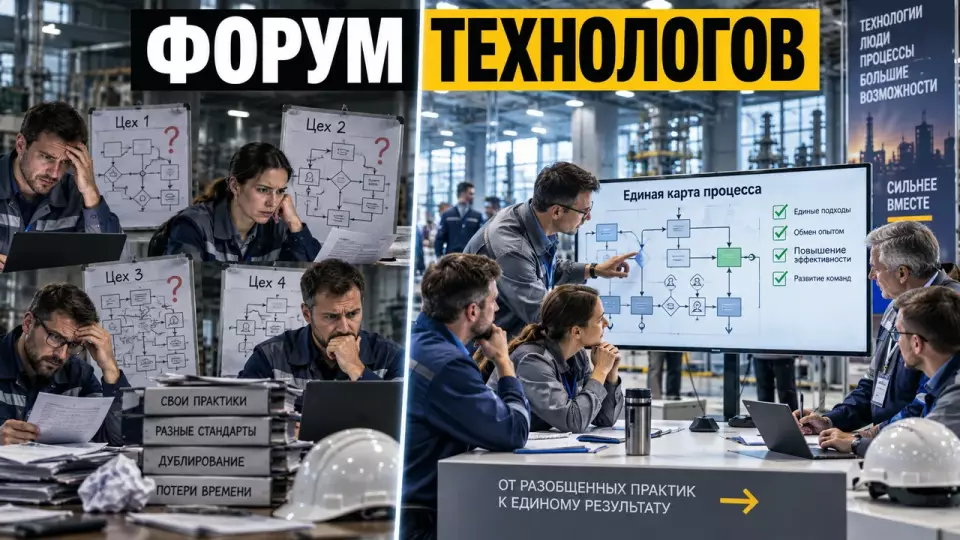
Enterprise technologists' forum program: from selection of production cases and safe demonstrations to applicability checks and working documents.
An enterprise technologists' forum is needed when practices from different workshops, plants, or production sites already produce working results but remain local. Technologists compare application conditions, analyze deviations, demonstrate working methods, and decide which ideas are worth testing in another context. The value is created by moving from a case to a local technical check. The number of presentations is secondary.
At Aventura, we design the program, participant routes, stage and group scenario, venue, technical support, and documentation of results. The client appoints content owners. They confirm the accuracy of production data, safety of solutions, applicability of standards, and acceptable level of disclosure. The event organizer cannot substitute for the chief technologist, production, quality, labor safety, or documentation owner.
Leave a request - we'll discuss the task
We'll clarify the event format and suggest the next step.
What distinguishes the enterprise technologist forum?
The enterprise technologist forum brings together specialists responsible for current production processes, technological regimes, instructions, tooling, operation quality, and the implementation of changes. Participants present verifiable practices in specific contexts, discuss limitations, and determine the next step. The outcome is a decision on local verification, document revision, or rejecting the transfer.
In different companies, the audience includes chief technologists, shop and section technologists, process engineers, specialists in quality, metrology, industrial safety, maintenance, automation, and training of production personnel. The composition depends on the case topic. If the processing mode is being discussed, the owners of the operation and control are needed. If a work instruction is being changed, the document owner and those who will work according to it are involved.
O*NET lists among the functions of manufacturing engineers the search for problems in materials and processes, production improvement, documentation preparation, training, and technical communication. For a corporate forum, this is a useful functional framework, although it does not replace Russian job documents and industry requirements.
The format has four characteristics. Together they distinguish a working technical forum from a general conference.
- the subject of discussion is related to a current production process;
- the author presents the initial conditions, change, observations, and limitations;
- the client's subject matter experts verify technical accuracy;
- the discussion ends with a documented decision on the next action.
R&D Day, or an internal research and development day, is needed by teams that defend hypotheses and ask for a decision on the development portfolio. When participants are only getting acquainted with colleagues' professions, the event is closer to a general internal conference. The technologist forum focuses on what already works or is being tested in a real production environment.
Format Boundaries and Related Events
The forum's boundary is defined by its subject and outcome. Production technologists discuss current processes and ways to document, verify, and transfer them. The Operational Efficiency Forum covers a broader range of initiatives related to quality, timing, costs, and flow organization. The Internal Experts Conference can include any function, while R&D Day deals with research and portfolio uncertainty.
The table summarizes the key points of the section: Format, Program Center, What They Show. Use it as a quick reference when preparing the event.
| Format | Program Center | What They Show | What Remains After the Event |
|---|---|---|---|
| Enterprise Technologists' Forum | current technological processes | mode, operation, material, tooling, control, limitation | decision to check applicability, owner, document change |
| R&D Day | research and development | hypothesis, method, evidence, uncertainty | decision on the next research step |
| Operational Efficiency Forum | improving system performance | losses, flow, quality, timing, function initiatives | improvement portfolio and management decisions |
| Internal Experts Conference | knowledge transfer between functions | professional cases from different departments | materials, contacts, knowledge base, tasks |
This division does not prohibit joint topics. A case on control automation may be of interest to technologists, quality, and IT. It is included in the forum program only when there is a production owner, verifiable initial conditions, and a clear question for the technological community.
Before starting, it is useful to compare the task with the material on the technical specification for a corporate forum. If the initial agenda is built around overall productivity improvement and initiatives from different functions, separately review the breakdown of the operational efficiency forum. These formats can be linked in an annual calendar, but it is not advisable to mix their selection criteria in a single application.
For event architecture, organizing forums and seminars is suitable. We connect the main stage, technical sections, work tables, demonstration areas, and decision log. The content criteria are set by the customer, because only their specialists know the real tolerances, equipment, and status of production documentation.
How to set a verifiable forum result?
The forum result is described through a decision, a document, and a follow-up action. Statements about sharing experience or developing the community do not provide grounds for a program. For each thematic area, the client determines what participants will be able to solve: assign a local check, request data, update instructions, form a working group, or deem the practice inapplicable.
We start with a results map. It contains the topic, audience, type of decision, authorized owner, and future working document. If a block leads to neither a decision nor material for continuation, its role in the program should be reconsidered. An overview report can be kept for general context, but the team explicitly states its purpose and does not expect an implementation plan from the audience.
It is useful to divide results into four levels. Each subsequent level requires more authority and verification.
- Understanding the context. Participants see the initial conditions of the case and do not extend conclusions beyond them.
- Assessing applicability. A specialized group identifies similarities, differences, risks, and missing data.
- Local verification. The owner describes a limited test according to the company's rules.
- Managed change. After the result is confirmed, the instruction, process map, checklist, training program, or other working document is updated.
ISO 10013 connects documented information with process support and preservation of organizational knowledge. Rosstandart describes general provisions of the Unified System of Technological Documentation in GOST R 3.001-2023. These sources do not define the forum program, but they support a simple principle: a useful conclusion must find a place in a managed document if the company decides to apply it in its work.
The event does not promise a production effect in advance. A practice may prove useful only with specific raw materials, equipment, qualifications, control system, or production volume. An honest result sometimes consists of a documented refusal to transfer with an explanation of the reasons.
We publish practical notes on business programs and event production in Aventura's Telegram channel. Short breakdowns for project teams are published there.
Roles of the client, experts, and organizer
The client confirms the technical credibility of the forum, while the organizer assembles the event structure and production. This separation protects the program from two mistakes: a polished presentation of an unverified solution, and technically strong material that cannot be safely shown to the audience. Each case must have a substantive owner, a reviewing expert, and a program editor with clear authority.
At Aventura, we are responsible for the participant journey, session formats, script, moderation, and venue operations. This also includes equipment, navigation, registration, contractors, and collecting agreed outcomes. We help the author make the case clear and prepare materials for presentation. Technological parameters and implementation decisions are confirmed by the client's specialists.
The table summarizes the key points of the section: Role, Responsibility, What should not be delegated to this role. Use it as a quick reference when preparing the event.
| Role | Responsibility | What should not be delegated to this role |
|---|---|---|
| Forum sponsor | goal, priorities, decision boundaries, resources for continuation | technical approval of each case without domain expertise |
| Chief technologist or program owner | thematic areas, criteria, experts, final decisions | venue production and management of all contractors |
| Subject matter expert | verification of data, assumptions, limitations, and terminology | assessment of stage appeal instead of content |
| Occupational health and safety | route, permits, hazardous areas, demonstration conditions | simplification of requirements for the sake of the schedule |
| Legal, IP, and information security | disclosure regime, rights, contractual and information restrictions | editing of technical substance without the process owner |
| Aventura | program, script, venue, equipment, coordination, and documentation | confirmation of the technical correctness of the production solution |
For a complex project, we create an approval matrix. It shows who reviews theses, numerical data, photographs, diagrams, videos, samples, demonstration, and final materials. A single overall 'approved' status hides too many different decisions.
If the program includes managers, equipment suppliers, or specialists from several plants, the right to the final technical conclusion still remains with the appointed representative of the client. The moderator can clarify the issue and record the disagreement, but should not announce the winning technological position.
How to collect and select production case studies?
Collecting case studies starts with a short production practice card, and a finished presentation is not needed at the first step. The author describes the process, the initial problem, and the implemented change, separately indicating observations, limitations, and a question for colleagues. Subject matter experts verify the data and the permissibility of discussion. After the substantive review, the program team selects the format.
It is useful to include the following fields in the application. They allow an initial review without a finished presentation.
- Process, operation, or area of application.
- Initial state and observed problem.
- What exactly was changed in the mode, tooling, material, control, or instruction.
- On which data and observations the conclusion is based.
- Which conditions remained unchanged.
- Where the solution was not tested or did not work.
- Which documents were changed after implementation.
- Which information cannot be disclosed to the general audience.
- Which question the author brings to colleagues.
- Which decision is required after discussion.
Penn State suggests evaluating conference submissions by clarity, completeness, relevance, and applicability in another context. For a production forum, these criteria are insufficient without technical review, but they help separate content from the author's status and the quality of the first version's formatting.
Initial selection can be conducted sequentially. First, the team checks the meaning and authority, then selects the format.
- Remove the author's name and department from the working copy of the application if the context allows the meaning to be preserved.
- Check compliance with the forum topic and the presence of a production owner.
- Pass the case to the client's subject matter specialists to verify data and terminology.
- Check the disclosure mode, rights to materials, and permissibility of filming.
- Assess whether the transfer of practice can be discussed without access to confidential data.
- Assign a format: presentation, case analysis, demonstration, closed session, or material without a presentation.
- Return to the author a specific list of improvements and a date for re-review.
A strong case study does not have to go on the main stage. A topic with many conditions works better at the table of a specialized group. Sensitive details can be discussed in a closed session. Sometimes a practice card and the author's contact are enough if a public presentation adds no benefit.
Enterprise Technologists Forum Program
The enterprise technologists forum program should lead from the general production framework to case analysis, applicability verification, and recording of next steps. The plenary part explains priorities and constraints. The main working time is allocated to technical sections, stand reviews, safe demonstrations, and solution tables. The finale gathers statuses without competing for the most impressive report.
Below is the program architecture. There is no universal schedule here. The duration and number of parallel tracks depend on the composition of technologists, the scale of the enterprise, the complexity of demonstrations, access mode, and the number of venues.
The table summarizes the key items of the section: Block, Participant Action, Block Output. Use it as a quick reference when preparing the event.
| Block | Participant Action | Block Output |
|---|---|---|
| Opening the production framework | understands priorities and decision boundaries | unified forum context |
| Map of site practices | notes experience, requests, and recurring problems | thematic network map |
| Short cases | sees conditions, change, data, and constraints | questions for deep analysis |
| Technical reviews | compares the case with one's own process | applicability map and missing data |
| Demonstration zones | observes an allowed process or sample | confirmed observations without breaking the mode |
| Document tables | links the conclusion to an instruction or process map | list of documents for review and change |
| Owners' council | assigns action, owner, and checkpoint | decision log |
| Closing | receives agreed statuses and continuation route | common package of next steps |
The working sequence may look like this. It leads from the general framework to process owners' decisions.
- The sponsor names production topics that the company is ready to discuss and support after the event.
- The chief technologist explains case criteria and transfer boundaries between sites.
- Authors present short versions of practices using a single template.
- Participants split into specialized reviews, demonstrations, and document tables.
- Each group fills in an applicability card. Report ratings are not needed for this task.
- Process owners make decisions on tests, data, and documents.
- At the finale, confirmed statuses, contentious issues, and the response route are announced.
For a forum with a common stage and several working tracks, we use the logic of organizing a business event. Content, space, and technical equipment are designed together. If you first book one hall and then add laboratories and demonstrations, the program will quickly run into noise, power supply, access issues, and impossibility to separate audiences.
How to conduct an applicability review of a practice?
The applicability review answers the question of whether it is safe to test someone else's practice in local conditions. The group does not select the best case and does not give the author an overall assessment. Participants compare the process, equipment, materials, requirements, control methods, and competencies. Then they record the missing data, the verification owner, and the stopping criterion.
The IAEA describes the exchange of operational experience as a cycle: significant information is found, qualified specialists assess its applicability, appropriate actions are assigned, conclusions are communicated to the right people, and effectiveness is verified. IAEA documents relate to the nuclear industry. In ordinary production, the cycle's logic itself can be used without transferring industry-specific requirements and the level of formalization.
The following order is suitable for a forum. It keeps the conversation within the boundaries of the solution under review.
- Author's context. What process, equipment, material, volume, and mode were in place in the original case.
- Observed problem. How it manifested and what confirmed it.
- Change. What exactly the author did and which process elements were affected.
- Evidence. What observations, measurements, and documents support the conclusion.
- Limitations. Where the solution was not tested, what could have influenced the result.
- Location comparison. Which conditions at the receiving site match and differ.
- Transfer risk. What needs to be checked before any change in operations.
- Decision. Rejection, data request, expert review, or local test according to an approved procedure.
- Documentation. Where the result will be recorded and who has the authority to approve it.
The moderator maintains the structure of the conversation. The subject matter expert handles technical clarifications. If specialists disagree, the protocol includes the wording of the disagreement and a way to obtain the missing data. The scenario should not push the group toward consensus for the sake of a neat ending.
NASA, in the decision analysis process, suggests defining in advance the decision itself, criteria, alternatives, evaluation methods, results, and recommendation. For a local production question, this framework can be shortened, but it is useful to retain explicit criteria and uncertainties.
Production Demonstrations and Safety
A demonstration is only permissible according to the enterprise's standard rules, along an approved route, and under confirmed demonstration conditions. The presence of guests does not justify removing guards, bypassing interlocks, changing the operating mode, or entering a hazardous area. The client defines the requirements and issues permits. We incorporate them into the route, timing, navigation, and team briefings.
Demonstrations can take different safe forms. The choice depends on the site's operating mode and the purpose of the show.
- observation of a standard operation from an authorized point;
- display of a prepared sample or cutaway outside the hazardous area;
- video recording of the process after disclosure review;
- digital model, diagram, or sequence of photographs;
- a stand with de-energized equipment, if such a mode is permitted by the owner;
- a closed demonstration for a pre-authorized group.
The Health and Safety Executive recommends planning maintenance, allowing only competent specialists to perform it, isolating energy sources, and maintaining protection against hazardous parts of equipment. These recommendations are not Russian regulations. They support the engineering principle: a demonstration does not eliminate protection, and intervention with equipment requires a separate procedure. In Russia, the client applies current requirements, local instructions, and risk assessment.
Preparation for a demonstration proceeds in steps. Each step must have an owner from the client side or the project team.
- The content owner articulates what the participant should see and why.
- Production and occupational safety determine the permissible mode, route, and group composition.
- Information security and the data owner review screens, labeling, and filming.
- The technical team checks lighting, sound, communication, power supply, and visibility without interfering with the process.
- The organizer prepares the briefing, navigation, personal protective equipment, and group size control according to the client's rules.
- The team conducts a rehearsal with the same roles and stopping points.
- In case of cancellation, an agreed substitute is prepared: video, sample, diagram, or data review.
For remote sites, a hybrid format is sometimes needed. The camera must not enter a restricted area or show closed screens. A remote participant needs a moderator, access to approved materials, and the ability to ask a technical question, otherwise it becomes a one-way broadcast.
How to protect technical data and intellectual property?
Protection starts before the case is selected. The information owner determines the audience, allowed details, filming mode, storage location, and the need for approval by lawyers, patent specialists, or security. A single common classification for the entire forum is too crude. Different materials require different access levels and post-event publication rules.
WIPO considers reasonable measures to protect trade secrets to include need-to-know access restrictions, physical and technical measures, training, and contractual terms. For the forum, this implies a working classification that the client adapts to their documents.
The table summarizes key points of the section: Level, Who participates, How the session is conducted. Use it as a quick reference when preparing the event.
| Level | Who participates | How the session is conducted | What remains after |
|---|---|---|---|
| General internal | employees with normal forum access | permitted presentation and questions | approved version of materials |
| Specialized | technologists and owners of related processes | detailed review without closed appendices | solution card with restricted access |
| Closed | pre-approved specialists | separate room without free filming | minutes in approved system |
| Pending approval | only information owners and experts | material not included in general program | decision on revision, closure, or other format |
A potentially patentable solution requires review before publication of abstracts, slides, photos, and video recordings. The decision on disclosure is made by a patent specialist or lawyer appointed by the client, taking into account planned applications, countries of protection, and contractual restrictions. The event team should not interpret internal approval as permission for any further publication.
Material review includes schematics and mode parameters, customer and supplier data, screen photos, document numbers, drawings, and video background. Confidential information often appears in the frame accidentally.
For filming, it is useful to coordinate in advance the work of the event photo and video production team. The operator receives a map of allowed areas, a list of prohibitions, and the owner of quick decisions. Final materials are reviewed before publication or transfer to a wide audience.
Rehearsal and a unified production scenario
The rehearsal checks the entire case journey: author access, the final version of the file, terminology, demonstration, group transition, filming mode, decision recording, and backup. Reading the timing at the table is not enough. The production run-through must show whether the team can execute the scenario in the real space without violating safety, access, and the logic of discussion.
Before the general run-through, the author undergoes substantive preparation. MIT Communication Lab advises linking the data to the main question of the talk, dedicating each slide to one main idea, checking the equipment in advance, and preparing backup materials for answers. For a technologist, this means a simple line: context, problem, change, observations, limitations, and a request to colleagues.
A unified scenario includes several groups of data. They are needed by both the host and the technical team.
- the readiness time of the author, moderator, and expert;
- the approved version of the presentation and the backup file;
- rules for pronouncing internal abbreviations and units of measurement;
- acceptable questions and the route for sensitive topics;
- transitions between the hall, section, and production area;
- personal protective equipment and accompanying persons;
- points where photo and video are prohibited;
- criteria for stopping the demonstration;
- a template for the applicability card and the decision log;
- the person who authorizes changes to the program.
A separate route for the technical rehearsal of the event helps check sound, presentations, connectivity, backup, and transitions. For a production forum, access permissions, briefing, protective equipment, and verification that the stage request does not conflict with the venue's mode are added to it.
Registration should also be checked as part of access. The material on event participant registration is useful for designing flows and data. The participant category at a technologists' forum can determine access to a closed section, an excursion group, or a set of materials.
What should remain after the forum?
After the forum, the decision log, applicability cards, and managed production artifacts remain. The presentation archive alone does not transfer practice into work. For each adopted action, an owner, a local outline, missing data, a verification procedure, and a document that will change upon a confirmed result are needed. Refusals and their technical justification are recorded separately.
The decision log may contain such fields. The customer adjusts their set to their document system.
The table summarizes key points of the section: Field, What to record. Use it as a quick reference when preparing the event.
| Field | What to record |
|---|---|
| Case | brief name and owner of the source practice |
| Context | process, equipment, material, and conditions |
| Status | rejected, data request, expert review, local test, accepted |
| Reason | facts, limitations, and disagreements |
| Owner | one person responsible for the next step |
| Participants | who provides data and verifies the result |
| Document | instruction, process map, specification, checklist, or training program |
| Checkpoint | date or event when the status is reviewed |
| Confirmation | how the company will see the action completed |
| Access mode | who can read the materials and results |
Work after the event is conveniently conducted sequentially. In this way, the team does not mix task assignment with a confirmed production result.
- The project team issues an agreed log without raw notes and closed attachments.
- Owners confirm the wording of actions and the list of required data.
- The host site conducts a technical applicability check according to its procedures.
- Permitted local tests receive stop criteria and a method for recording the result.
- Subject matter specialists decide whether a change to the working document is required.
- The document owner approves and disseminates the new version according to company rules.
- At the checkpoint, the team separates the fact of completion from the production result.
For work after the forum, it is useful to separate three questions: whether the action was assigned, whether the change was implemented, and what happened to the production indicator. The IAEA also links the use of operational experience with corrective actions and subsequent verification of their effectiveness. Participant satisfaction does not answer questions about implementation and production results.
It is better to plan the publication of materials in advance. The article on content after the conference covers record versions, rights, editing, and navigation. For a technologists' forum, a relevance check is added: an outdated instruction or unconfirmed case should not look like a current standard.
Project Brief and Budget
For the first calculation, you need the forum's objective, the composition of production sites, case topics, the number of work streams, demonstration requirements, access mode, and the package of materials after the event. The estimate depends on the venue, parallelism, technical equipment, on-site transport, protective equipment, filming, hybrid inclusions, moderation, and the amount of preparation for authors.
At the briefing, we at Aventura ask the client to define the initial conditions of the project. The answers become the basis for the program and budget.
- Which production functions and sites are involved.
- Which existing processes are on the agenda.
- What decisions the forum is authorized to make.
- Who confirms the technical validity of each area.
- Which cases already exist and in what form the data is presented.
- Which zones and materials have restricted access.
- Are demonstrations of equipment, samples, or production areas planned.
- Which specialists will coordinate occupational safety, security, IP, and filming.
- Which working documents may change after practice review.
- How the company will monitor actions after the event.
After the briefing, the team compiles a package of related documents: a results map, selection criteria, a case registry, and an approval matrix. Added to these are a flow diagram, a scenario, a demonstration plan, team instructions, and a decision log template. Based on this package, you can calculate the composition of specialists, rooms, equipment, and work.
We do not add equipment based on a generic list. First, we define participant actions and venue rules. Then we calculate equipment for displays and communication, power supply, navigation, and backup. This approach helps avoid paying for things that do not support the program and to see the limitations of the chosen space in advance.
Frequently Asked Questions
The enterprise technologists' forum brings together specialists responsible for current production processes, technological regimes, instructions, tooling, operation quality, and change implementation. Participants demonstrate verifiable practice under specific conditions, discuss limitations, and determine the next step. The outcome is a decision on local verification, document revision, or refraining from transfer.
The forum's boundary is defined by subject and outcome. Production technologists discuss current processes and ways to document, verify, and transfer them. The Operational Efficiency Forum covers a broader range of initiatives in quality, timing, costs, and flow organization. The Internal Experts Conference can include any function, while R&D Day deals with research and portfolio uncertainty.
The forum's outcome is described through a decision, a document, and a follow-up action. Statements about experience sharing or community development do not provide a basis for the program. For each thematic area, the client defines what participants will be able to resolve: schedule a local verification, request data, update an instruction, form a working group, or deem the practice inapplicable.
The client confirms the technical credibility of the forum, while the organizer assembles the event structure and production. This division protects the program from two mistakes: a polished presentation of an unverified solution and technically strong material that cannot be safely shown to the audience. Each case must have a substantive owner, a reviewing expert, and a program editor with clear authority.
Case collection starts with a short production practice card, and a finished presentation is not needed at the first step. The author describes the process, the initial problem, and the implemented change, separately noting observations, limitations, and a question for colleagues. Subject matter experts verify the data and the appropriateness of discussion. After substantive review, the program team selects the format.
The enterprise technologists' forum program should lead from the overall production framework to case analysis, applicability verification, and recording next actions. The plenary part explains priorities and limitations. The main working time is given to technical sections, poster discussions, safe demonstrations, and solution tables. The closing gathers statuses without competition for the most impressive presentation.
Leave a request - let's discuss the task
We'll clarify the event format and suggest the next step.
Sources
- O*NET: Manufacturing Engineers
- Rosstandart: GOST R 3.001-2023, Unified System for Technological Documentation
- ISO/TC 176: release of ISO 10013:2021 on documented information
- Penn State: How to Write a Conference Proposal
- IAEA TECDOC-1477: Trending of Low Level Events and Near Misses to Enhance Safety Performance in Nuclear Power Plants
- IAEA TECDOC-2078: Lessons Learned Programmes for Effective Knowledge Management in Nuclear Organizations
- WIPO: basics of trade secret protection
- HSE: safe maintenance of production equipment
- MIT Communication Lab: preparing a technical presentation
- NASA: Decision Analysis Process
Contents
Was this article helpful?