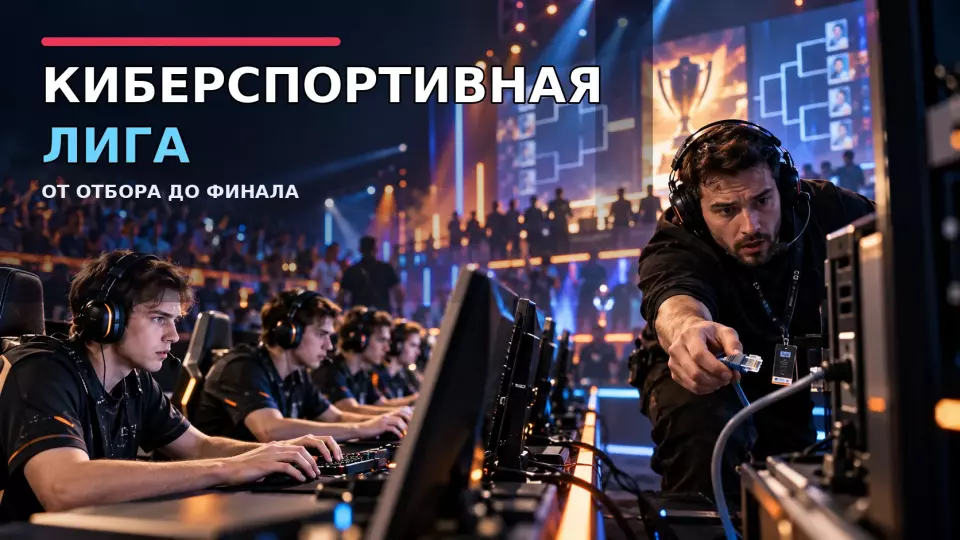
How to run a corporate esports tournament: choose games, check rights and connectivity, organize online qualifiers, a broadcast and an in-person final.
A corporate esports tournament is a good fit for companies with distributed teams and active internal communities. Before announcing it, check the publisher's rules and participation terms. Then run a technical test of servers, accounts and the broadcast.
In 2026, Russian corporate programs are already using a format with remote qualifiers and an in-person final. This format is convenient for branches: most participants play from their own city, while a limited number of teams come to the final program. At Aventura, we treat the league as a single event project, where online matches, communications and the final are all subordinated to one goal.
When is a corporate league better than a one-off tournament?
In short: A league is useful when a company needs to give employees several matches, connect branches and keep interest going for several weeks. A one-off cup is simpler and cheaper, but after the first loss some teams drop out of the programme immediately. A season with groups and playoffs gives participants more touchpoints and time to prepare.
A one-day tournament is suitable for a local office, a celebration or a separate gaming zone. It can be held at one venue, the winner can be determined quickly and the event can end with an awards ceremony. But this format scales poorly if employees are in different time zones or use different equipment.
A league distributes the load. First, the company gathers interest and confirms the rosters. Then teams go through a group stage or qualification. The best advance to the playoffs, and the final becomes a standalone event with commentators, spectators and an awards ceremony.
The table brings together the key points of the section: Format, When it suits, Limitation. Use it as a quick guide when preparing the event.
| Format | When it suits | Limitation |
|---|---|---|
| One-off cup | one office, a short programme, proven interest | some teams drop out after the first match |
| Seasonal league | branches, several weeks, a stable community | more work with the calendar, refereeing and support |
In the official federal tournament for employees of industrial enterprises in 2026, a remote qualifying stage was used before the in-person final stage. This scheme works as a reference point: the mass qualification takes place online, while the on-stage programme is built around a short final.
Goal, audience, and participation roles
At the start: First, the company chooses one main task: to introduce branches to each other, support the gaming community, or add a digital format to the sports calendar. Then the organizers define the roles of players, captains, commentators, and spectators. This order helps build a program for the entire audience, not just for the strongest teams.
A corporate tournament should start with the task of HR and internal communications. Possible goals vary: to introduce branches, support the employee community, add a digital format to the sports calendar, or hold a final of the corporate season. One program should not promise all results at once.
We offer several participation roles:
- player in the main roster;
- substitute player;
- team captain;
- commentator or studio host;
- community moderator;
- author of photos, videos, and short reviews;
- viewer of the online broadcast or in-person final.
This way, the tournament does not turn into a closed activity only for the most experienced players. A newcomer can join through an amateur division, an individual discipline, or a role in the media team. Strong teams can be given a separate standings so that the difference in level does not ruin the first matches.
The principle of voluntariness here is the same as in the corporate sports day. An employee should not participate due to pressure from a manager. Spectators and fans also need a clear route, otherwise most of the company will see only the final standings.
How to choose game titles?
Solution: The game is selected using a matrix of five factors: employee interest, publisher rules, age and content restrictions, equipment availability, and connection quality between offices. Popularity within a single chat does not replace this check. Before announcing, it is useful to conduct a survey and several test matches between the most remote teams.
The table summarizes the key points of the section: Criterion, What to check, Risk if skipped. Use it as a quick guide when preparing the event.
| Criterion | What to check | Risk if skipped |
|---|---|---|
| Interest | number of confirmed players and teams | empty bracket or mass no-shows |
| Rights | publisher permission, name, logos, broadcast | cancellation of the title after announcement |
| Content | age, chat, purchases, gambling mechanics | conflict with company policy |
| Technical | devices, game version, peripherals | unequal conditions and failures |
| Geography | servers, latency, time zones | advantage for one office |
| Accessibility | controls, subtitles, text communication | exclusion of some employees |
- Make a shortlist. In the survey, ask about experience, platform, account region, willingness to play in the evening, team availability, and acceptable communication format. Separately, ask whether the participant needs special accommodations, but do not require disclosure of a diagnosis.
- Check the rules of the specific publisher. General community rules sometimes apply only to small non-commercial competitions. A corporate brand may need separate permission for the name, logos, broadcast, or prize amount. This check is done before the game appears in the lineup.
- Review the rating and descriptors. ESRB specifically notes realistic violence, gambling mechanics, purchases, and user communication. For HR, it is also important to consider the toxicity of open chat, the need for personal spending, and the ability to disable controversial content.
We link the digital program to the overall organization of sports events. This helps to decide in advance where the online league ends and the in-person event with a venue, stage, audience, and awards ceremony begins.
Season format: online qualifiers and an in-person final
Working scheme: A participant must see the whole journey in a single calendar: registration, roster checks, connection test, groups, playoffs and the final. For a distributed company, the online stage reduces travel costs, while the in-person decisive stage creates an event for spectators. The scale of the season is chosen after a survey, not according to another league's template.
The working season should be clear to a participant in a single calendar. It shows registration, roster confirmation, connection test, group stage, transfer window, playoffs and the final. If dates appear piecemeal in different chats, captains quickly lose the current version.
The basic sequence looks like this:
- Interest survey and a shortlist of disciplines.
- Verification of rights, platforms, servers and technical requirements.
- Team registration and confirmation of employee status.
- Calibration matches or seeding based on a confirmed rating.
- Group stage with a guaranteed number of matches.
- Playoffs and a backup window for disputed or postponed matches.
- Technical rehearsal of the final.
- In-person or studio final with a broadcast and award ceremony.
- Publication of results and review of appeals.
For all branches, we keep unified rules, statuses and a reporting form. We tailor the schedule, coordinators and support to local time zones and venue conditions. This approach to a common core and local adaptation is discussed in more detail in the article about a federal series of corporate events.
Not every company needs a long season. If interest has not yet been tested, you can start with open qualifiers and a compact final. With a stable community, the program can include several disciplines and separate divisions, but each new wave increases the load on refereeing, support and communications.
Rules, Rosters and Fair Play
Working scheme: The rules must answer difficult questions in advance: who counts as an employee, when the roster is locked, whether a player can be changed, what happens in case of a no-show, a connection drop, a game update, and suspicion of someone else's account. A referee's decision looks fair only when the rule was published before the match and is applied consistently.
During registration, it is useful to separate public data from internal data. The bracket only needs the team name, in-game name and result. Proof of employment, the captain's contact and availability requests are stored separately with restricted access.
The roster specifies starting and substitute players. A deadline and reason are set for substitutions. Account sharing, an undeclared participant and playing on behalf of a colleague must have a clear sanction. If the platform supports tournament codes, logs or automatic result recording, it is better to use them instead of a captain's message in chat.
The rules include:
- the game version and permitted platforms;
- the match and map format;
- the procedure for choosing sides;
- permitted software;
- pauses and recovery after a disconnection;
- evidence of the result;
- the deadline for filing a protest;
- the appeal procedure;
- the scale of sanctions;
- the rule for updating the document.
We separate the game rules from the show script. The rules set the competition rules, while the script connects the host, graphics, broadcast and award ceremony. In a single document, these tasks get in the way of both the referees and the technical team.
How to ensure equal conditions for remote teams?
In short: Equal conditions start with a map of geography, equipment, and connectivity. Organizers test the server region between the most remote offices, set acceptable time windows, and describe in advance the actions to take if the connection is lost. The phrase "play from any city" is dangerous if a specific game ties an account or tournament to a region.
For each branch, the platform, connection quality, work network restrictions, and time zone are recorded. A corporate firewall may block voice communication or gaming services. An employee's home internet also cannot be considered a ready backup without verification.
First, a test match is conducted between the most remote offices. Then the server region, time windows, and the procedure for connection loss are established. Specific capabilities depend on the chosen game, platform, and account region.
Separate pathways are needed for the player, captain, referee, and spectator. In hybrid events we design online and offline participation as connected but distinct processes. For a tournament, this means separate instructions for entry, support, result recording, and connecting to the broadcast.
If branches work in shifts, one evening window may not be enough. The calendar must take into account production and working hours. Postponements are limited in advance, otherwise the season stretches and loses momentum.
Broadcast, rights and music
Before the broadcast: The holding of a match, the use of trademarks, the display of game content and music may be governed by different rules. Therefore the team separately checks the publisher's permission, the tournament branding, the broadcast platform and the rights to each audio track. A test broadcast on the working channel is conducted before the final, and a local recording is saved regardless of the platform.
A broadcast requires separate legal and technical review. Permission to hold a match does not always include the use of the publisher's logos, game materials, music and recording on a corporate channel. The rules differ even between games from the same publisher.
EA warns that rights to music and certain game elements may belong to third parties. YouTube checks the broadcast via Content ID, an automated copyright control system. In the event of a match, the broadcast may be stopped even if the organiser has a licence. Therefore the channel is agreed in advance with the rights holder and, if necessary, added to the allowlist.
Before the rehearsal, a register is compiled:
- approved tournament name;
- permitted logos and images;
- rights to in-game content;
- music in the game, intro screens and the venue;
- broadcast platform and recording archive;
- chat moderators;
- backup local recording;
- procedure for removing disputed footage.
For the broadcast, we can set up online event streaming with a production script, graphics, commentators and backup recording. The gameplay part remains the responsibility of the referees and discipline administrators.
Accessibility and Account Protection
Principle: Accessibility begins at registration, and account protection begins before the first test match. Participants need keyboard navigation through the form, a text schedule, an alternative communication channel, clear error statuses, and control options published in advance. Organizers need multi-factor authentication, separate access roles, and protection of linked email.
The W3C recommends building digital interfaces so that they can be used in different ways. For a tournament, this means an accessible form, rules in HTML or a properly formatted document, captions for key announcements, and a text channel instead of mandatory voice.
Microsoft suggests checking text size, contrast, subtitles, control remapping, time limits, photosensitivity, and the accessibility of in-game communications. Include these features in the discipline selection matrix before registration opens.
Requests for participation conditions are stored separately from the public bracket. The organizer does not need a diagnosis. What is needed is practical information: a text channel, extra time to connect, a different input device, a place without bright flashes, or an accessible finals area.
Multi-factor authentication is enabled for administrative and streaming accounts. Passwords are not shared in work chat. During rehearsal, check login from actual devices, account recovery, and the availability of a responsible person who can confirm an action without a shared account.
How to prepare an offline final?
In brief: An offline final requires its own script, venue and technical rehearsal. Teams receive information in advance about the equipment, settings, order of play and check times. Contingency plans are needed for failures in communications, recording and gaming stations. Time is left between matches for protests, setup and equipment recovery.
At the venue, the flows of players, spectators, referees and the technical team are separated. Gaming computers or consoles are assembled in identical configurations. Peripherals are labelled, and personal devices are allowed only under a pre-established rule.
The technical rehearsal checks the entire chain:
- player entry and account access;
- roster confirmation;
- connection to the server and match;
- transmission of video and audio to the production control room;
- operation of commentators and graphics;
- recording the result;
- updating the bracket;
- transition to the next match;
- backup if the main channel fails.
The detailed principle of end-to-end verification is covered in the article on technical rehearsal for an event. Close an issue only after a repeat test in the current configuration.
Leave a buffer between matches for protests, setup and equipment recovery. Without this, the first drawn-out dispute will delay the broadcast and the awards ceremony.
Metrics for HR and organizers
What to measure: The report distinguishes interest from actual participation. Registration, confirmed rosters, appearing for a match, and completed games are different indicators. For organizers, no-shows, support inquiries, rescheduled matches, and the time it takes to resolve protests also matter. These data show program quality more accurately than overall announcement reach or number of reactions.
Registrations show initial interest, but to evaluate the season we count confirmed rosters and actual match appearances separately. The difference shows at which stage participants drop out.
The table summarizes the key points of the section: Stage, What to measure, What it shows. Use it as a quick reference when preparing an event.
| Stage | What to measure | What it shows |
|---|---|---|
| Before the start | survey responses, confirmed rosters, geography | actual scale and accessibility of the format |
| Qualification | matches played, no-shows, support inquiries | robustness of rules and technology |
| Playoffs | rescheduled matches, protests, resolution time | quality of administration |
| Final | viewers, broadcast stability, completed matches | whether matches, broadcast and awards stay on schedule |
| After | repeat participation, community activity, feedback | whether there is a basis to continue the season |
We do not promise an increase in engagement from a single tournament. Results are influenced by company culture, voluntary participation, quality of communication, accessibility of disciplines, and community work after the final. In the report, we show registrations, matches played, no-shows, and support inquiries. We separate conclusions from assumptions.
We publish breakdowns of programs, broadcasts, and corporate formats in our Telegram channel.
What to send for an initial quote
For the brief: Set out the goal, the number of branches, a short list of games, the timeline and the format of the final. Add the owners on the HR, IT, information security and internal communications side. That is enough for the initial architecture of the season. A detailed rulebook and budget will follow once employees have been surveyed, rights have been checked and connectivity has been tested.
An initial quote requires the goal of the tournament, the number of branches, the intended games and the constraints of the corporate network. Separately, name the people responsible for the programme, the technology and communications.
Based on that information, we will propose the format of the qualifiers and the final, the team composition, the technical tests and the venue requirements.
Frequently asked questions
A one-day tournament works well for a local office, a celebration or a dedicated gaming zone. It can be held at a single venue, the winner can be decided quickly and the event can end with an award ceremony. But this format scales poorly if employees are in different time zones or use different equipment.
A corporate tournament should start with the objectives of HR and internal communications. The possible goals vary: to introduce branches to one another, to support the employee community, to add a digital format to the sports calendar or to hold the final of a corporate season. A single programme should not promise all of these outcomes at once.
We link the digital programme to the overall organisation of sports events. This helps to decide in advance where the online league ends and the in-person event begins, with its venue, stage, spectators and award ceremony.
A workable season must be clear to a participant from a single calendar. It shows registration, confirmation of rosters, connectivity testing, the group stage, the rescheduling window, the play-offs and the final. If dates appear piecemeal across different chats, captains quickly lose track of the current version.
At registration it helps to separate public data from internal data. The bracket only needs the team name, the game alias and the result. Proof of employment, the captain's contact details and availability requests are stored separately with restricted access.
For each branch, the platform, connection quality, corporate network restrictions and time zone are recorded. A corporate firewall may block voice communication or gaming services. An employee's home internet connection cannot be treated as a ready backup either without testing.
Sources
- Rostelecom: tournament for employees of industrial enterprises
- Russian Esports Federation: stages and disciplines of the championship
- ESRB: guide to age ratings and descriptors
- Riot Games: tournament lobbies, match codes and results
- EA SPORTS FC: rules for tournaments, branding and broadcasting
- YouTube: Content ID and live streams
- W3C: WCAG accessibility standard
- Microsoft: game accessibility guidelines
Contents
Was this article helpful?