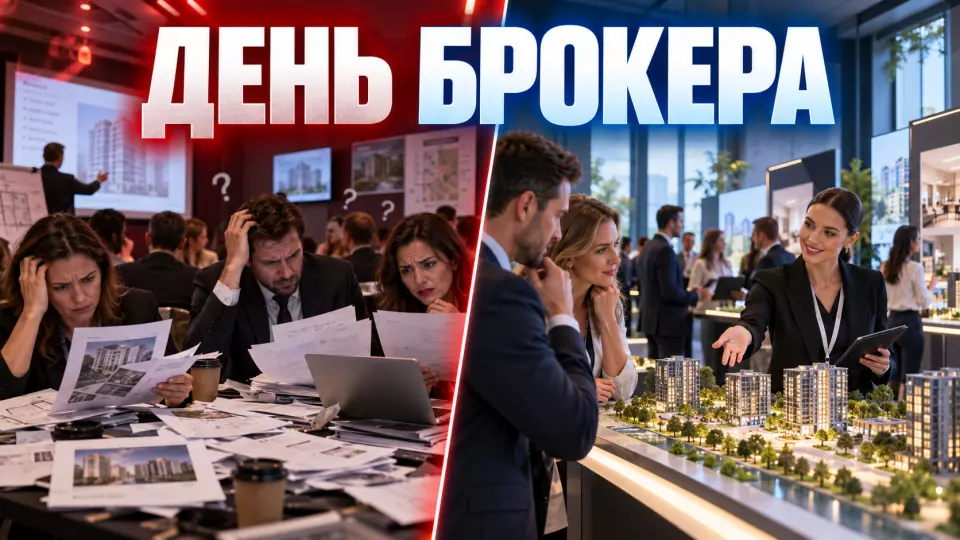
Broker Day helps you present a property, align materials, and set up lead management. We break down the agenda, the site visit, and registration.
An event for real estate brokers often loses its value when it is put together as a long developer presentation. Guests listen to general talking points, photograph a few slides, and leave without an answer to the main question: what exactly will they be able to explain to a buyer tomorrow?
At Aventura, we start with the working result. A broker needs to understand the product, see the property or materials that confirm its features, receive up-to-date materials, and know the next step with the client. If you are preparing a launch or updating a partner program, send us the property details and audience profile. We will put together questions for the agenda, route, and a preliminary estimate.
When should you hold an event for brokers?
A standalone event is justified if partners need to master a new product, test it on site, and receive a single version of sales materials. For a routine price list update, a digital message and a short webinar are enough. A Broker Day is needed where, without a demonstration, questions to subject-matter experts, and a walkthrough of the customer journey, the information would remain theoretical.
The occasion could be a sales launch, the opening of a showroom, the commissioning of a new building, a change in the product line, or the launch of a mortgage or service scenario. The event also helps restart the network after a long pause, when agencies have accumulated different versions of positioning.
First, we define the action to be taken after the meeting. It must be observable:
- a broker can select a property for a specific request;
- an agency head understands the rules of partnership and support;
- a mortgage specialist knows where to get current terms;
- a participant can verify project data in an official source;
- a question that has no answer in the room gets an owner and a deadline for resolution;
- a lead enters an agreed process rather than a manager's personal messages.
The phrase "increase broker loyalty" does not help build a program. A working goal describes what will change in the partner's actions. For example: after the event, a participant can conduct an initial consultation on the product, open the necessary documents, and schedule the client for the next step.
The format should not replace professional training or an industry conference. This is a client event for a single developer or property owner. Its program is built around a specific offering. We link the general plan for such projects with organizing business events and a separate plan for working with partner audiences.
Audience: who should be in the room
Participants cannot be treated as a single group just because they all work in real estate. An agency head evaluates partnership terms and team support. A broker needs product arguments, floor plans, a viewing route and quick access to a manager. A mortgage specialist looks at the process and sources of up-to-date terms. A commercial real estate professional asks different questions than a residential specialist.
Before the programme we build an audience matrix:
The table summarises the key points of this section: Segment, Main question, Suitable format. Use it as a quick reference when preparing the event.
| Segment | Main question | Suitable format |
|---|---|---|
| Agency heads | why prioritise the property | closed introductory session, terms of cooperation, questions to management |
| Experienced brokers | how the product differs and who it suits | client scenario walkthrough, proof stations |
| New partners | where to get data and who to contact | short basics, navigation through materials, meet the team |
| Mortgage specialists | how the customer journey works | working session with documents and up-to-date sources |
| Investment-focused specialists | which assumptions can be used | facts, limitations and scenarios without promising returns |
| Regional participants | how to work without frequent visits | broadcast, virtual route, booking a personal viewing |
The registration form collects only data that affects the programme: role, client type, experience with the product, buildings or floor areas of interest, transfer needs, in-person or online participation. Fields that do not change the service or follow-up work are best removed.
Federal Law No. 152-FZ requires linking personal data processing to a specific purpose and not collecting unnecessary information. We therefore recommend defining, before registration opens, the purposes for working with the guest list, exporting to the sales system, sending materials and passing the contact to a manager. The legal basis and wording are confirmed by the data controller together with a lawyer.
For a large audience, the logic of organising conferences and forums works well, but the broker's day programme must remain practical. The bigger the stage, the more important it is to preserve time for the route, questions and hands-on work with the product.
How to build a programme without a long presentation?
The programme alternates between a shared framework, a product demonstration, hands-on activity by each participant and Q&A. If every block is structured as a speech, the broker remains a spectator. It is harder for them to carry what they have heard into a conversation with a buyer. So the stage sets the context, while the main work happens at the model, the documents, the floor plans and with the relevant specialists.
We build the programme from five parts.
- Context. What has changed in the product, the property or the partner programme. Only the facts needed for the following blocks.
- Client scenarios. Which tasks the offer suits, and where its limitations should be stated straight away.
- Themed stations. The model, floor plans, finishes, engineering, infrastructure, documents, digital services and the transaction process.
- The broker's next step. How to register a client, run a viewing, get the terms confirmed and pass on a question.
- Consolidation. A single set of materials, contacts by function and the next step for different participant segments.
A plenary block is needed, but its role is limited. It creates the overall picture and explains the logic of the day. Details are better distributed across the stations, where a participant can ask a question of the relevant specialist.
The working rhythm of the day
After registration, guests receive a route. The shared part answers three questions: what is being sold, who it suits and what has changed. The groups then disperse to the stations. At the end, participants return to the common point, receive updated materials and sign up for the next action.
Transitions between stations are included in the overall timing. We count not only the length of the talk, but also gathering the group, moving, queuing, questions and returning. For a large property we appoint a route host and a receiver at each point.
If you want to link the stage, the demonstration and the managers' work into a single plan, request the programme and a preliminary estimate. We will check the group composition, route durations, equipment, registration and lead handover points.
How does a site visit help verify the product?
A site inspection answers the questions a broker will hear from the buyer. The route is built around the logic of choice: surroundings, entrance area, common areas, standard layouts, engineering systems, views, showroom, and a place for the next conversation. Each stop confirms a specific point from the presentation and gives the relevant specialist time for questions.
Before the event, the team walks the route without guests. We record:
- where the group can safely disembark and gather;
- which areas are open and who has authorised access;
- how many people can fit at the scale model or in a room at one time;
- where the speaker can be heard without shouting;
- which areas must not be photographed;
- where hard hats, vests or other protective equipment are kept, if needed;
- how guests are separated from machinery, workers and service routes;
- what contingency plan is activated in case of weather, delays or area closures.
A construction site does not become a tour venue just because a future development is there. The owner and responsible departments determine the accessible areas, escort arrangements and rules. We include these conditions in the invitation, registration and team briefing.
If a physical viewing is limited, instead of improvising we prepare a clear alternative to an in-person showing: an up-to-date scale model, material samples, a panorama, a walkthrough video, a views diagram, a detailed floor plan, and a specialist who can answer technical questions. Virtual content must not present a future view as an already completed result.
For remote brokers, a separate broadcast can be arranged, but the camera must show the same evidence, and the moderator must pass questions to the relevant station. A general overview over an employee's phone does not provide equal participation.
Materials the broker will take away
A participant needs one up-to-date access point instead of a folder of files with different dates. It contains verifiable information, commercial materials and contacts for follow-up questions. The broker should be able to quickly find the right floor plan, booking rules and the source of official data, while the developer's team can update materials without a new wave of conflicting mailings.
The Unified Information System for Housing Construction publishes the information and documents on housing construction projects required by law. For an event, this sets a simple principle: stage talking points, handouts and managers' answers cannot be prepared separately from the official version of the data.
A broker's kit typically includes:
- a short product and audience profile;
- floor plans or an area layout with the update date;
- a link to the official project documents;
- rules for booking a viewing and reservations;
- the client's journey through the deal;
- contacts for sales, mortgages, documents and technical matters;
- media materials with clear usage rights;
- answers to frequently asked questions;
- a change log after the event.
Every file has an owner, a date and a version. If the terms change, the old document does not remain at the same link without a warning. It is better to open a page with the current version and a change archive than to send a new PDF to several chats.
The mortgage section needs to be updated as of the event date. The Bank of Russia publishes mortgage lending market statistics, but general statistics do not replace the terms of a specific bank and client. On stage, it is safer to explain the process and sources of verification than to promise a rate or approval.
Advertising a property also requires discipline. The law prohibits information that does not correspond to reality, including about characteristics, price, discounts and purchase terms. We do not publish return forecasts without a methodology, assumptions and legal review. The team checks the stage, screen, signage and handout texts in advance.
Registration, leads and personal data
Registration links the invitation, access to the venue, the programme segment and all follow-up. It should not become a hidden sales-department questionnaire. For every field we define in advance its purpose, owner, retention period and recipient. Participants should understand why their answer is needed and what will happen after they submit the form.
The form should be clear: field labels visible, required fields marked, errors explaining what to fix. The W3C recommends associating form elements with explicit labels and providing instructions where the answer format is not obvious. These principles are useful even for a simple registration in Russian.
We map out the lead journey in advance:
- the participant registers and selects their interests;
- the system assigns a segment and a route;
- at the event the coordinator marks actual attendance;
- a question or client request is given a category;
- a responsible manager is assigned;
- the promised material is sent to the participant;
- the team records the outcome of the contact and next steps.
Scanning a badge at a station only makes sense with a clear purpose. If the scan is needed to monitor capacity, it should not automatically be turned into a buying signal. If a participant has requested a meeting, that is a separate action with explicit confirmation.
We plan photos and video together with the route. Participants can see in advance where filming takes place and whom to approach with questions. The specific rules for publishing photos and videos in which a person can be identified are determined by a lawyer, taking into account the scenario and the legal basis for processing. It should not be assumed that registration automatically permits any further use of a person's image and contact details.
Safety and service along the route
Brokerage event service begins at the arrival point and continues until departure. Participants need a predictable route that does not cross construction sites, service vehicles or closed areas. The team checks the entrance, meeting points, stations, catering, restrooms and evacuation route in advance together with the venue owner.
Participants need the address, entrance map, time, parking or transfer, clothing for the tour and photography restrictions. On site, signage should lead to registration, the cloakroom, the hall, stations, restrooms and the exit.
Fire safety regulations require keeping evacuation routes and exits clear. The venue owner also checks systems and the readiness of responsible staff. For a temporary programme, this means that stands, screens, queues, catering and tour groups must not block exits or service routes. The plan is confirmed by the venue owner and the responsible services.
We check accessibility across the entire chain: drop-off, entrance, desk, route, seat in the hall, restroom area and evacuation. If part of the venue is not accessible, the team says so before registration and prepares an equivalent way to receive information. Promising "accessible to all" without inspection and confirmation creates unnecessary risk.
We link catering to the programme. We do not schedule a coffee break in the same window when a group must leave for the venue. Rospotrebnadzor pays attention to labelling and delivery of public catering products. The caterer confirms documents, transportation and serving conditions, while the event team provides time, space, electricity, water and cleaning. For a large project, event catering is part of the overall production plan.
How do you measure the result of an event?
Sales after an event depend on the programme, the quality of the audience, the work of the managers and other touchpoints. We do not attribute every subsequent deal to the event. We measure separately the quality of participation, understanding of the product, how the route worked and the transition to an agreed next action. This kind of review shows what to fix in the next event and in the day-to-day work of the partner channel.
We define the metrics before registration opens. Each one has a formula, a source and an owner.
Audience
- invited and registered by segment;
- actual attendance;
- share of target roles;
- declines and reasons, if the person provided them voluntarily;
- in-person and remote participation.
Programme and route
- groups that completed the assigned route;
- late arrivals and queues at the stations;
- questions left unanswered on the day of the event;
- recurring unclear topics;
- use of the backup scenario;
- comments on accessibility and service.
Materials and follow-up after the event
- delivery of the promised pack;
- opens of the current materials page;
- scheduled demos or consultations;
- leads with an owner and a next action;
- response time to a question;
- cases where managers used different versions of the data.
Commercial result
Deals and revenue can be analysed according to rules that link the result to the event. Alongside them you need to show the length of the cycle, other touchpoints and the quality of the original audience. Registration shows the intention to attend. Interest is confirmed by a separate action: a question, a request for a demo, a consultation or a client case that has been passed on.
After the event we hold a short review with sales, marketing, product and the production team. We look not only at the final numbers but also at the points where a participant lost time or received a contradictory answer. This produces tasks for the next meeting and for the day-to-day work of the partner channel.
What should you include in the brief for the agency?
For an initial programme and estimate, we need the venue, the business objective, the composition of the partner network and any route constraints. We also need the product data owners and one current version of the materials. These inputs allow us to compare formats, determine the team composition and budget for the stage, the showcase, registration, catering, transfers and post-event follow-up.
Please provide:
- the goal of the event and the desired action you want participants to take afterwards;
- addresses, the venue's readiness status and available areas;
- broker segments and the geographic scope of invitations;
- the product line and official data sources;
- a draft partner programme;
- the roles of the sales, mortgage, product, legal and technical teams;
- access, photo and video shooting rules;
- registration and lead handover requirements;
- the proposed showcase formats;
- capacity, time and noise restrictions;
- streaming, accessibility and catering requirements;
- metrics and the reporting format.
At Aventura, we first check what the broker should be able to do after the meeting. We then build the programme, routes, technical setup, registration and service around that outcome.
Frequently asked questions
The occasion could be a sales launch, a showroom opening, the commissioning of a new building, a change in the product line, or the launch of a mortgage or service scenario. An event also helps relaunch the network after a long pause, when agencies have accumulated different versions of the positioning.
Participants cannot be treated as a single group just because they all work in real estate. An agency head evaluates the partnership terms and team support. A broker needs product arguments, floor plans, a viewing route and quick access to a manager. A mortgage specialist looks at the process and the sources of current terms. A commercial real estate professional asks different questions from a residential specialist.
We build the programme from five parts.
After registration, guests receive a route. The plenary part answers three questions: what is being sold, who it suits and what has changed. The groups then disperse to the stations. At the end, participants return to the common point, receive updated materials and sign up for the next step.
A site visit answers the questions a broker will hear from a buyer. The route follows the logic of a purchase decision: the surroundings, the entrance area, the communal areas, the standard layouts, the engineering, the views, the showroom and a place for the next conversation. Each stop confirms a specific point from the presentation and gives the relevant specialist time for questions.
The Unified Information System for Housing Construction publishes the information and documents about housing construction projects required by law. For an event, this sets a simple principle: the stage talking points, the handouts and the managers' answers cannot be prepared separately from the official version of the data.
If you are planning a property presentation or a broker day, send us the initial information. We will prepare brief questions, propose a format and calculate the cost of organising the event.
Sources
- Bank of Russia: mortgage housing lending market indicators
- Federal Law No. 214-FZ: information on housing construction and the project declaration
- Federal Law No. 38-FZ “On Advertising”
- Federal Law No. 152-FZ: principles of personal data processing
- W3C WAI: accessible forms
- Fire Safety Regulations in the Russian Federation
- Civil Code of the Russian Federation, Article 152.1: protection of a citizen’s image
- Rospotrebnadzor: catering for off-site service
Contents
Was this article helpful?