A practical programme for a career-guidance tour to an enterprise: educational goal, workstations, safe route, documents and metrics.
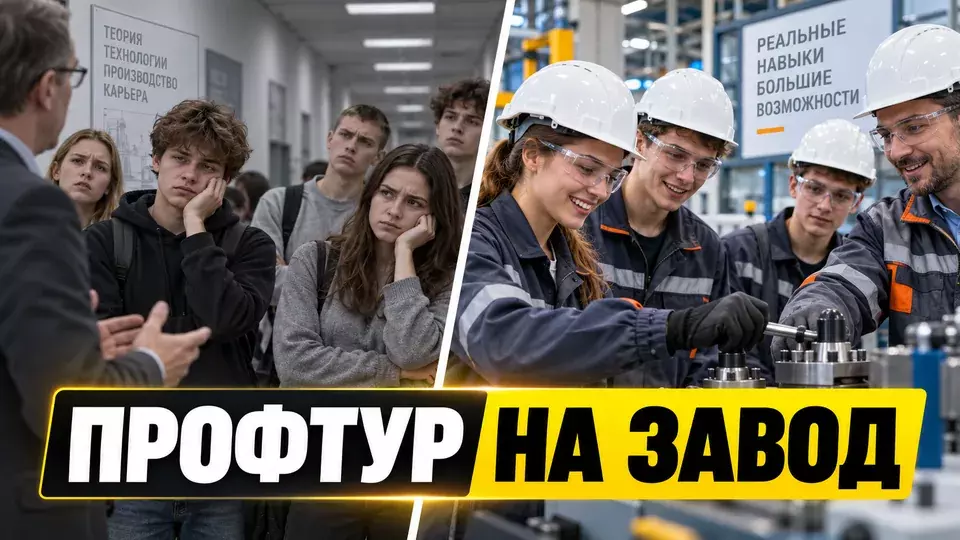
A career-guidance tour to an enterprise makes sense when a school student not only sees the production site but also understands the professions, tries a safe work task and chooses the next step in their education. A corridor tour with a long narration can impress. But without action, feedback and reflection, its educational outcome is hard to verify.
At Aventura we start such a project with the goal and the group's route. Then we bring in the production site, occupational health and safety, security, the school and the programme team. This way the site's constraints become part of the scenario before participants are invited, rather than a surprise at the checkpoint.
If a career-guidance tour is already in your plan, request the programme and a preliminary estimate. For the first conversation, it is enough to state the participants' age, the city, the type of enterprise, the desired educational outcome and the available zones.
What Makes a Tour Career-Oriented?
A career-oriented tour to an enterprise introduces a student to real professions, working conditions, and educational pathways. A hands-on trial enhances such a visit but is not a mandatory feature of every career-oriented excursion. The format is chosen based on the goal, the age of the group, and the capabilities of the site, so that the participant can see a clear next step.
The methodology of the "Ticket to the Future" project distinguishes informational visits, excursions, and professional trials. During a trial, the participant performs a model work task, evaluates the result, and receives feedback from a mentor. An excursion can fulfill a career-guidance objective even without a separate trial if it helps understand professions and the further path of education.
For an enterprise, this changes the logic of the program. The company's history and a general story about the product remain, but take up less space. The main part answers the student's questions: what a specialist does, what tools they work with, what criteria they use to check quality, and what one needs to learn to enter the profession.
We distinguish three formats:
The table summarizes the key points of the section: Format, Main Result, Key Elements. Use it as a quick reference when preparing an event.
| Format | Main Result | Key Elements |
|---|---|---|
| Industrial excursion | understanding of the site and the production cycle | route / explanation / safety |
| Career-oriented tour | understanding of professions and one's own interests | profession map / route / reflection / trials if possible |
| Career day | candidate's transition to a vacancy or interview | vacancies / HR conversation / next hiring step |
A separate career day at an industrial company is needed when the task is related to recruitment. In a career-oriented tour, we do not ask a student to make a job decision and do not turn an educational visit into the collection of candidate application forms.
The educational purpose of the tour
An educational tour helps participants understand the world of professions and relate it to their own interests. Such a tour can support school students' interest in an industry and in future education, but it must not promise employment or push them toward a specific job opening. The programme shows different roles, training requirements, working conditions and possible paths forward, while preserving the participant's right to choose a different direction.
A company may have a clear interest: to talk about its industry, support engineering education, and introduce schools to modern manufacturing. It is fine to state that interest. The problem begins when all professions are shown only from a promotional angle, difficult conditions are glossed over, and reflection is replaced by a call to come and work after graduation.
An honest career tour shows the context. An engineer is responsible not only for the idea but also for calculations and verification. An operator monitors conditions and quality. A laboratory follows procedures. An occupational safety specialist influences the route and the decision on access. A school student sees that manufacturing relies on various professions, not on a single stage hero.
The boundary is also useful for communication with parents. In the invitation, it is better to write that participants will learn about professions and educational paths. Wording about guaranteed internships, targeted training or future employment is acceptable only where the company runs a separate, confirmed programme.
How do you set a goal and the next step?
The goal of a tour describes a change in a participant's knowledge or choices, not the number of guests and photos. After the visit, a student should be able to name several professions at the enterprise and explain at least one educational pathway. Then they assess their interest and choose what comes next: a new hands-on trial, a meeting with a college, a club, or independent study of the field.
The phrase "introduce schoolchildren to the plant" is too broad. It doesn't help choose stations, mentors, and survey questions. We suggest building the goal from four parts: audience, new understanding, action on site, and follow-up after the visit.
For example: students from a specialized class learn about the production cycle, complete two safe hands-on trials, compare an engineering role and a shop-floor role, and then receive a map of educational programs and choose a topic for their next lesson. This wording already makes the content, the people, and the post-event materials clear.
Before writing the script, it helps to answer five questions:
- What ideas about professions does the group have before the visit?
- Which roles can the enterprise show without distortion or glossy advertising?
- What action can each participant perform on their own?
- What feedback is needed immediately after the hands-on trial?
- How will the school or company continue the topic after the group returns?
It is more convenient to plan the program as a business event: with an owner of the result, a working agenda, clear roles, and documented actions after the meeting. The difference lies in the language and the workload of the program, because the main audience here is schoolchildren.
If you need to connect an educational goal, a production route, and the work of several departments, discuss the task with us. We will put together the framework of the program, the roles, the stations, and a list of decisions that the enterprise needs to approve.
On-Site Tour Programme in 2026
The working programme of a career-guidance tour to an enterprise takes the group from registration and a short safety briefing through the production context, route stops, conversations with specialists and reflection. Hands-on professional trials are added where the site allows them to be run safely. The exact timing is set after walking the site and calculating group flows.
Below is the framework we adapt after viewing the site. If the production route is long or the group needs more time for transitions, it is better to reduce the number of modules. A packed programme with constant rushing is worse than a short tour where every participant has time to complete a task and ask a question.
The table summarises the key points of the section: Module, What Happens, Learning Outcome. Use it as a quick reference when preparing the event.
| Module | What Happens | Learning Outcome |
|---|---|---|
| Arrival and safety | group check / route rules / equipment / stop signals | the participant understands the boundaries and the order of movement |
| Enterprise context | product / clients / role of the site / career map | the link between production, people and the region becomes visible |
| Production route | several stops from the entry of raw materials or data to output control | the logic of the cycle is clear instead of a set of disconnected workshops |
| Hands-on professional trials | short tasks at training stations in subgroups | the participant performs an action and receives feedback |
| Dialogue with specialists | a typical day / training / the challenging sides of the profession / questions | a realistic idea of the work emerges |
| Educational pathway | colleges / universities / subjects / clubs / projects | the available next step is clear |
| Reflection and departure | short questionnaire / choice of interest / final roll call | the enterprise and the school receive material to continue |
The production showcase does not have to cover the entire site. A few stops are enough if each answers one question. For a large-scale visit, use streams: while one subgroup walks the route, another works at a station, and a third talks to a mentor.
If participants arrive as an organised group, check logistics and transfers in advance. Transport is part of the scenario: the drop-off point, the safe path to the entrance, the driver's waiting time, the contact person for the escort, and the departure procedure after the final roll call.
How to set up professional try-outs
A professional try-out simulates a recognizable work task and ends with a result that the participant can check or explain. The student acts independently, while the mentor provides context, monitors safety and discusses the work. A playful mechanic is appropriate if it is tied to a real profession, its tools and the way quality is assessed.
A good station fits into a short, clear framework. It has a profession, a task, materials or software, three or four steps, a result criterion and a reflection question. The mentor does not deliver a lecture before the start. They give a minimum of context, demonstrate a safe technique and leave the participant time to act.
We check a station against seven criteria:
- The task resembles a typical operation of the profession, but is safe for a school group.
- The result can be seen or explained: it is a diagram, a sample, a diagnostic conclusion or a solved problem.
- The instructions are short and require no special training.
- Every participant performs an action rather than watching from behind.
- The mentor asks a question and gives specific feedback.
- For a participant with disabilities there is an equivalent way to complete the task.
- Operating hazardous equipment is replaced by a training rig, a simulator or a remote demonstration.
A queue ruins a try-out faster than weak decoration. If one setup is designed for one person, the group is split or parallel workstations are prepared. In some projects the station can be set up as a master class, but the content must remain professional: the action is tied to a real task, and the participant understands where this skill is applied.
A complex process can be shown on a digital twin, a training console, safe samples or a model of a typical mistake. Such a substitution preserves the logic of the profession without access to an area where a visitor should not be.
Route safety and team roles
Safety is designed before stations and scenario effects, even before participants register. The company confirms the available zones, access conditions and equipment, while the responsibilities of the school, the company and the organiser are recorded in the documents for the specific visit. For each subgroup, chaperones, the roll-call procedure, communication and a backup route are defined in advance.
We start with a physical walk-through of the route. The team checks drop-off, waiting at the entrance and the issuing of protective equipment. It separately reviews intersections with service flows, speaker audibility and the path to the assembly point. Only then does it add educational modules in confirmed zones.
The table summarises the key points of this section: Role, What they are responsible for. Use it as a quick reference when preparing the event.
| Role | What they are responsible for |
|---|---|
| HR or programme manager | educational goal / partners / follow-up after the visit |
| Production | content of the stops / process availability / mentors |
| Occupational health and safety | route / restrictions / equipment / stop conditions |
| School and chaperones | group composition / documents / discipline / communication with parents |
| Organiser | scenario / timing / flows / stations / backup |
| Subgroup coordinator | roll call / movement / pace / communication with the programme manager |
The general principles of the Ministry of Emergency Situations for evacuating school groups are useful as a basis for the subgroup card: define a safe route, an assembly point and a roll-call procedure in advance. For the company, this scheme must be checked against its evacuation plan, local rules and responsible departments.
The detailed approach to the guest route can be cross-checked with the article on an open day for employees' families. A career-guidance tour differs in purpose, but uses the same discipline of access, transitions and chaperones.
What documents are needed for a school group?
Documents are divided by purpose. Participation in a trip, processing of necessary data, dissemination of data and use of an image require separate grounds and clear wording. The exact set is determined by the school and the enterprise, taking into account the format of the visit, the age and composition of the group, local regulations and the rules of the venue.
The exact set is confirmed by the school, the enterprise and their responsible specialists. The organiser does not replace legal assessment. But the scenario should show the statuses of documents, the deadline and the person who informs the team whether a participant can be included in the list, photographed and have materials shared.
The working sequence is as follows:
- Agree on the date and venue. Then confirm the route, transport and practical tasks.
- Check with the school whether written consent of the legal representative is required for participation in a specific trip, and prepare the required form.
- Determine the minimum set of personal data for the list and communication.
- Separately formalise data dissemination if materials will be published.
- Check the basis for photo and video with the image of participants.
- Collect a record of familiarisation with requirements for clothing and footwear, equipment and behaviour.
- Pass the status matrix to coordinators without unnecessary personal information.
The approximate briefing in the recommendations of the Ministry of Education provides that the group is informed in advance of the route, programme, practical tasks, requirements for clothing and footwear. It also specifies the written consent of legal representatives. The applicability and form of documents for a specific trip are confirmed by the school and the enterprise; the local rules of the venue remain in force.
Photos, video and accessibility
Filming should not be a condition of participation. The team decides in advance who can be filmed, where cameras are allowed, who will receive the photos and videos, and how long they will be stored. Accessibility is checked along the entire visit chain: from arrival and entry to the station, reflection and exit.
Filming requires a list of permitted locations and clear labelling of consent statuses. The photographer does not capture lists, badges, documents, access control screens or random close-ups of children. A participant without consent receives a full programme, not the role of someone who is constantly asked to step out of frame.
If the company needs reporting material, photo and video coverage of the event is included in the overall scenario. The brief contains permitted shots, prohibited areas, the approval path, storage rules and the procedure for handling participant requests regarding already published materials.
In our experience, accessibility begins with the invitation. It is better to ask what condition or assistance needs to be prepared than to collect unnecessary medical information. On site, the accessible route, passages, restroom, rest area and working height of the station are checked. The specific list is verified against the group's characteristics and the venue's requirements.
Video receives subtitles or a text transcript. The facilitator describes a visual object in words. For a noisy area, a quiet alternative with the same educational content is prepared. If the main route is inaccessible, we design an equivalent activity so that the participant does not remain only a spectator.
How to prepare mentors?
A mentor translates a complex process into a teenager's language, demonstrates one real work task and gives feedback without a promotional lecture. They know the age of the group, the goal of the station, acceptable topics, filming boundaries and how to stop an activity in advance. A good production specialist may need a rehearsal, because knowing the process and working with a school group require different skills.
A mentor card fits on one page. It contains the profession and the goal of the station. Below are the first question to the group, a short explanation and the steps of the task. The card ends with the success criterion, common mistakes, a reflection question and the coordinator's contact. Prohibited information is noted separately.
We ask the mentor to speak through action. Instead of ten minutes about a quality control system, a student gets a sample, compares features and explains the decision. After that, the specialist shows how similar logic works at the enterprise. This way the term appears after the experience and is remembered better.
Before the event, mentors go through a short run-through with a person who plays the participant and asks simple or awkward questions. It is useful to include this block in the technical rehearsal of the event. During the run-through you can see where the explanation is too long, the instruction is unclear, and one station is gathering a queue.
Metrics of the educational outcome
Attendance and reach show scale, but not the educational outcome. To evaluate a career guidance tour to an enterprise, compare knowledge about professions and understanding of the learning path before and after the visit. Add completed tasks, the quality of feedback and the next steps chosen by the participants. A short follow-up survey will show what remained after the first impression.
Before the visit, you can ask several identical questions: which professions at the enterprise the participant knows, whether they understand the learning path, what they expect from the trip and which fields they are considering. After the tour, the questions are repeated and supplemented with an assessment of the stations, mentors, working conditions and accessibility.
The table collects the key points of the section: Moment, What we check. Use it as a quick guide when preparing the event.
| Moment | What we check |
|---|---|
| Before the visit | baseline knowledge / interest / expectations / career certainty |
| Immediately after | completed try-outs / new understanding / chosen continuation |
| One to two weeks later | what was remembered and what the participant discussed with parents or a teacher |
| Later | a new try-out / club / open day / studying a training programme |
The OECD classifies observing specialists at work and workplace visits as forms of career development. In research, such activities are considered together with career certainty and subsequent outcomes, but a single tour by itself does not prove a causal effect and does not solve the enterprise's staffing task.
Do not make the number of photos, gifts or an overall "liked it" rating the main indicator. A positive impression is useful, but a student may rate the food highly and still not understand a single profession. Educational metrics bring the programme back to its goal.
How to build a project step by step?
A project is built from the goal to the route, and then to the stations and service. Before the announcement, you need to confirm the group composition, available areas, documents and the people responsible for each decision. After that, the team designs the try-outs, splits the group into subgroups, prepares mentors and runs a physical walkthrough. The final version of the programme includes a backup and a follow-up after the visit.
We use the following order:
- We define the audience and the educational goal. We immediately set the next step.
- We appoint the programme owner and the company's working group.
- We check the route and the constraints. We separately confirm accessibility and evacuation points.
- We choose the professions and design safe try-outs.
- We divide the flow into subgroups and calculate the throughput of the stations.
- We prepare the documents, the invitation and the transport plan.
- We brief the mentors and coordinators. We separately prepare the photographer and the accompanying staff.
- We walk the route and the stations at a rehearsal. Then we check the corrections.
- We run the tour. We gather feedback and record open questions.
- We hand over the materials to the school and launch the agreed next step.
There must be only one current version of the scenario. If the production site closes a point or changes its schedule, the programme manager sends the updated plan to all departments. The coordinator moves the group to a pre-confirmed backup route.
Frequently Asked Questions
The methodology of the "Ticket to the Future" project distinguishes informational visits, excursions and professional try-outs. During a try-out, a participant performs a model of a work task, evaluates the result and receives feedback from a mentor. An excursion can also serve a career-guidance purpose without a separate try-out if it helps students understand professions and further education paths.
An enterprise may have a clear interest: to talk about its industry, to support engineering education, to introduce schools to modern production. It is fine to state this interest. The problem begins when all professions are shown only from a promotional angle, difficult conditions are kept quiet, and reflection is replaced by a call to come and work here after graduation.
The phrase "introduce school students to a factory" is too broad. It does not help choose stations, mentors and survey questions. We suggest building the goal from four parts: the audience, the new understanding, the action on site and the follow-up after the visit.
A working programme for a career-guidance tour at an enterprise takes the group from checking attendance and a short safety briefing to the production context, route points, conversations with specialists and reflection. Professional try-outs are added where the site allows them to be conducted safely. The exact timing is determined after walking the site and calculating the flows.
A good station fits into a short, clear framework. It has a profession, a task, materials or software, three or four steps, a success criterion and a question for reflection. The mentor does not give a lecture before starting. They provide a minimum of context, demonstrate a safe technique and leave the participant time to act.
Safety is designed before the stations and scenario effects, even before participants register. The enterprise confirms the accessible zones, access conditions and equipment, while the responsibilities of the school, the enterprise and the organiser are recorded in the documents for the specific trip. For each subgroup, chaperones, the roll-call procedure, communication and a backup route are determined in advance.
If you need a career-guidance tour with an educational logic, a safe route and working stations, request a quote from us. At Aventura, we will start with the goal and the site's constraints, then put together the programme, roles, logistics and the team's work on site.
Sources
- “Ticket to the Future”: methodology for organizing professional tryouts
- “Ticket to the Future”: materials of the unified career guidance model
- ConsultantPlus: recommendations of the Ministry of Education on organizing field trips
- ConsultantPlus: sample safety briefing for field trip participants
- Ministry of Labor of Russia: recommendations on choosing methods for assessing occupational risks
- EMERCOM of Russia: fire safety in educational institutions
- Federal Resource Center for Accessible Environment
- ConsultantPlus: Article 152.1 of the Civil Code of the Russian Federation on the protection of a citizen’s image
- ConsultantPlus: Article 10.1 of Federal Law No. 152-FZ on the dissemination of personal data
- OECD: Digital technologies in career guidance for youth
Contents
Was this article helpful?