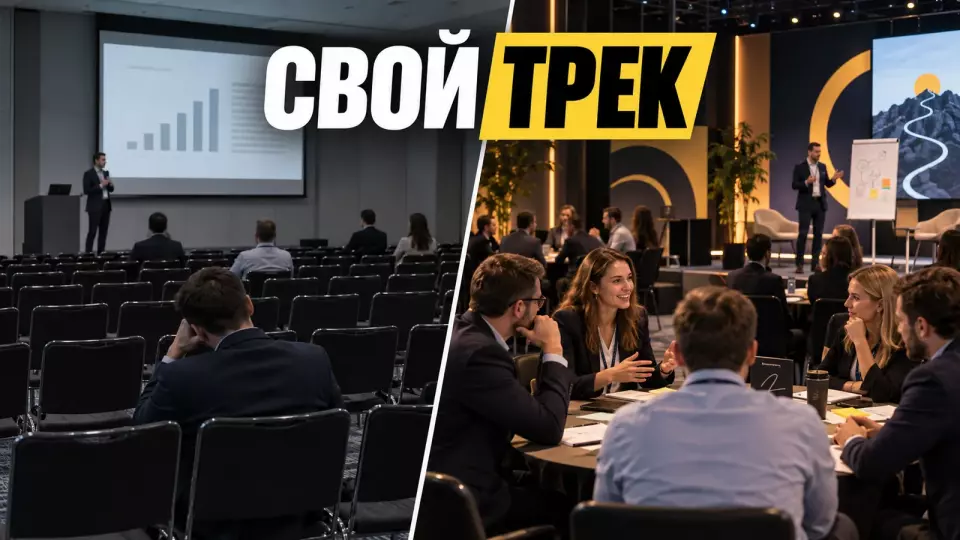
A practical plan for a branded track within an industry conference: from rights and a promise to the audience to the script, technical setup, rehearsal and results.
A dedicated track within an industry conference gives a brand more time than a single talk. But a slot in the schedule turns into a separate task: you need to assemble a useful programme, fit it into the overall grid, bring the audience into the hall and run several sessions without it feeling like a drawn-out advertisement.
At Aventura, we start with four questions. What has the organiser allowed? Why should a participant go to the brand's hall? What will they do there? How will the team verify that the programme went according to plan? The logo, décor and list of speakers come later.
If you are already discussing a dedicated hall or a series of sessions, submit a request for a scenario map and a preliminary estimate. For the first conversation, the conference programme, a description of the audience, a list of available rights and the company's goal are enough.
What is a branded track within a conference?
A branded track is a connected series of talks, discussions, or practical sessions within the program of an industry conference. The company is responsible for the content and delivery of its module but follows the organizer's rules. A separate hall becomes a cohesive program when it has a common promise, a clear order of topics, and an outcome for the participant.
A single sponsored talk usually covers one topic and one time slot. A track occupies several consecutive slots, so a participant can spend an hour, half a day, or the whole day in the hall. The program must work both for someone who came to one session and for a guest who stayed for the entire block.
A branded zone serves a different purpose. It works with passing traffic, demonstrations, and negotiations. A track is included in the schedule, has announced topics, speakers, capacity, and entry rules. If a company needs a general breakdown of participation rights, the venue, and the branded zone, it's helpful to first check the participation package for an external event.
Rights, promise, and outcome define the boundaries of the track
Before working on the program, we verify in writing what the organizer provides and what remains on the brand's side. Then the team answers two questions: why should someone go to this hall, and what will they take away from it. This way we avoid a beautiful hall with no value or a strong program that cannot be delivered under the available conditions.
First, we list everything the organizer gives the brand: the hall, access time, equipment, and entry rules. We separately note announcements, navigation, filming, participant data, and installation. We call this list the rights map. The phrase 'own track' by itself does not confirm any of the above.
Then comes the promise to the audience. It directly answers why a participant should choose this hall among parallel tracks. In a large program, a generic title like 'Future Technologies' does not help make a decision. You need a specific problem or task that a person recognizes as their own.
The outcome must be observable. The participant has analyzed a work situation, compared two approaches, received a template, or asked a question to a subject-matter expert. A discussion can end with an argument map. After a practical session, a completed worksheet remains. A demonstration should explain the conditions under which the solution is applicable.
When a brand needs a separate hall
A separate hall is needed when one session is not enough to cover the topic and the company is ready to take responsibility for the entire audience journey. In a track, you can connect the problem, practice, technology, and teamwork. The format is justified if there are several independent topics, a program curator, a moderator, technical equipment, and time for rehearsal.
A single talk is better if the task is narrow and the company has one strong speaker. A track is needed when the topics support each other. For example, a product review can transition into a technical demonstration, and then into a conversation about implementation and teamwork. Simply increasing the number of presentations does not create such logic.
The table summarizes the key points of the section: Criterion, One talk, Own brand track. Use it as a quick guide when preparing an event.
| Criterion | One talk | Own brand track |
|---|---|---|
| Scope of the topic | one complete thesis | several related issues |
| Experience control | a separate slot | a series of sessions, transitions, and the atmosphere of the hall |
| Resources | speaker, presentation, rehearsal | curator, moderator, editing, technical equipment, navigation, backup |
| Risk | get lost in the overall schedule | assemble a long promotional event without an audience |
| Result | interest in one presentation | a meaningful route and several points of contact |
We recommend checking the program before purchasing extended rights. If there are only two strong topics, it is better to have one substantial talk and one practical session than to fill a whole day with repetitions. When a company gathers the entire audience itself and owns the overall schedule, the task is closer to a product user conference rather than a module within someone else's event.
If the track should work as a unified business program, we can connect the content, hall, technical equipment, moderation, and the participants' journey in a project for organizing conferences. We calculate the estimate after we clarify what the organizer provides and what our team needs to do.
How do you connect topics, space and transitions?
A track needs one main idea. It helps select topics and explains to the participant why these sessions are placed next to each other. The idea should work in titles, moderator introductions, navigation and the next action after the session. Elaborate decor is not needed if it does not help to understand the program.
We assemble the editorial frame in one sentence. For example: 'we show how a product team makes decisions from a customer signal to launch'. After that, we check each topic: does it continue the promised route or live on its own? If the connection rests only on the company logo, it is better to remove the section.
The title 'Workshop' helps the participant expect practical work, tools and analysis. Such a metaphor is useful as long as the program confirms it with content. If the room only hosts general talks about the employer brand, the title promises more than the listener gets.
Space supports the logic. Talks need a clear frontal view. A case study requires a screen and a way to quickly gather questions. Small-group work needs tables, walkways and time for reconfiguration. If the format changes every hour, the team designs the transitions in advance and tests them at rehearsal.
How do you choose topics and speakers for your own track?
Topics are selected by their usefulness to the audience, their connection to the overall idea and the ability to support the points with practice. The speaker must master the material and be able to work in the given format. A job title and internal recognition do not replace a clear case study, a structured talk and a rehearsal with questions.
First we create a program table. In the rows we record the audience's questions, and next to them we put the level of familiarity with the topic, the format and the result. Such a table shows repetitions and helps separate product, technical and management conversations.
The working order is as follows:
- Collect the audience's questions. Sources are the conference program, submissions for past talks, customer questions and topics from the professional community.
- Choose one key point for each session. A talk should not try to cover the entire product or the company's history.
- Assign a format. A case study is best served by a breakdown, a controversial question by a moderated discussion, a skill by hands-on work, a product by a demonstration with conditions of use.
- Check the evidence. Numbers, examples and limitations must have an internal owner and permission for publication.
- Select a speaker. The expert must know the material and be ready for editing, timing and rehearsal.
- Assemble the transitions. The moderator links adjacent topics and explains who should stay for the next session.
For a technical session, the principle from the piece on customer seminar is useful: first define the participant's action and the readiness criterion for the demonstration, then select the equipment and the expert's speech.
Editorial framework protects against lengthy advertising
A brand can speak honestly about its practices and products, but a participant must understand the commercial relationship and receive a substantive answer. The editor removes general statements, repetitions and unsubstantiated promises. The more visible the sponsor's role, the more important clear rules for topic selection and a single standard for all sessions.
The review begins with the title. The option “How we built the platform” describes the company and does not explain the benefit to the listener. The title “How to separate shared services and product teams without double responsibility” already sets out the problem. A title may contain a brand if without it the meaning of the case is lost, but it must not replace the thesis.
Within the presentation we separate observation from promise. A speaker can show the architecture of a solution, the implementation process and limitations. They must not transfer the result of one team to any company. Slides with advertising formulas are better moved to a short final block with a clear next step.
Each session undergoes editorial review:
- the thesis is formulated in one sentence;
- the stated problem matches the content;
- examples are cleared for publication;
- figures and dates are verified by the fact owner;
- the product part is marked explicitly;
- time for questions is protected in the script;
- the final step does not pressure the participant.
We apply this review to external experts as well. An independent speaker retains a substantive role and does not serve as brand decoration. A company employee undergoes the same editorial selection regardless of position.
How to design the attendee journey before and inside the hall?
The journey begins in the conference schedule and ends after leaving the hall. Attendees must quickly understand the topic, find the room, enter according to clear rules, see an available seat, and receive the promised materials. Navigation and messaging work together. If one transition is unclear, a strong session loses part of the audience.
First, we identify all decision points: the card in the program, the brand announcement, the venue entrance, general navigation, the sign by the hall, and the moderator's announcement. At each point, the wording must match. Different names for the workshop in the app, on the screen, and at the door create doubt about whether the person has come to the right place.
We agree the entry rules with the organizer in advance. A general ticket may be enough, while a practical session sometimes requires registration due to limited seats. The team decides what to do about the queue, latecomers, and attendees without registration. The small-group format should not be promised if the seating does not support it.
The team builds transitions between sessions into the schedule. It is necessary to guide the audience out, quickly tidy the hall, check the microphone, and open the next speaker's materials. If the general program starts every 40 minutes, the branded hall must account for this rhythm so attendees can move to another track.
For a complex program, we connect the hall to the overall business event system. We assign in advance who registers guests, who changes the schedule, and who communicates the decision to the organizer. This way, issues are not lost between teams.
Space, technology and accessibility are just as important as content
A program is ready when it can be delivered in a real venue. The technical team checks whether everyone can see the screen and hear the speaker clearly. We test the internet connection and format switching separately. We also plan accessibility in advance: we keep aisles clear, prepare readable materials and a way to report special needs.
We put together a single venue layout and a short technical checklist. The layout shows speaker positions, the screen and aisles. The checklist lists the equipment, setup time and a backup option. Before each session, the team knows what needs to change and how long it will take.
The sound engineer checks the microphones for speakers and audience questions. The editor reviews contrast, text size and captions for diagrams. W3C recommendations advise asking participants about special needs in advance and making presentations accessible.
A hands-on session needs tables, clear aisles and time for reconfiguration. When organizing a workshop, we first check whether a participant can perform the promised action. If the venue is not suitable for this, we change the format before publishing the program.
At the rehearsal, we check the session opening, the demo, Q&A and the closing. We store video locally, prepare a spare microphone, and can run the demo without a network connection. This backup covers the main technical failures without a long list of contingency scenarios.
How to measure results for marketing, HR and sales?
Marketing selects metrics before the announcement and links them to the track's goal. Attendance shows interest in the topic but does not prove sales, hiring, or a change in brand perception. The team separately records the quality of execution, participant actions, and follow-up inquiries. We collect contacts through a consent form and explain the purpose in advance.
We divide indicators into three levels. The first is execution: the session started on time, the equipment worked, seats and materials were available. The second is participation: attendance, retention, questions, completed worksheets, meetings, and views of materials. The third is continuation: meeting requests, candidate responses, or inquiries on the topic, if the participant chose such a step themselves.
The table summarizes the key points of the section: Goal, What can be measured at the event, What to check afterwards. Use it as a quick reference when preparing an event.
| Goal | What can be measured at the event | What to check afterwards |
|---|---|---|
| Expertise | attendance, questions, saving materials | views of the recording, inquiries on the topic |
| Product marketing | participation in the demonstration, requests for clarification | voluntary requests for consultation |
| Employer brand | interest in team topics, questions about work | transitions to job openings, applications mentioning the event |
| Partnerships | scheduled conversations, topics of inquiries | agreed next steps |
We do not lump all contacts into a single 'leads' metric. A question to a speaker, a badge scan, and a meeting request have different meanings. If the organizer transfers data, the documents must specify the composition of the data, the purpose, the basis, and the period of use. If a participant leaves a contact in the brand's form, they must understand what will happen next.
Materials and follow-up after the conference
The life of the track continues if the team plans recording, summaries, and answers to questions in advance. A specific person is responsible for each session and the release deadline. A common page gathers the program and next steps. We put promises to participants in one list so they don't get lost after the teardown.
Before the event, we approve the list of materials. For one session, this could be a full recording, a short clip, a summary, a presentation, or answers to questions. Not every talk has to be released in all formats. The decision depends on rights, content, and usefulness.
The filming crew works according to the same script as the hall. Cameras must see the speaker, the screen, and audience action without obstructing the aisles. The sound engineer records clean audio separately. The full cycle can be handed over to our photo and video production team.
We determine the release order before the conference. A detailed scheme is in the article about content after the conference. Unanswered questions get an owner and an agreed channel. We pass a meeting request to the employee along with the context of the conversation.
Frequently Asked Questions
A branded track is a connected series of talks, case studies, or practical sessions in the program of an industry conference. The company is responsible for the content and delivery of its module but follows the organizer's rules. A separate hall becomes a cohesive program when it has a common promise, a clear order of topics, and a result for the participant.
Before working on the program, we verify in writing what the organizer provides and what remains on the brand's side. Then the team answers two questions: why should a person go to this hall and what will they take away from it. This way we avoid a beautiful hall without benefit or a strong program that cannot be delivered under the available conditions.
A separate hall is needed when one session is not enough to cover the topic and the company is ready to be responsible for the entire audience journey. In a track, you can connect the problem, practice, technology, and team work. The format is justified if there are several independent topics, a program curator, a moderator, equipment, and time for rehearsal.
A track needs one main idea. It helps select topics and explains to the participant why these sessions are placed next to each other. The idea should work in titles, moderator introductions, navigation, and the next action after the session. Complex decoration is not needed if it does not help to understand the program.
Topics are selected based on usefulness for the audience, connection to the main idea, and the ability to support the statements with practice. The speaker must master the material and be able to work in the given format. Position and fame within the company do not replace a clear case, a speech structure, and a rehearsal with questions.
The brand can honestly talk about its practice and products, but the participant must understand the commercial relationship and receive a substantive answer. The editor removes general statements, repetitions, and unconfirmed promises. The more noticeable the sponsor's role, the more important clear rules for selecting topics and a single standard for all sessions.
At Aventura, we can put together a programme and run a branded track end to end. Submit a request for a programme and budget, if you are choosing a participation format or already have your own time in the schedule.
Sources
Contents
Was this article helpful?