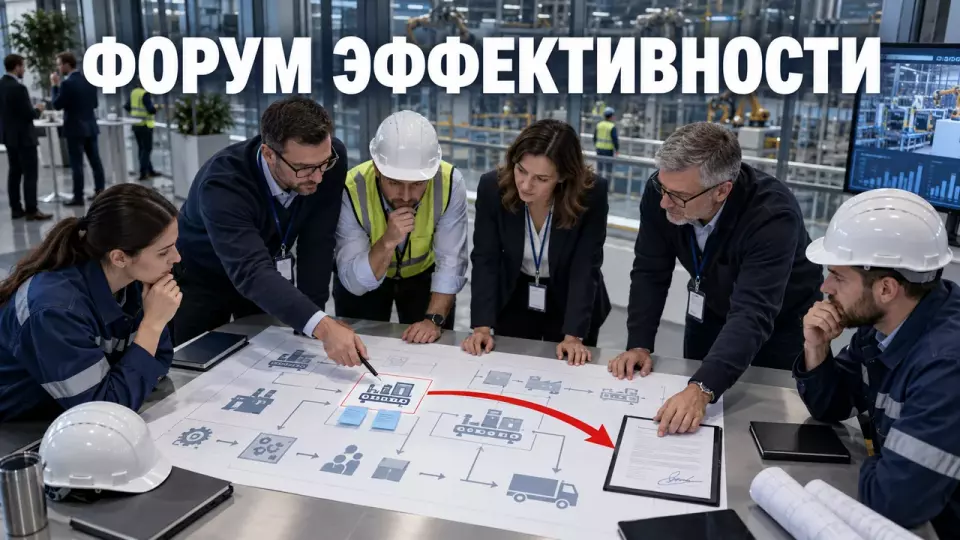
A practical framework for an operational efficiency forum: case selection, program, demo zone, safe route, and handover of decisions after the event.
Forum on operational efficiency brings together managers, production teams, and improvement authors around one goal: to select solutions worth testing or scaling. To do that, it's not enough to set up a stage and give each department time for a presentation. You need unified case criteria, working discussions, a clear participant route, and a register of decisions after the event.
At Aventura, we start such a forum with the outcome. Then we design the program, demo zone, production route, registration, and technical run-through. Enterprise experts are responsible for the content and validity of the projects. Our event team ties these materials into a controlled day without promising economic impact that no one has yet verified.
Why does an enterprise need an operational efficiency forum?
In short: an operational efficiency forum is needed when a company needs to bring together practices from different departments, compare them under common rules, and define the next step. The event makes team work visible, speeds up cross-functional dialogue, and helps managers select projects for testing or scaling. The forum itself does not validate the impact; that is done by the company's operating system.
The forum should have one working outcome statement. For example: select projects for a pilot, find solutions for multiple sites, or collect proposals for a specific production process. The formula "share experience" is too broad. With such a broad promise, it is difficult to decide whom to invite, which case studies to select, and what to record as the final outcome.
The official forum "Productivity 360" is described as a platform for sharing practices and developing solutions. An internal company forum does not need a federal scale. What is useful is the underlying logic: different participants look at the same task through specific examples, and the conversation ends with choosing next steps.
We separate content from presentation from the very start. The production unit sets the topic of conversation. Process owners validate the data. Managers define the boundaries of decisions. The event team is responsible for a clear participant journey, timing, venue, technology, and coordination.
Forum result: from cases to solutions
Before sending out the first invitation, the team specifies the expected result. She describes in advance which decisions can be made on the spot and which require additional verification. For each case, you need an owner, a question for the audience, and an acceptable next step. Then the discussion ends with a specific task instead of general praise for the presentation author.
Conveniently divide the result into three levels. The first level - the participant understood the practice and knows whom to contact. The second - the working group agreed on verification of the solution. The third - the manager appointed a pilot or requested a calculation. These levels cannot be mixed in a single attendance figure.
The table summarizes the key points of the section: Level, What happens at the forum, What remains after. Use it as a quick reference when preparing the event.
| Level | What happens at the forum | What remains after |
|---|---|---|
| Acquaintance | participant sees a case and asks a question | contact of the owner and materials |
| Working analysis | team checks applicability | list of conditions and open questions |
| Decision | authorized manager selects an action | task, responsible person and deadline for verification |
If the project involves several functions, appoint a moderator for the decision in advance. The author of the improvement knows the practice, but cannot always coordinate resources, security, digital systems, or procurement. The moderator keeps the conversation within bounds and moves disputed items to a register.
Which projects to include in the program?
In short: projects are accepted into the program if they can be explained through the original problem, the change made, the verification method, and the boundaries of applicability. A nice final slide without the initial conditions is weaker than an honest review of an unfinished pilot. The selection committee checks the facts and selects cases that are useful to several departments or important for the forum's overall goal.
We ask the author to fill out a short passport. There is no requirement to prove success at any cost. The passport helps to understand whether the project is ready for public discussion and what format suits it.
- Describe the process and the original problem without internal information that cannot be shown to the entire audience.
- Specify what the team changed and who was involved in the work.
- Explain how the result was verified and over what period.
- State the limitations: where the approach has not yet been tested or is not suitable.
- Formulate a question for the forum participants.
- Propose a next step that the process owner is entitled to assign.
Some cases are suitable for the stage. Others are better discussed at the working group table. A project with a physical prototype or a visual process map can be placed in the demo zone. An unfinished pilot is useful in a closed session if the author needs substantive feedback.
The evaluation system is announced before applications are submitted. Criteria may include relevance to the forum's goal, verifiability of data, applicability in another department, and the owner's willingness to continue the work. A ranking of departments is not needed if the criteria and initial conditions of projects differ.
If you want to combine case selection, the business program, the demo zone, and the venue work into one scenario, request a quote from us. We will clarify the task, participant composition, routes, and technical limitations.
We discuss the practice of corporate and business events in the Telegram channel of Aventura.
Participant Route and Zone Map
Different roles need their own paths through the program. A manager needs an overview of projects and decision points. A case author needs time for questions and a clear way to hand over materials. An expert needs a working session on their topic, and a new employee needs explanations of terms and navigation that doesn't lead them into a restricted production area.
A single long sequence of presentations forces everyone to follow the same path. We design a common start and several clear branches. The participant sees which sessions are open, where sign-up is required, and at which point a decision is recorded.
The table collects the key points of the section: Zone, Purpose, Control Point. Use it as a quick reference when preparing the event.
| Zone | Purpose | Control Point |
|---|---|---|
| Main Stage | forum objectives, rules, key cases | participant understands route choice |
| Work Tables | discussion of applicability and limitations | question recorded, owner assigned |
| Demo Zone | showcasing prototypes, maps, and solutions | exhibit has an author and display script |
| Production Route | connecting discussion to the actual process | group follows only the agreed path |
| Decision Point | collecting session outcomes | action entered into a single registry |
The zone map is checked for capacity, sound, and crossing flows. A demonstration next to a working session can interfere with conversation. A queue for a tour can block registration. Planning and a run-through reveal these problems in advance. A concept presentation hides them.
For a distributed company, you can set up a common broadcast and local working groups. The principles of a unified framework and local versions are discussed in the article about a series of corporate events in different cities.
How to build the day's program?
The forum program alternates between general context, short case studies, practical breakdowns, and transition time. Each block has an outcome and an owner. Only content useful to the entire audience is put on the main stage. Specialized topics go to small groups, and demonstrations get separate slots that do not compete with case studies useful to all attendees.
The general kick-off is needed for three things: state the objective, explain the rules for working with data, and show the route. A long overview of the efficiency program eats up time but does not help participants choose a session. It is better to tie the executive's opening to the issues the company is ready to discuss today.
A possible structure for the day:
- Registration and introduction to the case study map.
- General kick-off with the objective, rules, and route.
- Several short presentations featuring different types of projects.
- Parallel working sessions on pre-collected questions.
- Demo area and an agreed production route.
- Collection of solutions from moderators and process owners.
- Final alignment on next steps without a lengthy ceremony.
Time for transitions is left between blocks. If a working group finishes late, its participants should not walk in front of the stage during the next talk. Each parallel track needs a coordinator who knows the capacity, the list of registered participants, and a backup option.
A recognition ceremony is appropriate when the criteria were announced in advance. It should not replace meaningful results. We have separately described the approach to nominations and preparing participants in the article about the employee awards ceremony.
Production site tour and safety
The production route is added only after agreement with the responsible departments of the enterprise and before registration opens for guests. The group receives rules, protective equipment, an escort, and the exact route. We take into account transport, operating lines, photo restrictions, capacity of areas, and points where we can stop for explanation.
The British health and safety authority Health and Safety Executive (HSE) recommends informing contractors and visiting drivers in advance about the site rules, routes used, information about machinery, and specific hazards. In HSE layout materials, it is proposed to separate pedestrian and vehicle flows. This is foreign engineering practice. The Russian procedure for route, access, and briefing is drawn up by the client according to their own current rules and applicable occupational safety requirements.
Before the forum, the team walks the route without guests. The check is carried out in the following order:
- entrance, pass, and issue of protective equipment;
- safe assembly of the group;
- movement between points without crossing paths with machinery;
- audibility of explanations in the working environment;
- stop locations and group boundaries;
- return to the business area;
- actions in case of changes in the operation of the area.
Photo and video shooting are agreed separately. The guest should be told in advance where filming is allowed and where the device should be put away. If the route has to be changed on the day of the forum, the coordinator informs the entire chain of the new scheme: the entrance, escorts, moderators, and technical team.
A practical framework for working with guests at an operating facility is in our article about a press tour of production.
Who is responsible for the forum?
The forum is run by a single project team, but the content, decisions, and venue have different owners. At the start, we ask the client to appoint a project manager and authorized persons for production, occupational safety, data, and communications. The event team assembles the schedule, flows, technical equipment, and coordination. Moderators return session outcomes to a unified register.
The division of roles protects the project from two extremes. In the first, the event team must be responsible for production facts it cannot confirm. In the second, each expert builds their own block separately, and the day falls apart into disconnected parts.
The table summarizes the key points of the section: Role, Responsibility before the forum, Responsibility on the day of the forum. Use it as a quick reference when preparing the event.
| Role | Responsibility before the forum | Responsibility on the day of the forum |
|---|---|---|
| Project manager | task, budget, decisions | escalation and final check |
| Content owner | case criteria, fact-checking | answers on program and data |
| Occupational health and safety | route, access permits, rules | control of production zones |
| Event producer | script, schedule, contractors | venue coordination |
| Technical manager | equipment layout and backup | communications, screen, sound, power |
| Moderator | questions and outcome template | debrief and handover of decisions |
| Zone coordinator | lists, navigation, materials | participant flow and assistance |
Before the opening, the project team conducts a technical run-through. It includes entry, opening screens, presentations, microphones, moderator transitions, collection of outcomes, and backup actions. Detailed instructions are available in the guide to technical rehearsal of an event.
The contact list should show not only the person's number but also the issue they handle. Then the coordinator won't have to call the whole team because of one faulty microphone or a route change.
Accessibility, Registration, and Data
Accessibility checks start with entrance, navigation, seating, sound, materials, and digital registration. Participants need a way to communicate their needs in advance without a public explanation. The team checks the route with different participation scenarios and prepares materials in a format that can be read from various devices.
WCAG 2.2 web content accessibility guidelines provide verifiable success criteria for digital content. For the forum, this is a reason to check the registration form, program, contrast, heading structure, and post-event materials. Physical accessibility is assessed separately: the path from the entrance, doors, elevators, restrooms, seating in the hall, and the production route.
Registration collects only the data needed for access and the program. Article 5 of Law No. 152-FZ links the processing of personal data to pre-defined purposes. Before launching the form, the client and lawyer define the set of fields, legal basis for processing, recipients, retention period, and consent procedure.
For selecting sessions, a working identifier, participant role, and required time slots are sufficient. Health data belongs to special categories of personal data and requires a separate review of the legal basis and processing conditions. For requesting special needs, it is better to provide a secure channel with a limited circle of responsible persons, explain the purpose, and not include the response in the general list of coordinators unless necessary.
In registration statuses, you can distinguish invitation, confirmation, selected session, access to the route, and attendance. We discussed the entry scenario and waitlist in detail in the article on event participant registration.
How to record decisions after the forum?
Every decision goes into a single register right during the working session. The entry contains the question, the action taken, the owner, the check deadline, and the missing data. After the forum, the project secretary reconciles the wording with the responsible persons. Participants receive only that part of the outcomes that the company is ready to disclose to the selected audience.
The register template is agreed upon before the forum. Then moderators record the results in the same way. A free-form protocol of several pages is difficult to compare and pass on to managers.
The table contains the key points of the section: Field, What to record. Use it as a quick reference when preparing the event.
| Field | What to record |
|---|---|
| Question | what problem the group discussed |
| Basis | what case or data they relied on |
| Decision | what to do next |
| Owner | who is responsible for the next step |
| Check deadline | when the check status is needed |
| Constraints | what else needs to be confirmed |
| Access | to whom the record can be passed |
The final session should not retell the entire day. Moderators only name decisions that are ready for general recording, and issues that require a separate route. Disputed data remains with the process owner until verification.
After the event, it is useful to send different packages. To the participant - materials from available sessions and contacts. To the decision owner - the record from the register and a status form. To the manager - a summary by action types, without artificially summing up incomparable effects.
Budget and Technical Reserve
The calculation depends on the program, the number of parallel streams, the production route, and the venue requirements. The cost is influenced by rooms, equipment, registration, demo zone design, navigation, staff, catering, filming, broadcasting, and preparation of materials. Without a ready scenario, comparing proposals is difficult: participants in the calculation see different amounts of work.
The forum reserve is a set of pre-described scenarios with associated costs. The team decides what to replace an unavailable segment with, how to continue a session without a screen, where to move an overcrowded group, and who changes the program. We link the financial reserve to these decisions and agree it with the client before installation.
The technical scheme takes into account different critical points. On the main stage, we check sound, presentations, and timing. At the work tables, we test audibility, recording of results, and availability of materials. In the demo zone, we check equipment power and passageways in advance, and ask the author to be nearby. For the route, we prepare communication for the guides and a backup path.
We check three levels of readiness: the main scenario, quick replacement, and stopping a block without harming the rest of the program. Not every failure requires urgent rental of new equipment. Sometimes it is better to remove the demonstration and move it to a separate meeting than to delay the whole forum.
Frequently Asked Questions
The forum should have one working statement of the result. For example: select projects for a pilot, find solutions for several sites, or collect proposals for a specific production process. The formula "exchange experience" is too broad. After such a promise, it is difficult to decide whom to invite, which case studies to select, and what to record at the end.
Before the first invitation, the team sets the expected result. It describes in advance which decisions can be made on site and which require additional verification. For each case study, an owner, a question to the audience, and an acceptable next step are needed. Then the discussion ends with a specific task instead of general praise for the presentation author.
We ask the author to fill out a short passport. There is no requirement to prove success at any cost. The passport helps understand whether the project is ready for public discussion and what format suits it.
Different roles need their own paths through the program. A manager needs an overview of projects and decision-making points. A case study author needs time for questions and a clear way to hand over materials. An expert needs a working session on their topic, and a new employee needs explanations of terms and navigation that does not lead them into a restricted production area.
The forum program alternates general context, short case studies, working breakdowns, and time for transitions. Each block has a result and an owner. Only what is useful to the entire audience is given to the stage. Specialized questions go to small groups, and demonstrations get separate slots without competing with case studies useful to the entire audience.
The production route is added only after agreement with the responsible services of the enterprise and before opening registration for guests. The group receives rules, protective equipment, a guide, and an exact route. We take into account transport, operating lines, photo restrictions, capacity of areas, and points where you can stop for explanation.
If you are preparing an internal improvement forum, leave a request for a calculation. We will gather the inputs, propose a program outline, and show which items depend on the venue, number of streams, and production route.
Sources
- Federal Competence Center: "Productivity 360" Forum
- W3C: Web Content Accessibility Guidelines
- HSE: preparing visitors and managing transport risks
- HSE: site layout and flow separation
- Federal Law No. 152-FZ "On Personal Data"
Contents
Was this article helpful?