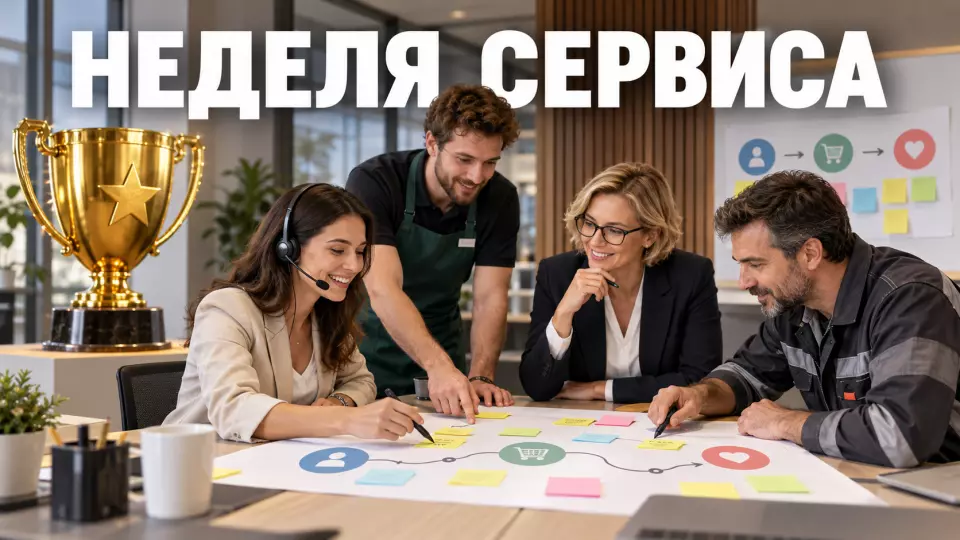
A five-day Customer Service Week programme: shifts, branches, hands-on practice, recognition, metrics and next steps — without pausing day-to-day operations.
A Customer Service Week for employees can start with a good idea and fall apart into a set of unrelated activities. On Monday they show customer stories, on Tuesday they run a quiz, on Friday they celebrate the most visible participants. Then employees go back to their shifts, while inconsistent answers, lost questions and inconvenient rules stay exactly where they were.
At Aventura we build this kind of week as an internal five-day programme. The team selects customer signals and analyses the underlying operational causes. Participants then practise specific behaviours, and systemic issues get owners. The format suits contact centres and retail chains. It can be adapted for branches, field services and other departments that cannot all be taken off work at the same time.
Leave a request — let's discuss your task
We'll clarify the event format and suggest the next step.
What Is Customer Service Week for Employees?
Customer Service Week for employees is a series of connected internal modules built around specific customer situations. Participants spot recurring signals, examine the conditions they work under, try out the right action and pass issues on to those responsible for the processes. The format does not replace ongoing customer experience management, but it helps focus the company's attention on selected situations.
The audience for the programme is the company's employees and managers. The customer experience is presented through anonymised enquiries, aggregated feedback themes, a journey map or material that the client has pre-approved for internal use. If customers, dealers or invited clients take part in the programme, they need a separate scenario for a client event.
The scope of the week should also be limited. The product, logistics, authority, interfaces and metrics require ongoing work. In five days, a team can select a few situations, agree on clear actions and assign owners to open issues. Promising to fix the entire service in a week will only create false expectations.
Material featuring the voice of the customer becomes the starting point for a conversation, not a standalone result. The signal is linked to an employee's work situation, handovers between departments, practice and the follow-up decision. This sequence helps move away from emotional discussion of individual stories towards actions that can be tested on the job.
We test the concept with a simple question: what will the employee do differently in their next interaction with a customer or colleague? The answer "become more customer-centric" is too broad. It is more useful to name the action: clarify the expectation, explain the limitation without making a false promise, pass on the enquiry together with its context, or return an agreed status.
Customer Service Week for employees must not turn the front line into the only party responsible for the outcome. If a person is held back by an outdated instruction, lack of access or contradictory rules, the issue is passed to the process owner. Training helps where an employee needs to master an action. Changing the system requires a different solution.
The Goal of the Week and the Business Result
Before developing the scenario, the goal of the week needs to be tied to several observable actions and process obstacles. Then the cases, practice, communication and evaluation all support a single objective. A general call to "improve service quality" will be understood differently by each department, and the final report will boil down to the number of broadcasts and publications.
At the outset, we suggest making six decisions:
- Which customer situations are in focus.
- Which groups of employees can influence them.
- Which action needs to be made uniform or clearer.
- Which obstacles cannot be removed by training frontline staff.
- Based on which data the team will monitor continuation.
- Who makes decisions after day five.
This set keeps the connection between the event and day-to-day work. For example, a repeat contact may arise from a missed clarification, an outdated instruction, different statuses in two departments, or an unavailable channel. Politeness training will only address part of the possible causes, so the situation needs to be analysed first.
It is convenient to divide the results by level of responsibility. An employee needs clear actions and observation criteria. A first-line manager needs questions for a short debrief and a way to escalate an obstacle. Process owners need the topic, context, next step and the date the status will be reported back.
The table summarises the key points of the section: Level, What Can Change, How to Confirm Continuation. Use it as a quick reference when preparing the event.
| Level | What Can Change | How to Confirm Continuation |
|---|---|---|
| Employee action | clarifying the request; explaining the limitation; passing on the enquiry | practice; manager observation; quality calibration |
| Manager's work | feedback; help in a difficult situation; a short shift debrief | observation sheet and list of obstacles |
| Knowledge base | answer; instruction; route or template | published update and user notification |
| Cross-functional process | handover between frontline, product, IT and logistics | owner; status; next step and reporting deadline |
| Internal communication | a single explanation of changes | current version of the material and an available channel for questions |
This division protects employees from unfair responsibility. A lack of authority, a systemic error or a conflict of rules go on the list of decisions. If, however, the problem is related to a skill, the team receives practice and manager support after the week.
At the same time, metrics that must not deteriorate are set. Changing one number means little if the workload has increased, overtime has appeared, or errors in another channel have become more frequent. Before the start, the team agrees on what shift it wants to see and what constraints it will take into account when evaluating.
Who takes part in the programme?
The composition of participants is determined by the customer journey, not just by the organisational structure. The programme includes employees with direct contact and first-line managers. They are joined by the back office and process owners. HR, the customer experience team, learning and internal communications support the overall logic. Content decisions remain with the client's specialists.
We start with an audience map. For each group we note whether it receives a request, makes a decision, passes on a task, updates data or manages the people who do this every day. The same job title in two departments can mean different roles in the customer journey.
The table brings together the key points of the section: Group, What it needs from the week, Suitable format. Use it as a quick guide when preparing the event.
| Group | What it needs from the week | Suitable format |
|---|---|---|
| Contact centre and support | consistent answers and clear handover of requests | dialogue reviews; role-play practice; calibration |
| Retail and front office | solutions for live traffic and local constraints | short modules in work windows; action cards |
| Field teams | access outside a fixed workplace | mobile pack; repeatable briefing; contact with the manager |
| Back office | to see the impact of internal deadlines and rules on the customer | journey map and review of handovers between functions |
| Shift and site managers | to support the application of the skill | observation sheet and feedback questions |
| HR and learning | to ensure access and evaluate the training modules | group matrix; repeat calendar; pre- and post-check |
| Customer experience and quality team | to select cases and criteria | topic review; preparation of scenarios; alignment of observations |
| Product, IT, logistics and legal function | to take on systemic issues | thematic meetings; list of decisions; written summary |
First-line managers are especially important after the general module. They translate the topic into the actions of a specific shift, store, branch or service team. The manager sees whether the employee has applied the new approach and what got in the way. We look at this role in more detail in the article about the forum for line managers.
We supplement the map with access conditions. Who works at a computer? Who receives news via the corporate app? Who has only a short window at the start of a shift? Who is on the road? Where is printed material, subtitles, a text version or the help of a local facilitator needed?
After this review, the programme stops depending on a single central broadcast. A common content core, several participation windows and versions of materials for different working conditions emerge. This reduces the risk that a convenient head office schedule will exclude night shifts or field roles.
A Five-Day Week Programme
Five days can be linked into a short programme: a client signal, a review of causes, a practice of action, questions for adjacent departments and a wrap-up with next steps. A day does not have to take many hours. What matters more is that each module has a clear objective, fits the work schedule and leaves material for the next step.
A five-day programme usually consists of short modules in working windows. Managers and process owners may need separate meetings. The information part can be recorded if participants were warned about the recording in advance and the requirements for legal basis, necessary consents, access and retention period were met. Practice is best repeated live for each group.
For each day we prepare a kit that can be handed over to a local facilitator: a task card, participant material, a moderator's guide, a manager's sheet and a place for questions. The asynchronous version includes only what can be studied without feedback. This way the content is preserved when repeated in other shifts.
Day 1. The Client Signal and the Subject of the Conversation
The first day shows which situations have been selected and why the company is taking them on. Participants are told the boundaries of the programme, the schedule of repeats and how to submit a question. Contests and awards can support the week later on, but first employees need a common subject of conversation.
The day's programme includes:
- A short opening by a manager with a clear objective.
- Generalised topics of enquiries without unnecessary personal data.
- A diagram of what the client sees and what happens inside the company.
- A review of a short situation or an initial comprehension check.
- Collecting questions from shifts, branches and the back office.
- Publishing the schedule of repeats and available materials.
The manager explains why these particular situations were chosen and what the company will do with employees' questions. The scope of possible decisions is best stated right away. If some topics require lengthy analysis, participants are told when and where the next status update will appear.
We only take on client material with the client's voice after checking the purpose and composition of the data. For the programme, a generalised topic, a journey diagram or a retelling of several similar cases is often enough. An emotional quote is replaced with a safe retelling if the combination of details could identify a person.
Leave a request - let's discuss your task
We'll clarify the format of the event and suggest the next step.
Day 2. Reviewing Enquiries and Operational Causes
On the second day the team looks at several prepared situations from different channels. Participants note the client's expectation, the steps inside the company, the transfer of information and the point where the difficulty arose. The task is to choose the next action without looking for someone to blame.
Causes can be grouped into several categories. Knowledge and instructions, authority, access to data and regulations are looked at separately. Then workload, handovers between departments and the expectation created by communication are checked. The remaining cases are marked for separate analysis. This grouping serves as a working prompt and does not prove a cause without additional verification.
A behavioural issue is passed on to the practice programme. A gap in the knowledge base gets an owner for the update. A systemic topic is sent to product, IT, logistics or another function. Assessing an employee's personality is not part of such a review.
In a large company, parallel meetings on different types of contact are useful. The contact centre reviews the conversation and the handover of the enquiry. Retail looks at the situation at the point of sale. The back office shows what happens after an internal request. The groups then compare the points where the same problem is described in different words.
Day 3. Skills Practice
The third day is devoted to an action that can be heard or seen in a real contact. An employee gets to know the model, tries it on a typical situation, receives feedback and repeats a difficult fragment. A short practice shows the first way of acting, and the application is checked later at work.
The practice sequence is simple:
- The facilitator explains the chosen model.
- An expert demonstrates it on one case.
- Participants try the action in pairs or a small group.
- An observer gives feedback against clear criteria.
- The participant repeats the difficult fragment.
- The manager receives a checklist for observation after the module.
The criterion should describe an action. For example, the employee clarified the request, named the real next step, checked understanding and passed on the context. The wording "showed empathy" remains too broad until the team has agreed on what exactly the client will hear.
If the topic requires a difficult conversation, we build the scenario on a typical situation rather than a verbatim recording of a real client. This approach reduces the amount of personal data and allows us to keep the details needed for training. Formats of short learning stations are described in more detail in the article about the corporate learning fair.
Day 4. Questions for Adjacent Departments
The fourth day focuses on conditions that an employee cannot change through a single training session. We send topics to product, IT and logistics in advance. Other questions get owners of rules, the knowledge base, quality and training. The expert sees the context before the meeting and understands what decision employees expect.
Answers receive clear statuses: can be applied, needs updating, requires analysis, the limitation remains for now, or the topic is beyond the scope of the week. If there is no ready-made solution, the speaker does not improvise or make personal promises. They record the next action, the owner and the date of the next update.
For a large company, instead of one long broadcast, several themed meetings can be held. Employees choose the relevant topic, and managers see recurring questions. After the meetings, the team issues a single written version for those who were not present.
Pre-collection, moderation and follow-up on open answers can be supplemented with the approach from the article about a town hall for a company. In the service week, this module is tied to selected client situations and does not replace the ongoing work of process owners.
Day 5. Recognition and next steps
The final day combines employee recognition with a working outcome. Participants see useful actions, decisions made, open limitations and dates of the next updates. The celebratory part supports the programme if it does not crowd out information about what will change after Friday.
We link recognition to criteria announced in advance. You can recognise an employee or a team that helped a client get through a difficult stage, spotted a recurring topic, improved an instruction, passed on a request together with its context, or supported a colleague.
The working outcome answers six questions:
- Which materials have been updated.
- Which tasks have been taken on by process owners.
- Which questions remain open.
- How managers will continue monitoring.
- When the next status update will appear.
- Where employees will see the decisions and can ask a follow-up question.
A photo, an employee's name or a video are used only after verifying the legal basis and obtaining the necessary consents. The company determines in advance where the material will be published, who will have access to it and how long it will be stored. Refusing public posting should not deprive a person of recognition itself: a team, written or non-public format can be chosen.
How do you include shifts, branches and field teams?
A single common programme can have several schedules. The theme of the day, the expected action, the practice criterion and the way to return to the question stay the same. The time, channel and local example are adapted to a shift or branch. Reach is then counted by individual groups, not by the total number of invitees.
First we build a matrix of "branch, function, shift, device access". It shows the route for each group. A live stream suits some employees. Others need a replay, a text version or a pack for the shift supervisor. This work is done before the invitation is issued.
The practical scheme includes a mandatory content core, several windows for key modules, a set of local hosts and an accessible way to ask a question. The information parts can be recorded. Live practice is run separately, because the participant needs an attempt, feedback and repetition.
Before recording participants, they are notified in advance of its purpose and intended use. The client checks the applicable legal basis and the necessary consents, determines the access scope and the retention period. A recording should not be made "just in case": the team first decides who needs it and whether it can be replaced by a text summary or a presentation.
Training is scheduled in working windows, taking into account the workload, breaks and the schedule of a specific group. If a module cannot be delivered during working hours, the client needs to agree the procedure with HR and legal in advance, and also check the requirements for compensation and the formalities of participation. We do not set such conditions on the employer's behalf and include only the agreed decision in the plan.
For branches, the in-person and remote routes are designed separately. The remote audience has its own moderator, question channel, available materials and a way to return to the outcomes. The technical details are covered in the material on a hybrid conference for branches.
If part of the programme takes place online, participants are told in advance how to turn on subtitles or open a text alternative, where to ask a question and what to do if there is a connection problem. A person may join from a phone, from a noisy room or with an unstable internet connection. One way of taking part does not suit everyone.
Communication is also divided by role. Front-line employees need to know the time of the module and the action for practice. A manager needs an observation task. Back-office staff need the topic of the meeting and a list of input questions. We described the logic of the message series in more detail in the article on promoting a corporate event.
When a customer service week for employees connects a central venue and a distributed audience, we use solutions for hybrid events. We connect the hall, the broadcast, remote moderation and materials, but we choose the technologies after mapping the audiences.
We publish breakdowns of internal and business formats in the Aventura Telegram channel. Subscribe if you are preparing a programme for a distributed team and want to compare practical solutions.
Working Safely with Client Cases
Removing a name is not enough if the person can be identified by a combination of date, rare product, branch, job title or sequence of events. For training material, only the necessary details are kept, indirect identification is checked separately, and the original request is not shared with the entire project team. The client verifies the specific procedure against its own rules and applicable law.
We start with the training objective. If participants are practising how to explain a limitation, they do not need the order number, the exact address or the full contact history. The fewer unnecessary details that end up in the case file, the clearer the situation for practice and the lower the risk of data disclosure.
Preparing a case involves several steps: choosing the objective, removing direct identifiers, generalising rare characteristics, rewriting free-form text and checking whether a colleague from a specific branch could recognise the person. The training version is separated from the original request. For working copies, an access owner and a deletion deadline are assigned.
Screenshots and screen recordings require particular attention. They may still contain a name, number, address, internal identifier, an adjacent tab or a notification. A redacted fragment does not guarantee safety if the surrounding context reveals the situation.
We receive the client's material only to the extent needed for the agreed content. The client verifies the legal basis for transferring and using the data, as well as the necessary consents. Access is granted only to production participants who need it. Once the training version is approved, the source files must not be stored uncontrolled in shared folders.
A recording of a real conversation cannot automatically be considered acceptable training material. The same applies to video featuring a person, a photograph and a name. Before use, the purpose and legal basis are verified. The necessary consents, the circle of recipients and the retention period are determined separately. If a typical scenario serves the same purpose, it is safer to work with that.
ICO and NIST guidance materials suggest assessing risk with regard to the environment, possible cross-referencing with other data and the access procedure. They are useful for organising the review, but they do not replace Russian legislation or a company's internal policies. The legal assessment is carried out by the client together with its responsible specialists.
How do you combine practice with questions for adjacent departments?
Practice helps an employee master an action. Questions for adjacent departments reveal the conditions for applying it. If you mix the two tasks, participants will start discussing the interface during a role-play. The opposite can also happen: the group will wait for a system-level decision where a skill is what's needed. That's why each format has its own facilitators, criteria and outcome.
Before practice, the team chooses one observable skill. A broad topic produces a superficial conversation. It's better to separately rehearse the start of a difficult dialogue, handing over a request, explaining a delay or capturing a customer signal.
The participant card contains context without unnecessary data, the task, available authority, a constraint and feedback criteria. At the end, the person repeats the difficult fragment and chooses the next step in real work. The manager receives the same criteria to support the application of the skill after the session.
Questions for other functions are collected separately. The moderator groups similar wording but does not draw a conclusion about how frequent a problem is based only on the number of messages. Several questions may reflect a single active chat, and a group's silence does not mean there are no difficulties. The scale of the topic is checked against available work data.
During the meeting, the expert distinguishes between explaining the current procedure and making a decision. The phrase "the system works this way" provides context. A decision requires an action, an owner and a status. If a change is not yet possible, employees are honestly told about the constraint and the agreed way of working under existing conditions.
After the meeting, a compact list is published:
The table summarises the key points of the section: Field, What to record. Use it as a quick reference when preparing the event.
| Field | What to record |
|---|---|
| Topic | a brief wording of the question |
| Context | where the situation arises and who it affects |
| Status | resolved, under analysis, a constraint or outside this week's tasks |
| Owner | the function responsible for the next step |
| Action | what is being checked, updated or explained |
| Next update | when and where employees will see the status |
Such a list preserves the questions after the event and highlights topics that cannot be closed by the event itself. Sometimes the useful outcome is an honest admission: the process requires a separate project, and the temporary procedure needs to be explained to employees right now.
For a programme with several streams, moderators and decision owners, the business event format is suitable. At Aventura, we are responsible for the dramaturgy, production and collection of materials, while the client's specialists make the content decisions.
Employee recognition without a popularity contest
Recognition becomes clear when the criteria are announced in advance and tied to a specific contribution. The basis can be a clear explanation to a client, a high-quality handover between departments, spotting a systemic problem, helping a colleague, or improving a guideline. A single customer metric and the number of thank-you notes do not describe an employee's entire contribution.
The "most customer-centric employee" nomination leaves too much room for personal impression. It is hard for colleagues to understand which action to repeat. It is harder for the back office to show its impact on the customer journey, and managers compare incomparable situations.
We suggest choosing several observable bases:
- spotted a problem and passed it to its owner;
- helped a client get through a difficult stage without a false promise;
- passed a request along with the necessary context;
- supported a colleague in a difficult situation;
- improved a guideline or the knowledge base;
- explained a limitation in plain language.
Criteria are verified against available facts, without moving customer data into a public story. An employee's photo, name and video are used only after the legal basis and necessary consents have been verified. If a person does not want to go on stage or appear in an internal publication, we offer another form of recognition.
It is useful to combine individual and team formats. Service is rarely created by one person. Behind a front-line answer there may be a knowledge base specialist, a product team, a mentor and a shift manager. Team recognition shows this connection and does not reduce the result to one participant's popularity.
Recognition can be spread across the whole week. A manager notes useful actions during shifts, and the finale brings together several telling stories. The detailed mechanics of the criteria and the scenario can be taken from the material on the employee award ceremony, without turning a service program into a separate large ceremony.
How do you measure results and keep the momentum going after the week?
Evaluation is built around the decisions the team wants to make. Reach shows which groups had access. Practice helps verify understanding of the action. Manager observation shows application on the job. Client and process metrics provide an additional signal, but on their own they do not prove that the week was what caused the change.
First you formulate the question, then you choose the metric. If you need to understand whether night shifts were left out, you collect reach by group. To test a skill, you use a case study or observation. To see systemic work, you track task statuses, updates to instructions and owner response times.
A compact set might include:
The table brings together the key points of the section: Level, What to look at, Which decision it supports. Use it as a quick reference when preparing the event.
| Level | What to look at | Which decision it supports |
|---|---|---|
| Access | participation by shift; branch and role | where a repeat or a different channel is needed |
| Learning | solving the case and demonstrating the action | what is understood and what needs practice |
| Application | manager or quality observation | whether the skill is being used on the job |
| Process | handovers; waiting; escalations; how current the knowledge base is | where the working procedure is changing |
| Owner decisions | closed tasks and updated rules | what was done after employee questions |
| Constraints | workload; errors; overtime | whether a new problem has emerged |
Attendance confirms access, but not learning outcomes. A high participant rating shows a reaction, but not application of the skill. A change in a client metric after the week may be linked to workload, the product, the sample or the collection method. That is why conclusions are formulated cautiously and comparable data is compared.
Before launch, it is enough to answer five questions: which decision do we want to make, which metric will help, where the data lives, when the baseline is taken and who is responsible for the follow-up check. The full methodology is described in the article on corporate event KPIs.
Work after the week begins at the programme stage. The team appoints in advance the recipients of questions, the owners of updates and the dates of messages to employees. After day five, what remains is a list of decisions, tasks with owners, up-to-date materials, a plan for manager observation and a date for the control check.
Employees should see how the company handled their questions. A status of "the constraint remains" is more useful than silence if the reason, the temporary procedure and the date of the next return to the topic are explained. This kind of feedback maintains trust in new suggestion-gathering rounds.
A customer service week for employees provides material for follow-up, not ready-made proof of a long-term effect. We help package the data and decisions into a final document, but the client assesses the causes and priorities together with the process owners.
Programme mistakes and the brief for our team
A weak programme often gives itself away before the script is even developed. It is packed with activities, but no client situation has been chosen; a single broadcast is considered sufficient reach; enquiries are presented without verifying the data; training is scheduled outside the agreed working windows; and the finale is left without owners or dates. These risks can be eliminated at the brief stage.
One group of mistakes relates to content. Festive mechanics replace the business task, a public debrief looks for someone to blame, and training is offered where the employee lacks the authority or the tool. We bring the discussion back to the client's situation, the employee's action and the question that the process owner needs to decide.
Another group relates to access. A single broadcast is convenient for the central team, but ignores shifts, field roles, time zones and employees without a computer. A formal guest list does not confirm attendance. That is why we build an audience map before choosing the venue and channel.
A separate risk arises when working with data and recognition. A real case can identify the client through a combination of details. An award based on a single metric can compare incomparable conditions. Both decisions require context checks, access restrictions and clear criteria.
Finally, a programme loses its meaning without a written outcome. Participants heard the answers, but do not know who took the question on board or when to expect a change. Promising to fix everything in five days makes this problem worse. A realistic finale shows what has been done, the open limitations and the next steps.
For the first brief, our team only needs you to prepare:
- The goal of the programme and several business situations.
- The composition of audiences, branches, shifts and access conditions.
- Permitted materials on the enquiries and the rules for using them.
- The process owners who will take on systemic questions.
- Constraints on time, workload and internal approvals.
- Data sources for the baseline and follow-up review.
We will clarify the missing details together with the client. Based on the brief, we will put together the programme architecture, the repeat calendar, module scenarios, the technical scheme and documents for the facilitators. If the format resembles an internal forum with several tracks, we draw on our experience of organising conferences. For a broader corporate programme, organising corporate events is the right fit.
It is best to bring our team on board before the overall calendar is approved and the announcement is released. That way we will have time to link the content to shift windows, check the technical conditions, prepare accessible versions of the materials and agree on the procedure for working with data. If the invitation has already been published, we will first check the promises made to participants against the actual production capabilities.
Frequently Asked Questions
A customer service week for employees is a series of connected internal modules built around specific customer situations. Participants spot recurring signals, examine the conditions they work under, try out the right action and pass questions on to those responsible for the processes. The format does not replace ongoing customer experience management, but it helps focus the company's attention on selected situations.
Before developing the scenario, the goal of the week needs to be tied to a few observable actions and process obstacles. Then the cases, practice, communication and evaluation all support a single objective. A general call to "improve service quality" will be understood differently by each department, and the final report will boil down to the number of broadcasts and publications.
The participants are determined by the customer journey, not just by the organisational structure. The programme includes employees with direct contact and first-line managers. They are joined by the back office and process owners. HR, the customer experience team, learning and internal communications support the shared logic. Content decisions remain with the client's specialists.
The five days can be linked into a short programme: a customer signal, analysis of the causes, practising the action, questions for related departments and a wrap-up with next steps. A day does not have to take many hours. What matters more is that each module has a clear objective, fits the work schedule and leaves material for the next step.
A shared programme can have several schedules. What stays the same is the theme of the day, the expected action, the practice criterion and the way questions are returned. The time, channel and local example are adapted to a shift or branch. Coverage is then counted by individual groups, not by the total number of invitees.
Removing a name is not enough if the person can be identified by a combination of date, a rare product, branch, job title or the sequence of events. Only the necessary details are kept for training material, indirect identification is checked separately, and the original enquiry is not shared with the entire project team. The client verifies the specific procedure against its own rules and applicable legislation.
Leave a request - let's discuss your task
We'll clarify the format of the event and suggest the next step.
Sources
- ICO - checking the effectiveness of anonymisation
- NIST - managing data anonymisation
- HSE HSG256 - managing the risks of shift work
- Acas - consulting employees and feeding back results
- CIPD - overview of employee incentives and recognition
- GOV.UK Service Manual - measuring user satisfaction
- OPM - performance management cycle and recognition
Contents
Was this article helpful?