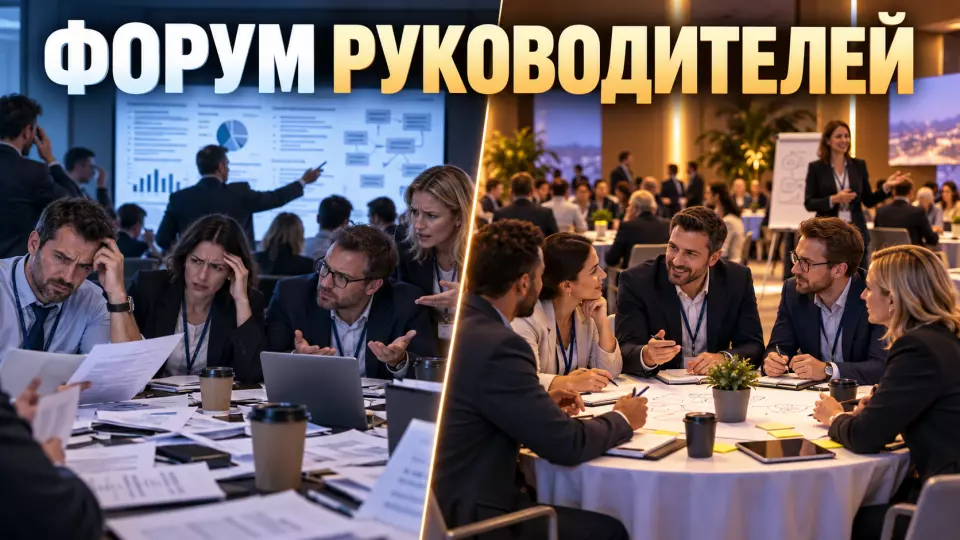
How to build a program for a forum of line managers: goals, practical stations, case clinics, dialogue with the top team, and a cascade of decisions.
A program for a line managers' forum is needed when communicating another set of messages from top to bottom is no longer enough. Shift supervisors, store managers, site managers, branch heads, and service group leaders need to understand changes in daily work, try new actions, and get answers to cross-functional questions.
A good program is far from a parade of presentations. It connects business priorities, real situations of the first line, training of managerial conversations, and decisions of function owners. The outcome includes presentations and a list of actions: responsible parties, place of application, and a checkpoint.
In 2026, a fashionable superstructure is of no use to the format's logic. It is more useful to honestly separate skill-based, process, and systemic tasks, outline the event's authority in advance, and design the continuation. Below, we at Aventura show a working approach without invented standards and promises of universal effect.
Leave a request - let's discuss the task
We will clarify the event format and suggest the next step.
What is a line managers' forum?
The line managers' forum program turns a working event for current first-line managers and functional partners into a sequence of specific work tasks. Here the company's priorities are translated into management actions, network barriers are examined, systemic issues are handed over to owners, and next steps are agreed for each significant issue.
The first line in different companies includes shift and section heads, managers of stores, warehouses, branches, service teams, contact centers, and territorial units. Job titles vary, but the position is similar: these people link head office decisions with the daily work of employees.
Therefore, simply passing on information is not enough. A line manager usually works in a field of competing demands: meeting the plan, complying with quality and safety standards, retaining the team, implementing changes, and responding to uncontrollable constraints. Gallup research and the CIPD review draw attention to the first line's workload, clarity of expectations, support, authority, and quality of people management.
A working forum has several notable features:
- a network of units, regions, sites, or shifts is represented;
- the agenda is linked to current business priorities;
- participants work with real situations instead of passively listening to presentations;
- owners of operational and functional solutions are present in the program;
- cases are anonymized and edited in advance;
- solutions get owners, deadlines, and a verification method;
- the end of the event launches a cascade into the units.
The program should depend on the participation of line managers. Without practice, it turns into a communication day, and the absence of function owners leaves systemic problems without a route to resolution.
The boundary with training and adjacent formats
The main product distinguishes the first-line meeting from a management school, an HR forum, and an operational efficiency session. Lengthy training, assessment of potential for a future position, and analysis of process metrics remain tasks for adjacent formats. Here, the product becomes managerial actions and decisions that are transferred to the network upon completion of the event.
The table contains the key points of the section: Format, Main question, Typical horizon. Use it as a quick reference when preparing the event.
| Format | Main question | Typical horizon | What remains as output |
|---|---|---|---|
| Frontline managers forum | What should managers and functions do differently now? | Event and short implementation cycle | Decisions, practiced actions, owners and checkpoints |
| Management school | Which competencies need to be consistently developed? | Several modules or months | Learning progress, assignments and development plan |
| HR reserve forum | Who is ready for the next role and how to develop potential? | Career cycle | Assessment, projects and development routes |
| Leadership Day | What common framework does management convey to managers? | Usually one day | Unified messages and context |
| Operational efficiency forum | How to improve process, quality, timelines or costs? | Project or operational cycle | Process changes and a set of operational initiatives |
Boundaries protect the project from inflated promises. A full-fledged management school requires more than one day. Safe work with cases is incompatible with hidden HR assessment of statements. Communication training is also pointless when the root cause of the problem is hidden in scheduling, IT systems, or lack of authority.
Before designing, it is useful to compare the forum with other internal formats. For choosing the overall logic, the material on technical specifications for a corporate forum will be helpful. We cover the difference with the process agenda in more detail in the article about operational efficiency forum, and we show the boundary with successor development in the analysis of HR reserve forum.
How to determine the outcome of a forum?
The outcome of an event is described through observable actions and decisions made. General formulas about engagement and experience sharing are useless here. Before developing the scenario, the client and the project team agree on new actions for participants and issues that the company is ready to solve or officially take into work.
At Aventura, we start with four levels of results:
- Overall clarity. Managers have a shared understanding of priorities, constraints, and what remains unchanged.
- Managerial action. The participant practices a specific conversation, short brief, delegation, feedback, or escalation.
- System solution. The functional owner accepts the issue, gives a status, and assigns the next step.
- Transfer to the department. The manager receives the material for the team, the date of first application, and the feedback channel.
The phrase "improve management quality" is too broad. The working version sounds different: "managers practice a conversation about violations of standards based on facts, and issues outside their authority are transferred to owners through a single escalation card." Then the program can already be checked for alignment with the goal.
Collected cases are immediately divided into three types. A skills-related case requires behavior training. A local process problem allows a small test in one department. A systemic constraint is transferred to the function or sponsor. This sorting eliminates the false message that a communication skill will fix any problem.
The result is fixed in a one-page project contract. It includes the audience, business priorities, permissible scope of decisions, mandatory outputs, sensitive topics, issue owners, and the rhythm of subsequent review. The document is used by the client, the program director, and moderators.
Program architecture
The working architecture leads participants from the general context to practice, then to decisions and cascading to units. In a two-day event, we typically maintain four layers: business frame, voice of the network, action training, and commitment capture. A one-day option requires fewer topics but retains a trial of management action and involvement of owners of systemic issues.
Below is an example that does not claim to be a universal standard. Block durations depend on the network scale, case complexity, number of parallel groups, and the authority participants have.
Day 1: context and real constraints
- Sponsor's opening. Three or more priorities, conflicting demands, boundaries of the forum's decisions.
- Translating strategy into unit operations. Groups determine what the manager starts, stops, and continues doing.
- Network barriers map. Participants compare issues across regions, shifts, or unit formats.
- Practice stations. First round of management situations with observation and feedback.
- Case clinics. Small groups analyze pre-prepared work cases.
- Operational council. Function owners assign systemic issues to statuses.
- Personal commitment. Each participant chooses one action, one ritual, and one request upward.
Day 2: repetition and decisions
- Review of day one. The group names what worked, what remained unclear, and what needs to change.
- Second round of practice. Participants repeat the action considering feedback or move to a related scenario.
- Cross-functional clinics. Operations, HR, IT, quality, and other owners work with network cases.
- Local experiments. Teams describe a small test, starting point, and date to review the result.
- Decision cascade. Regional groups prepare a unified message for their units.
- Function contract. Each function states its outcome, owner, and control date.
- Sponsor's closing. Only adopted decisions and honest statuses of unresolved issues are confirmed.
We design the one-day program separately, without a sped-up replay of the two days. We keep the general frame, a limited set of stations, a few strong cases, a council of owners, and time for commitment. Otherwise participants will remember the pace but leave without a trial of a new action and an agreed decision.
The organizational part of the program is convenient to design together with the content part. The service of organizing forums and seminars covers the venue, registration, stage setup, group work, and contractor coordination. Technical perfection is powerless without a clear goal, so we first design the logic of participants' work.
Case clinics for the first line
A case clinic is useful when a manager brings a current work situation and asks colleagues to structure their perspective. The group separates facts from interpretations, identifies constraints, gathers hypotheses, and selects a testable step. The author retains the right to accept or reject the proposed options. The format remains a mutual review among colleagues; psychological therapy and public evaluation of the author are outside its scope.
It is better to collect cases before the general meeting. An editor or methodologist clarifies the context, removes personal data, checks the author's question, and determines whether group discussion is appropriate. A raw story often contains evaluations of people, unnecessary details, and several problems at once.
The workflow of a case clinic may look like this:
- Contract. The author formulates the question, and the moderator reminds the rules of confidentiality and recording.
- Story. The author describes the facts, actions taken, constraints, and desired outcome.
- Clarification. Participants ask questions, refraining from giving advice and demonstrating their own expertise.
- Author's pause. The author listens to the group's hypotheses and is not obliged to respond immediately.
- Hypotheses. Colleagues propose possible explanations and label them as versions.
- Action options. The group collects several realistic moves.
- Choice. The author decides what to test first and what signal to observe.
- Escalation. The moderator clarifies whether the involvement of the function owner is required.
- Process review. The group notes what helped thinking and where advice appeared too early.
The clinic is stopped when medical, disciplinary, or other sensitive information that is closed to group discussion appears. The same rule applies if an investigation or legal decision is required. The moderator forwards such a question to a pre-agreed closed channel.
A common mistake is advice from experienced participants from the very first minute. The author receives a dozen ready-made recipes, although the original question remains unexamined. A good moderator holds the stages and returns the conversation to the facts.
Practical stations
Practical stations turn the event theme into observable managerial behavior. The participant acts in a familiar situation, receives feedback according to pre-defined clear criteria, and makes a second attempt. Observers discuss specific actions rather than the personal qualities of the leader. Repetition distinguishes practice from demonstration and allows immediately testing a different way of working.
For each station, we define five elements: work context, participant's role, partner's role, observation criteria, and transfer to real work. The scenario tests actions instead of knowledge of fancy phrases. The leader faces a choice similar to a situation in a shift, store, branch, or service group.
The program can include the following stations:
- Priority conflict. The leader chooses what to do now, what to postpone, and what to escalate. The observer evaluates the clarity of the choice and the explanation to the team.
- Feedback on work facts. The participant names the observed action, explains its impact, asks a question, and agrees on the next step.
- Resistance to change. The leader acknowledges the unknown, shares confirmed information, and gathers questions without false promises.
- Cross-functional escalation. The participant states the fact, impact, steps already taken, required decision, and deadline for response.
- Conversation about quality or safety. The leader stops the risk, identifies the causes, and does not support pressure to "do it at any cost."
- Short team brief. Within a limited time, the participant synchronizes the goal, roles, risks, and feedback channel.
It is better to make the criteria short and observable. During feedback, they check the specificity of the fact, whether a question was asked to the employee, the agreement, and the method of control. Ratings like 'showed leadership' do little to help the participant in the second round.
Stations can be distributed by choice instead of an identical carousel. A new leader benefits from a basic conversation about a task, while an experienced shift supervisor benefits from cross-functional escalation. A preliminary audience map helps to distribute different levels of complexity among the instructions.
How to Prepare Moderators and Experts?
Moderators and experts are trained according to a single script; otherwise, parallel groups will receive different rules and incomparable results. In addition to familiarizing themselves with the timing, the preparation includes rehearsing conflicts, checking role boundaries, ways of recording, and the escalation route for sensitive situations. Each facilitator must have the same understanding of the block's goal, acceptable outcome, and grounds for stopping the discussion.
We separate the functions of the moderator and the subject-matter expert. The moderator is responsible for the process, equal participation, safety of the conversation, and progress toward the output. The expert helps with the subject framework, maintaining a working format instead of a lecture at every table. When roles are combined, boundaries are discussed especially clearly.
It is convenient to conduct preparation in seven steps:
- Define the goal and outcome of each block.
- Analyze the power map: subordination and situations where the presence of a manager will suppress the conversation.
- Edit the cases, remove personality assessments and sensitive information.
- Rehearse the opening, instructions, transitions, and closing of the block.
- Role-play difficult situations: dominance, silence, accusation, emotional reaction, and dispute over functions.
- Approve criteria for stopping and referring the issue to HR, security, legal, or the sponsor.
- Check the decision recording template and exclude psychological characteristics of participants.
The competencies of the International Association of Facilitators specifically highlight working with participation, conflict, trust, neutrality, and useful outcomes. At a first-line meeting, this is especially important: participants quickly notice the expectation of "correct answers" instead of real problems.
After each parallel block, a short debrief of the moderators is needed. What was planned, what happened, what risk arose, what to change in the next round. Such a cycle is more useful than the general advice to "be more active", because it is tied to a specific process.
Dialogue with the top team and boundaries of authority
Dialogue with the top team is beneficial when boundaries are known in advance: which issues are resolved immediately, taken into work, or remain outside the meeting's authority. Participants also need a clear deadline for the next response on postponed topics. An open microphone without such a framework quickly turns into a ceremony of safe questions or a stream of promises without owners.
Before the event, we suggest dividing questions into four statuses:
- resolve during the meeting, when the owner is in the room and there is enough data;
- verify, if additional information is required;
- escalate, if the decision is made at another level;
- decline with explanation, when the request conflicts with priorities or limitations.
The question card records the problem statement, impact on work, actions already taken, required solution, and affected departments. This way the top team responds to the substance instead of reacting only to the emotionality of the presentation.
The format of an operational council is useful. Representatives of business and functions distribute questions by status instead of instant answers to everything, assign one owner, and name the date of the next communication. While a solution is impossible, an honest status is better than the promise 'we will definitely take it into account'.
A public rating of departments destroys the conversation. Numbers without context provoke defensiveness and disputes about data accuracy. If comparison is necessary, the methodology, period, and limitations are shown in advance, then the discussion returns to causes and actions.
The format of a leadership meeting with a wide audience has its own logic. It can be checked against our material on leadership meeting with employees. At the forum of line managers, such dialogue is part of the working program, not a replacement for the entire program.
Hybrid and Distributed Network
The hybrid format requires a scenario where remote participants are on equal footing, not just a camera in the room. Branches need access to case studies, the opportunity to ask questions, work in their own group, and influence decisions. To achieve this, local moderators and a unified method for recording results are designated beforehand. A single visible stage only provides a broadcast without genuine network participation.
First, define the tasks for synchronous shared time. The strategic framework, sponsor's answers, and confirmation of decisions can take place in the common broadcast. Case clinics, stations, and regional cascade often work better in separate groups with local moderators.
For a distributed network, we check:
- whether instructions are equally clear in the hall and online;
- whether remote groups have their own moderator and help channel;
- whether participants without a camera can submit a question or result;
- whether the host sees questions from the online audience;
- whether all groups receive the same templates and versions of materials;
- whether time zones, shifts, and re-entries are accounted for;
- who transfers the results from breakout rooms to the common decision log.
It is better to choose the technical model after the scenario. Sometimes a full studio and several streams are needed. In other cases, it is more reliable to hold a central plenary part and hand over the practice to trained moderators on site. We take both circuits into account when organizing hybrid events, but online connection alone does not prove accessibility.
For narrower tasks, a separate logic of online conference is useful. At a network forum, the difference lies in the large volume of group work and the need to bring local results into a single decision log.
Continue preparation. In Aventura's Telegram channel, we publish observations about business and corporate events, scenarios, and venue organization. Go to channel.
Accessibility, recording, and data
Accessibility, recording mode, and data handling must be part of the design from the start of the project. The team determines participation conditions, types of materials, filming rules, file access, and retention periods in advance. These issues cannot be left until the last week, because the venue, platform, registration forms, and group work scenario may already limit participation.
In the registration form, it is enough to ask what would help a person participate fully. There is no need to require disclosure of a diagnosis. Answers about special accommodations should be separated from the general list of participants and shared only with those who organize the relevant support.
W3C and Section 508 materials suggest looking at several levels at once: the route through the venue, the stage, microphones, materials, subtitles, visual information, the digital platform, and ways to ask questions. For a forum, this means, for example, accessible documents before the event, verbalizing important diagrams, working microphones in groups, and an alternative to oral presentation.
The decision to record is made separately for each type of session:
- the plenary presentation can be recorded only after verifying the legal basis, informing participants, and obtaining consent where required;
- the facilitator's demonstration of a skill can be filmed separately from participants' practice;
- case clinics and sensitive group discussions are better not recorded;
- decisions are transferred to an agreed log, not stored as a raw transcript;
- file access, retention period, and deletion are assigned in advance.
Automatic transcription is also data processing, not a neutral technical function. The company must check the service used, access, storage, and the permissibility of transferring information. For a Russian organization, the specific decision should be agreed with lawyers and a data protection specialist, taking into account current requirements and internal documents.
Minimization helps reduce risk. Do not collect registration fields 'just in case.' Anonymize cases before uploading to the shared system. Do not publish participant lists unnecessarily. Do not leave drafts, recordings, and transcripts without an owner and a deletion deadline.
Practical preparation of the venue and equipment should be checked against the technical rehearsal checklist and the material on participant registration for the event. These issues affect not only comfort but also a person's ability to participate in the program.
Action Cascade After the Forum
After the forum, two related loops are launched: organizational solutions and manager application. The first closes systemic issues and communicates updated statuses to the network. The second helps transfer the worked-out action to a specific division. Both loops require owners, clear materials, checkpoints, and a channel for questions that will arise during the work.
A unified log is needed for organizational solutions. It may contain the following fields:
The table summarizes the key points of the section: Field, What we record. Use it as a quick reference when preparing the event.
| Field | What we record |
|---|---|
| Problem | Brief description without sensitive details |
| Status | Resolved, check, escalated, or rejected |
| Next step | A specific action, not 'take into work' |
| Owner | One person responsible for moving the issue forward |
| Participants | Who provides data or performs part of the work |
| Application scope | Divisions, regions, or processes |
| Control date | When the status is reviewed |
| Confirmation | How it will be seen that the action is completed |
| Communication | Who and how communicates the decision to the network |
Each manager keeps a personal transfer card. It is enough to include one critical behavior, the application situation, the date of the first step, a person for a short check-in, and an observable sign of completion. A long list of promises usually loses to one action that can be tried.
The sequence after the forum may be as follows:
- The project team releases an agreed decision log and materials without raw transcripts.
- Managers conduct a local briefing on the unified package.
- Within the agreed period, a short check-in with a colleague or direct manager takes place.
- Function owners update the statuses of systemic issues.
- Teams review small tests: what was expected, what happened, and what to change next.
- The sponsor decides which practices to scale, adjust, or stop.
The Plan-Do-Study-Act approach, i.e., 'plan, do, study, act', is useful for small local tests. It does not require declaring the idea successful in advance. The team formulates an expectation, conducts a limited test, looks at the facts, and chooses the next step.
The cascade should not turn into a retelling of the entire forum. The division needs answers to simple questions: what has been decided, what is changing, what is not yet changing, what the manager should do, where to direct questions, and when an update will appear.
What to measure without invented standards?
It is worth measuring the quality of participation, mastery of the action, application in work, and movement of specific decisions. For each level, an observable indicator and a verification method are chosen in advance. There is no universal success percentage for a forum. Goals are set based on the initial situation, risk, resources, and cost of error, and business results cannot be automatically attributed to a single event.
It is convenient to use four levels of evaluation:
- Participation experience. Did the person understand the next step, was the practice relevant, could they speak safely about the problem, were the materials accessible.
- Learning. Was the participant able to perform the action according to the given criteria, did the second round improve after feedback.
- Behavior. Was the agreed conversation held, is the new template used, did the reconciliation take place, was a local test launched.
- Results. Did the indicator related to the specific case change, and what other factors could have influenced it.
The Kirkpatrick model also distinguishes reaction, learning, behavior, and results. It is useful as a framework if it is not turned into proof of causality. Quality improvement, reduced timelines, or changes in turnover can depend on many parallel decisions.
Separately, the decision cascade is measured:
- how many questions have one owner and a control date;
- how many decisions received an updated status;
- whether the unified package reached the necessary departments;
- which questions are repeated and indicate unclear communication;
- which decisions were returned for revision due to lack of data;
- whether the promised responses from functions took place.
Do not pass off the number of participants, photographs, and overall satisfaction as a change in management. These indicators may be useful for organizing the event, but they do not answer the question of whether the manager applied a new action and whether the systemic issue moved.
Different First-Line Contexts
The same forum mechanics work differently in a factory, retail chain, logistics, and contact center. The job title is less important here than the manager's work rhythm. We look at where they make decisions, what data they see, with whom they coordinate deviations, and at what moment they can stop an unsafe or low-quality action.
The table summarizes the key points of the section: Context, Main Working Situation, What to Practice at the Forum. Use it as a quick reference when preparing the event.
| Context | Main Working Situation | What to Practice at the Forum | What Systemic Issue to Raise to the Owner |
|---|---|---|---|
| Production Shift | Handover of tasks between shifts, deviation from standard, stopping work | Short pre-shift briefing, risk logging, discussion of a violation | Availability of instructions, authority to stop, speed of response from technical function |
| Retail Network | Peak-hour load, conflict between service and plan, promo implementation | Prioritization, role distribution, feedback during the shift | Realism of plans, completeness of materials, IT and support performance |
| Warehouse and Logistics | Schedule disruption, staff shortage, crossing flows | Escalation with facts, safe task rearrangement, shift handover | Rules for route changes, data quality, availability of transport and equipment |
| Service Network | Customer complaint, repeat visit, dependence on adjacent function | Conversation with employee and customer, solution within authority | Compensation limit, route for complex requests, unified ticket status |
| Contact Center | Peak queue, script change, emotionally difficult call | Quick briefing, operator support, contact review by observable criteria | Knowledge base relevance, workload, rules for request transfer |
In production, the forum should be linked to the real shift cycle. Participants can analyze the morning briefing, handover of unfinished work, and situations where the plan conflicts with safety. The scenario should not replace mandatory occupational safety training. It tests the managerial aspect: how the leader stops the risk, communicates the reason, and initiates the established route.
In retail, short scenarios with rapidly changing situations are useful. A store manager rarely gets an hour for discussion. They need to allocate people, explain priorities, and check understanding within a few minutes. Therefore, a long training case should be broken into a series of decisions: shift opening, peak flow, cash register failure, stock-out, and day closing.
For logistics, the language of facts is important. "We won't make it" does little to help the adjacent function make a decision. An escalation card needs the extent of deviation, impact on the next stage, steps already taken, and the time after which restoring the schedule will become more difficult. At the forum, such a card can be tested on several typical disruptions.
In service units, the authority of the line manager and the rules of the customer function are often mixed. The practice should show the boundary: what can be resolved on the spot, where approval is required, and how to avoid making the customer repeat their story to several employees. The system owner then sees not a single complaint, but a recurring process gap.
The contact center needs a separate mode for working with recordings and data. Real conversations are used only after verifying the legality of the source recording, the right to reuse it, anonymization, and permission to show the material. An alternative is a scenario based on a recurring type of inquiry. Participants then discuss the manager's action rather than the identity of the operator or customer.
This separation helps avoid building a program from abstract 'leadership competencies'. Each group works with a recognizable moment of their workday. The general plenary part connects these moments with company priorities, and the functional council receives issues that recur across different contexts.
Where to Begin Your Preparation
Preparation for a forum of line managers should begin with a brief project brief, an audience map, and several interviews with business, HR, and Operations. These materials show role differences, work constraints, and the permissible decision framework. Choosing a facilitator and stage design come later. First, you need to understand what actions and decisions should emerge after the forum.
The first work cycle can include eight steps:
- Name the sponsor and project owner.
- Select several business priorities that relate to the front line.
- Describe the audience by roles, tenure, types of units, regions, and shifts.
- Collect real cases and divide them into skill-based, local, and systemic ones.
- Determine which decisions can be made at the event.
- Assemble the program architecture and check the share of active participant work.
- Prepare moderators, decision templates, and data handling rules.
- Design the cascade and checkpoints before registration launch.
For a complex forum, a separate production plan is useful. It links content, venue, registration, technical direction, parallel group work, catering, navigation, and output of materials. The overall framework can be supplemented with an article about a strategic session for a company, but do not mix formats: strategy defines choices, while a front-line forum translates already-set priorities into the work of the network.
We at Aventura can assemble the project entirely or plug into a separate circuit: develop the program, design practical blocks, organize the venue and equipment, prepare moderators, and conduct the event. For the business program, the conference organization service is also suitable if it includes front-line work in advance, not just stage presentations.
Leave a request - we'll discuss your task
We will clarify the event format and suggest the next step.
Frequently Asked Questions
The front-line leaders' forum program turns a work event for current first-line managers and functional partners into a sequence of specific work tasks. Here, company priorities are translated into management actions, network barriers are analyzed, systemic issues are handed over to owners, and follow-up is agreed on each significant issue.
The main product distinguishes the first-line meeting from a leadership school, HR forum, and operational efficiency session. Long-term training, potential assessment for future positions, and process metrics analysis remain the tasks of adjacent formats. Here, the product becomes management actions and decisions that are transferred to the network upon event completion.
The event result is described through observable actions and decisions made. General formulas about engagement and experience exchange are useless here. Before developing the script, the customer and project team agree on new participant actions and issues that the company is ready to solve or officially take into work.
The working architecture leads participants from general context to practice, then to solutions and cascade into units. In a two-day event, we usually keep four layers: business frame, voice of the network, action training, and commitment fixation. A one-day version requires fewer topics but retains the trial of managerial action and participation of owners of systemic issues.
The answer to this question is detailed in the corresponding section of the article.
We assemble a one-day program separately, without accelerated reproduction of two days. We keep a general frame, a limited set of stations, several strong cases, an owners' advisory, and time for fixation. Otherwise, participants will remember the pace but leave without trying a new action and an agreed decision.
Sources
- Gallup: How to Engage Frontline Managers
- Gallup: A Great Manager's Most Important Habit
- CIPD: Effective people managers
- International Association of Facilitators: Core Competencies
- Presencing Institute: Case Clinic and other tools
- AHRQ PSNet: Debriefing for Clinical Learning
- Institute for Healthcare Improvement: PDSA Worksheet
- W3C Web Accessibility Initiative: Accessible Presentations
- Section 508: Create Accessible Meetings
- NCSC: How to secure your online meetings
- NIST Privacy Framework
- Kirkpatrick Partners: The Kirkpatrick Model
Contents
Was this article helpful?