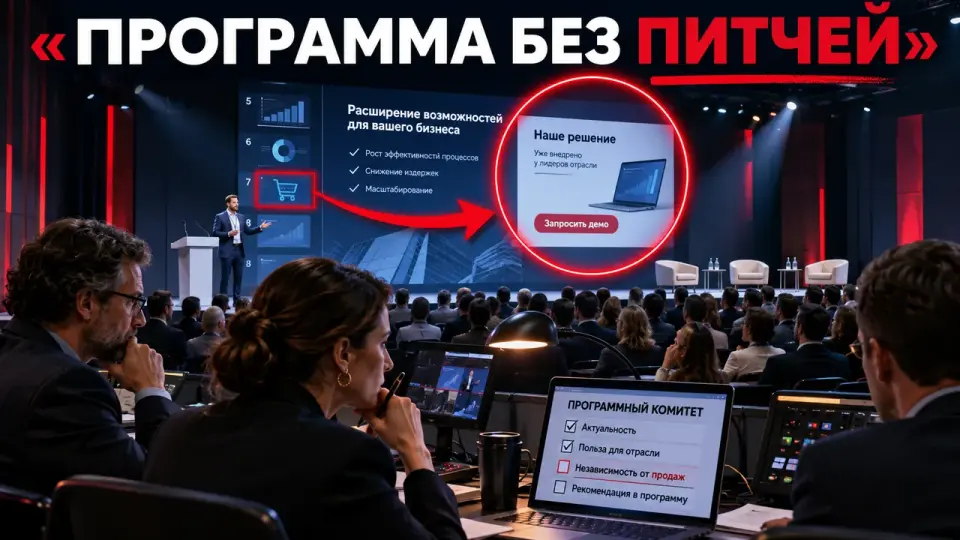
How to select talks without hidden sales pitches in 2026: application criteria, peer review, sponsor boundaries, slide checks and moderation.
A promotional talk rarely begins with the words "now we're going to sell you something." In the programme it looks like an industry case study, but on stage it turns into a company story, a feature overview and an invitation to talk to the sales department. A request to "please, no advertising" does not stop this substitution.
At Aventura, we suggest treating the task as an editorial system. It links selection, speaker preparation and on-stage control. The goal is not to ban vendors or product names, but to preserve the stated value for the participant.
If you are building an industry programme and want to connect editorial selection with production preparation, submit a request for conference organisation. For the first conversation, it is enough to have the event goal, audience composition, a draft agenda and a list of sponsor obligations.
What Counts as a Promotional Talk?
In short: a promotional talk puts a commercial goal above the promised value for the attendee. The main test is simple: can the listener verify or apply the takeaway without buying the product and talking to a salesperson? If the material leads only to one specific solution, it should be reworked or clearly labelled in advance as a partner session.
The speaker's employer alone proves nothing. A supplier's employee can walk through a genuinely useful method, while an independent expert can spend an entire talk promoting their own services. That is why we assess the content, the evidence and whether the conclusions are transferable. The job title in the byline is secondary.
A promotional talk usually has several noticeable signs. They are assessed together, because a single element rarely gives a definitive answer.
- the title is built around the company or product;
- the original problem is replaced by the brand's story and a list of capabilities;
- the outcome of the session boils down to an introduction to the solution;
- the case study hides limitations and alternatives;
- the ending leads to a purchase, a request or a contact with the sales department.
A single logo on the title slide does not make a presentation promotional. The name of a product that was actually used may also be necessary to understand the case. The line is crossed where the product stops being part of the evidence and becomes the main character instead of the real-world problem.
The practical test is simple: after the talk, can the listener try the approach in their own conditions, even if they never become the speaker's client? If so, the material can stay in the editorial programme. If not, the content needs to change or the session should be honestly moved into commercial mode.
Three program modes: editorial, partner, and brand
The program should be divided into three modes in advance. An editorial talk meets the general criteria of usefulness, a partner session discloses its commercial status, and a brand track brings the company's related topics together in a separate section. Attendees understand the context before they enter the room, and the organizer doesn't have to disguise a paid slot as an independent analysis.
Hidden advertising appears where the actual mode diverges from the promise in the program. An attendee expects an independent analysis and gets a paid slot with no labeling. Both the content and the trust in the schedule suffer at the same time.
The table summarizes the key points of this section: Criterion, Editorial session, Partner session. Use it as a quick reference when preparing your event.
| Criterion | Editorial session | Partner session | Brand track |
|---|---|---|---|
| Who sets the framework | program committee | organizer and partner under agreed rules | brand within the conference rules |
| How selection works | general criteria of usefulness and evidence | separate contractual and content review | own program with a clear promise to the audience |
| How the connection is labeled | relevant commercial connection is disclosed | partner status is visible in advance | brand is named as the owner of the track |
| Permissible product content | only if needed as evidence | possible within designated limits | possible, but must not replace the usefulness of each session |
| What the attendee gets | a takeaway conclusion or a working method | clear commercial context without disguise | a connected route through the brand's topics |
An editorial talk goes through the same review regardless of how well known the company is. A partner session can be more product-focused, but its status must be visible in the schedule and in the room. For a series of commercially related topics, it is more honest to design a brand track at a conference than to hide several sales presentations among independent talks.
We do not recommend mixing these modes in a single program card. The wording "expert session supported by a partner" explains nothing if the partner chooses the topic, the speaker, and the final call to action. The team must state in writing who makes the editorial decision and what commercial rights the brand has received.
Why is a ban alone not enough?
In short: the phrase "advertising is prohibited" is too general. It does not set uniform criteria, checkpoints, a decision owner or consequences for violation. The working rule applies in the application, review, acceptance letter, speaker agreement, slide check and moderator brief. At each stage, the team determines in advance how to check and how to send back for revision.
One person considers any mention of a product a violation. Another lets twenty minutes of demonstration through if there is no price on the slides. A third makes an exception for a well-known company because they are afraid of losing the speaker or partner.
A ban starts to work when the team describes unacceptable actions and appoints an owner for the assessment. Then it records the points for return for revision and the procedure for checking slides. A separate rule explains what the moderator does if the content has changed already on stage.
The rule needs to be repeated in the application form, review criteria, acceptance letter, speaker agreement and moderator brief. The repetition is needed for different process owners: at each stage, the method of checking and the person responsible change.
It is worth separating editorial policy and the schedule. The material on how to put together a conference programme without overload helps remove unnecessary blocks and protect transitions. The system against hidden selling solves a different task: it controls the content and status of each session.
The rule against hidden selling works together with the programme, the speaker office and stage moderation. If you need to assemble this whole outline, request the programme and a preliminary estimate. We will start with the audience, session types, sponsorship obligations and decision owners.
The session brief keeps the editorial promise
The editorial brief preserves the promise of a talk from proposal to stage. It records the audience, the problem, the main thesis, the takeaway for attendees, the evidence, the limitations, the alternatives and the commercial ties. The committee, the editor, the speaker office and the moderator use this brief to check the content against one agreed version, even when the presentation changes during preparation.
A title and a short abstract give too little data for selection. A beautifully written paragraph may hide a product overview, while a strong hands-on case may look dry. That is why we first ask for the logic of the material to be laid out. The finished presentation will be needed later.
The session brief needs fields that show the logic of the material and the commercial context.
The table brings together the key points of the section: Field, What the programme committee checks. Use it as a quick reference when preparing an event.
| Field | What the programme committee checks |
|---|---|
| Audience and problem | who needs the material, what level of expertise is assumed and which work task is being addressed |
| Thesis and takeaway | which conclusion the talk tests and what attendees will be able to do after the session |
| Context and evidence | under what conditions the result was obtained and how it is substantiated |
| Limitations and alternatives | where the approach needs adaptation and which options the author considered |
| Commercial tie | which relationships with an employer, sponsor or product matter for the assessment |
| Format | whether a talk, case review, interview, discussion or product demo is needed |
| Questions and next step | how the audience will test the thesis and what they will get without a mandatory sale |
A learning takeaway is best started with an action. "Get to know our system" describes the speaker's intention. "Compare two ways of checking", "draw up a list of criteria" or "find a risk in your own scheme" describes the attendee's takeaway.
For a hands-on case, a useful framework is: the initial problem, the limitations, the options considered, the chosen path, the changes along the way, the confirmed result and the boundaries of transferability. The same principle is examined in detail in the article on the product user conference. A client logo does not replace any element of this chain.
Important. The brief must not demand a number just for persuasiveness. If the result cannot be disclosed or substantiated, the material is anonymised, moved to a closed format, or built around the method without synthetic figures.
How to shortlist submissions without giving status a head start?
The first substantive review should be carried out without the author's name, job title or reputation, as far as the topic allows. The speaker's details are then brought back to check experience, conflicts of interest and programme balance. Red flags are assessed separately: a direct call to buy or a hidden commercial connection retains its weight regardless of the submission's average score.
Blind review does not eliminate bias entirely. A recognisable case study or a rare technology can still give the author away. The purpose of this order is to focus the review first on the problem, the thesis and the evidence, and to bring the author's status details back at the next step.
The submission form is conveniently split into three layers. The first is seen by reviewers: topic, audience, outline, results, evidence and commercial ties to the extent needed for evaluation. The second is available to the programme owner: name, job title, experience and contacts. The third holds administrative information that the whole committee does not need.
Each reviewer first gives their own score, without looking to colleagues. If a person is connected to the speaker, the company or the topic, they declare a conflict and step out of reviewing that submission. The pretalx documentation shows that review, final acceptance and recusal can be separated into stages instead of a shared email thread.
In addition to the average score, we flag red flags separately. A direct call to buy, a hidden commercial connection or substituting the problem with a product-line overview cannot be offset by the author's fame and a polished presentation. The full journey of submissions and decisions can be supplemented with practices from the article on a conference of internal experts.
The committee needs calibration before the main selection. Several test submissions are scored together and discussed: why one passes, the second needs revision, and the third belongs to a partner format. This way the word "advertising" gets the same working meaning for the whole team.
The pipeline from submission to stage
The pipeline connects the editorial decision, speaker preparation, the master version of the presentation, the rehearsal and the moderator's actions. Each stage has an owner, a verifiable status and a condition for being sent back for revision. This way, changes to the topic, facts or product-related content go through a substantive review, even if they appear after the submission has been accepted.
We recommend the following sequence. It links the editorial decision to speaker preparation and to the team's actions in the room.
- Set the rules and collect submissions. The team defines the session types and commercial boundaries, while the author describes the problem, audience, thesis, evidence and connections.
- Carry out an initial screening. The coordinator removes duplicates, empty topics, sensitive information and obvious sales pitches that fall outside the format.
- Organise independent review. A subject-matter reviewer checks the content, an editor checks clarity, and anyone with a conflict of interest steps out of the assessment.
- Make and formalise the decision. The committee chooses acceptance, revision, a change of format or rejection; the speaker confirms the terms in writing.
- Hand the session over to preparation. The speaker office receives the decision, deadlines, files and checkpoints.
- Lock in the content and the master version. The team checks the thesis, facts, restrictions and product-related content; any substantive edit goes back for review.
- Hold a substantive rehearsal. The editor and moderator listen to the oral delivery, the product demonstration and the answers to difficult questions.
- Prepare the moderator and debrief. The brief sets out the questions and the order of intervention, while feedback helps update the rules for the next cycle.
After the committee's decision, the session should not be run with the words "the talk is ready". It is more convenient to use verifiable statuses: thesis confirmed, content approved, commercial part flagged, file received, editorial run-through completed, technical test closed. The detailed route of the person, files and run-throughs is described in the material on the conference speaker office.
For a large programme, the editorial loop is best built into conference organisation from the start. Then the selection criteria are linked to the schedule, script, moderators, equipment and the team's actions at the venue. A separate "no advertising" document without owners in production quickly loses its force.
The result of each stage must be visible to the next role. The speaker office should not have to guess which product mentions the committee has approved. The moderator should not learn about a conflict of interest for the first time a minute before the speaker goes on.
We publish working breakdowns of programmes, speakers and venues in the Aventura Telegram channel. You can follow new materials in the channel, while the rules of a specific conference are best kept in the project's private space.
Sponsorship rights and editorial decisions
A sponsorship package should separately describe the partner's commercial rights and the rules for editorial admission. A guaranteed slot, the right to submit a proposal and the right to suggest a topic are different commitments. Before selling the package, the team defines the format labelling, the owner of the final decision, the permitted product component and the route for material that does not fit the main programme.
Conflicts are often created by an unclear offer from the organiser. The wording "a presentation by a company representative" can mean either a guaranteed commercial slot or the right to submit a proposal on the same terms as everyone else. These options require different labelling, pricing and approval processes.
In both the contractual and working framework, the partner's rights and restrictions should be recorded separately. Such a list removes disputes before the programme is published.
- which visibility formats and ways of suggesting a topic the partner receives;
- who makes the final editorial decision;
- how commercial status is indicated and where product display is permitted;
- where material is moved if the topic changes or it does not fit the main programme.
Partner status does not make material weak. A company may have rare practices, data and a strong subject-matter expert. But the same reasons do not give the right to conceal the commercial mode or bypass the criteria that apply to other authors.
If a sponsor needs a product presentation, it is more honest to offer a labelled session, a product display area, a consultation or a separate branded track. Participants understand the context in advance and choose the format themselves. The main programme thereby retains trust.
Important. The conditions for stopping or withdrawing a presentation must be agreed with the client's lawyers and set out in the project documents. This editorial scheme does not establish a universal sanction for any conference.
How to check slides and rehearsal?
In short: slides are checked against the approved application, and at the rehearsal the actual oral delivery, product demonstration and Q&A are assessed. First, the editorial team confirms the thesis, evidence, limitations, commercial relationships and final call to action. Then the production team accepts the specific file, records the master version and checks its playback at the venue.
It is better to split the check into content and technical. First, the editorial team confirms the topic, thesis, facts, limitations, product names, disclosure of relationships and final call to action. Then production accepts the specific file, checks its playback and records the master version.
During the content check, we ask questions about compliance with the approved concept. The answers show whether the material needs to be returned to the author before technical release.
- does the presentation match the title, abstract and working problem;
- are facts and numbers confirmed;
- are limitations and alternatives shown;
- is a product demonstration needed to prove the thesis;
- are the commercial relationship, final call to action and time for questions indicated.
After content approval, a late edit should not go through as a regular file replacement. If the thesis, numbers, product part or terms of use have changed, the editorial owner repeats the necessary part of the check. The technical procedure for master versions and exceptions is covered in the article on freezing presentations before a conference.
Submitting materials in advance helps check advertising and accessibility. W3C recommendations suggest preparing accessible slides and multimedia in advance, describing meaningful visual elements and avoiding distracting animation. Editorial control can be combined with checking contrast, readability, captions and alternatives for important video or audio.
At the rehearsal, the speaker delivers the opening, transition to the case, demonstration, conclusion and answers to likely questions. The editor listens to see if the neutral presentation has turned into an oral sales pitch. The moderator tries returning questions and clarifies where the boundary of their intervention lies.
Moderation and questions from the floor
The moderator keeps the session within its stated frame, protects time for substantive questions and follows an agreed escalation ladder. The brief sets out the goal, the key message, disclosed commercial ties, red flags, follow-up questions and the channel for contacting the programme owner. Substantive disputes over facts are referred to the programme owner.
The moderator's brief should contain the session goal, the key message, participants' commercial ties, confirmed limitations and topics that must not be disclosed publicly. It should also record the channel for contacting the programme director and the procedure for handling a material breach.
An escalation ladder is useful. It lets you start with a neutral clarification and avoid jumping straight into a public conflict.
- Bring the speaker back to the stated question.
- Ask them to name the conditions, evidence or limitation.
- Stop the repetition and hand over to a second participant or the audience.
- State that the product part falls outside the editorial frame and move it to the labelled channel.
- If the breach continues, refer the decision to the programme owner under the agreed protocol.
We recommend starting with neutral questions. "What general principle can be transferred here?", "What alternatives did you consider?" and "Where would this approach not work?" bring the conversation back to substance. If a speaker responds only with a product pitch, the audience and the team can see the gap with the stated frame.
Questions from the floor can also steer the session into sales. A "where can I buy it" request need not be banned, but it can be moved to the commercial channel after the talk. In the main part, priority goes to questions about conditions of use, the basis for comparison, limitations and what did not work.
For complex discussions, a separate roundtable moderator brief comes in handy. If editorial control is tied to registration, the run of show and several halls, it should be built into the overall organisation of a business event. A personal agreement between the host and the speaker is not enough for such a framework.
What to do with a strong but product-focused case study?
A strong product-focused case study can be conditionally accepted, sent back for revision, have its format changed, or be moved into a labelled partner programme. The committee records in writing the verifiable conditions: remove the direct sales pitch, add limitations and alternatives, disclose relationships, and describe the outcome through the participant's action. After the edits, the material undergoes a second review.
Conditional acceptance preserves practical material while also protecting editorial criteria. The committee lists in writing the changes after which the session can enter the programme. The author understands the boundaries even before preparing the slides.
Most often, the conditions that help are those that put the working problem back at the centre. The committee selects only those changes that can be verified at the second review.
- move the working problem into the title and replace the feature overview with an analysis of the task;
- add the initial conditions, alternatives and limitations;
- show failed attempts or the reasons for rejecting other options;
- rewrite the outcome through the participant's actions;
- remove the direct sales pitch and disclose commercial relationships.
The presence of a client does not automatically make a case study independent. A joint presentation can also be marketing. The committee still checks the evidence, the limitations and the possibility of applying the conclusions without buying a specific solution.
If the edits deprive the material of its meaning, it is moved into a labelled partner session, a product demonstration or a branded track. This way the content and the audience's expectations align without a hidden substitution of format.
Program Readiness Checklist
A program is ready for publication when editorial, partner and branded modes are separated, the rules are clear to all roles, and every disputed decision has an owner and a next step. The checklist covers the application, review, disclosure of relationships, content lock, master version, rehearsal, moderator brief and post-event feedback.
Before publishing the program, check the entire session route. The checklist must confirm both the editorial logic and the handover of decisions to production.
- a promotional talk is defined by its purpose and transferability; the author's profession alone decides nothing;
- editorial, partner and branded formats are separated;
- commercial status is visible to the participant in advance;
- the application form captures the problem, thesis, results, evidence and limitations;
- relevant financial and non-financial relationships are disclosed;
- the first review does not show the author's name and job title where possible;
- reviewers declare conflicts and are recused;
- commercial risk is a separate criterion and is not hidden in an average score;
- the committee's decision allows for revision and a change of format;
- the terms of acceptance are confirmed in writing;
- the speaker office has received the editorial decision and verifiable statuses;
- content is locked before the technical master version;
- substantive edits after the lock go back to review;
- slides are checked for accessibility and compliance with the application;
- the substantive rehearsal includes the demo and questions;
- the moderator knows the redirecting questions and the escalation procedure;
- feedback separately asks about applicability and commercial neutrality;
- violations affect the rules for the next selection.
A conference without promotional talks is supported by transparent modes, a shared session card and the team's right to verify the promise against the content before going on stage. In our experience, this procedure helps control the risk of hidden selling while still keeping the expertise of suppliers and partners in the program.
Frequently asked questions
The speaker's place of work alone proves nothing. An employee of a vendor may walk through a genuinely useful method, while an independent expert may spend an entire talk promoting their own services. That is why we assess the content, the evidence and whether the conclusions can be applied elsewhere. A job title in the byline is secondary.
The programme should be divided into three modes in advance. An editorial talk goes through the general criteria of usefulness, a partner session discloses its commercial status, and a branded track brings together related company topics in a separate section. Attendees understand the context before they enter the room, and the organiser does not have to disguise a paid slot as an independent analysis.
One person considers any mention of a product a violation. Another lets twenty minutes of demonstration slide if there is no price on the slides. A third makes an exception for a well-known company because they are afraid of losing the speaker or the partner.
The editorial card preserves the promise of the talk from application to stage. It records the audience, the problem, the main thesis, the takeaway for attendees, the evidence, the limitations, the alternatives and the commercial ties. The committee, the editor, the speaker office and the moderator use this card to check the content against a single approved version, even when the presentation changes during preparation.
The first substantive review should be carried out without the author's name, title or fame, as far as the topic allows. The speaker's details are then brought back to check experience, conflicts of interest and programme balance. Red flags are assessed separately: a direct call to buy or a hidden commercial tie keeps its weight regardless of the application's average score.
The pipeline links the editorial decision, speaker preparation, the master version of the presentation, the rehearsal and the moderator's actions. Each stage has an owner, a verifiable status and a condition for sending work back for revision. This way, changes to the topic, facts or product part go through a substantive review, even if they appear after the application has been accepted.
If you need to bring the rules, the programme, the speaker workflow and on-stage moderation together in one project, request the programme and a preliminary estimate. We will start with the audience, session types, sponsorship commitments and decision owners.
Sources
- pretalx: documentation on reviewing, scoring and conflicts
- W3C WAI: accessible presentations and advance preparation of materials
Contents
Was this article helpful?