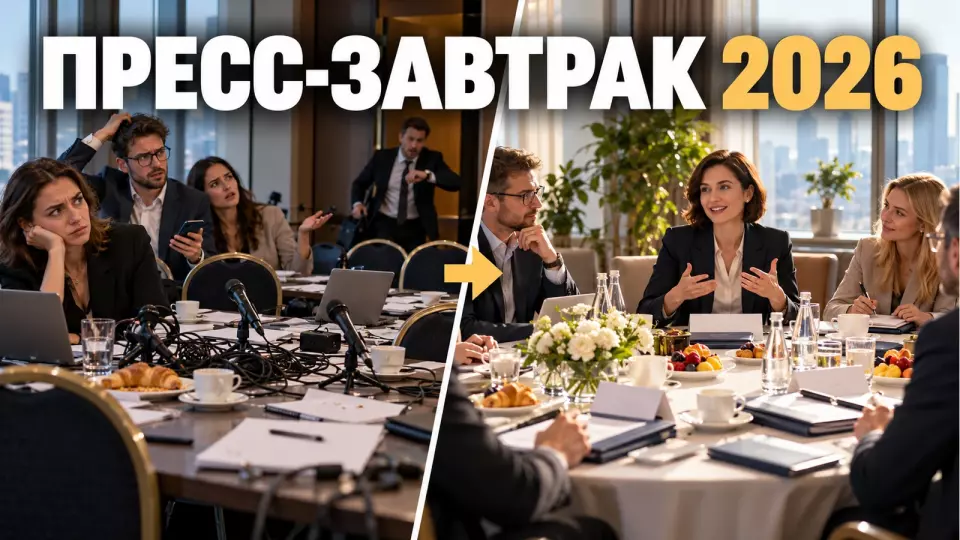
A practical guide to a company press breakfast: choosing a topic and media, the brief, venue, agenda, speakers, press kit, and post-event follow-up.
If you need to understand how to organize a company press breakfast, start not with a restaurant and coffee, but with a reason for a journalist to come in the morning. You need a topic worth discussing, access to competent speakers, and materials that the editorial team can use after the meeting. That is why at Aventura we start a press breakfast with the editorial task, and only then choose the table, menu, lighting, and table setting.
A company press breakfast is a limited-format meeting with relevant media. The company announces news or provides meaningful context, answers questions, and leaves time for short one-on-one conversations. The format does not promise publications. Its task is to create working conditions for an accurate and substantive conversation.
If a press breakfast is already in the plan, request a quote and discuss the format. In the request, specify the topic, city, proposed date, speakers, and media outlets for which the meeting may be useful.
When is a press breakfast appropriate?
A press breakfast is suitable when a company needs to explain new information to a small group of specialized journalists and give them direct access to experts. The format is justified if the editorial teams can ask questions and obtain evidence. If the topic can be fully covered by a press release, a single comment or an individual interview, a separate event will only add costs and organizational risks.
Start with one sentence: "After the meeting, the journalist will be able to explain to their audience that...". The continuation should contain a specific fact, change, research, launch, industry conclusion or the company's position. The wording "introduce the media to the brand" is too general. It does not answer the editorial team's question: why allocate time for travel and conversation.
The format works when five conditions coincide:
- there is new information or a complex topic that needs context;
- the company is ready to show data sources and answer clarifications;
- a manager or specialized expert with the facts is available;
- the invited journalists regularly write on this topic;
- the team can quickly send the promised answers, documents and photos.
If the main content is a demonstration of a workshop, laboratory or facility, it is better to consider a press tour to the production site. If the news is aimed at a wide pool of media and requires a formal public session, a larger organization of a media meeting in the format of a press conference is more useful.
Refusing the event can also be the right decision. We recommend it if the speaker is not ready to discuss complex issues, the numbers have not yet been verified, legal restrictions have not been analyzed, or there is no unified position within the company. Postponing the meeting is cheaper than correcting contradictory comments after publication.
Comparison of a press breakfast with other formats
A press breakfast differs from a press conference in size and depth of conversation, from a briefing in duration and amount of context, and from an interview in the absence of exclusivity for a single outlet. Food remains a service element and does not define the format. If the main guests are clients and partners, it is already a business breakfast, even if a journalist is present at the meeting.
The table summarises the key points of the section: Format, Main task, Participants. Use it as a quick reference when preparing an event.
| Format | Main task | Participants | Nature of the conversation | When to choose |
|---|---|---|---|---|
| Press breakfast | explain the topic and provide access to experts | a limited group of specialised media | moderated conversation, questions, short interviews | the topic requires context and live clarification |
| Press conference | publicly announce significant news | a wide pool of media, several speakers | a formal programme and a general Q&A block | the news is important for many outlets at once |
| Briefing | quickly communicate a position or update | journalists on a specific agenda | a short statement and limited questions | speed is more important than in-depth discussion |
| One-on-one interview | give an outlet its own angle for the story | one journalist or one film crew | a detailed one-on-one conversation | exclusivity or a personal story is needed |
| Press tour | show a facility, process or technology | a group of media and accompanying persons | a route, demonstration, questions at stops | the main proof is at the site |
| Business breakfast | discuss a business topic with clients and partners | representatives of business and the community | presentation, discussion, networking | the main goal is related to relationships and sales |
The format's shell may be similar. A morning slot, a small hall and a common table are also found at business events. The difference lies in the task, the composition of guests and the rules for using information. For a client audience, we separately organise an intimate business breakfast, where the editorial independence of the media is not the centre of the scenario.
Do not mix formats for the sake of status. If half of the programme is taken up by a product presentation, and journalists' questions are left for the last minutes, the name 'press breakfast' changes nothing. An outlet evaluates access to information, not the sign at the entrance.
How to put together a brief for a press breakfast?
A brief connects the news hook, media audience, speakers, evidence, constraints, and the desired follow-up. One page is enough for the first discussion. It records what the journalist will get and who is responsible for each fact. A detailed scenario will come later, once the client confirms that the topic can withstand questions and the team has materials to answer.
At Aventura, we start with a short client brief. It is filled out by the PR team, the project manager, and the employee responsible for data on the business side. The lawyer and the person responsible for personal data are brought in for fields involving embargoes, disclosure restrictions, registration, or filming.
Sample brief
The table contains the key points of the section: Field, What to write, Check question. Use it as a quick guide when preparing the event.
| Field | What to write | Check question |
|---|---|---|
| Meeting topic | one change, research, launch, or industry conclusion | what new will the editorial team learn? |
| Editorial value | facts, documents, demonstration, access to an expert | why is a press release not enough? |
| Target media | topic, type of outlet, role of the journalist | who does the topic directly concern? |
| Speakers | name, position, area of expertise | who confirms each point? |
| Three messages | short statements with evidence | how is each message substantiated? |
| Difficult questions | risks, criticism, deadlines, prices, impact on people | who owns the precise answer? |
| Information mode | general session, embargo, recording, photo and video | what is agreed before disclosure? |
| Materials | press release, fact sheet with key facts, report, photos, charts | what will the journalist get and when? |
| Logistics | city, date, approximate time, access requirements | can the route be walked in the morning? |
| Outcome | follow-up requests, interviews, accurate coverage of the topic | how will the team understand the quality of the meeting? |
After filling it out, hold a short meeting with the internal client. Read the brief as a journalist: where is the statement, where is the evidence, where is the promotional formula, and where an honest answer is still missing. Remove beautiful words. Send unverified numbers to the data owner.
Then assemble the work assignment in order:
- Lock in one topic and editorial outcome.
- Appoint a project owner on the company side.
- Draft a list of outlets on the topic.
- Select speakers for likely questions.
- Gather facts, documents, and disclosure boundaries.
- Choose the format for the general part and one-on-one conversations.
- Only then calculate the venue, service, equipment, and filming.
This order protects the budget. If you first book a restaurant and then find out that the speaker is only available online or the data cannot be disclosed, the team will have to rebuild the already purchased shell.
Need to bring the topic, media list, program, venue, and service together into one brief? Request a quote. We will review the inputs and show which decisions are needed before booking.
Newsroom map and the invitation
Invite journalists based on relevance to the topic, not on the outlet's fame or the size of an old contact base. For each newsroom, you need to understand its profile, recent articles, a possible question, and a suitable speaker. The invitation communicates the news, participation terms, and editorial value without advertising promises or pressure. This kind of selection is better than a mass mailing to old contacts.
For each newsroom, specify the topic profile, possible interest, a suitable speaker, available materials, and the next contact. It helps to see that the same meeting offers different value to a business publication, an industry media outlet, a city newsroom, and a professional author.
Don't add to the media list everyone who has ever communicated with the company. Check whether the person writes on the topic now, whether they still work in the same newsroom, and whether the format suits their articles. A generic appeal "to the editor" is more often lost because it doesn't explain why the letter arrived at this particular recipient.
The invitation needs:
- a specific topic without advertising superlatives;
- speakers and a brief explanation of their expertise;
- date, start and end time, address, and entry rules;
- the format of the discussion and pre-agreed embargo terms, if any;
- materials or access that the newsroom will receive;
- deadline for confirming participation and a working contact;
- a way to communicate accessibility and catering requirements.
The first email should fit on one screen without a long company history. Put the details on the registration page or in a short information sheet. The subject line should help the editor assess the content: "Media invitation: market research results and a conversation with the authors" is clearer than "A brand's private breakfast".
Registration takes place in two steps. First, the participant submits an application; then the team confirms the place, taking into account capacity and the profile of the meeting. In the confirmation email, provide a calendar file, entrance map, contact on the day of the event, and gathering time. If there are no places, honestly inform about the waiting list without promising participation.
We covered the detailed mechanics of the form, application statuses, and on-site registration in the article on event participant registration. For a press breakfast, verification of the newsroom and the guest's role is added, but the principle of minimal data collection remains.
How to choose a venue and menu?
The venue must ensure audibility, privacy, convenient entrance, accessible route, working surface and a quiet place for interviews. The menu is subordinate to the program: serving, clearing and the coffee machine should not coincide with a key statement or a difficult question. The decision is made after a morning site visit, when real noise, guest flow and service operations are visible.
Come for a viewing on the same day of the week and at the same time as the planned meeting. A morning restaurant sounds different from an empty hall in the afternoon. Check the neighboring tables, music, dishes, coffee machine, ventilation, entrance flow and the service route of waiters.
We walk the guest's path from the street to the seat at the table. Along the route, we check the entrance, cloakroom, elevator, restroom, signs and meeting point. A journalist should not have to call the organizer from a neighboring building entrance or search for a closed floor five minutes before the start.
For working in the hall, you need:
- seating where participants can see and hear each other;
- space for a laptop, phone, notebook and water;
- power outlets or safe charging points;
- a microphone if the acoustics do not allow recording clear speech;
- even lighting on the speakers' faces and a readable screen;
- a clear angle for the photographer without passing between the table and the speaker;
- a separate quiet corner for short interviews;
- an accessible route and the ability to communicate individual needs in advance.
We do not seat the entire company team in a single line opposite the media. Such a layout quickly creates two camps and hinders conversation. The moderator needs a clear view of the table, and it is better to distribute speakers so that a journalist can address the right expert without passing a question across the entire hall.
Service gets its own scenario. Welcome coffee can be served before the official opening. During key messages and the general Q&A block, a quiet window applies: venue staff do not change dishes, do not offer hot courses and do not walk in front of the cameras. It is convenient to check the detailed choice of service with the material on catering format at an event. If the venue does not provide suitable service, calculate catering for a business meeting separately.
The menu should allow you to work. Avoid dishes that require complex serving, are loudly cut or take up the whole table. Clarify allergens and dietary restrictions voluntarily and pass them only to those who need this information for service. For an initial search, you can find a venue for an intimate meeting, but acoustics, privacy and morning conditions are confirmed only by a visit.
Agenda, roles and working timing
The agenda guides participants from a calm arrival through the news, questions and one-on-one conversations. The plenary part should be shorter than the time allotted for discussion. One producer keeps the current version of the timing, the moderator manages the content, and the coordinator logs questions and promised materials. For every transition, an owner and a fallback scenario are assigned in advance.
Below is an example for 105 minutes. It is not a standard. Shorten or extend the blocks to suit the complexity of the topic, the number of speakers, editorial requirements and venue logistics.
The table brings together the key points of this section: Time, Stage, Editorial task. Use it as a quick reference when preparing the event.
| Time | Stage | Editorial task | Service action | Owner |
|---|---|---|---|---|
| 08:30-08:50 | arrival and coffee | introduce guests and clarify requests | welcome coffee, no active service at the table | guest coordinator |
| 08:50-08:55 | opening | state the topic, agenda and information mode | service stops | moderator |
| 08:55-09:07 | first statement | deliver the news and key evidence | quiet window | lead speaker |
| 09:07-09:17 | expert context | explain the methodology, product or industry significance | quiet window | subject-matter expert |
| 09:17-09:42 | general questions | work through clarifications and difficult topics | water and coffee only on request | moderator and speakers |
| 09:42-09:55 | open conversation | let participants clarify details at the table | discreet service without clearing around the speakers | venue team |
| 09:55-10:15 | short interviews | record personal comments | service leaves the recording area | interview coordinator |
Roles should not be combined without good reason. The host welcomes guests and sets the context, while the moderator keeps an eye on the topic, the order of speakers and the time. The press contact checks the facts and takes editorial deadlines into account. The one-on-one interview coordinator collects journalists' requests; the technical specialist is responsible for the microphone, screen and recording. Another team member keeps the question log.
The order of preparing the agenda:
- Put the team's arrival time and the technical check in the calendar.
- Separate registration, welcome coffee and the official start.
- Limit the number of speeches to only the necessary speakers.
- Set aside separate time for the general Q&A block.
- Allow time for short interviews and distribution of materials.
- Align food service with the quiet and conversation windows.
- Add buffer time for delays, a presentation failure or breaking news on the agenda.
- Assign an owner for every transition.
Plan B is prepared before the rehearsal. If the lead speaker is late, the moderator can start with context and introductions. If the presentation won't open, the speaker still has a printed fact sheet and a spoken version of the statement. If a major news story has distracted the newsrooms, the team decides whether to postpone the meeting, connect participants online or send the materials without an event.
How to prepare speakers for questions?
A speaker needs three verified messages, a map of likely questions, the boundaries of their competence, and a clear procedure for clarifying facts. Rehearsal checks the content, not the acting delivery. If there is no precise answer, the speaker says so directly and passes the question to the owner, who will return with verified material.
The company's top executive is not always the best speaker for every question. A manager can explain a decision and strategy, while the methodology of a study, technical specifications, or impact on a process are better covered by a subject-matter expert. The lineup is chosen based on the questions from editorial teams, not on job hierarchy.
Prepare a card for each speaker:
- main topic and role in the overall programme;
- three messages with facts or examples;
- exact names, titles, dates, units of measurement, and basis of comparison;
- questions the speaker answers themselves;
- topics they pass to another expert;
- information that cannot be disclosed in the chosen mode;
- wording for a case when an answer requires verification;
- contact of the employee responsible for materials and answers after the meeting.
Do not write long memorized answers. They sound like a press release and get in the way of responding to a question. It is better to give the speaker a short logic: acknowledge the question, answer to the point, provide confirmation, and indicate the boundary of what is known.
During rehearsal, the moderator asks both comfortable and uncomfortable questions. The team checks whether the speakers contradict each other, whether they substitute fact with opinion, and whether they promise data that does not exist. It is useful to record a short fragment on a phone: this makes it easier to hear overloaded phrases and unnecessary jargon.
We separately run through the transitions: opening, handing over the floor, a difficult question, a request for an exclusive comment, a service stop, and recording a deferred answer. The general method of such a run-through is described in the article about technical rehearsal of an event.
The phrase 'no comment' often leaves more questions than clarity. If the company cannot disclose information, the speaker briefly states the reason within permissible limits. If the data is not at hand, they report that the question has been logged and the answer will be provided after verification. The specific deadline is set by the owner of the fact, taking into account the editorial deadline.
Information mode, registration and personal data
It is safer to hold the general part with permission for publication and direct quotation (
on the record), and agree on any exceptions before disclosing information. An embargo works as a preliminary agreement on the publication time. The registration form collects only the data needed to confirm participation, contact, access and voluntarily stated guest requirements.
Associated Press defaults to the on the record mode and requires other conditions to be agreed in advance. In practice, editorial teams may understand the background mode (background) and the off the record mode (off the record) differently. So do not limit yourself to one word. Spell out whether the information can be published, how to credit the source and what data is excluded.
A working formulation by the moderator might sound like this: “The general session is on the record. Embargoed materials can be published after the date and time specified in the letter. If a particular answer is offered as background information, we will first agree on the exact attribution wording.”
The table collects the key points of the section: Mode, What it means for the organizer, What to agree in advance. Use it as a quick reference when preparing an event.
| Mode | What it means for the organizer | What to agree in advance |
|---|---|---|
| On the record | information and quotes can be used with direct attribution | name, position, accuracy of facts |
| Background | information can be used with an agreed description of the source | the exact attribution wording and topic boundaries |
| Off the record | information is not intended for publication | the very fact of switching to the mode before disclosure |
| Embargo | material is prepared in advance but published after the set time | date, time, time zone and editorial confirmation |
Do not declare something said to be off the record after the fact. Do not send a sensitive file with a small note at the bottom of the email and expect the editorial team to automatically agree. If the conditions are critical, obtain explicit confirmation before handing over the material.
The word “accreditation” in the Russian Federation Law on Mass Media is associated with formal rules of the organization and an application from the editorial team. For a private small meeting, “media registration” or “participation confirmation” is usually sufficient. If a company introduces full accreditation, the rules, deadlines, rights of participants and grounds for decisions must be documented separately.
The registration form must match the purpose. Typically, name, editorial team, role and work contact are needed. Make fields about meals, accessibility or assistance optional. Request passport data only when the venue or a restricted facility requires it for entry. In that case, explain the purpose, recipients, storage period and deletion procedure.
Federal Law No. 152-FZ requires a specific purpose, proportionate amount of data and limited storage period. From September 1, 2025, consent to personal data processing, if used as a legal basis, is formalized separately from other confirmed information. Do not combine participation, data processing and advertising mailing into one mandatory checkbox. The specific form is checked by a lawyer or the company's personal data officer.
Before starting audio, photo or video recording, notify participants about the recording, purposes and ways of using the materials. Determine the legal basis and form of consent together with a lawyer; obtain separate consent where required. The guest should always have a clear way to report a restriction on recording.
What to include in a press kit?
A press kit should save newsrooms time searching and reduce the number of follow-up requests. Put together a single up-to-date HTTPS page or folder with the news item, fact sheet, speaker bios, source data, photos, captions and a working contact. Every file should have a clear name, version and date updated.
Minimum set:
- One paragraph summarizing the news.
- Program and organizational information.
- Press release or media advisory.
- A fact sheet with key facts, periods, units of measurement and sources.
- Exact names, titles and short bios of the speakers.
- A report, study or methodology description if the topic is based on data.
- Photos, logos and charts with captions and usage terms.
- Answers to difficult questions that can be published.
- Contact details for someone who can respond by newsroom deadlines.
- Date updated and version number.
Don't send several heavy archives with files named final_final2. It's better to host the main package at a single stable link, and in the email provide a short description and one key document. The PDF should have a text layer. For tables, a machine-readable file is useful; for images, captions and alternative text.
Before the event, you can provide logistics and open reference materials. Embargoed material is shared only after the terms have been agreed. After the event, update the package with answers, photos and revised versions. We discuss in detail how to organize the release of photos, videos and transcripts in the article about post-conference materials.
Post-meeting work and evaluation of results
After the meeting, the team closes each promise separately: a fact, a comment, a photo, a document, or an expert contact. The result is evaluated by the relevance of participants, the accuracy of coverage, the quality of questions, and further requests. A single number of publications does not show whether the editorial teams understood the topic. It is also important to check which information required clarification or correction.
During the meeting, the coordinator keeps a log:
The table summarizes the key points of the section: Question or request, Editorial team, Status. Use it as a quick reference when preparing the event.
| Question or request | Editorial team | Status | Owner | Material | Next contact |
|---|---|---|---|---|---|
| clarification on data | indicated in the working file | requires verification | analyst | table and methodology | personal letter |
| speaker photo | indicated in the working file | ready | press contact | file and caption | link to press kit |
| expert comment | indicated in the working file | scheduled | interview coordinator | recording or text | agreed channel |
Real contacts and internal evaluations do not appear in the public article or the general mailing list. The working log is available only to the team that needs it for a response.
After the meeting, proceed in order:
- Check that the press kit link opens and contains current versions.
- Send the promised general materials to participants.
- Respond personally to deferred questions.
- Pass the package to confirmed journalists who could not attend.
- Correct the found error in all versions and indicate the update.
- Update the media list and contact history.
- Conduct an internal review of the program, questions, service, and venue.
- Collect monitoring without pressuring the editorial teams.
Do not ask to approve a finished article if there was no such agreement. The company may correctly point out a factual error and provide confirmation, but the editorial assessment and conclusions belong to the media.
AMEC separates the immediate results of work, audience perception of information, subsequent changes, and contribution to the organization's goal. Immediate results include released materials, conducted interviews, and publications. Perception shows attention, understanding of the topic, quality of questions, and journalists' participation. Subsequent changes can include new inquiries, changes in attitude or behavior, if measured. Contribution to the organization's goal is assessed only where causation can be justified.
Do not use the advertising value equivalent of publications as a universal evaluation. Look at accuracy, relevance of the publication, visibility of key messages, quality of questions, new contacts, and the need for corrections. The absence of an immediate article does not always mean failure: the editorial team may have gained context for a future piece or kept the expert as a source.
Budget and Final Checklist
When comparing budgets for a press breakfast, look at the same scope of work, not just the total amount. Count separately the preparation of content, venue, catering, equipment, registration, filming, and post-event work. The final check should confirm the readiness of the news, speakers, guest route, and answer owners.
Ask contractors for estimates based on the same brief. Otherwise, one proposal will include equipment and staff, another will show only rent, and a third will leave post-production outside the total. The breakdown helps you see which block changes when you reduce the number of participants, choose a different venue, or opt out of video recording.
What to Include in the Budget
The table summarizes the key points of the section: Block, What May Be Included, What It Depends On. Use it as a quick reference when preparing the event.
| Block | What May Be Included | What It Depends On |
|---|---|---|
| Preparation | production, script, timing, coordination, rehearsal | complexity of the topic, number of approvers, deadlines |
| Venue | rent, early access, furniture, cloakroom, cleaning | city, date, privacy, duration |
| Catering | welcome coffee, breakfast, water, service staff | menu, number of guests, serving format, restrictions |
| Equipment | microphones, screen, lighting, recording, internet | acoustics, hybrid format, media requirements |
| Guest Management | form, confirmations, navigation, welcome desk | number of editorial offices, entry rules, staff |
| Photo and Video | filming, interviews, captions, processing, file transfer | number of cameras, turnaround speed, usage rights |
| Materials | design, fact sheet with key facts, charts, printing, web folder | volume of data, number of versions, format availability |
| Post-Event Work | request log, mailing, monitoring, report | number of personal responses and observation period |
Do not include an unconfirmed number of publications as a result that the organizer must guarantee. The contractor manages the production of the meeting, while the PR team is responsible for the quality of the topic, relationships, and materials. The decision to publish is made by the editorial office.
Checklist Several Weeks Before the Meeting
- the topic is formulated in one sentence;
- facts, sources, and acceptable wording are confirmed;
- the format and composition of editorial offices are chosen;
- speakers and owners of complex answers are appointed;
- the information mode, recording, and filming are agreed upon;
- the venue is viewed in the morning;
- the budget is compiled based on the same scope of work.
Checklist One Week Before
- invitations have been sent to relevant contacts;
- registrations are checked, participants have received confirmation;
- the program and seating are arranged;
- the press kit is uploaded and opened from an external device;
- speakers have completed a rehearsal;
- the service knows the quiet windows;
- Plan B is confirmed by decision makers.
Checklist the Day Before and on the Day of the Meeting
- names and titles are verified in all materials;
- the entry list is submitted with the minimum necessary number of people;
- the route, elevator, signs, and accessible entrance are checked;
- microphones, screen, lighting, recording, and internet are working;
- the moderator knows the information mode and the order of questions;
- the coordinator has opened the request log;
- service is paused during key messages;
- the press contact is ready to correct the file and update the version.
Checklist After the Meeting
- promised materials have been sent;
- deferred questions have been assigned owners and statuses;
- interested editorial offices that did not attend have received the package;
- errors are corrected in all versions;
- monitoring checks facts and key messages;
- the media list and contact history are updated;
- the team has conducted a debrief on the venue, program, and service.
Frequently asked questions
Start with one sentence: "After the meeting, the journalist will be able to explain to their audience that..." The continuation should contain a specific fact, change, research, launch, industry insight or the company's position. The wording "introduce the media to the brand" is too general. It does not answer the editorial team's question: why set aside time for travel and a conversation.
The format's shell may look similar. A morning slot, a small hall and a shared table also occur at business events. The difference lies in the objective, the guest list and the rules for using information. For a client audience, we separately organise an intimate business breakfast, where the editorial independence of the media is not the centre of the scenario.
At Aventura, we start with a short client brief. It is filled in by the public relations team, the project manager and the employee responsible for data on the business side. The lawyer and the person responsible for personal data are involved in the fields where there is an embargo, disclosure restrictions, registration or filming.
After filling it in, hold a short meeting with the internal client. Read the brief like a journalist: where is the statement, where is the proof, where is the promotional formula, and where an honest answer is still missing. Remove flowery language. Send unverified figures to the data owner.
For each editorial team, specify the topic profile, possible interest, a suitable spokesperson, available materials and the next contact. It helps to see that the same meeting offers different value to a business publication, an industry media outlet, a city editorial team and a professional author.
Come for a viewing on the same day of the week and at the same time as the meeting is planned. A morning restaurant sounds different from an empty hall in the afternoon. Check the neighbouring tables, the music, the tableware, the coffee machine, the ventilation, the flow of people at the entrance and the service route of the waiters.
A company's press breakfast is conveniently organised as a single working route: the topic, editorial teams, speakers, venue, service, materials and post-meeting work are all gathered in one plan. At Aventura, we can prepare the meeting and coordinate the work of all contractors according to a single timeline. Request a quote for a press breakfast.
Sources
- American Library Association: Media Relations Handbook
- Associated Press: Telling the Story
- Russian Federation Law on Mass Media, Article 48: Accreditation
- Federal Law No. 152-FZ, Article 5: Principles of Personal Data Processing
- Federal Law No. 152-FZ, Article 9: Consent to Personal Data Processing
- W3C WAI: Making Events Accessible
- AMEC: Integrated Evaluation Framework - Planning
- AMEC: Taxonomy of Evaluation
- AMEC: Barcelona Principles 4.0
Contents
Was this article helpful?