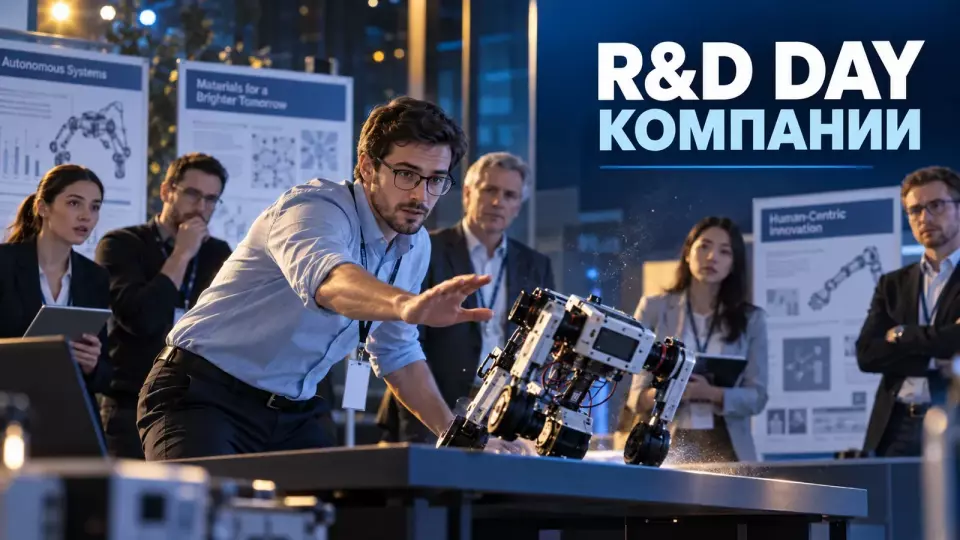
A working program for a company's R&D Day: how to select research, protect sensitive data, prepare posters and demos, and capture the next stage of projects.
A company's R&D Day is needed when leaders and research teams need to see the entire portfolio. Authors show not only the successful result, but also the initial uncertainty, the validation method, limitations, and the request for the next stage. The business gets a comparable picture, and teams get substantive feedback and a solution owner.
We at Aventura start such a project with boundaries. First, we determine which research can be shown to the whole company, which require a closed room, and which cannot be brought to the event until intellectual property is checked. Then we assemble the program, participant routes, posters, demos, and technical plan.
Leave a request - let's discuss the task
We'll clarify the event format and suggest the next step.
How is R&D Day different from Demo Day and a hackathon?
In this article we use a working distinction between formats. R&D Day looks at the current research and development portfolio. Teams explain the hypothesis, method, evidence, uncertainties and the next research step. Demo Day shows prepared solutions, Innovation Day collects or selects ideas, and a hackathon creates a prototype in a limited time. These formats can coexist, but should not replace each other.
The table contains the key points of the section: Format, What they show or do, Main result. Use it as a quick reference when preparing the event.
| Format | What they show or do | Main result |
|---|---|---|
| R&D Day | hypothesis, method, evidence and limitations | decision on the next research step |
| Demo Day | prepared prototype or solution | decision on pilot, implementation or support |
| Innovation Day | ideas, cases, lectures and demonstrations | engagement and selection of directions |
| Hackathon | solution created in a limited time | prototype and team evaluation |
The boundary is important for selection. If participants come with a ready-made product and ask for permission for a pilot, this is closer to a corporate Demo Day. If the program is broader than the research portfolio and includes idea collection, lectures and demonstrations, a scenario for Innovation Day in the company is suitable. If the team assembles the solution right at the event, a scenario for corporate hackathon is needed. R&D Day works earlier or in parallel: it helps to understand what has already been proven and what uncertainty remains to be tested.
The OECD Frascati Manual 2015 describes research and development through novelty, creativity, uncertainty, systematicity, and the possibility of transferring or reproducing the result. For an application to R&D Day, this framework can be translated into five simple questions: what is new here, what hypothesis was tested, what was the uncertainty, how was the work conducted, and whether another team can repeat the method.
If a project does not pass such a filter, it should not be devalued. Engineering improvements and scaling can be moved to a separate track. Then the jury does not compare fundamental research with already implemented automation on the same scale.
Decisions determine the R&D Day program
Short: Before choosing the stage, venue, and speakers, the company defines the decisions that should remain after R&D Day. For each project, this could be continuing the experiment, additional verification, merging teams, data access, preparing a patent application, a technical pilot, or stopping the direction. Without this framework, the day turns into an exhibition without continuation.
The first project document is the day's outcome card. It records the portfolio owner, the decision-making panel, the types of permissible decisions, and the deadline for the next checkpoint. We build the program backwards from this card.
Participants are told in advance what request they can bring to the committee. The phrasing "need support" is too broad. Working requests are specific: provide a test site, appoint a materials expert, open an anonymized dataset, conduct an IP review, or confirm resources for the next experiment.
For the production of the event, the mechanics of a business event are suitable: a single headquarters, decision owners, transition scenario, and change log. The organizer does not assess the scientific validity of the project. We connect experts, authors, management, and technical services so that the decision is made at the right moment and recorded.
How to select projects?
Selection takes place in two rounds. First, technical experts check whether the application relates to research and whether it has enough evidence for discussion. Then the program team chooses the appropriate format: short talk, poster, demo, closed review, or digital gallery. The author's charisma and video quality should not replace content.
The application may consist of seven fields:
- problem or research question;
- initial uncertainty and hypothesis;
- method and data used;
- obtained result;
- limitations and negative results;
- level of disclosure;
- request for the next stage.
In the first pass, we suggest hiding the author's position and department name so that reviewers look at the project description. Such an assessment will not become fully blind, but the internal hierarchy will distract less from the content. After technical verification, the program group distributes projects into tracks: discovery, methods, engineering, translation, scale, and shared research infrastructure.
Not every strong project has to go on the main stage. A complex methodology works better in a poster session. Sensitive details are discussed in a closed room. A demonstration is needed only where the audience must see the prototype's behavior, not a beautiful interface.
Leave a request - let's discuss the task
We will clarify the event format and suggest the next step.
Disclosure is divided into three access levels
In short: Each project should have an information owner and a confirmed disclosure level before editorial work on the presentation. The team separately checks trade secrets, patentable features, agreements with partners, personal data, export and industry restrictions. Recording, photos and the general archive are only opened for approved materials and audiences.
WIPO links the protection of trade secrets to reasonable measures for maintaining secrecy. Among such measures, an organization may use confidentiality agreements, labeling, and restrictions on physical or technological access. The European Patent Office points out that public written or oral disclosure can affect the assessment of novelty.
For an event it is convenient to use three levels:
The table summarizes key points of the section: Level, Audience, What we show. Use it as a quick reference when preparing the event.
| Level | Audience | What we show |
|---|---|---|
| General internal | company employees | task, high-level method, permitted result and request |
| Limited | specialized experts and managers | technical details without restricted attachments |
| Closed | pre-authorized group | sensitive data, architecture, contractual restrictions and IP issues |
This approach is more precise than the binary 'show or hide'. The European Research Executive Agency formulates the principle of open science as maximum openness with necessary closure due to intellectual property, personal data, confidentiality and security.
Before filming, the team prepares a map of zones. Posters and screens should not contain access keys, real client data, surnames without justification, closed schemes or accidentally open work chats. The client defines the legal basis and rules, and we transfer them into the script, navigation and briefing of the film crew.
Company R&D Day Program
A strong program alternates short presentations, posters, demonstrations, meetings with business stakeholders, and closed expert reviews. The main stage provides navigation across the portfolio, but deep work happens in small formats. The finale is dedicated to decisions, owners, and deadlines, not just awards and a group photo.
The working sequence might look like this:
- Quiet start and digital gallery. Participants familiarize themselves with approved materials in advance, check routes and accessibility requests.
- Portfolio opening. The R&D leader names priority unknowns and explains the types of decisions for the day.
- Short research talks. Each author presents the problem, method, evidence, limitation, and request.
- Poster session. Authors are at their stands according to the schedule, and participants follow thematic routes.
- Lunch with problem tables. Seating is arranged around tasks, not departments.
- Negative results session. Teams analyze refuted hypotheses and conditions under which the method does not work.
- Demo session. Prototypes are shown after readiness checks and with a backup scenario.
- Reverse business pitches. Departments formulate research tasks and available resources.
- Closed expert rooms. Authorized participants discuss sensitive details.
- Portfolio committee. For each project, the next step, owner, and review date are recorded.
For the main stage, parallel sessions, and registration, you can leverage the experience of organizing conferences. But R&D Day cannot be assembled as a continuous series of talks. Researchers need time at the posters, experts need separate rooms, and leaders need a short decision block.
A poster reveals one story, a demo reveals one effect
In short: A poster conveys one central story, while a demo shows one verifiable effect. The author does not put the entire report on the stand and does not open all the prototype's features. A unified template, editorial check, clear chart captions, and a backup recording help the participant quickly understand the logic of the result without revealing too much.
We ask the author to build the poster around one main story, shorten the text, and use fonts that are readable from a distance. We check contrast and accessibility of the color scheme according to W3C recommendations. For a corporate R&D Day, the poster answers seven questions: problem, hypothesis, method, data, result, limitations, and next experiment.
The author should have two explanations. The first is intended for a specialist in their field. The second is for a competent colleague from another function. This helps transfer knowledge between R&D, product, manufacturing, and business without simplifying to an advertising slogan.
The demo undergoes a streamlined readiness check. The team tests equipment, network, accounts, data, security, stop criterion, and backup scenario. NASA requires a Test Readiness Review for tests with new or modified equipment and/or procedures; the review confirms and documents safety, technical, and operational readiness. For a corporate event, we use a shortened analog of such control.
For AI projects, we separately ask to name the application context, data, metrics, limitations, human oversight, and known errors. The NIST AI Risk Management Framework links responsible work with four functions: Govern, Map, Measure, and Manage. For an event, this means a clear owner, a described application context, verifiable metrics, and a risk treatment plan.
How to evaluate research and development?
In short: Evaluation separates the quality of the research, the potential impact, and the feasibility of the next stage. The presentation format is given a small separate weight and does not compensate for weak evidence. The criteria are published before submissions are made, and the technical evaluation is conducted before the event. Audience voting can be kept as an additional signal, but not as the only result.
The European Commission uses pre-announced criteria for research applications: scientific quality, impact, quality and efficiency of implementation. For an internal R&D Day, this 100-point rubric is suitable:
The table summarizes the key points of the section: Criterion, Points, What we check. Use it as a quick reference when preparing the event.
| Criterion | Points | What we check |
|---|---|---|
| Research question | 20 | significance, clarity of hypothesis, actual unknown |
| Method and evidence | 20 | data quality, comparisons, honest limitations |
| Novelty | 15 | what is new and relative to what baseline |
| Reproducibility | 10 | can another team repeat the verification |
| Potential impact | 15 | product, safety, customer, knowledge or strategic option |
| Next stage | 10 | resources, dependencies, risks and stop criteria |
| Team contribution | 5 | development of people, platforms and cross-functional connections |
| Disclosure and accessibility | 5 | compliance with IP, data, security and accessibility gate |
Awards are also better categorized by type of contribution: best evidence, strong negative result, reproducible method, research infrastructure, mentoring, and accessible poster. Then the company does not create a single ranking in which a mature product always beats early research.
Venue, Hybrid, and Accessibility
The venue must support quiet poster areas, safe demonstrations, closed rooms, a common stage, and clear routes. Hybrid participants get a digital gallery, remote questions, and access to approved materials. Accessibility is planned before registration opens: the physical path, subtitles, keyboard navigation, and document formats are checked.
If the program includes posters, demos, and closed reviews, one hall is usually not enough for simultaneous zones. Posters require even lighting and wide aisles. Demos need electricity, network, and a controlled area. Closed expert sessions should not take place behind a makeshift screen next to the main stage.
If research centers are located in different cities, we use the hybrid format. Remote presenters check sound, screen sharing, backup recording, and access rights in advance. The main broadcast should not accidentally show private windows or internal notifications.
W3C recommends considering accessibility before, during, and after the event. In practice, this means an accessible route, a request form for accommodations, subtitles, microphones for questions, well-structured materials, sufficient contrast, and a digital gallery that can be used with a keyboard.
Rehearsal Checks the Entire Participant Journey
In short: The rehearsal repeats the participant journey and the material lifecycle. The team checks registration, access rights, posters, demonstrations, transitions, closed rooms, committee decisions, and publication of approved outcomes. Each risk has an owner and a backup. A table read of the script is not enough if prototypes and systems have not been tested at the actual venue.
The project headquarters needs owners for six areas:
- R&D content and technical selection;
- intellectual property and legal restrictions;
- information and physical security;
- program, moderation, and decisions;
- venue, technology, and hybrid;
- internal communications and final materials.
At Aventura, we combine their decisions into a director's script. It specifies readiness times, access levels, escorts, filming restrictions, demo stop points, backup files, and the person who authorizes the transition to the next block.
We separately check event photo and video shooting. The filming crew receives a map of allowed zones and a list of materials. Recording in the closed technical room is not done by default. The public video is reviewed by information owners before publication.
What to do after R&D Day?
After the event, a registry of decisions remains, not just a photo album. For each project, the status, owner of the next action, necessary resources, and review date are recorded. We recommend setting checkpoints at 30, 60, and 90 days. At these points, the team reviews which experiments are continued, which methods are reused, where an IP or security review was required, and which directions are stopped for a clear reason.
Attendance and satisfaction help evaluate the service, but they do not replace portfolio results. It is more useful to count the number of scheduled reviews, merged teams, opened data accesses, technical pilots, and closed initiatives with documented rationale.
Materials also get a lifecycle. The general gallery stores only the authorized version. Restricted files reside in a system with role-based access. The owner periodically checks who still needs the material and when access should be revoked.
About working observations, preparation, and new business formats, we write in Aventura's Telegram channel.
Frequently Asked Questions
Briefly: Clients most often ask how many projects to include, whether to invite external guests, whether every author needs a stage, and whether demos can be recorded. The answer depends on the portfolio and information mode. First, the company defines decisions and disclosure levels, then selects formats. The number of presentations is adjusted to the depth of discussion, not the other way around.
How many projects should be included in R&D Day?
The number depends on the formats. The main stage can accommodate a limited number of short talks. Other strong projects can be shown in poster sessions, a digital gallery, and closed rooms. It is better to give the author time for questions than to assemble a long queue of talks without discussion.
Can clients, partners, and universities be invited?
Yes, if a separate level of materials is prepared for the external audience. A guest's access to the venue does not mean access to the entire portfolio. Partner agreements, intellectual property, and personal data are checked before sending the invitation.
Are awards needed?
Awards help recognize different types of contribution, but they should not replace decisions about projects. We advise highlighting evidence, reproducibility, negative results, infrastructure, and mentorship, not just the most impressive prototype.
What to do if a demo fails during rehearsal?
The team decides whether the issue can be safely fixed before the event. If not, the live demo is replaced with a vetted recording or poster. The backup undergoes the same disclosure check because the video may contain restricted data and interfaces.
Should all presentations be published after the event?
No. For each material, the access level, retention period, and owner are set in advance. The general archive should not automatically receive restricted attachments, source data, and working versions of presentations.
How to measure the benefit of R&D Day?
Look at decisions and portfolio movement: assigned experiments, merged teams, access to resources, reuse of methods, completed reviews, and the share of completed next steps. These metrics complement attendance and participant feedback.
If the company is preparing an overview of its research portfolio, we at Aventura can put together selection, access modes, posters, demos, expert rooms, and a decision committee into one scenario. Request a quote via the form to discuss project composition, audience, and technical limitations.
Sources
- OECD: Frascati Manual 2015 - five criteria for R&D
- WIPO: trade secret protection
- European Patent Office: Guidelines for Examination 2026, disclosure
- European Commission: how research projects are evaluated
- European Research Executive Agency: Open Science
- W3C WAI: accessible presentations and events
- NASA: Test Readiness Review
- NIST: AI Risk Management Framework 1.0
Contents
Was this article helpful?